
Apple iPhone Fold vs Xiaomi Mix Fold 3: A Foldable Face-Off
| Phones Images | |||||
|---|---|---|---|---|---|
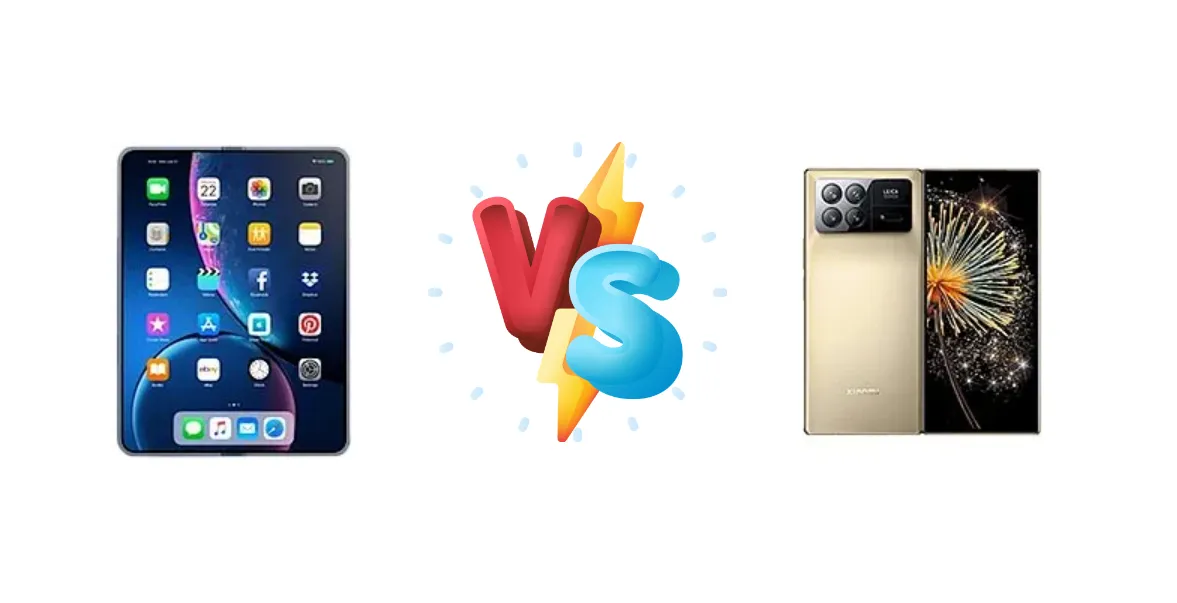
|
🏆 Quick Verdict
For the average user prioritizing raw performance and seamless software integration, the Apple iPhone Fold likely holds the edge thanks to the A19 Pro chipset. However, the Xiaomi Mix Fold 3 counters with significantly faster charging and a proven endurance rating, making it a compelling choice for power users.
| PHONES | ||
|---|---|---|
| Phone Names | Apple iPhone Fold | Xiaomi Mix Fold 3 |
| Network | ||
|---|---|---|
| 2G bands | GSM 850 / 900 / 1800 / 1900 | GSM 850 / 900 / 1800 / 1900 |
| 3G bands | HSDPA 850 / 900 / 1700(AWS) / 1900 / 2100 | HSDPA 800 / 850 / 900 / 1700(AWS) / 1900 / 2100 |
| 4G bands | LTE | 1, 2, 3, 4, 5, 7, 8, 12, 17, 18, 19, 26, 34, 38, 39, 40, 41, 42 |
| 5G bands | SA/NSA/Sub6 | 1, 3, 5, 8, 28, 38, 40, 41, 77, 78, 79 SA/NSA |
| Speed | HSPA, LTE, 5G, EV-DO Rev.A 3.1 Mbps | HSPA, LTE, 5G |
| Technology | GSM / CDMA / HSPA / EVDO / LTE / 5G | GSM / CDMA / HSPA / EVDO / LTE / 5G |
| Launch | ||
|---|---|---|
| Announced | Exp. announcement 2026 | 2023, August 14 |
| Status | Rumored | Available. Released 2023, August 14 |
| Body | ||
|---|---|---|
| Build | Amorphous alloy frame | Glass front (folded), plastic front (unfolded), glass back or aramid fiber back, aluminum frame |
| Dimensions | - | Unfolded: 161.2 x 143.3 x 5.3 mm Folded: 161.2 x 73.5 x 10.9 mm |
| SIM | eSIM | Nano-SIM + Nano-SIM |
| Weight | - | 255 g or 259 g (8.99 oz) |
| Display | ||
|---|---|---|
| Resolution | 1920 x 2713 pixels (~428 ppi density) | 1916 x 2160 pixels (~360 ppi density) |
| Size | 7.76 inches, 183.2 cm2 | 8.03 inches, 206.5 cm2 (~89.4% screen-to-body ratio) |
| Type | Foldable LTPO OLED, 120Hz, HDR10+ | Foldable LTPO OLED+, 1B colors, 120Hz, HDR10+, Dolby Vision, 1300 nits (peak) |
| Platform | ||
|---|---|---|
| CPU | - | Octa-core (1x3.36 GHz Cortex-X3 & 2x2.8 GHz Cortex-A715 & 2x2.8 GHz Cortex-A710 & 3x2.0 GHz Cortex-A510) |
| Chipset | Apple A19 Pro (3 nm) | Qualcomm SM8550-AC Snapdragon 8 Gen 2 (4 nm) |
| GPU | - | Adreno 740 |
| OS | iOS | Android 13, upgradable to Android 14, HyperOS |
| Memory | ||
|---|---|---|
| Card slot | No | No |
| Internal | 256GB 12GB RAM, 512GB 12GB RAM, 1TB 12GB RAM | 256GB 12GB RAM, 512GB 16GB RAM, 1TB 16GB RAM |
| Main Camera | ||
|---|---|---|
| Features | Dual-LED dual-tone flash, HDR (photo/panorama) | Color spectrum sensor, LED flash, HDR, panorama, Leica lenses |
| Quad | - | 50 MP, f/1.8, 23mm (wide), 1/1.49", 1.0µm, PDAF, OIS 10 MP, f/2.0, 75mm (telephoto), 1/3.94", 1.0µm, PDAF, OIS, 3.2x optical zoom 10 MP, f/2.9, 115mm (telephoto), 1/3.94", 1.0µm, PDAF, OIS, 5x optical zoom 12 MP, f/2.2, 15mm, 120˚ (ultrawide), 1/3.1", 1.12µm |
| Triple | 48 MP, f/1.8, 24mm (wide), 1/1.28", 1.22µm, dual pixel PDAF, sensor-shift OIS 12 MP, f/2.8, 120mm (periscope telephoto), 1/3.06", 1.12µm, dual pixel PDAF, 3D sensor‑shift OIS, 5x optical zoom 48 MP, f/2.2, 13mm (ultrawide), 1/2.55", 0.7µm, PDAF TOF 3D LiDAR scanner (depth) * camera details are illustrative, no rumored information is available | - |
| Video | 4K@24/25/30/60/100/120fps, 1080p@25/30/60/120/240fps, 10-bit HDR, Dolby Vision HDR (up to 60fps), ProRes, 3D (spatial) video/audio, stereo sound rec. | 8K@24fps, 4K@24/30/60fps, 1080p@30/60/120/240/960/1920fps, Dolby Vision HDR |
| Selfie camera | ||
|---|---|---|
| Features | HDR, Dolby Vision HDR, 3D (spatial) audio, stereo sound rec. | HDR, panorama |
| Single | 4 MP, f/1.8, 26mm (wide), 1/3.0", 2.0µm, under display Cover camera: 12 MP, f/1.9, 23mm (wide), 1/3.6", 1.0µm, PDAF, OIS | 20 MP, f/2.3, 23mm (wide), 1/4.0", 0.8µm Cover camera: 20 MP, f/2.3, 23mm (wide), 1/4.0", 0.8µm |
| Video | 4K@24/25/30/60fps, 1080p@25/30/60/120fps, gyro-EIS | 1080p@30/60fps |
| Sound | ||
|---|---|---|
| 35mm jack | No | No |
| Loudspeaker | Yes, with stereo speakers | Yes, with stereo speakers |
| Comms | ||
|---|---|---|
| Bluetooth | 5.3, A2DP, LE | 5.3, A2DP, LE |
| Infrared port | - | Yes |
| NFC | Yes | Yes |
| Positioning | GPS (L1+L5), GLONASS, GALILEO, BDS, QZSS, NavIC | GPS (L1+L5), GLONASS (G1), BDS (B1I+B1c+B2a), GALILEO (E1+E5a), QZSS (L1+L5), NavIC (L5) |
| Radio | No | No |
| USB | USB Type-C | USB Type-C 3.2, OTG |
| WLAN | Wi-Fi 802.11 a/b/g/n/ac/6e/7, tri-band, hotspot | Wi-Fi 802.11 a/b/g/n/ac/6e/7, dual-band (tri-band after future SW update) |
| Features | ||
|---|---|---|
| Sensors | Fingerprint (side-mounted), accelerometer, gyro, proximity, compass, barometer | Fingerprint (side-mounted), accelerometer, gyro, proximity, compass, barometer |
| Battery | ||
|---|---|---|
| Charging | Wired | 67W wired, PD3.0, QC4, 100% in 40 min 50W wireless, 100% in 55 min |
| Type | 5500-6000 mAh | Li-Po 4800 mAh |
| Misc | ||
|---|---|---|
| Colors | Black; other colors | Black, Gold |
| Models | - | 2308CPXD0C |
| Price | About 2500 EUR | About 1150 EUR |
Apple iPhone Fold
- Likely superior processing power with the A19 Pro.
- Tight software integration within the Apple ecosystem.
- Potential for best-in-class color accuracy on the display.
- Charging details are currently unknown, potentially slower than the Mix Fold 3.
- Price is expected to be significantly higher.
Xiaomi Mix Fold 3
- Excellent battery endurance (117h rating).
- Fast charging: 67W wired and 50W wireless.
- More open Android ecosystem.
- Snapdragon 8 Gen 2 may be outperformed by the A19 Pro.
- Image processing may not appeal to all users.
Display Comparison
The Xiaomi Mix Fold 3 boasts a measured peak brightness of 1277 nits, a substantial figure suggesting excellent outdoor visibility. While Apple doesn’t disclose peak brightness, their displays typically excel in color accuracy. The absence of LTPO specification for either device makes it difficult to assess power efficiency of the panels. The foldable form factor inherently introduces a crease; the quality of hinge design and panel gap will be critical differentiators, but data is unavailable. The aspect ratios of both inner and outer displays will heavily influence usability, a detail currently missing.
Camera Comparison
Both devices are described as having 'Photo / Video' capabilities, which is insufficient for a detailed comparison. Sensor size, aperture, and optical image stabilization (OIS) are critical factors. Without these details, it’s impossible to assess image quality. Apple typically prioritizes computational photography and natural-looking images, while Xiaomi often leans towards more vibrant, saturated colors. The absence of megapixel counts or specific lens details makes a meaningful comparison impossible. We can assume both will offer multi-camera systems, but the quality will depend on the underlying hardware and software processing.
Performance
The core battle here is between Apple’s 3nm A19 Pro and Qualcomm’s 4nm Snapdragon 8 Gen 2. The A19 Pro, built on a smaller node, theoretically offers superior power efficiency and transistor density, translating to higher performance per watt. The Snapdragon 8 Gen 2, with its Octa-core configuration (1x3.36 GHz Cortex-X3, 2x2.8 GHz Cortex-A715, 2x2.8 GHz Cortex-A710, 3x2.0 GHz Cortex-A510), is a proven performer, but the A19 Pro is expected to surpass it in both CPU and GPU benchmarks. The impact of RAM speed (likely LPDDR5X on both) will be less significant than the chipset architecture. Thermal management will be crucial; the A19 Pro’s efficiency may allow for sustained performance without aggressive throttling.
Battery Life
The Xiaomi Mix Fold 3’s 117-hour endurance rating is a significant advantage, suggesting excellent battery life under typical usage. This is further bolstered by its impressive charging capabilities: 67W wired (100% in 40 minutes), PD3.0, QC4, and 50W wireless (100% in 55 minutes). The Apple iPhone Fold’s charging is only specified as 'Wired', lacking wattage or time-to-full details. The A19 Pro’s efficiency may partially offset a potentially smaller battery capacity, but the Mix Fold 3’s charging speed and endurance rating are clear wins.
Buying Guide
Buy the Apple iPhone Fold if you need the absolute best processing power for demanding tasks, a tightly integrated ecosystem, and are willing to pay a premium for Apple’s software experience. Buy the Xiaomi Mix Fold 3 if you prioritize battery life, fast charging (both wired and wireless), and a more open Android experience, potentially at a lower price point.