
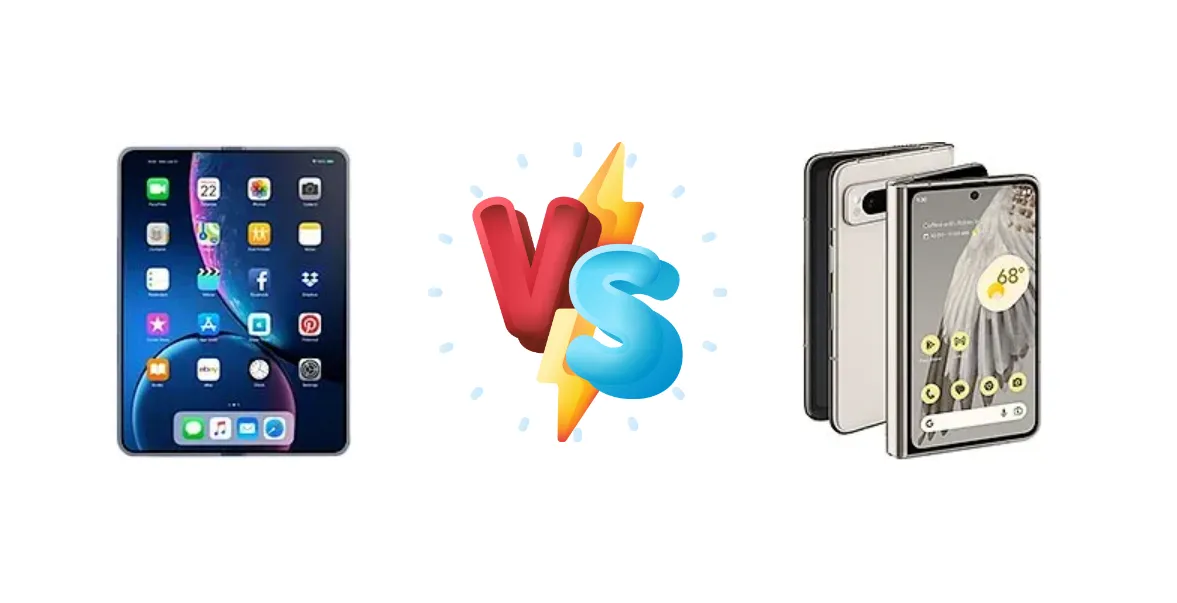
Apple iPhone Fold vs. Google Pixel Fold: Which Foldable Reigns Supreme?
| Phones Images | |||||
|---|---|---|---|---|---|
|
🏆 Quick Verdict
For users prioritizing raw processing power and sustained performance, the Apple iPhone Fold, powered by the A19 Pro, is the clear winner. However, the Google Pixel Fold’s Tensor G2 offers a more balanced experience with the convenience of wireless charging and Google’s AI-driven features, making it ideal for everyday users.
| PHONES | ||
|---|---|---|
| Phone Names | Apple iPhone Fold | Google Pixel Fold |
| Network | ||
|---|---|---|
| 2G bands | GSM 850 / 900 / 1800 / 1900 | GSM 850 / 900 / 1800 / 1900 |
| 3G bands | HSDPA 850 / 900 / 1700(AWS) / 1900 / 2100 | HSDPA 800 / 850 / 900 / 1700(AWS) / 1900 / 2100 |
| 4G bands | LTE | 1, 2, 3, 4, 5, 7, 8, 12, 13, 14, 17, 18, 19, 20, 21, 25, 26, 28, 29, 30, 32, 38, 39, 40, 41, 42, 46, 48, 66, 71 |
| 5G bands | SA/NSA/Sub6 | 1, 2, 3, 5, 7, 8, 12, 14, 20, 25, 28, 30, 38, 40, 41, 48, 66, 71, 75, 76, 77, 78, 79, 257, 258, 260, 261 SA/NSA/Sub6/mmWave |
| Speed | HSPA, LTE, 5G, EV-DO Rev.A 3.1 Mbps | HSPA, LTE, 5G |
| Technology | GSM / CDMA / HSPA / EVDO / LTE / 5G | GSM / CDMA / HSPA / EVDO / LTE / 5G |
| - | CDMA2000 1xEV-DO | |
| Launch | ||
|---|---|---|
| Announced | Exp. announcement 2026 | 2023, May 10 |
| Status | Rumored | Available. Released 2023, June 27 |
| Body | ||
|---|---|---|
| Build | Amorphous alloy frame | Glass front (Gorilla Glass Victus) (folded), plastic front (unfolded), glass back (Gorilla Glass Victus), aluminum frame |
| Dimensions | - | Unfolded: 139.7 x 158.7 x 5.8 mmFolded: 139.7 x 79.5 x 12.1 mm |
| SIM | eSIM | Nano-SIM + eSIM |
| Weight | - | 283 g (9.98 oz) |
| - | IPX8 water resistant | |
| Display | ||
|---|---|---|
| Resolution | 1920 x 2713 pixels (~428 ppi density) | 1840 x 2208 pixels (~378 ppi density) |
| Size | 7.76 inches, 183.2 cm2 | 7.6 inches, 183.3 cm2 (~82.7% screen-to-body ratio) |
| Type | Foldable LTPO OLED, 120Hz, HDR10+ | Foldable OLED, 120Hz, HDR10+, 1000 nits (HBM), 1450 nits (peak) |
| - | Cover display: OLED, 120Hz, HDR, Corning Gorilla Glass Victus 5.8 inches, 1080 x 2092 pixels, 17.4:9 ratio, 408 ppi 1200 nits (HBM), 1550 nits (peak) | |
| Platform | ||
|---|---|---|
| CPU | - | Octa-core (2x2.85 GHz Cortex-X1 & 2x2.35 GHz Cortex-A78 & 4x1.80 GHz Cortex-A55) |
| Chipset | Apple A19 Pro (3 nm) | Google Tensor G2 (5 nm) |
| GPU | - | Mali-G710 MP7 |
| OS | iOS | Android 13, upgradable to Android 15, up to 5 major Android upgrades |
| Memory | ||
|---|---|---|
| Card slot | No | No |
| Internal | 256GB 12GB RAM, 512GB 12GB RAM, 1TB 12GB RAM | 256GB 12GB RAM, 512GB 12GB RAM |
| - | UFS 3.1 | |
| Main Camera | ||
|---|---|---|
| Features | Dual-LED dual-tone flash, HDR (photo/panorama) | Laser AF, Dual-LED flash, HDR, panorama |
| Triple | 48 MP, f/1.8, 24mm (wide), 1/1.28", 1.22µm, dual pixel PDAF, sensor-shift OIS 12 MP, f/2.8, 120mm (periscope telephoto), 1/3.06", 1.12µm, dual pixel PDAF, 3D sensor‑shift OIS, 5x optical zoom 48 MP, f/2.2, 13mm (ultrawide), 1/2.55", 0.7µm, PDAF TOF 3D LiDAR scanner (depth) * camera details are illustrative, no rumored information is available | 48 MP, f/1.7, 25mm (wide), 1/2.0", 0.8µm, dual pixel PDAF, OIS 10.8 MP, f/3.1, 112mm (telephoto), 1/3.1", 1.22µm, dual pixel PDAF, OIS, 5x optical zoom 10.8 MP, f/2.2, 121˚, (ultrawide), 1/3.0", 1.25µm |
| Video | 4K@24/25/30/60/100/120fps, 1080p@25/30/60/120/240fps, 10-bit HDR, Dolby Vision HDR (up to 60fps), ProRes, 3D (spatial) video/audio, stereo sound rec. | 4K@30/60fps, 1080p@30/60/120/240fps, 10-bit HDR |
| Selfie camera | ||
|---|---|---|
| Features | HDR, Dolby Vision HDR, 3D (spatial) audio, stereo sound rec. | HDR, panorama |
| Single | 4 MP, f/1.8, 26mm (wide), 1/3.0", 2.0µm, under display Cover camera: 12 MP, f/1.9, 23mm (wide), 1/3.6", 1.0µm, PDAF, OIS | 8 MP, f/2.0, 24mm (wide), 1/4.0", 1.12µm Cover camera: 9.5 MP, f/2.2, 24mm (wide), 1.22µm, dual pixel PDAF |
| Video | 4K@24/25/30/60fps, 1080p@25/30/60/120fps, gyro-EIS | 4K@30/60fps, 1080p@30/60fps |
| Sound | ||
|---|---|---|
| 3.5mm jack | - | No |
| 35mm jack | No | No |
| Loudspeaker | Yes, with stereo speakers | Yes, with stereo speakers |
| Comms | ||
|---|---|---|
| Bluetooth | 5.3, A2DP, LE | 5.2, A2DP, LE, aptX HD |
| NFC | Yes | Yes |
| Positioning | GPS (L1+L5), GLONASS, GALILEO, BDS, QZSS, NavIC | GPS, GLONASS, GALILEO, BDS |
| Radio | No | No |
| USB | USB Type-C | USB Type-C 3.2, OTG |
| WLAN | Wi-Fi 802.11 a/b/g/n/ac/6e/7, tri-band, hotspot | Wi-Fi 802.11 a/b/g/n/ac/6e, tri-band, Wi-Fi Direct |
| Features | ||
|---|---|---|
| Sensors | Fingerprint (side-mounted), accelerometer, gyro, proximity, compass, barometer | Fingerprint (side-mounted), accelerometer, gyro, proximity, compass, barometer |
| - | Ultra Wideband (UWB) support | |
| Battery | ||
|---|---|---|
| Charging | Wired | Wired, PD3.0 Wireless |
| Type | 5500-6000 mAh | Li-Po 4821 mAh |
| Misc | ||
|---|---|---|
| Colors | Black; other colors | Porcelain, Obsidian |
| Models | - | G9FPL |
| Price | About 2500 EUR | € 670.87 / $ 389.26 / £ 899.99 |
Apple iPhone Fold
- Unmatched processing power with the A19 Pro
- Potentially superior display quality and color accuracy
- Likely better thermal management due to 3nm efficiency
- Lacks wireless charging
- Potentially higher price point
Google Pixel Fold
- Convenience of wireless charging (Qi and PD3.0)
- Google’s AI-powered features and software integration
- Strong computational photography capabilities
- Less powerful chipset compared to the A19 Pro
- Potential for thermal throttling under sustained load
Display Comparison
While specific display specs are missing, we can infer that both devices will utilize LTPO technology for variable refresh rates to optimize battery life. The iPhone Fold, leveraging Apple’s display expertise, likely boasts superior color accuracy and peak brightness. However, the Pixel Fold may benefit from Google’s software optimizations for content viewing. Bezels will be a key differentiator, with Apple historically minimizing them, potentially giving the iPhone Fold a more immersive experience.
Camera Comparison
Without detailed camera specs, it’s difficult to make definitive claims. However, Apple typically prioritizes larger sensors and advanced image stabilization (OIS). The iPhone Fold is likely to feature a more sophisticated camera system, focusing on natural image processing. The Pixel Fold, leveraging Google’s computational photography prowess, will excel in low-light conditions and offer unique features like Magic Eraser. The absence of specific aperture information makes it hard to assess low-light performance, but Apple’s larger sensors generally provide an advantage.
Performance
The Apple A19 Pro, built on a 3nm process, represents a substantial leap in transistor density and efficiency compared to the Google Tensor G2’s 5nm architecture. This translates to significantly higher peak performance and improved power efficiency. The Tensor G2’s octa-core configuration (2x2.85 GHz Cortex-X1, 2x2.35 GHz Cortex-A78, 4x1.80 GHz Cortex-A55) is a capable processor, but it cannot match the A19 Pro’s single-core and multi-core performance. The A19 Pro will likely pair with faster LPDDR5X RAM, further enhancing responsiveness. Thermal management will be crucial; the A19 Pro’s efficiency should mitigate throttling, but the Pixel Fold may rely more on software optimizations to manage heat.
Battery Life
Battery capacity is unknown for both devices. However, the A19 Pro’s 3nm efficiency gives the iPhone Fold a potential advantage in battery life despite potentially having a similar capacity to the Pixel Fold. The Pixel Fold’s inclusion of both wired (PD3.0) and wireless charging provides greater flexibility. PD3.0 allows for faster wired charging speeds, while wireless charging offers convenience. The iPhone Fold’s reliance on wired charging only is a notable omission, especially considering the premium price point.
Buying Guide
Buy the Apple iPhone Fold if you need uncompromising performance for demanding tasks like video editing, high-end gaming, or professional workflows. Its 3nm A19 Pro chipset delivers a significant advantage. Buy the Google Pixel Fold if you prioritize a more integrated software experience, value the convenience of wireless charging, and appreciate Google’s computational photography capabilities. It’s the better choice for everyday productivity and content consumption.