
iPhone Air vs Xiaomi 14T Pro: A Deep Dive into Apple's Newest and Xiaomi's Powerhouse
| Phones Images | |||||
|---|---|---|---|---|---|
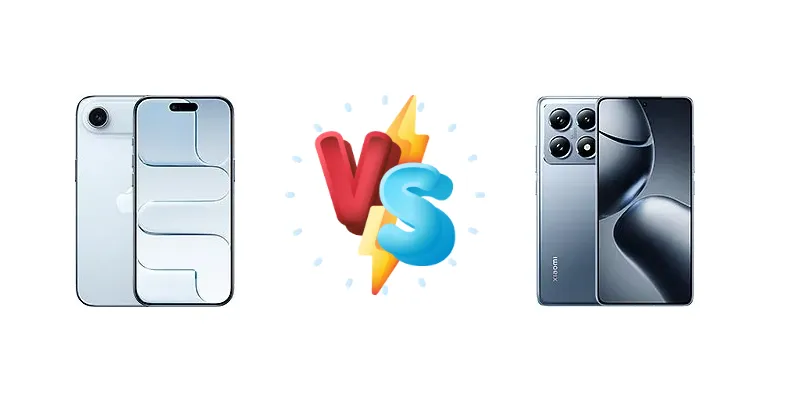
|
🏆 Quick Verdict
For the average user prioritizing long-term software support and ecosystem integration, the iPhone Air is the better choice. However, the Xiaomi 14T Pro’s significantly faster 120W charging and brighter display make it a compelling option for power users who demand speed and visual clarity.
| PHONES | ||
|---|---|---|
| Phone Names | Apple iPhone Air | Xiaomi 14T Pro |
| Network | ||
|---|---|---|
| 2G bands | GSM 850 / 900 / 1800 / 1900 | GSM 850 / 900 / 1800 / 1900 |
| 3G bands | HSDPA 850 / 900 / 1700(AWS) / 1900 / 2100 | HSDPA 800 / 850 / 900 / 1700(AWS) / 1900 / 2100 |
| 4G bands | 1, 2, 3, 4, 5, 7, 8, 12, 13, 17, 18, 19, 20, 25, 26, 28, 30, 32, 34, 38, 39, 40, 41, 42, 48, 53, 66 - A3517 | 1, 2, 3, 4, 5, 7, 8, 12, 13, 17, 18, 19, 20, 25, 26, 28, 32, 38, 39, 40, 41, 42, 48, 66 |
| 5G bands | 1, 2, 3, 5, 7, 8, 12, 20, 25, 26, 28, 30, 38, 40, 41, 48, 53, 66, 70, 75, 77, 78, 79 SA/NSA/Sub6 - A3517 | 1, 2, 3, 5, 7, 8, 12, 20, 25, 26, 28, 38, 40, 41, 48, 66, 75, 77, 78 SA/NSA |
| Speed | HSPA, LTE, 5G, EV-DO Rev.A 3.1 Mbps | HSPA, LTE, 5G |
| Technology | GSM / CDMA / HSPA / EVDO / LTE / 5G | GSM / HSPA / LTE / 5G |
| Launch | ||
|---|---|---|
| Announced | 2025, September 09 | 2024, September 26 |
| Status | Available. Released 2025, September 19 | Available. Released 2024, September 26 |
| Body | ||
|---|---|---|
| Build | Glass front (Ceramic Shield 2), titanium frame (grade 5), glass back (Ceramic Shield) | Glass front (Gorilla Glass 5), aluminum frame, glass back (Panda X) |
| Dimensions | 156.2 x 74.7 x 5.6 mm (6.15 x 2.94 x 0.22 in) | 160.4 x 75.1 x 8.4 mm (6.31 x 2.96 x 0.33 in) |
| SIM | eSIM + eSIM (8 or more, max 2 at a time) | · Nano-SIM + eSIM· eSIM + eSIM· Nano-SIM + Nano-SIM |
| Weight | 165 g (5.82 oz) | 209 g (7.37 oz) |
| Display | ||
|---|---|---|
| Protection | Ceramic Shield 2, Mohs level 5 | Corning Gorilla Glass 5 |
| Resolution | 1260 x 2736 pixels, 19.5:9 ratio (~460 ppi density) | 1220 x 2712 pixels, 20:9 ratio (~446 ppi density) |
| Size | 6.5 inches, 104.9 cm2 (~89.9% screen-to-body ratio) | 6.67 inches, 107.4 cm2 (~89.1% screen-to-body ratio) |
| Type | LTPO Super Retina XDR OLED, 120Hz, HDR10, Dolby Vision, 1000 nits (typ), 1600 nits (HBM), 3000 nits (peak) | AMOLED, 68B colors, 144Hz, 3840Hz PWM, Dolby Vision, HDR10+, 1600 nits (HBM), 4000 nits (peak) |
| Platform | ||
|---|---|---|
| CPU | Hexa-core (2x4.26 GHz + 4xX.X GHz) | Octa-core (1x3.4 GHz Cortex-X4 & 3x2.85 GHz Cortex-X4 & 4x2.0 GHz Cortex-A720) |
| Chipset | Apple A19 Pro (3 nm) | Mediatek Dimensity 9300+ (4 nm) |
| GPU | Apple GPU (5-core graphics) | Immortalis-G720 MC12 |
| OS | iOS 26, upgradable to iOS 26.1 | Android 14, HyperOS |
| Memory | ||
|---|---|---|
| Card slot | No | No |
| Internal | 256GB 12GB RAM, 512GB 12GB RAM, 1TB 12GB RAM | 256GB 12GB RAM, 512GB 12GB RAM, 512GB 16GB RAM, 1TB 12GB RAM |
| Main Camera | ||
|---|---|---|
| Features | Dual-LED dual-tone flash, HDR (photo/panorama) | Leica lens, Ultra HDR, LED flash, HDR, panorama |
| Single | 48 MP, f/1.6, 26mm (wide), 1/1.56", 1.0µm, dual pixel PDAF, sensor-shift OIS | - |
| Triple | - | 50 MP, f/1.6, 23mm (wide), 1/1.31", 1.2µm, PDAF, OIS 50 MP, f/2.0, 60mm (telephoto), 1/2.88", 0.61µm, PDAF, 2.6x optical zoom 12 MP, f/2.2, 15mm (ultrawide), 1/3.06", 1.12µm |
| Video | 4K@24/25/30/60fps, 1080p@25/30/60/120/240fps, HDR, Dolby Vision HDR (up to 60fps), stereo sound rec. | 8K@24/30fps, 4K@24/30/60fps, 1080p@30/60/120/240/960fps, gyro-EIS, 10-bit Rec. 2020, HDR10+ |
| Selfie camera | ||
|---|---|---|
| Features | HDR, Dolby Vision HDR, 3D (spatial) audio, stereo sound rec. | HDR |
| Single | 18 MP multi-aspect, f/1.9, 20mm (ultrawide), PDAF SL 3D, (depth/biometrics sensor) | 32 MP, f/2.0, 25mm (wide), 1/3.44", 0.64µm |
| Video | 4K@24/25/30/60fps, 1080p@25/30/60/120fps, gyro-EIS | 4K@30fps, 1080p@30/60fps, HDR10+ |
| Sound | ||
|---|---|---|
| 35mm jack | No | No |
| Loudspeaker | Yes | Yes, with stereo speakers |
| Comms | ||
|---|---|---|
| Bluetooth | 6.0, A2DP, LE | 5.4, A2DP, LE, LHDC |
| Infrared port | - | Yes |
| NFC | Yes | Yes (market/region dependent) |
| Positioning | GPS, GALILEO, GLONASS, QZSS, BDS, NavIC | GPS (L1+L5), BDS (B1I+B1C+B2a+B2b), GALILEO (E1+E5a+E5b), QZSS (L1+L5), NavIC (L5), GLONASS |
| Radio | No | No |
| USB | USB Type-C 2.0 | USB Type-C 2.0, OTG |
| WLAN | Wi-Fi 802.11 a/b/g/n/ac/6e/7, tri-band, hotspot | Wi-Fi 802.11 a/b/g/n/ac/6e/7, dual-band, Wi-Fi Direct |
| Features | ||
|---|---|---|
| Sensors | Face ID, accelerometer, gyro, proximity, compass, barometer | Fingerprint (under display, optical), accelerometer, gyro, proximity, compass |
| Battery | ||
|---|---|---|
| Charging | Wired, PD2.0, 50% in 30 min 20 wireless MagSafe/Qi2, 50% in 30 min (15W - China) 4.5W reverse wired | 120W wired, PD3.0, QC4, 100% in 19 min 50W wireless, 100% in 45 min |
| Type | Li-Ion 3149 mAh | Li-Po 5000 mAh |
| Misc | ||
|---|---|---|
| Colors | Space Black, Cloud White, Light Gold, Sky Blue | Titan Gray, Titan Blue, Titan Black |
| Models | iPhone18,4, A3517, A3260, A3518, A3516 | 2407FPN8EG |
| Price | € 948.99 / $ 949.99 / £ 899.10 | $ 550.00 / £ 498.00 / € 539.99 |
| SAR | 1.19 W/kg (head) 1.19 W/kg (body) | - |
| SAR EU | 1.49 W/kg (head) 1.49 W/kg (body) | 0.99 W/kg (head) 1.00 W/kg (body) |
| EU LABEL | ||
|---|---|---|
| Battery | 40:00h endurance, 1000 cycles | - |
| Energy | Class A | - |
| Free fall | Class B (180 falls) | - |
| Repairability | Class C | - |
Apple iPhone Air
- Superior ecosystem integration with Apple devices
- Likely longer software support and updates
- Potentially better thermal management due to 3nm chip
- Slower charging speeds compared to Xiaomi 14T Pro
- Lower peak display brightness
- Potentially higher price
Xiaomi 14T Pro
- Blazing-fast 120W wired charging
- Brighter display for outdoor visibility
- More flexible Android operating system
- Potentially shorter software support lifespan
- 4nm chip may run hotter under sustained load
- Ecosystem lock-in is less seamless
Display Comparison
The Xiaomi 14T Pro boasts a notably brighter display, reaching a measured 1228 nits compared to the iPhone Air’s 998 nits. This translates to superior visibility in direct sunlight. While both likely employ high-refresh-rate panels (implied by the competitive positioning), the data doesn’t specify. The iPhone Air’s display benefits from Apple’s color calibration expertise, but the Xiaomi’s higher peak brightness is a significant advantage for outdoor use. The absence of LTPO specification for either device means we can't assess adaptive refresh rate efficiency.
Camera Comparison
The provided data doesn’t detail camera specifications beyond the processors. Given the market positioning, we can expect both phones to feature multi-camera systems. However, without sensor size, aperture, or OIS details, a direct comparison is impossible. Apple typically prioritizes computational photography and natural-looking images, while Xiaomi often leans towards vibrant, saturated colors. The absence of any mention of telephoto lenses suggests neither phone prioritizes optical zoom.
Performance
The core difference lies in the chipsets: Apple’s 3nm A19 Pro versus MediaTek’s 4nm Dimensity 9300+. While the A19 Pro’s hexa-core configuration (2x4.26 GHz + 4xX.X GHz) suggests a focus on peak performance, the Dimensity 9300+’s octa-core setup (1x3.4 GHz Cortex-X4 & 3x2.85 GHz Cortex-X4 & 4x2.0 GHz Cortex-A720) offers a broader range of processing power. The 4nm process of the Dimensity 9300+ should offer good efficiency, but the A19 Pro’s 3nm node likely provides a further edge in thermal management and power consumption. The iPhone Air’s LPDDR5X RAM (implied) will contribute to fast app loading and multitasking.
Battery Life
Both phones achieve similar active use scores (iPhone Air: 12:44h, Xiaomi 14T Pro: 12:32h), indicating comparable real-world battery life despite the lack of mAh specifications. However, the charging speeds are drastically different. The Xiaomi 14T Pro’s 120W wired charging (PD3.0, QC4) can fully charge the device in just 19 minutes, while the iPhone Air’s 50W wired charging (PD2.0) takes 30 minutes to reach 50%. Wireless charging also favors the Xiaomi with 50W (100% in 45 min) versus the iPhone Air’s 15W MagSafe/Qi2 (50% in 30 min). The iPhone Air offers 4.5W reverse wired charging, a niche feature absent on the Xiaomi.
Buying Guide
Buy the Apple iPhone Air if you need seamless integration with other Apple devices, prioritize long-term software updates, and value a refined user experience. Buy the Xiaomi 14T Pro if you prefer blazing-fast charging, a brighter display for outdoor visibility, and the flexibility of the Android operating system, all at a potentially lower price point.