
iPhone Air vs. Samsung Galaxy S24 FE: A Detailed Comparison of Apple's Newcomer and Samsung's Fan Edition
| Phones Images | |||||
|---|---|---|---|---|---|
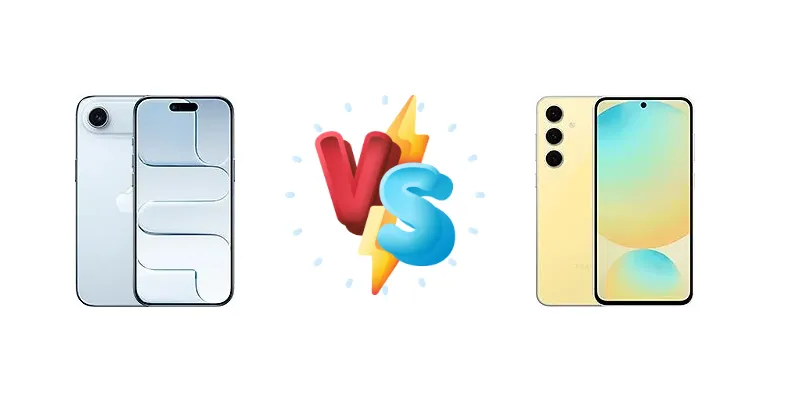
|
🏆 Quick Verdict
For the average user prioritizing long-term battery health and a brighter display, the Samsung Galaxy S24 FE emerges as the stronger choice. Its 42-hour endurance and 1372 nits peak brightness offer a tangible advantage, while the iPhone Air excels in raw processing power but falls slightly behind in sustained usability.
| PHONES | ||
|---|---|---|
| Phone Names | Apple iPhone Air | Samsung Galaxy S24 FE |
| Network | ||
|---|---|---|
| 2G bands | GSM 850 / 900 / 1800 / 1900 | GSM 850 / 900 / 1800 / 1900 |
| 3G bands | HSDPA 850 / 900 / 1700(AWS) / 1900 / 2100 | HSDPA 850 / 900 / 1700(AWS) / 1900 / 2100 |
| 4G bands | 1, 2, 3, 4, 5, 7, 8, 12, 13, 17, 18, 19, 20, 25, 26, 28, 30, 32, 34, 38, 39, 40, 41, 42, 48, 53, 66 - A3517 | 1, 2, 3, 4, 5, 7, 8, 12, 17, 18, 19, 20, 25, 26, 28, 32, 38, 40, 41, 66 - International |
| 5G bands | 1, 2, 3, 5, 7, 8, 12, 20, 25, 26, 28, 30, 38, 40, 41, 48, 53, 66, 70, 75, 77, 78, 79 SA/NSA/Sub6 - A3517 | 1, 2, 3, 5, 7, 8, 12, 20, 25, 26, 28, 38, 40, 41, 66, 75, 77, 78 SA/NSA/Sub6 - International |
| Speed | HSPA, LTE, 5G, EV-DO Rev.A 3.1 Mbps | HSPA, LTE, 5G |
| Technology | GSM / CDMA / HSPA / EVDO / LTE / 5G | GSM / HSPA / LTE / 5G |
| Launch | ||
|---|---|---|
| Announced | 2025, September 09 | 2024, September 26 |
| Status | Available. Released 2025, September 19 | Available. Released 2024, October 03 |
| Body | ||
|---|---|---|
| Build | Glass front (Ceramic Shield 2), titanium frame (grade 5), glass back (Ceramic Shield) | Glass front (Gorilla Glass Victus+), glass back (Gorilla Glass Victus+), aluminum frame |
| Dimensions | 156.2 x 74.7 x 5.6 mm (6.15 x 2.94 x 0.22 in) | 162 x 77.3 x 8 mm (6.38 x 3.04 x 0.31 in) |
| SIM | eSIM + eSIM (8 or more, max 2 at a time) | · Nano-SIM· Nano-SIM + Nano-SIM· Nano-SIM + eSIM· eSIM + eSIM |
| Weight | 165 g (5.82 oz) | 213 g (7.51 oz) |
| Display | ||
|---|---|---|
| Protection | Ceramic Shield 2, Mohs level 5 | Corning Gorilla Glass Victus+, Mohs level 5 |
| Resolution | 1260 x 2736 pixels, 19.5:9 ratio (~460 ppi density) | 1080 x 2340 pixels, 19.5:9 ratio (~385 ppi density) |
| Size | 6.5 inches, 104.9 cm2 (~89.9% screen-to-body ratio) | 6.7 inches, 110.2 cm2 (~88.0% screen-to-body ratio) |
| Type | LTPO Super Retina XDR OLED, 120Hz, HDR10, Dolby Vision, 1000 nits (typ), 1600 nits (HBM), 3000 nits (peak) | Dynamic AMOLED 2X, 120Hz, HDR10+, 1900 nits (peak) |
| Platform | ||
|---|---|---|
| CPU | Hexa-core (2x4.26 GHz + 4xX.X GHz) | 10-core (1x3.1 GHz + 2x2.9 GHz + 3x2.6 GHz + 4x1.95 GHz) |
| Chipset | Apple A19 Pro (3 nm) | Exynos 2400e (4 nm) |
| GPU | Apple GPU (5-core graphics) | Xclipse 940 |
| OS | iOS 26, upgradable to iOS 26.1 | Android 14, up to 7 major Android upgrades, One UI 8.0 |
| Memory | ||
|---|---|---|
| Card slot | No | No |
| Internal | 256GB 12GB RAM, 512GB 12GB RAM, 1TB 12GB RAM | 128GB 8GB RAM, 256GB 8GB RAM, 512GB 8GB RAM |
| Main Camera | ||
|---|---|---|
| Features | Dual-LED dual-tone flash, HDR (photo/panorama) | LED flash, HDR, panorama |
| Single | 48 MP, f/1.6, 26mm (wide), 1/1.56", 1.0µm, dual pixel PDAF, sensor-shift OIS | - |
| Triple | - | 50 MP, f/1.8, 24mm (wide), 1/1.57", 1.0µm, dual pixel PDAF, OIS 8 MP, f/2.4, 75mm (telephoto), 1/4.4", 1.0µm, PDAF, OIS, 3x optical zoom 12 MP, f/2.2, 13mm, 123˚ (ultrawide), 1/3.0", 1.12µm |
| Video | 4K@24/25/30/60fps, 1080p@25/30/60/120/240fps, HDR, Dolby Vision HDR (up to 60fps), stereo sound rec. | 8K@30fps, 4K@30/60/120fps, 1080p@30/60/120/240fps |
| Selfie camera | ||
|---|---|---|
| Features | HDR, Dolby Vision HDR, 3D (spatial) audio, stereo sound rec. | - |
| Single | 18 MP multi-aspect, f/1.9, 20mm (ultrawide), PDAF SL 3D, (depth/biometrics sensor) | 10 MP, f/2.4, 26mm (wide), 1/3.0", 1.22µm |
| Video | 4K@24/25/30/60fps, 1080p@25/30/60/120fps, gyro-EIS | 4K@30/60fps, 1080p@30/60fps; gyro-EIS |
| Sound | ||
|---|---|---|
| 35mm jack | No | No |
| Loudspeaker | Yes | Yes, with stereo speakers |
| Comms | ||
|---|---|---|
| Bluetooth | 6.0, A2DP, LE | 5.3, A2DP, LE |
| NFC | Yes | Yes |
| Positioning | GPS, GALILEO, GLONASS, QZSS, BDS, NavIC | GPS, GLONASS, GALILEO, BDS |
| Radio | No | Unspecified |
| USB | USB Type-C 2.0 | USB Type-C 3.2, OTG |
| WLAN | Wi-Fi 802.11 a/b/g/n/ac/6e/7, tri-band, hotspot | Wi-Fi 802.11 a/b/g/n/ac/6e, dual-band or tri-band (market/region dependent), Wi-Fi Direct |
| Features | ||
|---|---|---|
| Sensors | Face ID, accelerometer, gyro, proximity, compass, barometer | Fingerprint (under display, optical), accelerometer, gyro, compass |
| Battery | ||
|---|---|---|
| Charging | Wired, PD2.0, 50% in 30 min 20 wireless MagSafe/Qi2, 50% in 30 min (15W - China) 4.5W reverse wired | 25W wired, PD, QC2, 50% in 30 min 15W wireless Reverse wireless |
| Type | Li-Ion 3149 mAh | 4700 mAh |
| Misc | ||
|---|---|---|
| Colors | Space Black, Cloud White, Light Gold, Sky Blue | Blue, Graphite, Gray, Mint, Yellow |
| Models | iPhone18,4, A3517, A3260, A3518, A3516 | SM-S721B, SM-S721B/DS, SM-S721U1, SM-S721U, SM-S721W, SM-S7210, SM-S721N |
| Price | € 948.99 / $ 949.99 / £ 899.10 | $ 249.74 / C$ 498.99 / £ 335.00 / € 387.00 / ₹ 34,180 |
| SAR | 1.19 W/kg (head) 1.19 W/kg (body) | 0.94 W/kg (head) 0.71 W/kg (body) |
| SAR EU | 1.49 W/kg (head) 1.49 W/kg (body) | 0.86 W/kg (head) 1.29 W/kg (body) |
| EU LABEL | ||
|---|---|---|
| Battery | 40:00h endurance, 1000 cycles | 42:00h endurance, 2000 cycles |
| Energy | Class A | Class B |
| Free fall | Class B (180 falls) | Class A (270 falls) |
| Repairability | Class C | Class C |
Apple iPhone Air
- Potentially faster CPU performance due to 3nm A19 Pro chip
- Seamless integration with the Apple ecosystem
- MagSafe wireless charging and reverse wired charging
- Lower peak display brightness compared to the S24 FE
- Slightly lower battery endurance rating
Samsung Galaxy S24 FE
- Significantly brighter display (1372 nits)
- Longer battery endurance (42 hours)
- More versatile camera system (likely)
- Exynos 2400e may be more prone to throttling under sustained load
- Android ecosystem may not appeal to all users
Display Comparison
The Samsung Galaxy S24 FE boasts a considerable advantage in display brightness, reaching a measured 1372 nits compared to the iPhone Air’s 998 nits. This translates to superior visibility in direct sunlight. While both likely utilize OLED panels, the S24 FE’s higher peak brightness is immediately noticeable. We lack information on panel technology (LTPO vs standard OLED) for the iPhone Air, but given its positioning, it may not feature the power-saving benefits of LTPO. Bezels appear comparable based on typical designs from both manufacturers, and color accuracy is expected to be excellent on both devices, though independent calibration data is needed for a definitive assessment.
Camera Comparison
Without detailed camera specifications, a direct comparison is limited. However, the market positioning suggests the Galaxy S24 FE will likely feature a more versatile camera system. Samsung typically prioritizes camera features in its FE models. The iPhone Air will likely focus on computational photography and video quality, leveraging Apple’s image processing pipeline. The presence of Optical Image Stabilization (OIS) is expected on both main sensors, but sensor size and lens apertures are crucial factors missing from the provided data. We can safely assume both phones will offer excellent image quality in good lighting conditions, but low-light performance will depend heavily on sensor capabilities.
Performance
The iPhone Air’s Apple A19 Pro, built on a 3nm process, promises exceptional performance, particularly in single-core tasks. Its hexa-core CPU configuration (2x4.26 GHz + 4xX.X GHz) is designed for efficiency and speed. However, the Samsung Galaxy S24 FE’s Exynos 2400e, while fabricated on a larger 4nm node, compensates with a 10-core CPU (1x3.1 GHz + 2x2.9 GHz + 3x2.6 GHz + 4x1.95 GHz). This core count suggests a focus on multi-threaded performance. The 3nm process of the A19 Pro should offer better thermal efficiency, potentially reducing throttling during sustained workloads, but the Exynos 2400e’s larger die size and core count could provide competitive performance in specific scenarios. RAM speed (LPDDR5x is expected on both) will also play a role, but the chipset architecture is the primary differentiator.
Battery Life
The Galaxy S24 FE claims a significant lead in battery endurance with 42 hours compared to the iPhone Air’s 40 hours. While endurance tests are complex, this suggests the S24 FE’s combination of chipset efficiency and battery capacity provides longer runtimes. Active use scores are closer, at 11:48h for the S24 FE and 12:44h for the iPhone Air, indicating the A19 Pro is more efficient during intensive tasks. The S24 FE supports 25W wired charging, while the iPhone Air offers 50% charge in 30 minutes with PD2.0. Both support 50% charge in 30 minutes with wireless charging (MagSafe/Qi2 for iPhone Air, 15W for S24 FE). The iPhone Air also offers 4.5W reverse wired charging, a feature present on the S24 FE as well, though wattage is unspecified.
Buying Guide
Buy the Apple iPhone Air if you prioritize peak CPU performance for demanding tasks like video editing or gaming, and value the seamless integration of the Apple ecosystem. Buy the Samsung Galaxy S24 FE if you prefer a longer-lasting battery, a significantly brighter display for outdoor visibility, and the flexibility of the Android operating system, all at a potentially lower price point.