
iPhone Air vs OnePlus 12R: A Detailed Comparison of Apple's Efficiency and OnePlus's Power
| Phones Images | |||||
|---|---|---|---|---|---|
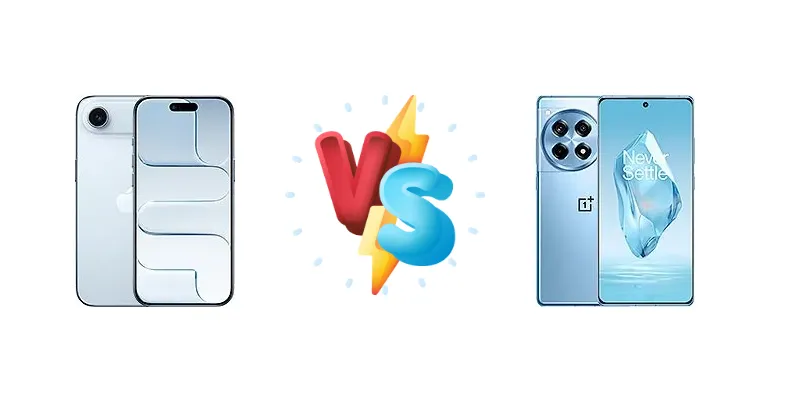
|
🏆 Quick Verdict
For the average user prioritizing long-term battery health and seamless ecosystem integration, the iPhone Air is the better choice. However, the OnePlus 12R delivers significantly faster charging and a brighter display, making it ideal for power users who demand speed and visual vibrancy.
| PHONES | ||
|---|---|---|
| Phone Names | Apple iPhone Air | OnePlus 12R |
| Network | ||
|---|---|---|
| 2G bands | GSM 850 / 900 / 1800 / 1900 | GSM 850 / 900 / 1800 / 1900 |
| 3G bands | HSDPA 850 / 900 / 1700(AWS) / 1900 / 2100 | HSDPA 850 / 900 / 1700(AWS) / 1900 / 2100 |
| 4G bands | 1, 2, 3, 4, 5, 7, 8, 12, 13, 17, 18, 19, 20, 25, 26, 28, 30, 32, 34, 38, 39, 40, 41, 42, 48, 53, 66 - A3517 | 1, 2, 3, 4, 5, 7, 8, 12, 17, 18, 19, 20, 26, 28, 32, 38, 39, 40, 41, 66 |
| 5G bands | 1, 2, 3, 5, 7, 8, 12, 20, 25, 26, 28, 30, 38, 40, 41, 48, 53, 66, 70, 75, 77, 78, 79 SA/NSA/Sub6 - A3517 | 1, 2, 3, 5, 7, 8, 12, 20, 28, 38, 40, 41, 66, 77, 78 SA/NSA |
| Speed | HSPA, LTE, 5G, EV-DO Rev.A 3.1 Mbps | HSPA, LTE, 5G |
| Technology | GSM / CDMA / HSPA / EVDO / LTE / 5G | GSM / CDMA / HSPA / LTE / 5G |
| Launch | ||
|---|---|---|
| Announced | 2025, September 09 | 2024, January 23 |
| Status | Available. Released 2025, September 19 | Available. Released 2024, February 06 |
| Body | ||
|---|---|---|
| Build | Glass front (Ceramic Shield 2), titanium frame (grade 5), glass back (Ceramic Shield) | Glass front (Gorilla Glass Victus 2), aluminum frame, glass back |
| Dimensions | 156.2 x 74.7 x 5.6 mm (6.15 x 2.94 x 0.22 in) | 163.3 x 75.3 x 8.8 mm (6.43 x 2.96 x 0.35 in) |
| SIM | eSIM + eSIM (8 or more, max 2 at a time) | · Nano-SIM + Nano-SIM + eSIM (max 2 at a time)· Nano-SIM + Nano-SIM |
| Weight | 165 g (5.82 oz) | 207 g (7.30 oz) |
| Display | ||
|---|---|---|
| Protection | Ceramic Shield 2, Mohs level 5 | Corning Gorilla Glass Victus 2 |
| Resolution | 1260 x 2736 pixels, 19.5:9 ratio (~460 ppi density) | 1264 x 2780 pixels (~450 ppi density) |
| Size | 6.5 inches, 104.9 cm2 (~89.9% screen-to-body ratio) | 6.78 inches, 111.7 cm2 (~90.9% screen-to-body ratio) |
| Type | LTPO Super Retina XDR OLED, 120Hz, HDR10, Dolby Vision, 1000 nits (typ), 1600 nits (HBM), 3000 nits (peak) | LTPO4 AMOLED, 1B colors, 120Hz, HDR10+, Dolby Vision, 1600 nits (HBM), 4500 nits (peak) |
| Platform | ||
|---|---|---|
| CPU | Hexa-core (2x4.26 GHz + 4xX.X GHz) | Octa-core (1x3.2 GHz Cortex-X3 & 2x2.8 GHz Cortex-A715 & 2x2.8 GHz Cortex-A710 & 3x2.0 GHz Cortex-A510) |
| Chipset | Apple A19 Pro (3 nm) | Qualcomm SM8550-AB Snapdragon 8 Gen 2 (4 nm) |
| GPU | Apple GPU (5-core graphics) | Adreno 740 |
| OS | iOS 26, upgradable to iOS 26.1 | Android 14, up to 3 major Android upgrades, OxygenOS 15 |
| Memory | ||
|---|---|---|
| Card slot | No | No |
| Internal | 256GB 12GB RAM, 512GB 12GB RAM, 1TB 12GB RAM | 128GB 8GB RAM, 256GB 8GB RAM, 256GB 12GB RAM, 256GB 16GB RAM |
| Main Camera | ||
|---|---|---|
| Features | Dual-LED dual-tone flash, HDR (photo/panorama) | Laser AF, color spectrum sensor, LED flash, HDR, panorama |
| Single | 48 MP, f/1.6, 26mm (wide), 1/1.56", 1.0µm, dual pixel PDAF, sensor-shift OIS | - |
| Triple | - | 50 MP, f/1.8, 24mm (wide), 1/1.56", 1.0µm, multi-directional PDAF, OIS 8 MP, f/2.2, 16mm, 112˚ (ultrawide), 1/4.0", 1.12µm 2 MP (macro) |
| Video | 4K@24/25/30/60fps, 1080p@25/30/60/120/240fps, HDR, Dolby Vision HDR (up to 60fps), stereo sound rec. | 4K@30/60fps, 1080p@30/60/120/240fps, gyro-EIS, OIS |
| Selfie camera | ||
|---|---|---|
| Features | HDR, Dolby Vision HDR, 3D (spatial) audio, stereo sound rec. | HDR, panorama |
| Single | 18 MP multi-aspect, f/1.9, 20mm (ultrawide), PDAF SL 3D, (depth/biometrics sensor) | 16 MP, f/2.4, 26mm (wide), 1/3", 1.0µm |
| Video | 4K@24/25/30/60fps, 1080p@25/30/60/120fps, gyro-EIS | 1080p@30fps, gyro-EIS |
| Sound | ||
|---|---|---|
| 35mm jack | No | No |
| Loudspeaker | Yes | Yes, with stereo speakers |
| Comms | ||
|---|---|---|
| Bluetooth | 6.0, A2DP, LE | 5.3, A2DP, LE, aptX HD |
| Infrared port | - | Yes |
| NFC | Yes | Yes |
| Positioning | GPS, GALILEO, GLONASS, QZSS, BDS, NavIC | GPS, GALILEO, GLONASS, BDS, QZSS |
| Radio | No | No |
| USB | USB Type-C 2.0 | USB Type-C 2.0 |
| WLAN | Wi-Fi 802.11 a/b/g/n/ac/6e/7, tri-band, hotspot | Wi-Fi 802.11 a/b/g/n/ac/6/7, dual-band |
| Features | ||
|---|---|---|
| Sensors | Face ID, accelerometer, gyro, proximity, compass, barometer | Fingerprint (under display, optical), accelerometer, gyro, proximity, compass |
| Battery | ||
|---|---|---|
| Charging | Wired, PD2.0, 50% in 30 min 20 wireless MagSafe/Qi2, 50% in 30 min (15W - China) 4.5W reverse wired | 100W wired, 100% in 26 min |
| Type | Li-Ion 3149 mAh | Li-Ion 5500 mAh |
| Misc | ||
|---|---|---|
| Colors | Space Black, Cloud White, Light Gold, Sky Blue | Iron Gray, Cool Blue, Electric Violet, Sunset Dune |
| Models | iPhone18,4, A3517, A3260, A3518, A3516 | CPH2609, CPH2585, CPH2611 |
| Price | € 948.99 / $ 949.99 / £ 899.10 | € 410.84 / $ 399.95 / £ 649.00 |
| SAR | 1.19 W/kg (head) 1.19 W/kg (body) | 1.19 W/kg (head) 0.82 W/kg (body) |
| SAR EU | 1.49 W/kg (head) 1.49 W/kg (body) | - |
| EU LABEL | ||
|---|---|---|
| Battery | 40:00h endurance, 1000 cycles | - |
| Energy | Class A | - |
| Free fall | Class B (180 falls) | - |
| Repairability | Class C | - |
Apple iPhone Air
- Exceptional long-term battery health (1000 cycles)
- Seamless integration with the Apple ecosystem
- Efficient performance optimized for everyday tasks
- Slower charging speeds compared to OnePlus 12R
- Lower peak display brightness
- Potentially higher price point
OnePlus 12R
- Blazing-fast 100W charging (0-100% in 26 minutes)
- Brighter display for superior outdoor visibility
- Powerful Snapdragon 8 Gen 2 processor
- Potentially shorter battery lifespan compared to iPhone Air
- Less refined software experience (compared to iOS)
- May lack the same level of ecosystem integration
Display Comparison
The OnePlus 12R boasts a notably brighter display, reaching 1181 nits compared to the iPhone Air’s 998 nits. This translates to superior visibility under direct sunlight. While both likely employ high refresh rate panels (implied for this segment), the OnePlus’s higher peak brightness is a clear advantage for outdoor use. The iPhone Air’s display technology is likely optimized for color accuracy and power efficiency, typical of Apple’s approach, but lacks the raw luminance of the OnePlus. We expect both to utilize OLED technology, but the iPhone Air may benefit from a more refined color calibration process.
Camera Comparison
Without detailed camera specifications, a direct comparison is limited. However, given the market positioning, we can infer that the OnePlus 12R will likely feature a more versatile camera system with a higher megapixel count. The iPhone Air will likely prioritize computational photography and video recording quality, leveraging Apple’s image processing pipeline. The absence of specific sensor details suggests both manufacturers are focusing on software optimization to enhance image quality. The OnePlus 12R may offer features like a dedicated telephoto lens, while the iPhone Air will likely excel in consistent, natural-looking photos and cinematic video capture.
Performance
The core difference lies in the chipsets: Apple’s 3nm A19 Pro versus Qualcomm’s 4nm Snapdragon 8 Gen 2. The A19 Pro’s hexa-core architecture, with its 4.26 GHz peak clock speed, suggests a focus on single-core performance, crucial for responsive app launches and smooth UI navigation. The Snapdragon 8 Gen 2’s octa-core configuration, featuring Cortex-X3 and Cortex-A715 cores, excels in multi-threaded tasks and sustained performance. The 4nm process node of the Snapdragon 8 Gen 2 offers better thermal efficiency than the A19 Pro’s 3nm node, potentially leading to less throttling during extended gaming sessions. While the A19 Pro is likely more power efficient overall, the Snapdragon 8 Gen 2 provides a more robust performance ceiling.
Battery Life
The OnePlus 12R’s 100W wired charging is a game-changer, achieving a full charge in just 26 minutes. The iPhone Air, with its PD2.0 and MagSafe/Qi2 support, takes 30 minutes to reach 50% charge, implying a longer overall charging time. While the iPhone Air boasts a 1000-cycle battery lifespan, indicating exceptional long-term durability, the OnePlus 12R’s active use score of 14:32h surpasses the iPhone Air’s 12:44h, suggesting a real-world battery life advantage despite potentially lower capacity. The 4.5W reverse wired charging on the iPhone Air is a niche feature, while the OnePlus 12R lacks this capability.
Buying Guide
Buy the Apple iPhone Air if you need a phone deeply integrated with the Apple ecosystem, value long-term battery health with its 1000 cycle lifespan, and prioritize efficient performance for everyday tasks. Buy the OnePlus 12R if you prefer blazing-fast 100W charging, a brighter display for outdoor visibility, and raw processing power for demanding applications and gaming, all without the premium Apple price tag.