
iPhone Air vs. Nothing Phone (2): A Detailed Comparison of Apple's Newest and Nothing's Boldest
| Phones Images | |||||
|---|---|---|---|---|---|
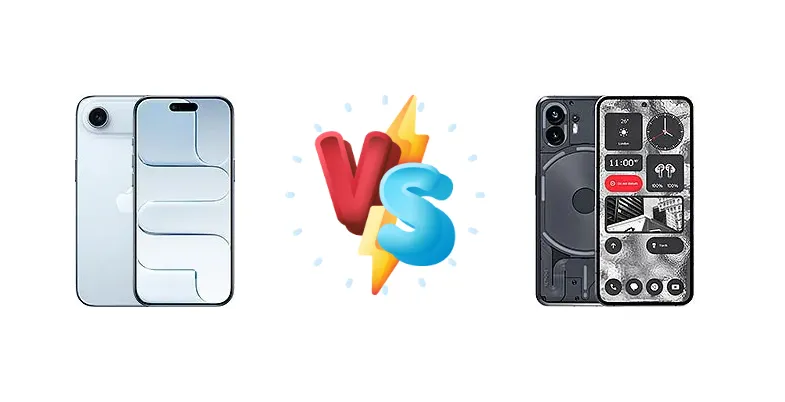
|
🏆 Quick Verdict
For the average user prioritizing long-term performance and ecosystem integration, the iPhone Air emerges as the winner. Its A19 Pro chip and 1000-cycle battery longevity offer a compelling package. However, the Nothing Phone (2) provides a faster charging experience and a unique aesthetic at a potentially lower price point.
| PHONES | ||
|---|---|---|
| Phone Names | Apple iPhone Air | Nothing Phone (2) |
| Network | ||
|---|---|---|
| 2G bands | GSM 850 / 900 / 1800 / 1900 | GSM 850 / 900 / 1800 / 1900 |
| 3G bands | HSDPA 850 / 900 / 1700(AWS) / 1900 / 2100 | HSDPA 800 / 850 / 900 / 1700(AWS) / 1900 / 2100 |
| 4G bands | 1, 2, 3, 4, 5, 7, 8, 12, 13, 17, 18, 19, 20, 25, 26, 28, 30, 32, 34, 38, 39, 40, 41, 42, 48, 53, 66 - A3517 | 1, 2, 3, 4, 5, 7, 8, 12, 17, 18, 19, 20, 25, 26, 28, 30, 32, 34, 38, 39, 40, 41, 42, 48, 66, 71 |
| 5G bands | 1, 2, 3, 5, 7, 8, 12, 20, 25, 26, 28, 30, 38, 40, 41, 48, 53, 66, 70, 75, 77, 78, 79 SA/NSA/Sub6 - A3517 | 1, 2, 3, 5, 7, 8, 12, 20, 25, 28, 30, 38, 40, 41, 66, 71, 75, 77, 78 SA/NSA |
| Speed | HSPA, LTE, 5G, EV-DO Rev.A 3.1 Mbps | HSPA, LTE, 5G |
| Technology | GSM / CDMA / HSPA / EVDO / LTE / 5G | GSM / HSPA / LTE / 5G |
| Launch | ||
|---|---|---|
| Announced | 2025, September 09 | 2023, July 11 |
| Status | Available. Released 2025, September 19 | Available. Released 2023, July 17 |
| Body | ||
|---|---|---|
| Build | Glass front (Ceramic Shield 2), titanium frame (grade 5), glass back (Ceramic Shield) | Glass front (Gorilla Glass 5), glass back (Gorilla Glass 5), aluminum frame |
| Dimensions | 156.2 x 74.7 x 5.6 mm (6.15 x 2.94 x 0.22 in) | 162.1 x 76.4 x 8.6 mm (6.38 x 3.01 x 0.34 in) |
| SIM | eSIM + eSIM (8 or more, max 2 at a time) | Nano-SIM + Nano-SIM |
| Weight | 165 g (5.82 oz) | 201.2 g (7.09 oz) |
| Display | ||
|---|---|---|
| Protection | Ceramic Shield 2, Mohs level 5 | Corning Gorilla Glass 5 |
| Resolution | 1260 x 2736 pixels, 19.5:9 ratio (~460 ppi density) | 1080 x 2412 pixels, 20:9 ratio (~394 ppi density) |
| Size | 6.5 inches, 104.9 cm2 (~89.9% screen-to-body ratio) | 6.7 inches, 108.0 cm2 (~87.2% screen-to-body ratio) |
| Type | LTPO Super Retina XDR OLED, 120Hz, HDR10, Dolby Vision, 1000 nits (typ), 1600 nits (HBM), 3000 nits (peak) | LTPO OLED, 1B colors, 120Hz, 1920Hz PWM, HDR10+, 1600 nits (HBM), 1600 nits (peak) |
| Platform | ||
|---|---|---|
| CPU | Hexa-core (2x4.26 GHz + 4xX.X GHz) | Octa-core (1x3.0 GHz Cortex-X2 & 3x2.5 GHz Cortex-A710 & 4x1.80 GHz Cortex-A510) |
| Chipset | Apple A19 Pro (3 nm) | Qualcomm SM8475 Snapdragon 8+ Gen 1 (4 nm) |
| GPU | Apple GPU (5-core graphics) | Adreno 730 |
| OS | iOS 26, upgradable to iOS 26.1 | Android 13, upgradable to Android 15, up to 3 major Android upgrades, Nothing OS 3.0 |
| Memory | ||
|---|---|---|
| Card slot | No | No |
| Internal | 256GB 12GB RAM, 512GB 12GB RAM, 1TB 12GB RAM | 128GB 8GB RAM, 256GB 12GB RAM, 512GB 12GB RAM |
| Main Camera | ||
|---|---|---|
| Dual | - | 50 MP, f/1.9, 24mm (wide), 1/1.56", 1.0µm, PDAF, OIS 50 MP, f/2.2, 114˚ (ultrawide), 1/2.76", 0.64µm, AF |
| Features | Dual-LED dual-tone flash, HDR (photo/panorama) | LED flash, panorama, HDR |
| Single | 48 MP, f/1.6, 26mm (wide), 1/1.56", 1.0µm, dual pixel PDAF, sensor-shift OIS | - |
| Video | 4K@24/25/30/60fps, 1080p@25/30/60/120/240fps, HDR, Dolby Vision HDR (up to 60fps), stereo sound rec. | 4K@30/60fps, 1080p@30/60fps, gyro-EIS, live HDR, OIS |
| Selfie camera | ||
|---|---|---|
| Features | HDR, Dolby Vision HDR, 3D (spatial) audio, stereo sound rec. | HDR |
| Single | 18 MP multi-aspect, f/1.9, 20mm (ultrawide), PDAF SL 3D, (depth/biometrics sensor) | 32 MP, f/2.5, (wide), 1/2.74", 0.8µm |
| Video | 4K@24/25/30/60fps, 1080p@25/30/60/120fps, gyro-EIS | 1080p@30fps |
| Sound | ||
|---|---|---|
| 35mm jack | No | No |
| Loudspeaker | Yes | Yes, with stereo speakers |
| Comms | ||
|---|---|---|
| Bluetooth | 6.0, A2DP, LE | 5.3, A2DP, LE, aptX HD, aptX Adaptive |
| NFC | Yes | Yes |
| Positioning | GPS, GALILEO, GLONASS, QZSS, BDS, NavIC | GPS (L1+L5), GLONASS (L1), BDS (B1I+B1c), GALILEO (E1), QZSS (L1), NavIC |
| Radio | No | No |
| USB | USB Type-C 2.0 | USB Type-C 2.0, OTG |
| WLAN | Wi-Fi 802.11 a/b/g/n/ac/6e/7, tri-band, hotspot | Wi-Fi 802.11 a/b/g/n/ac/6, dual-band, Wi-Fi Direct |
| Features | ||
|---|---|---|
| Sensors | Face ID, accelerometer, gyro, proximity, compass, barometer | Fingerprint (under display, optical), accelerometer, proximity, gyro, compass |
| Battery | ||
|---|---|---|
| Charging | Wired, PD2.0, 50% in 30 min 20 wireless MagSafe/Qi2, 50% in 30 min (15W - China) 4.5W reverse wired | 45W wired, PD3.0, PPS, QC4, 100% in 55 min 15W wireless, 100% in 130 min 5W reverse wireless |
| Type | Li-Ion 3149 mAh | Li-Ion 4700 mAh |
| Misc | ||
|---|---|---|
| Colors | Space Black, Cloud White, Light Gold, Sky Blue | White, Dark Gray |
| Models | iPhone18,4, A3517, A3260, A3518, A3516 | A065 |
| Price | € 948.99 / $ 949.99 / £ 899.10 | $ 379.99 / £ 370.00 |
| SAR | 1.19 W/kg (head) 1.19 W/kg (body) | - |
| SAR EU | 1.49 W/kg (head) 1.49 W/kg (body) | - |
| EU LABEL | ||
|---|---|---|
| Battery | 40:00h endurance, 1000 cycles | - |
| Energy | Class A | - |
| Free fall | Class B (180 falls) | - |
| Repairability | Class C | - |
Apple iPhone Air
- Superior processor performance with the A19 Pro.
- Exceptional battery longevity with 1000 charge cycles.
- Seamless integration with the Apple ecosystem.
- MagSafe wireless charging convenience.
- Slower wired charging compared to the Nothing Phone (2).
- Potentially higher price point.
Nothing Phone (2)
- Faster 45W wired charging with PD3.0, PPS, and QC4.
- Unique and eye-catching design.
- Potentially more affordable price.
- Longer active use battery score.
- Less powerful processor compared to the A19 Pro.
- Wireless charging is slower than MagSafe.
Display Comparison
Both the iPhone Air and Nothing Phone (2) boast a peak brightness of 998 nits, ensuring excellent visibility in outdoor conditions. However, the absence of LTPO technology in either device suggests a less adaptive refresh rate compared to higher-end flagships, potentially impacting battery life during static content viewing. While both displays are likely excellent, the lack of detailed panel specifications (like color gamut coverage) makes a definitive judgment difficult. The similar brightness levels mean viewing experience under direct sunlight will be comparable.
Camera Comparison
The provided data lacks specific camera details for both devices. However, given Nothing’s marketing focus, the Phone (2) likely prioritizes camera capabilities. The iPhone Air, while historically strong in computational photography, may not emphasize camera hardware as heavily. Without sensor size, aperture, or OIS information, it’s impossible to definitively compare image quality. We can assume the Nothing Phone (2) will offer more camera modes and features, while the iPhone Air will likely excel in video recording and consistent image processing.
Performance
The iPhone Air's Apple A19 Pro, built on a 3nm process, is expected to deliver significantly higher single-core and multi-core performance than the Nothing Phone (2)'s Snapdragon 8+ Gen 1 (4nm). The A19 Pro’s hexa-core configuration, with two high-performance cores clocked at 4.26 GHz, suggests a focus on burst performance. The Snapdragon 8+ Gen 1’s octa-core setup, while capable, will likely trail in raw processing power. This translates to faster app launches, smoother multitasking, and superior performance in demanding games on the iPhone Air. The 3nm node of the A19 Pro also implies better thermal efficiency, potentially reducing throttling during sustained workloads.
Battery Life
The Nothing Phone (2) demonstrates a longer active use score (14:21h) compared to the iPhone Air (12:44h), suggesting better real-world battery performance under typical usage. However, the iPhone Air’s endurance rating of 40:00h, while a different metric, indicates exceptional longevity. The A19 Pro’s efficiency likely contributes to this, despite a potentially smaller battery capacity (not specified). The Nothing Phone (2) boasts 45W wired charging, achieving 100% in 55 minutes, significantly faster than the iPhone Air’s 50% in 30 minutes via PD2.0. Wireless charging is also faster on the Nothing Phone (2) at 15W (130 min to full) versus the iPhone Air’s 15W MagSafe/Qi2 (30 min to 50%).
Buying Guide
Buy the Apple iPhone Air if you need a consistently powerful processor for demanding tasks, seamless integration with the Apple ecosystem, and a phone designed for longevity with its 1000-cycle battery. Buy the Nothing Phone (2) if you prefer a distinctive design, faster wired charging speeds, and a more open Android experience, potentially at a more competitive price.