
iPhone Air vs. Google Pixel 8a: A Deep Dive into the $500 Smartphone Battle
| Phones Images | |||||
|---|---|---|---|---|---|
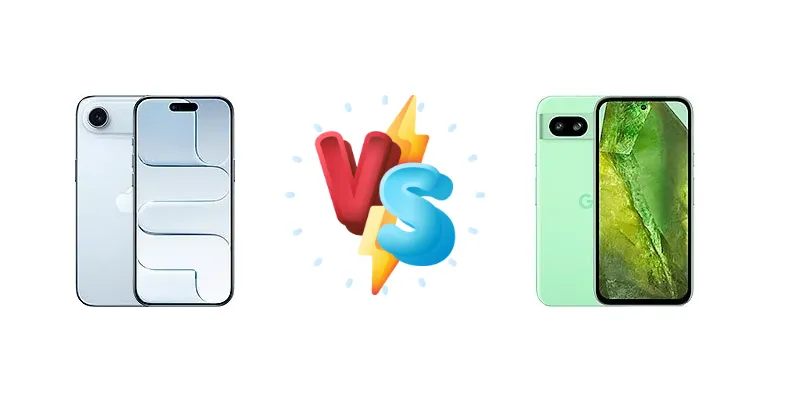
|
🏆 Quick Verdict
For the average user prioritizing raw processing power and a streamlined ecosystem, the iPhone Air emerges as the winner. Its Apple A19 Pro chipset and 1000-cycle battery longevity provide a performance edge. However, the Pixel 8a’s significantly brighter display and faster charging protocol make it a strong contender for media consumers and those valuing quick top-ups.
| PHONES | ||
|---|---|---|
| Phone Names | Apple iPhone Air | Google Pixel 8a |
| Network | ||
|---|---|---|
| 2G bands | GSM 850 / 900 / 1800 / 1900 | GSM 850 / 900 / 1800 / 1900 |
| 3G bands | HSDPA 850 / 900 / 1700(AWS) / 1900 / 2100 | HSDPA 800 / 850 / 900 / 1700(AWS) / 1900 / 2100 |
| 4G bands | 1, 2, 3, 4, 5, 7, 8, 12, 13, 17, 18, 19, 20, 25, 26, 28, 30, 32, 34, 38, 39, 40, 41, 42, 48, 53, 66 - A3517 | 1, 2, 3, 4, 5, 7, 8, 12, 17, 18, 19, 20, 26, 28, 32, 38, 40, 41, 42, 66 - G6GPR (International) |
| 5G bands | 1, 2, 3, 5, 7, 8, 12, 20, 25, 26, 28, 30, 38, 40, 41, 48, 53, 66, 70, 75, 77, 78, 79 SA/NSA/Sub6 - A3517 | 1, 2, 3, 5, 7, 8, 12, 20, 26, 28, 38, 40, 41, 66, 75, 76, 77, 78 SA/NSA/Sub6 - G6GPR (International) |
| Speed | HSPA, LTE, 5G, EV-DO Rev.A 3.1 Mbps | HSPA, LTE, 5G |
| Technology | GSM / CDMA / HSPA / EVDO / LTE / 5G | GSM / HSPA / LTE / 5G |
| Launch | ||
|---|---|---|
| Announced | 2025, September 09 | 2024, May 07 |
| Status | Available. Released 2025, September 19 | Available. Released 2024, May 14 |
| Body | ||
|---|---|---|
| Build | Glass front (Ceramic Shield 2), titanium frame (grade 5), glass back (Ceramic Shield) | Glass front (Gorilla Glass 3), aluminum frame, plastic back |
| Dimensions | 156.2 x 74.7 x 5.6 mm (6.15 x 2.94 x 0.22 in) | 152.1 x 72.7 x 8.9 mm (5.99 x 2.86 x 0.35 in) |
| SIM | eSIM + eSIM (8 or more, max 2 at a time) | Nano-SIM + eSIM |
| Weight | 165 g (5.82 oz) | 188 g (6.63 oz) |
| Display | ||
|---|---|---|
| Protection | Ceramic Shield 2, Mohs level 5 | Corning Gorilla Glass 3, Mohs level 5 |
| Resolution | 1260 x 2736 pixels, 19.5:9 ratio (~460 ppi density) | 1080 x 2400 pixels, 20:9 ratio (~430 ppi density) |
| Size | 6.5 inches, 104.9 cm2 (~89.9% screen-to-body ratio) | 6.1 inches, 90.3 cm2 (~81.6% screen-to-body ratio) |
| Type | LTPO Super Retina XDR OLED, 120Hz, HDR10, Dolby Vision, 1000 nits (typ), 1600 nits (HBM), 3000 nits (peak) | OLED, HDR, 120Hz, 2000 nits (peak) |
| Platform | ||
|---|---|---|
| CPU | Hexa-core (2x4.26 GHz + 4xX.X GHz) | Nona-core (1x3.0 GHz Cortex-X3 & 4x2.45 GHz Cortex-A715 & 4x2.15 GHz Cortex-A510) |
| Chipset | Apple A19 Pro (3 nm) | Google Tensor G3 (4 nm) |
| GPU | Apple GPU (5-core graphics) | Immortalis-G715s MC10 |
| OS | iOS 26, upgradable to iOS 26.1 | Android 14, upgradable to Android 16, up to 7 major Android upgrades |
| Memory | ||
|---|---|---|
| Card slot | No | No |
| Internal | 256GB 12GB RAM, 512GB 12GB RAM, 1TB 12GB RAM | 128GB 8GB RAM, 256GB 8GB RAM |
| Main Camera | ||
|---|---|---|
| Dual | - | 64 MP (16 MP eff.), f/1.9, 26mm (wide), 1/1.73", 0.8µm, dual pixel PDAF, OIS 13 MP, f/2.2, 120˚ (ultrawide), 1.12µm |
| Features | Dual-LED dual-tone flash, HDR (photo/panorama) | Dual-LED flash, Pixel Shift, Ultra HDR, panorama, Best Take |
| Single | 48 MP, f/1.6, 26mm (wide), 1/1.56", 1.0µm, dual pixel PDAF, sensor-shift OIS | - |
| Video | 4K@24/25/30/60fps, 1080p@25/30/60/120/240fps, HDR, Dolby Vision HDR (up to 60fps), stereo sound rec. | 4K@30/60fps, 1080p@30/60/120/240fps, OIS |
| Selfie camera | ||
|---|---|---|
| Features | HDR, Dolby Vision HDR, 3D (spatial) audio, stereo sound rec. | HDR, panorama |
| Single | 18 MP multi-aspect, f/1.9, 20mm (ultrawide), PDAF SL 3D, (depth/biometrics sensor) | 13 MP, f/2.2, 20mm (ultrawide), 1.12µm |
| Video | 4K@24/25/30/60fps, 1080p@25/30/60/120fps, gyro-EIS | 4K@30fps, 1080p@30/60fps |
| Sound | ||
|---|---|---|
| 35mm jack | No | No |
| Loudspeaker | Yes | Yes, with stereo speakers |
| Comms | ||
|---|---|---|
| Bluetooth | 6.0, A2DP, LE | 5.3, A2DP, LE |
| NFC | Yes | Yes |
| Positioning | GPS, GALILEO, GLONASS, QZSS, BDS, NavIC | GPS, GLONASS, GALILEO, BDS, QZSS, NavIC |
| Radio | No | No |
| USB | USB Type-C 2.0 | USB Type-C 3.2 |
| WLAN | Wi-Fi 802.11 a/b/g/n/ac/6e/7, tri-band, hotspot | Wi-Fi 802.11 a/b/g/n/ac/6e, dual/tri-band (market/region dependent) |
| Features | ||
|---|---|---|
| Sensors | Face ID, accelerometer, gyro, proximity, compass, barometer | Fingerprint (under display, optical), accelerometer, gyro, proximity, compass, barometer |
| Battery | ||
|---|---|---|
| Charging | Wired, PD2.0, 50% in 30 min 20 wireless MagSafe/Qi2, 50% in 30 min (15W - China) 4.5W reverse wired | 18W wired, PD3.0 7.5W wireless Bypass charging |
| Type | Li-Ion 3149 mAh | Li-Po 4492 mAh |
| Misc | ||
|---|---|---|
| Colors | Space Black, Cloud White, Light Gold, Sky Blue | Obsidian, Porcelain, Bay, Aloe |
| Models | iPhone18,4, A3517, A3260, A3518, A3516 | GKV4X, G6GPR, G8HHN, G576D |
| Price | € 948.99 / $ 949.99 / £ 899.10 | $ 229.98 / C$ 417.99 / £ 279.00 / € 299.99 / ₹ 33,300 |
| SAR | 1.19 W/kg (head) 1.19 W/kg (body) | - |
| SAR EU | 1.49 W/kg (head) 1.49 W/kg (body) | - |
| EU LABEL | ||
|---|---|---|
| Battery | 40:00h endurance, 1000 cycles | 40:06h endurance, 1000 cycles |
| Energy | Class A | Class B |
| Free fall | Class B (180 falls) | Class A (270 falls) |
| Repairability | Class C | Class B |
Apple iPhone Air
- Superior processing power with the A19 Pro chipset
- Long-term battery health with 1000 charge cycles
- Seamless integration within the Apple ecosystem
- MagSafe wireless charging convenience
- Lower peak display brightness compared to the Pixel 8a
- Slower wired charging speed than the Pixel 8a
Google Pixel 8a
- Significantly brighter display for outdoor visibility
- Faster wired charging with PD3.0
- Google’s AI-powered camera features
- Bypass charging for improved battery health
- Less powerful chipset compared to the A19 Pro
- Slower wireless charging speed
Display Comparison
The Pixel 8a immediately distinguishes itself with a measured peak brightness of 1508 nits, nearly double the iPhone Air’s 998 nits. This translates to significantly better outdoor visibility, a crucial advantage for users frequently exposed to direct sunlight. While both devices likely employ OLED panels, the Pixel 8a’s higher brightness suggests a more advanced panel design. The iPhone Air’s display specifications don’t mention refresh rate, implying a standard 60Hz panel, while the Pixel 8a’s is not specified, but is likely 60Hz as well. The difference in brightness will be the most noticeable difference for most users.
Camera Comparison
Without detailed camera specifications, a direct comparison is challenging. However, Google’s Pixel line is renowned for its computational photography prowess, leveraging AI to enhance image quality. The Pixel 8a likely benefits from Google’s advanced image processing algorithms, potentially compensating for any hardware limitations. The iPhone Air, while capable, typically relies more on hardware quality. The absence of detailed sensor information for either device makes it difficult to assess low-light performance or dynamic range. It's safe to assume both will offer excellent image quality, but with different aesthetic signatures – the Pixel leaning towards a more processed, vibrant look, and the iPhone aiming for greater realism.
Performance
The core of the performance disparity lies in the chipsets. Apple’s 3nm A19 Pro, a hexa-core processor with two high-performance cores clocked at 4.26 GHz, is expected to deliver significantly higher single-core and multi-core performance than Google’s 4nm Tensor G3. The Tensor G3’s nona-core configuration (1x3.0 GHz Cortex-X3, 4x2.45 GHz Cortex-A715, 4x2.15 GHz Cortex-A510) prioritizes AI and machine learning tasks, but lags behind the A19 Pro in raw computational power. While both likely utilize LPDDR5X RAM, the A19 Pro’s architectural advantages will result in smoother multitasking and faster app loading times. The A19 Pro’s efficiency also contributes to the iPhone Air’s impressive 40:00h endurance rating.
Battery Life
Both the iPhone Air and Pixel 8a boast impressive 40-hour endurance ratings, with the Pixel 8a slightly edging out the iPhone Air at 40:06h versus 40:00h. Active use scores show the iPhone Air at 12:44h and the Pixel 8a at 11:25h. However, charging speeds differ significantly. The iPhone Air supports PD2.0, achieving 50% charge in 30 minutes via wired charging, and offers 15W wireless charging via MagSafe/Qi2 (limited to 15W in China). The Pixel 8a utilizes PD3.0 for 18W wired charging and 7.5W wireless charging. The Pixel 8a’s bypass charging feature allows charging the battery directly, bypassing heat generation, potentially extending battery lifespan. The iPhone Air also offers 4.5W reverse wired charging.
Buying Guide
Buy the Apple iPhone Air if you need a consistently fast and responsive experience, particularly if you're already invested in the Apple ecosystem. Its long-term battery health and optimized software will provide years of reliable use. Buy the Google Pixel 8a if you prioritize display visibility in bright sunlight, prefer Google’s AI-powered features and camera processing, and value the convenience of faster charging, even if it's at a lower wattage.