
iPhone Air vs. Google Pixel 8 Pro: A Head-to-Head Comparison of Flagship Features
| Phones Images | |||||
|---|---|---|---|---|---|
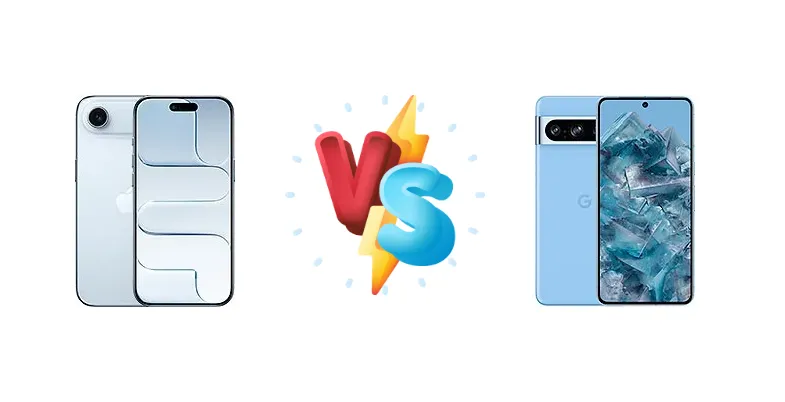
|
🏆 Quick Verdict
For the average user prioritizing all-day battery life and a streamlined ecosystem, the iPhone Air emerges as the winner. Its 40-hour endurance and efficient A19 Pro chip offer a compelling package. However, the Pixel 8 Pro’s superior display and advanced camera capabilities make it ideal for content creators and photography enthusiasts.
| PHONES | ||
|---|---|---|
| Phone Names | Apple iPhone Air | Google Pixel 8 Pro |
| Network | ||
|---|---|---|
| 2G bands | GSM 850 / 900 / 1800 / 1900 | GSM 850 / 900 / 1800 / 1900 |
| 3G bands | HSDPA 850 / 900 / 1700(AWS) / 1900 / 2100 | HSDPA 800 / 850 / 900 / 1700(AWS) / 1900 / 2100 |
| 4G bands | 1, 2, 3, 4, 5, 7, 8, 12, 13, 17, 18, 19, 20, 25, 26, 28, 30, 32, 34, 38, 39, 40, 41, 42, 48, 53, 66 - A3517 | 1, 2, 3, 4, 5, 7, 8, 12, 13, 14, 17, 18, 19, 20, 25, 26, 28, 29, 30, 38, 39, 40, 41, 46, 48, 66, 71 - G1MNW |
| 5G bands | 1, 2, 3, 5, 7, 8, 12, 20, 25, 26, 28, 30, 38, 40, 41, 48, 53, 66, 70, 75, 77, 78, 79 SA/NSA/Sub6 - A3517 | 1, 2, 3, 5, 7, 8, 12, 20, 25, 26, 28, 29, 30, 38, 40, 41, 48, 66, 70, 71, 77, 78, 257, 258, 260, 261 SA/NSA/Sub6/mmWave - G1MNW |
| Speed | HSPA, LTE, 5G, EV-DO Rev.A 3.1 Mbps | HSPA, LTE, 5G |
| Technology | GSM / CDMA / HSPA / EVDO / LTE / 5G | GSM / HSPA / LTE / 5G |
| Launch | ||
|---|---|---|
| Announced | 2025, September 09 | 2023, October 04 |
| Status | Available. Released 2025, September 19 | Available. Released 2023, October 12 |
| Body | ||
|---|---|---|
| Build | Glass front (Ceramic Shield 2), titanium frame (grade 5), glass back (Ceramic Shield) | Glass front (Gorilla Glass Victus 2), glass back (Gorilla Glass Victus 2), aluminum frame |
| Dimensions | 156.2 x 74.7 x 5.6 mm (6.15 x 2.94 x 0.22 in) | 162.6 x 76.5 x 8.8 mm (6.40 x 3.01 x 0.35 in) |
| SIM | eSIM + eSIM (8 or more, max 2 at a time) | Nano-SIM + eSIM |
| Weight | 165 g (5.82 oz) | 213 g (7.51 oz) |
| Display | ||
|---|---|---|
| Protection | Ceramic Shield 2, Mohs level 5 | Corning Gorilla Glass Victus 2 |
| Resolution | 1260 x 2736 pixels, 19.5:9 ratio (~460 ppi density) | 1344 x 2992 pixels, 20:9 ratio (~489 ppi density) |
| Size | 6.5 inches, 104.9 cm2 (~89.9% screen-to-body ratio) | 6.7 inches, 108.7 cm2 (~87.4% screen-to-body ratio) |
| Type | LTPO Super Retina XDR OLED, 120Hz, HDR10, Dolby Vision, 1000 nits (typ), 1600 nits (HBM), 3000 nits (peak) | LTPO OLED, 120Hz, HDR10+, 1600 nits (HBM), 2400 nits (peak) |
| Platform | ||
|---|---|---|
| CPU | Hexa-core (2x4.26 GHz + 4xX.X GHz) | Nona-core (1x3.0 GHz Cortex-X3 & 4x2.45 GHz Cortex-A715 & 4x2.15 GHz Cortex-A510) |
| Chipset | Apple A19 Pro (3 nm) | Google Tensor G3 (4 nm) |
| GPU | Apple GPU (5-core graphics) | Immortalis-G715s MC10 |
| OS | iOS 26, upgradable to iOS 26.1 | Android 14, upgradable to Android 16, up to 7 major Android upgrades |
| Memory | ||
|---|---|---|
| Card slot | No | No |
| Internal | 256GB 12GB RAM, 512GB 12GB RAM, 1TB 12GB RAM | 128GB 12GB RAM, 256GB 12GB RAM, 512GB 12GB RAM, 1TB 12GB RAM |
| Main Camera | ||
|---|---|---|
| Features | Dual-LED dual-tone flash, HDR (photo/panorama) | Multi-zone Laser AF, Dual-LED flash, Pixel Shift, Ultra-HDR, panorama, Best Take, Zoom Enhance |
| Single | 48 MP, f/1.6, 26mm (wide), 1/1.56", 1.0µm, dual pixel PDAF, sensor-shift OIS | - |
| Triple | - | 50 MP, f/1.7, 25mm (wide), 1/1.31", 1.2µm, dual pixel PDAF, OIS 48 MP, f/2.8, 113mm (periscope telephoto), 1/2.55", 0.7µm, dual pixel PDAF, OIS, 5x optical zoom 48 MP, f/2.0, 126˚ (ultrawide), 1/2.0", 0.8µm, dual pixel PDAF |
| Video | 4K@24/25/30/60fps, 1080p@25/30/60/120/240fps, HDR, Dolby Vision HDR (up to 60fps), stereo sound rec. | 4K@30/60fps, 1080p@24/30/60/120/240fps; gyro-EIS, OIS, 10-bit HDR |
| Selfie camera | ||
|---|---|---|
| Features | HDR, Dolby Vision HDR, 3D (spatial) audio, stereo sound rec. | HDR, panorama |
| Single | 18 MP multi-aspect, f/1.9, 20mm (ultrawide), PDAF SL 3D, (depth/biometrics sensor) | 10.5 MP, f/2.2, 20mm (ultrawide), 1/3.1", 1.22µm, PDAF |
| Video | 4K@24/25/30/60fps, 1080p@25/30/60/120fps, gyro-EIS | 4K@24/30/60fps, 1080p@30/60fps |
| Sound | ||
|---|---|---|
| 35mm jack | No | No |
| Loudspeaker | Yes | Yes, with stereo speakers |
| Comms | ||
|---|---|---|
| Bluetooth | 6.0, A2DP, LE | 5.3, A2DP, LE, aptX HD |
| NFC | Yes | Yes |
| Positioning | GPS, GALILEO, GLONASS, QZSS, BDS, NavIC | GPS (L1+L5), GLONASS (G1), GALILEO (E1+E5a), QZSS (L1+L5) |
| Radio | No | No |
| USB | USB Type-C 2.0 | USB Type-C 3.2 |
| WLAN | Wi-Fi 802.11 a/b/g/n/ac/6e/7, tri-band, hotspot | Wi-Fi 802.11 a/b/g/n/ac/6e/7, tri-band, Wi-Fi Direct |
| Features | ||
|---|---|---|
| Sensors | Face ID, accelerometer, gyro, proximity, compass, barometer | Fingerprint (under display, optical), accelerometer, gyro, proximity, compass, barometer, thermometer (skin temperature) |
| Battery | ||
|---|---|---|
| Charging | Wired, PD2.0, 50% in 30 min 20 wireless MagSafe/Qi2, 50% in 30 min (15W - China) 4.5W reverse wired | 30W wired, PD3.0, PPS, 50% in 30 min 23W wireless Reverse wireless Bypass charging |
| Type | Li-Ion 3149 mAh | Li-Ion 5050 mAh |
| Misc | ||
|---|---|---|
| Colors | Space Black, Cloud White, Light Gold, Sky Blue | Obsidian, Porcelain, Bay, Mint |
| Models | iPhone18,4, A3517, A3260, A3518, A3516 | GC3VE, G1MNW |
| Price | € 948.99 / $ 949.99 / £ 899.10 | € 362.00 / $ 289.97 / £ 329.95 / ₹ 54,999 |
| SAR | 1.19 W/kg (head) 1.19 W/kg (body) | - |
| SAR EU | 1.49 W/kg (head) 1.49 W/kg (body) | - |
| EU LABEL | ||
|---|---|---|
| Battery | 40:00h endurance, 1000 cycles | - |
| Energy | Class A | - |
| Free fall | Class B (180 falls) | - |
| Repairability | Class C | - |
Apple iPhone Air
- Exceptional battery life (40h endurance)
- Powerful and efficient A19 Pro chip
- Seamless Apple ecosystem integration
- Lower peak display brightness compared to Pixel 8 Pro
- Camera system may lack the advanced features of the Pixel 8 Pro
Google Pixel 8 Pro
- Brilliant 1600 nit display for outdoor visibility
- Advanced camera system with AI-powered features
- Open Android ecosystem with customization options
- Slightly shorter battery life than iPhone Air
- Tensor G3 may not match A19 Pro in sustained performance
Display Comparison
The Pixel 8 Pro immediately distinguishes itself with a peak brightness of 1600 nits, significantly exceeding the iPhone Air’s 998 nits. This translates to superior visibility in direct sunlight. While both likely employ OLED panels, the Pixel 8 Pro’s higher brightness and potentially wider color gamut will appeal to users who consume a lot of HDR content. The iPhone Air’s display, while excellent, is geared towards efficiency, potentially contributing to its longer battery life. We expect the Pixel 8 Pro to have a variable refresh rate (LTPO) for power saving, a feature Apple commonly includes in its Pro models, but is absent in the 'Air' designation.
Camera Comparison
The Pixel 8 Pro’s camera system is a key differentiator. While specific sensor details are missing, Google’s history suggests a focus on large sensors and advanced computational photography. The Pixel 8 Pro’s strength lies in its image processing algorithms, leveraging the Tensor G3’s AI capabilities for features like Magic Eraser and Photo Unblur. The iPhone Air, while undoubtedly capable, will likely prioritize natural-looking images with accurate color reproduction. The absence of detailed camera specs for the iPhone Air suggests a more conservative approach, focusing on refinement rather than groundbreaking hardware changes. The Pixel 8 Pro’s video capabilities are also expected to be strong, potentially offering features like cinematic mode and improved stabilization.
Performance
The Apple A19 Pro, built on a 3nm process, is expected to deliver leading-edge performance. Its hexa-core architecture, with two high-performance cores clocked at 4.26 GHz, suggests a focus on single-core speed, crucial for responsive app launches and smooth UI navigation. The Google Tensor G3, fabricated on a 4nm node, employs a nona-core configuration, prioritizing AI and machine learning tasks. While the Tensor G3’s Cortex-X3 core offers strong performance, the A19 Pro’s architectural advantages and smaller process node likely translate to superior sustained performance and thermal efficiency, especially during demanding tasks like video editing or gaming. The iPhone Air’s efficiency will also benefit from Apple’s tight hardware-software integration.
Battery Life
The iPhone Air boasts an impressive 40-hour endurance rating and 12:44h of active use, suggesting exceptional power efficiency. While the Pixel 8 Pro’s 11:14h of active use is respectable, its older 90-hour endurance rating is less informative than the iPhone Air’s active use score. The iPhone Air supports both 50% charge in 30 minutes via wired PD2.0 and wireless MagSafe/Qi2 charging. The Pixel 8 Pro offers 30W wired charging with PD3.0 and PPS, also achieving 50% charge in 30 minutes, and 23W wireless charging. The Pixel 8 Pro’s inclusion of ‘bypass charging’ – allowing direct power to the phone while charging – is a notable feature for preserving long-term battery health. The iPhone Air also offers 4.5W reverse wired charging, a feature mirrored by the Pixel 8 Pro’s reverse wireless charging.
Buying Guide
Buy the Apple iPhone Air if you need a phone that seamlessly integrates into the Apple ecosystem, prioritizes long battery life, and offers consistently smooth performance for everyday tasks. Buy the Google Pixel 8 Pro if you prefer a more open Android experience, demand the best possible camera performance with AI enhancements, and value a brighter, more vibrant display for media consumption.