
iPhone 6s Plus vs iPhone SE (2020): A Detailed Showdown
| Phones Images | |||||
|---|---|---|---|---|---|
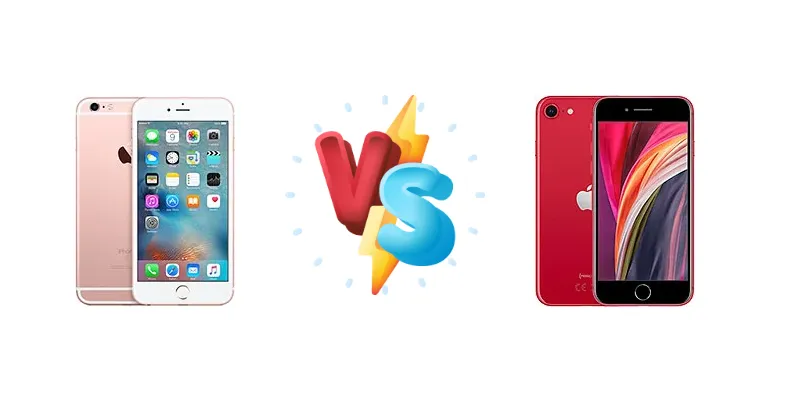
|
🏆 Quick Verdict
The iPhone SE (2020) is the clear winner. While the 6s Plus boasts a larger screen and impressive endurance rating, the SE's significantly faster A13 Bionic chip, brighter display, and faster charging make it a more compelling choice for most users in 2024.
| PHONES | ||
|---|---|---|
| Phone Names | Apple iPhone 6s Plus | Apple iPhone SE (2020) |
| Network | ||
|---|---|---|
| 2G bands | GSM 850 / 900 / 1800 / 1900 | GSM 850 / 900 / 1800 / 1900 |
| 3G bands | HSDPA 850 / 900 / 1700 / 1900 / 2100 | HSDPA 850 / 900 / 1700(AWS) / 1900 / 2100 |
| 4G bands | 1, 2, 3, 4, 5, 7, 8, 12, 13, 17, 18, 19, 20, 25, 26, 28, 29, 30 - A1633 | 1, 2, 3, 4, 5, 7, 8, 11, 12, 13, 17, 18, 19, 20, 21, 25, 26, 28, 29, 30, 32, 34, 38, 39, 40, 41, 42, 46, 48, 66 - A2296 |
| Speed | HSPA 42.2/5.76 Mbps, LTE (2CA) Cat6 300/50 Mbps, EV-DO Rev.A 3.1 Mbps | HSPA 42.2/5.76 Mbps, LTE (5CA) Cat16 1024/150 Mbps, EV-DO Rev.A 3.1 Mbps |
| Technology | GSM / CDMA / HSPA / EVDO / LTE | GSM / CDMA / HSPA / EVDO / LTE |
| 1, 2, 3, 4, 5, 7, 8, 12, 13, 17, 18, 19, 20, 25, 26, 28, 29, 30, 38, 39, 40, 41 - A1634 | 1, 2, 3, 4, 5, 7, 8, 12, 13, 14, 17, 18, 19, 20, 25, 26, 29, 30, 34, 38, 39, 40, 41, 42, 46, 48, 66, 71 - A2275, A2298 | |
| Launch | ||
|---|---|---|
| Announced | 2015, September 09. Released 2015, September 25 | 2020, April 15 |
| Status | Discontinued | Available. Released 2020, April 24 |
| Body | ||
|---|---|---|
| Build | Glass front (Corning-made glass), aluminum back, aluminum frame | Glass front, glass back, aluminum frame |
| Dimensions | 158.2 x 77.9 x 7.3 mm (6.23 x 3.07 x 0.29 in) | 138.4 x 67.3 x 7.3 mm (5.45 x 2.65 x 0.29 in) |
| SIM | Nano-SIM | Nano-SIM + eSIM |
| Weight | 192 g (6.77 oz) | 148 g (5.22 oz) |
| Apple Pay (Visa, MasterCard, AMEX certified) | IP67 dust/water resistant (up to 1m for 30 min) Apple Pay (Visa, MasterCard, AMEX certified) | |
| Display | ||
|---|---|---|
| Protection | Ion-strengthened glass, oleophobic coating | Ion-strengthened glass |
| Resolution | 1080 x 1920 pixels, 16:9 ratio (~401 ppi density) | 750 x 1334 pixels, 16:9 ratio (~326 ppi density) |
| Size | 5.5 inches, 83.4 cm2 (~67.7% screen-to-body ratio) | 4.7 inches, 60.9 cm2 (~65.4% screen-to-body ratio) |
| Type | IPS LCD | Retina IPS LCD, 625 nits (typ) |
| 3D Touch display | - | |
| Platform | ||
|---|---|---|
| CPU | Dual-core 1.84 GHz Twister | Hexa-core (2x2.65 GHz Lightning + 4x1.8 GHz Thunder) |
| Chipset | Apple A9 (14/16 nm - maker dependant) | Apple A13 Bionic (7 nm+) |
| GPU | PowerVR GT7600 (six-core graphics) | Apple GPU (4-core graphics) |
| OS | iOS 9, upgradable to iOS 15.8.5 | iOS 13, upgradable to iOS 26.1 |
| Memory | ||
|---|---|---|
| Card slot | No | No |
| Internal | 16GB 2GB RAM, 32GB 2GB RAM, 64GB 2GB RAM, 128GB 2GB RAM | 64GB 3GB RAM, 128GB 3GB RAM, 256GB 3GB RAM |
| NVMe | NVMe | |
| Main Camera | ||
|---|---|---|
| Features | Dual-LED dual-tone flash, HDR | Quad-LED dual-tone flash, HDR, panorama |
| Single | 12 MP, f/2.2, 29mm (standard), 1/3.0", 1.22µm, PDAF, OIS | 12 MP, f/1.8 (wide), PDAF, OIS |
| Video | 4K@30fps, 1080p@60fps, 1080p@120fps, 720p@240fps | 4K@24/30/60fps, 1080p@30/60/120/240fps, HDR, OIS, stereo sound rec. |
| Selfie camera | ||
|---|---|---|
| Features | Face detection, HDR, panorama | HDR |
| Single | 5 MP, f/2.2, 31mm (standard) | 7 MP, f/2.2 |
| Video | 720p@30fps | 1080p@30fps; gyro-EIS |
| Sound | ||
|---|---|---|
| 3.5mm jack | Yes | No |
| 35mm jack | Yes | No |
| Loudspeaker | Yes | Yes, with stereo speakers |
| 16-bit/44.1kHz audio | - | |
| Comms | ||
|---|---|---|
| Bluetooth | 4.2, A2DP, LE | 5.0, A2DP, LE |
| NFC | Yes (Apple Pay only) | Yes |
| Positioning | GPS, GLONASS, GALILEO, QZSS | GPS, GLONASS |
| Radio | No | No |
| USB | Lightning, USB 2.0 | Lightning, USB 2.0 |
| WLAN | Wi-Fi 802.11 a/b/g/n/ac, dual-band, hotspot | Wi-Fi 802.11 a/b/g/n/ac/6, dual-band, hotspot |
| Features | ||
|---|---|---|
| Sensors | Fingerprint (front-mounted), accelerometer, gyro, proximity, compass, barometer | Fingerprint (front-mounted), accelerometer, proximity, gyro, compass, barometer |
| Battery | ||
|---|---|---|
| Charging | - | 18W wired, 50% in 30 min 7.5W wireless (Qi) |
| Stand-by | Up to 384 h (3G) | - |
| Talk time | Up to 24 h (3G) | - |
| Type | Li-Ion 2750 mAh, non-removable (10.45 Wh) | Li-Ion 1821 mAh (6.91 Wh) |
| Misc | ||
|---|---|---|
| Colors | Space Gray, Silver, Gold, Rose Gold | Black, White, Red |
| Models | A1634, A1687, A1690, A1699, iPhone8,2 | A2275, A2296, A2298, iPhone12,8 |
| Price | About 240 EUR | $ 120.00 / C$ 165.75 / £ 99.95 / € 130.89 |
| SAR | 1.12 W/kg (head) 1.14 W/kg (body) | 1.17 W/kg (head) 1.16 W/kg (body) |
| SAR EU | 0.93 W/kg (head) 0.98 W/kg (body) | 0.98 W/kg (head) 0.99 W/kg (body) |
| Tests | ||
|---|---|---|
| Audio quality | Noise -93.4dB / Crosstalk -71.1dB | - |
| Battery life | Endurance rating 85h | Endurance rating 59h |
| Camera | Photo / Video | Photo / Video |
| Display | Contrast ratio: 1382:1 (nominal), 3.530 (sunlight) | Contrast ratio: 1544:1 (nominal) |
| Loudspeaker | Voice 65dB / Noise 65dB / Ring 64dB | -24.1 LUFS (Very good) |
| Performance | Basemark OS II 2.0: 2261 | AnTuTu: 462253 (v8) GeekBench: 3237 (v5.1) |
Apple iPhone 6s Plus
- Larger screen
- Longer battery endurance (on paper)
- More affordable (used)
- Outdated processor
- Slower charging
- Lower camera quality
- No wireless charging
Apple iPhone SE (2020)
- Powerful A13 Bionic chip
- Brighter display
- Better camera
- Fast charging (wired & wireless)
- Compact size
- Smaller battery
- Shorter battery endurance (compared to 6s Plus)
- Higher price (used)
Display Comparison
The iPhone SE (2020) features a noticeably brighter display with a measured peak brightness of 670 nits, significantly outperforming the 6s Plus. While both offer good contrast ratios (1382:1 and 1544:1 respectively), the SE's improved brightness makes it easier to view in sunlight. The 6s Plus has a larger 5.5-inch screen, while the SE has a 4.7-inch screen.
Camera Comparison
While both phones offer 'Photo / Video' capabilities, the iPhone SE (2020)'s camera benefits from Apple's computational photography advancements. It delivers better image quality, especially in low light, and offers features like Smart HDR. The 6s Plus camera is still capable, but noticeably dated.
Performance
The A13 Bionic chip in the iPhone SE (2020) is a generational leap over the A9 in the 6s Plus. Expect significantly faster app loading, smoother multitasking, and better gaming performance on the SE. The SE's hexa-core CPU also provides a performance advantage over the 6s Plus's dual-core processor.
Battery Life
The iPhone 6s Plus has a higher endurance rating (85h) than the iPhone SE (2020) (59h). However, this is largely due to the 6s Plus's older technology and lower power consumption from its less powerful processor. The iPhone SE (2020) supports 18W fast charging and wireless charging, features absent in the 6s Plus.
Buying Guide
Who should buy the iPhone 6s Plus? Those seeking a large-screen iPhone on a tight budget and prioritizing long battery life. Who should buy the iPhone SE (2020)? Users wanting a compact, powerful iPhone with modern features, a great camera, and fast performance, even if it means a smaller battery.