
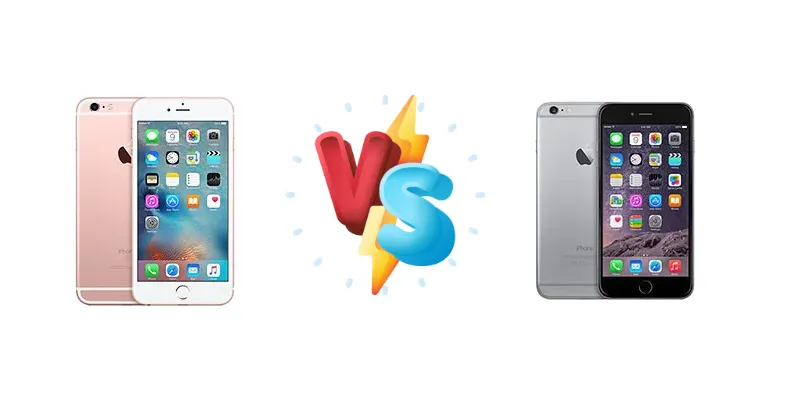
iPhone 6s Plus vs iPhone 6 Plus: A Detailed Comparison
| Phones Images | |||||
|---|---|---|---|---|---|
|
🏆 Quick Verdict
The iPhone 6s Plus edges out the 6 Plus thanks to its slightly better performance (A9 chip), improved display sunlight readability, and marginally better battery life. However, both are aging devices, and finding a reliable one in good condition is key.
| PHONES | ||
|---|---|---|
| Phone Names | Apple iPhone 6s Plus | Apple iPhone 6 Plus |
| Network | ||
|---|---|---|
| 2G bands | GSM 850 / 900 / 1800 / 1900 | GSM 850 / 900 / 1800 / 1900 - A1522 (GSM), A1522 (CDMA), A1524 |
| 3G bands | HSDPA 850 / 900 / 1700 / 1900 / 2100 | HSDPA 850 / 900 / 1700 / 1900 / 2100 - A1522 (GSM), A1522 (CDMA), A1524 |
| 4G bands | 1, 2, 3, 4, 5, 7, 8, 12, 13, 17, 18, 19, 20, 25, 26, 28, 29, 30 - A1633 | 1, 2, 3, 4, 5, 7, 8, 13, 17, 18, 19, 20, 25, 26, 28, 29 - A1522 GSM, A1522 CDMA |
| Speed | HSPA 42.2/5.76 Mbps, LTE (2CA) Cat6 300/50 Mbps, EV-DO Rev.A 3.1 Mbps | HSPA 42.2/5.76 Mbps, LTE Cat4 150/50 Mbps, EV-DO Rev.A 3.1 Mbps |
| Technology | GSM / CDMA / HSPA / EVDO / LTE | GSM / CDMA / HSPA / EVDO / LTE |
| 1, 2, 3, 4, 5, 7, 8, 12, 13, 17, 18, 19, 20, 25, 26, 28, 29, 30, 38, 39, 40, 41 - A1634 | - | |
| Launch | ||
|---|---|---|
| Announced | 2015, September 09. Released 2015, September 25 | 2014, September 09. Released 2014, September 19 |
| Status | Discontinued | Discontinued |
| Body | ||
|---|---|---|
| Build | Glass front (Corning-made glass), aluminum back, aluminum frame | Glass front (Corning-made glass), aluminum back, aluminum frame |
| Dimensions | 158.2 x 77.9 x 7.3 mm (6.23 x 3.07 x 0.29 in) | 158.1 x 77.8 x 7.1 mm (6.22 x 3.06 x 0.28 in) |
| SIM | Nano-SIM | Nano-SIM |
| Weight | 192 g (6.77 oz) | 172 g (6.07 oz) |
| Apple Pay (Visa, MasterCard, AMEX certified) | - | |
| Display | ||
|---|---|---|
| Protection | Ion-strengthened glass, oleophobic coating | Ion-strengthened glass, oleophobic coating |
| Resolution | 1080 x 1920 pixels, 16:9 ratio (~401 ppi density) | 1080 x 1920 pixels, 16:9 ratio (~401 ppi density) |
| Size | 5.5 inches, 83.4 cm2 (~67.7% screen-to-body ratio) | 5.5 inches, 83.4 cm2 (~67.8% screen-to-body ratio) |
| Type | IPS LCD | IPS LCD |
| 3D Touch display | - | |
| Platform | ||
|---|---|---|
| CPU | Dual-core 1.84 GHz Twister | Dual-core 1.4 GHz Typhoon (ARM v8-based) |
| Chipset | Apple A9 (14/16 nm - maker dependant) | Apple A8 (20 nm) |
| GPU | PowerVR GT7600 (six-core graphics) | PowerVR GX6450 (quad-core graphics) |
| OS | iOS 9, upgradable to iOS 15.8.5 | iOS 8, upgradable to iOS 12.5.7 |
| Memory | ||
|---|---|---|
| Card slot | No | No |
| Internal | 16GB 2GB RAM, 32GB 2GB RAM, 64GB 2GB RAM, 128GB 2GB RAM | 16GB 1GB RAM, 64GB 1GB RAM, 128GB 1GB RAM |
| NVMe | - | |
| Main Camera | ||
|---|---|---|
| Features | Dual-LED dual-tone flash, HDR | Dual-LED dual-tone flash, HDR |
| Single | 12 MP, f/2.2, 29mm (standard), 1/3.0", 1.22µm, PDAF, OIS | 8 MP, f/2.2, 29mm (standard), 1/3.0", 1.5µm, PDAF, OIS |
| Video | 4K@30fps, 1080p@60fps, 1080p@120fps, 720p@240fps | 1080p@60fps, 720p@240fps |
| Selfie camera | ||
|---|---|---|
| Features | Face detection, HDR, panorama | face detection, HDR, FaceTime over Wi-Fi or Cellular |
| Single | 5 MP, f/2.2, 31mm (standard) | 1.2 MP, f/2.2, 31mm (standard) |
| Video | 720p@30fps | 720p@30fps |
| Sound | ||
|---|---|---|
| 3.5mm jack | Yes | Yes |
| 35mm jack | Yes | Yes |
| Loudspeaker | Yes | Yes |
| 16-bit/44.1kHz audio | - | |
| Comms | ||
|---|---|---|
| Bluetooth | 4.2, A2DP, LE | 4.0, A2DP, LE |
| NFC | Yes (Apple Pay only) | Yes (Apple Pay only) |
| Positioning | GPS, GLONASS, GALILEO, QZSS | GPS, GLONASS |
| Radio | No | No |
| USB | Lightning, USB 2.0 | Lightning, USB 2.0 |
| WLAN | Wi-Fi 802.11 a/b/g/n/ac, dual-band, hotspot | Wi-Fi 802.11 a/b/g/n/ac, dual-band, hotspot |
| Features | ||
|---|---|---|
| Sensors | Fingerprint (front-mounted), accelerometer, gyro, proximity, compass, barometer | Fingerprint (front-mounted), accelerometer, gyro, proximity, compass, barometer |
| Battery | ||
|---|---|---|
| Stand-by | Up to 384 h (3G) | Up to 384 h (3G) |
| Talk time | Up to 24 h (3G) | Up to 24 h (3G) |
| Type | Li-Ion 2750 mAh, non-removable (10.45 Wh) | Li-Po 2915 mAh, non-removable (11.1 Wh) |
| Misc | ||
|---|---|---|
| Colors | Space Gray, Silver, Gold, Rose Gold | Space Gray, Silver, Gold |
| Models | A1634, A1687, A1690, A1699, iPhone8,2 | A1522, A1524, iPhone7,1 |
| Price | About 240 EUR | About 420 EUR |
| SAR | 1.12 W/kg (head) 1.14 W/kg (body) | 1.19 W/kg (head) 1.19 W/kg (body) |
| SAR EU | 0.93 W/kg (head) 0.98 W/kg (body) | 0.99 W/kg (head) 0.91 W/kg (body) |
| Tests | ||
|---|---|---|
| Audio quality | Noise -93.4dB / Crosstalk -71.1dB | Noise -94dB / Crosstalk -72dB |
| Battery life | Endurance rating 85h | Endurance rating 79h |
| Camera | Photo / Video | Photo / Video |
| Display | Contrast ratio: 1382:1 (nominal), 3.530 (sunlight) | Contrast ratio: 1361 (nominal), 3.023 (sunlight) |
| Loudspeaker | Voice 65dB / Noise 65dB / Ring 64dB | Voice 67dB / Noise 65dB / Ring 66dB |
| Performance | Basemark OS II 2.0: 2261 | - |
Apple iPhone 6s Plus
- Slightly faster performance (A9 chip)
- Better sunlight display readability
- Marginally longer battery life
- 4K video recording
- 3D Touch
- Aging hardware
- Battery degradation likely
- Limited software updates
Apple iPhone 6 Plus
- More affordable (typically)
- Still functional for basic tasks
- Compact size compared to newer phones
- Slower performance (A8 chip)
- Poorer sunlight display readability
- Shorter battery life
- No 4K video recording
- No 3D Touch
Display Comparison
Both phones feature a 5.5-inch Retina HD display. However, the 6s Plus boasts a slightly better contrast ratio (1382:1 vs 1361:1) and significantly improved sunlight readability (3.530 vs 3.023). The 6s Plus also introduced 3D Touch, offering pressure-sensitive interactions, a feature absent in the 6 Plus.
Camera Comparison
While both phones offer capable cameras for their time, the 6s Plus features a slightly improved 12MP rear camera with larger pixels, resulting in better low-light performance and more detailed photos. The 6s Plus also introduced 4K video recording, a feature not available on the 6 Plus. Both have 1.2MP front-facing cameras.
Performance
The iPhone 6s Plus has a clear advantage with its Apple A9 chip and a dual-core 1.84 GHz Twister CPU compared to the iPhone 6 Plus's A8 chip and 1.4 GHz Typhoon CPU. This translates to noticeably faster app loading times, smoother multitasking, and better overall responsiveness on the 6s Plus. Both phones have 2GB of RAM.
Battery Life
The iPhone 6s Plus offers a slightly longer endurance rating (85h vs 79h), suggesting a bit more battery life in real-world usage. However, both phones are aging, and battery degradation is a significant concern with used models.
Buying Guide
The iPhone 6s Plus is a better choice for those prioritizing slightly faster performance and a more visible screen in bright sunlight. The iPhone 6 Plus remains a viable option for budget-conscious users who don't need the absolute latest features, but both are best suited for light use due to their age.