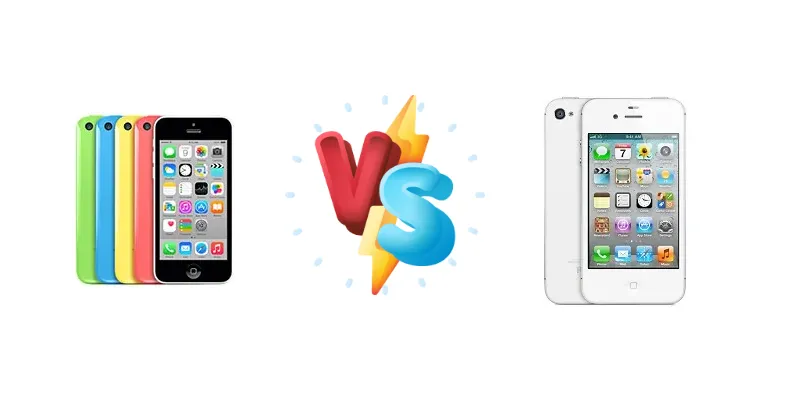
Remember the days of iOS 7 and the vibrant plastic iPhone 5c? Let's revisit these classic Apple devices and see how they stack up against each other. This comparison will help you decide which older iPhone is the better choice if you're looking for a budget-friendly option or a nostalgic throwback.
🏆 Quick Verdict
The iPhone 5c edges out the 4s thanks to slightly better battery life and a more modern design. While both are dated, the 5c's A6 chip offers a minor performance boost, and its brighter sunlight display makes it more usable outdoors. Ultimately, both are relics of a bygone era.
| Network |
|---|
| 2G bands | GSM 850 / 900 / 1800 / 1900 - all versions | GSM 850 / 900 / 1800 / 1900 |
| 3G bands | HSDPA 850 / 900 / 1700 / 1900 / 2100 - A1532 (GSM), A1532 (CDMA), A1456 | HSDPA 850 / 900 / 1900 / 2100 |
| 4G bands | 1, 2, 3, 4, 5, 8, 13, 17, 19, 20, 25 - A1532 GSM, A1532 CDMA | - |
| Speed | HSPA 42.2/5.76 Mbps, LTE Cat3 100/50 Mbps, EV-DO Rev.A 3.1 Mbps | HSPA 14.4/5.76 Mbps |
| Technology | GSM / CDMA / HSPA / LTE | GSM / CDMA / HSPA / EVDO |
| | 1, 2, 3, 5, 7, 8, 20, 38, 39, 40 - A1529 | CDMA2000 1xEV-DO |
| Launch |
|---|
| Announced | 2013, September 10. Released 2013, September 20 | 2011, October 04. Released 2011, October 14 |
| Status | Discontinued | Discontinued |
| Body |
|---|
| Build | Glass front, plastic back, plastic frame | Glass front (Corning-made glass), glass back, stainless steel frame |
| Dimensions | 124.4 x 59.2 x 9 mm (4.90 x 2.33 x 0.35 in) | 115.2 x 58.6 x 9.3 mm (4.54 x 2.31 x 0.37 in) |
| SIM | Nano-SIM | Micro-SIM |
| Weight | 132 g (4.66 oz) | 140 g (4.94 oz) |
| | - | Scratch-resistant glass back panel |
| Display |
|---|
| Protection | - | Corning Gorilla Glass, oleophobic coating |
| Resolution | 640 x 1136 pixels, 16:9 ratio (~326 ppi density) | 640 x 960 pixels, 3:2 ratio (~330 ppi density) |
| Size | 4.0 inches, 44.1 cm2 (~59.9% screen-to-body ratio) | 3.5 inches, 36.5 cm2 (~54.0% screen-to-body ratio) |
| Type | IPS LCD | IPS LCD |
| Platform |
|---|
| CPU | Dual-core 1.3 GHz Swift (ARM v7-based) | Dual-core 1.0 GHz Cortex-A9 |
| Chipset | Apple A6 (32 nm) | Apple A5 (45 nm) |
| GPU | PowerVR SGX 543MP3 (triple-core graphics) | PowerVR SGX543MP2 |
| OS | iOS 7, upgradable to iOS 10.3.3 | iOS 5, upgradable to iOS 9.3.6 |
| Memory |
|---|
| Card slot | No | No |
| Internal | 8GB 1GB RAM, 16GB 1GB RAM, 32GB 1GB RAM | 8GB 512MB RAM, 16GB 512MB RAM, 32GB 512MB RAM, 64GB 512MB RAM |
| Main Camera |
|---|
| Features | LED flash, panorama, HDR | LED flash, panorama, HDR |
| Single | 8 MP, f/2.4, 33mm (standard), 1/3.2", 1.4µm, AF | 8 MP, f/2.4, 35mm (standard), 1/3.2", 1.4µm, AF |
| Video | 1080p@30fps | 1080p@30fps |
| Selfie camera |
|---|
| Features | face detection, FaceTime over Wi-Fi or Cellular | - |
| Single | 1.2 MP | VGA, videocalling over Wi-Fi and 3G |
| Video | 720p@30fps | 480p@30fps |
| Sound |
|---|
| 3.5mm jack | Yes | Yes |
| 35mm jack | Yes | Yes |
| Loudspeaker | Yes | Yes |
| | 16-bit/44.1kHz audio
| - |
| Comms |
|---|
| Bluetooth | 4.0, A2DP, LE | 4.0, A2DP, LE |
| NFC | No | - |
| Positioning | GPS, GLONASS | GPS, A-GPS, GLONASS |
| Radio | No | No |
| USB | Lightning, USB 2.0 | 2.0 |
| WLAN | Wi-Fi 802.11 a/b/g/n, dual-band | Wi-Fi 802.11 b/g/n, hotspot |
| Features |
|---|
| Sensors | Accelerometer, gyro, proximity, compass | Accelerometer, gyro, proximity, compass |
| Battery |
|---|
| Stand-by | Up to 250 h (3G) | Up to 200 h (3G) |
| Talk time | Up to 10 h (3G) | Up to 8 h (3G) |
| Type | Li-Po 1510 mAh, non-removable (5.73 Wh) | Li-Po 1432 mAh, non-removable (5.3 Wh) |
| Misc |
|---|
| Colors | White, Blue, Green, Yellow, Pink | Black, White |
| Models | A1456, A1507, A1516, A1529, A1532, iPhone5,3, iPhone5,4 | A1431, A1387, iPhone4,1 |
| Price | About 300 EUR | About 190 EUR |
| SAR | 1.15 W/kg (head) 1.17 W/kg (body) | 1.18 W/kg (head) 0.98 W/kg (body) |
| SAR EU | 1.00 W/kg (head) 0.96 W/kg (body) | 0.99 W/kg (head) 0.99 W/kg (body) |
| Tests |
|---|
| Audio quality |
Noise -93.9dB / Crosstalk -80.3dB |
Noise -91.2dB / Crosstalk -93.0dB |
| Battery life |
Endurance rating 52h
|
Endurance rating 45h
|
| Camera |
Photo / Video |
Photo / Video |
| Display |
Contrast ratio: 1233:1 (nominal) / 3.512:1 (sunlight) |
Contrast ratio: 1261:1 (nominal) / 2.269:1 (sunlight) |
| Loudspeaker |
Voice 66dB / Noise 65dB / Ring 66dB
|
Voice 65dB / Noise 64dB / Ring 74dB
|
| Performance |
Basemark X: 2225 | - |
Apple iPhone 5c
- Slightly better battery life
- Improved sunlight display
- More modern design (plastic)
- Slightly faster processor
- Very dated hardware
- Limited app compatibility
- Plastic build may not appeal to everyone
Apple iPhone 4s
- Iconic iPhone 4 design
- Potentially lower price
- Compact size
- Weaker processor
- Poorer sunlight display
- Shorter battery life
- Very dated hardware
Display Comparison
Both phones feature 3.5-inch displays with a nominal contrast ratio of around 1233:1. However, the iPhone 5c boasts a significantly better sunlight contrast ratio (3.512:1) compared to the 4s (2.269:1), making it easier to see in bright conditions. The 5c's screen also tends to be slightly brighter.
Camera Comparison
Both phones have similar camera capabilities – they are capable of taking basic photos and videos. Image quality is acceptable for their time, but don't expect anything spectacular. The 5c's camera might offer slightly improved color reproduction due to the newer chip.
Performance
The iPhone 5c's A6 chip (1.3 GHz dual-core) provides a noticeable performance advantage over the iPhone 4s's A5 chip (1.0 GHz dual-core). While neither phone can handle modern apps smoothly, the 5c will generally feel a bit snappier. Both run older versions of iOS.
Battery Life
The iPhone 5c has a slightly better endurance rating (52h) compared to the iPhone 4s (45h). This translates to a bit more usage time on a single charge, which is a welcome advantage.
Buying Guide
Who should buy the iPhone 5c? Those seeking slightly better battery life and a more contemporary (though still dated) design. Who should buy the iPhone 4s? Those prioritizing a potentially lower price point and a more compact form factor, or those who appreciate the iconic iPhone 4 design.
Frequently Asked Questions
❓ Are these phones still supported with iOS updates?
No, both the iPhone 5c and iPhone 4s are long past end-of-life for iOS updates. They are running very old versions of iOS and will not receive any further updates.
❓ Can I use these phones with a modern cellular network?
Potentially, but it depends on your carrier. Both phones support older 3G networks, but 4G LTE support is limited or non-existent. Check with your carrier for compatibility.