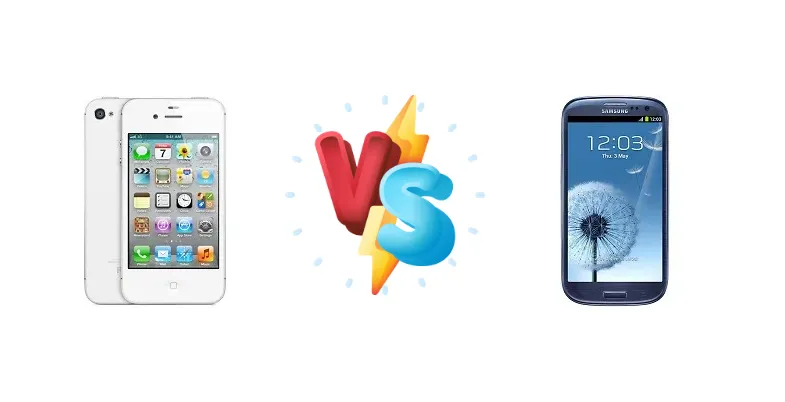
The iPhone 4s and Samsung Galaxy S3 were titans of their time, defining smartphone experiences in 2011 and 2012 respectively. Both offered groundbreaking features and fierce competition. Let's revisit these iconic devices and see how they stack up today.
🏆 Quick Verdict
The Galaxy S3 edges out the iPhone 4s with its superior processing power, brighter display, and slightly longer battery life. However, the iPhone 4s boasts a more refined iOS experience and a loyal following. Ultimately, the S3 offers more raw performance for the time.
| Network |
|---|
| 2G bands | GSM 850 / 900 / 1800 / 1900 | GSM 850 / 900 / 1800 / 1900 |
| 3G bands | HSDPA 850 / 900 / 1900 / 2100 | HSDPA 850 / 900 / 1900 / 2100 |
| Speed | HSPA 14.4/5.76 Mbps | HSPA 21.1/5.76 Mbps |
| Technology | GSM / CDMA / HSPA / EVDO | GSM / HSPA |
| | CDMA2000 1xEV-DO | - |
| Launch |
|---|
| Announced | 2011, October 04. Released 2011, October 14 | 2012, May. Released 2012, May |
| Status | Discontinued | Discontinued |
| Body |
|---|
| Build | Glass front (Corning-made glass), glass back, stainless steel frame | Glass front (Gorilla Glass 2), plastic back, plastic frame |
| Dimensions | 115.2 x 58.6 x 9.3 mm (4.54 x 2.31 x 0.37 in) | 136.6 x 70.6 x 8.6 mm (5.38 x 2.78 x 0.34 in) |
| SIM | Micro-SIM | Micro-SIM |
| Weight | 140 g (4.94 oz) | 133 g (4.69 oz) |
| | Scratch-resistant glass back panel | - |
| Display |
|---|
| Protection | Corning Gorilla Glass, oleophobic coating | Corning Gorilla Glass 2 |
| Resolution | 640 x 960 pixels, 3:2 ratio (~330 ppi density) | 720 x 1280 pixels, 16:9 ratio (~306 ppi density) |
| Size | 3.5 inches, 36.5 cm2 (~54.0% screen-to-body ratio) | 4.8 inches, 63.5 cm2 (~65.9% screen-to-body ratio) |
| Type | IPS LCD | Super AMOLED |
| Platform |
|---|
| CPU | Dual-core 1.0 GHz Cortex-A9 | Quad-core 1.4 GHz Cortex-A9 |
| Chipset | Apple A5 (45 nm) | Exynos 4412 Quad (32 nm) |
| GPU | PowerVR SGX543MP2 | Mali-400MP4 |
| OS | iOS 5, upgradable to iOS 9.3.6 | Android 4.0.4 (Ice Cream Sandwich), 4.3 (Jelly Bean), TouchWiz UI |
| Memory |
|---|
| Card slot | No | microSDXC (dedicated slot) |
| Internal | 8GB 512MB RAM, 16GB 512MB RAM, 32GB 512MB RAM, 64GB 512MB RAM | 16GB 1GB RAM, 32GB 1GB RAM, 64GB 1GB RAM |
| Main Camera |
|---|
| Features | LED flash, panorama, HDR | LED flash |
| Single | 8 MP, f/2.4, 35mm (standard), 1/3.2", 1.4µm, AF | 8 MP, f/2.6, 1/3.0", AF |
| Video | 1080p@30fps | 1080p@30fps |
| Selfie camera |
|---|
| Single | VGA, videocalling over Wi-Fi and 3G | 1.9 MP, f/2.6 |
| Video | 480p@30fps | 720p@30fps |
| Sound |
|---|
| 3.5mm jack | Yes | Yes |
| 35mm jack | Yes | Yes |
| Loudspeaker | Yes | Yes |
| Comms |
|---|
| Bluetooth | 4.0, A2DP, LE | 4.0, A2DP, EDR, aptX |
| NFC | - | Yes |
| Positioning | GPS, A-GPS, GLONASS | GPS, A-GPS, GLONASS |
| Radio | No | Stereo FM radio, RDS |
| USB | 2.0 | microUSB 2.0 (MHL TV-out), OTG |
| WLAN | Wi-Fi 802.11 b/g/n, hotspot | Wi-Fi 802.11 a/b/g/n, dual-band, Wi-Fi Direct, DLNA, hotspot |
| Features |
|---|
| Sensors | Accelerometer, gyro, proximity, compass | Accelerometer, gyro, proximity, compass, barometer |
| | - | S-Voice natural language commands and dictation |
| Battery |
|---|
| Stand-by | Up to 200 h (3G) | Up to 590 h (2G) / Up to 790 h (3G) |
| Talk time | Up to 8 h (3G) | Up to 21 h 40 min (2G) / Up to 11 h 40 min (3G) |
| Type | Li-Po 1432 mAh, non-removable (5.3 Wh) | Removable Li-Ion 2100 mAh battery |
| Misc |
|---|
| Colors | Black, White | Pebble blue, Marble white, Amber brown, Garnet red, Sapphire black, Titanium grey, La Fleur |
| Models | A1431, A1387, iPhone4,1 | GT-I9300, GT-I9300I, SHV-E210S, SHW-M440S |
| Price | About 190 EUR | About 190 EUR |
| SAR | 1.18 W/kg (head) 0.98 W/kg (body) | 0.55 W/kg (head) 1.49 W/kg (body) |
| SAR EU | 0.99 W/kg (head) 0.99 W/kg (body) | 0.21 W/kg (head) |
| Tests |
|---|
| Audio quality |
Noise -91.2dB / Crosstalk -93.0dB |
Noise -90.3dB / Crosstalk -92.6dB |
| Battery life |
Endurance rating 45h
|
Endurance rating 50h
|
| Camera |
Photo / Video |
Photo / Video |
| Display |
Contrast ratio: 1261:1 (nominal) / 2.269:1 (sunlight) |
Contrast ratio: Infinite (nominal) / 3.419:1 (sunlight) |
| Loudspeaker |
Voice 65dB / Noise 64dB / Ring 74dB
|
Voice 75dB / Noise 66dB / Ring 75dB
|
Apple iPhone 4s
- Refined iOS experience
- Strong ecosystem
- Good image processing
- Compact design
- Older processor
- Less vibrant display
- Limited storage options
- Outdated features
Samsung I9300 Galaxy S III
- Powerful quad-core processor
- Bright Super AMOLED display
- More customizable Android
- Larger screen
- Slightly better battery life
- Android updates discontinued
- Potential security vulnerabilities
- Plastic build quality
- Can feel dated
Display Comparison
The Galaxy S3's Super AMOLED display offered a significantly brighter and more vibrant experience than the iPhone 4s' Retina display, especially in sunlight. While the iPhone 4s had a respectable contrast ratio, the S3's 'infinite' nominal contrast and 3.419:1 sunlight ratio provided better visibility. The S3 also had a slightly larger screen.
Camera Comparison
Both phones offered decent camera capabilities for their time. The iPhone 4s was known for its image processing and generally pleasing results, while the Galaxy S3 offered more manual controls and features. Image quality was comparable, but the S3's slightly higher resolution sensor gave it a marginal edge in detail.
Performance
The Galaxy S3's Exynos 4412 Quad-core processor and 1.4 GHz CPU gave it a noticeable performance advantage over the iPhone 4s' dual-core A5 chip. Apps launched faster, multitasking was smoother, and demanding games ran better on the S3. While the iPhone 4s was optimized for iOS, the S3's raw power was undeniable.
Battery Life
Both devices had an endurance rating of 45-50 hours, indicating similar battery performance. Real-world usage would likely vary depending on usage patterns, but the S3's slightly higher rating suggests a minor advantage.
Buying Guide
Who should buy the Apple iPhone 4s? Those seeking a simple, user-friendly experience with a strong ecosystem and a nostalgic connection to early iOS. Who should buy the Samsung Galaxy S3? Users prioritizing performance, a vibrant display, and a more customizable Android experience.
Frequently Asked Questions
❓ Is the iPhone 4s still usable in 2024?
Yes, the iPhone 4s can still be used for basic tasks like calls, texts, and light browsing. However, it lacks support for modern apps and features, and its performance is significantly slower than current smartphones.
❓ Which phone had better software support?
The iPhone 4s received iOS updates for a longer period than the Galaxy S3 received Android updates. However, both devices are now beyond their official support lifecycles.