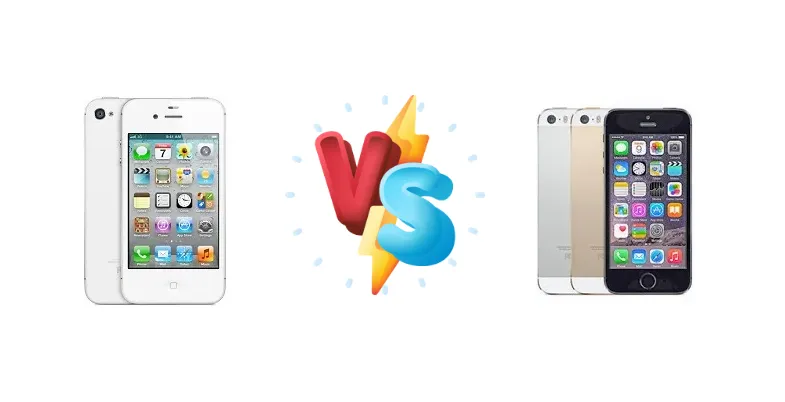
The iPhone 4s and 5s represent pivotal moments in Apple's history. Both offer a nostalgic glimpse into a simpler era of smartphones, but significant upgrades separate them. This comparison dives deep into their features to help you decide which vintage iPhone is right for you.
🏆 Quick Verdict
The iPhone 5s is the clear winner. While the 4s boasts impressive endurance for its age, the 5s's A7 chip, superior sunlight display, and slightly better battery life provide a noticeably more modern and responsive experience. It's a worthwhile upgrade if you're seeking a vintage iPhone.
| Network |
|---|
| 2G bands | GSM 850 / 900 / 1800 / 1900 | GSM 850 / 900 / 1800 / 1900 - all models |
| 3G bands | HSDPA 850 / 900 / 1900 / 2100 | HSDPA 850 / 900 / 1700 / 1900 / 2100 - A1533 (GSM), A1453 |
| 4G bands | - | 1, 2, 3, 4, 5, 8, 13, 17, 19, 20, 25 - A1533 GSM, A1533 CDMA |
| Speed | HSPA 14.4/5.76 Mbps | HSPA 42.2/5.76 Mbps, LTE Cat3 100/50 Mbps, EV-DO Rev.A 3.1 Mbps |
| Technology | GSM / CDMA / HSPA / EVDO | GSM / CDMA / HSPA / EVDO / LTE |
| | CDMA2000 1xEV-DO | 1, 2, 3, 5, 7, 8, 20, 38, 39, 40 - A1530 |
| Launch |
|---|
| Announced | 2011, October 04. Released 2011, October 14 | 2013, September 10. Released 2013, September 20 |
| Status | Discontinued | Discontinued |
| Body |
|---|
| Build | Glass front (Corning-made glass), glass back, stainless steel frame | Glass front (Corning-made glass), aluminum back, aluminum frame |
| Dimensions | 115.2 x 58.6 x 9.3 mm (4.54 x 2.31 x 0.37 in) | 123.8 x 58.6 x 7.6 mm (4.87 x 2.31 x 0.30 in) |
| SIM | Micro-SIM | Nano-SIM |
| Weight | 140 g (4.94 oz) | 112 g (3.95 oz) |
| | Scratch-resistant glass back panel | - |
| Display |
|---|
| Protection | Corning Gorilla Glass, oleophobic coating | Corning Gorilla Glass, oleophobic coating |
| Resolution | 640 x 960 pixels, 3:2 ratio (~330 ppi density) | 640 x 1136 pixels, 16:9 ratio (~326 ppi density) |
| Size | 3.5 inches, 36.5 cm2 (~54.0% screen-to-body ratio) | 4.0 inches, 44.1 cm2 (~60.8% screen-to-body ratio) |
| Type | IPS LCD | IPS LCD |
| Platform |
|---|
| CPU | Dual-core 1.0 GHz Cortex-A9 | Dual-core 1.3 GHz Cyclone (ARM v8-based) |
| Chipset | Apple A5 (45 nm) | Apple A7 (28 nm) |
| GPU | PowerVR SGX543MP2 | PowerVR G6430 (quad-core graphics) |
| OS | iOS 5, upgradable to iOS 9.3.6 | iOS 7, upgradable to iOS 12.5.7 |
| Memory |
|---|
| Card slot | No | No |
| Internal | 8GB 512MB RAM, 16GB 512MB RAM, 32GB 512MB RAM, 64GB 512MB RAM | 16GB 1GB RAM, 32GB 1GB RAM, 64GB 1GB RAM |
| Main Camera |
|---|
| Features | LED flash, panorama, HDR | Dual-LED dual-tone flash, HDR |
| Single | 8 MP, f/2.4, 35mm (standard), 1/3.2", 1.4µm, AF | 8 MP, f/2.2, 29mm (standard), 1/3.0", 1.5µm, AF |
| Video | 1080p@30fps | 1080p@30fps, 720p@120fps |
| Selfie camera |
|---|
| Features | - | face detection, HDR, FaceTime over Wi-Fi or Cellular |
| Single | VGA, videocalling over Wi-Fi and 3G | 1.2 MP, f/2.4, 31mm (standard) |
| Video | 480p@30fps | 720p@30fps |
| Sound |
|---|
| 3.5mm jack | Yes | Yes |
| 35mm jack | Yes | Yes |
| Loudspeaker | Yes | Yes |
| | - | 16-bit/44.1kHz audio
|
| Comms |
|---|
| Bluetooth | 4.0, A2DP, LE | 4.0, A2DP |
| NFC | - | No |
| Positioning | GPS, A-GPS, GLONASS | GPS, GLONASS |
| Radio | No | No |
| USB | 2.0 | Lightning, USB 2.0 |
| WLAN | Wi-Fi 802.11 b/g/n, hotspot | Wi-Fi 802.11 a/b/g/n, dual-band, hotspot |
| Features |
|---|
| Sensors | Accelerometer, gyro, proximity, compass | Fingerprint (front-mounted), accelerometer, gyro, proximity, compass |
| Battery |
|---|
| Stand-by | Up to 200 h (3G) | Up to 250 h (3G) |
| Talk time | Up to 8 h (3G) | Up to 10 h (3G) |
| Type | Li-Po 1432 mAh, non-removable (5.3 Wh) | Li-Po 1560 mAh, non-removable (5.92 Wh) |
| Misc |
|---|
| Colors | Black, White | Space Gray, White/Silver, Gold |
| Models | A1431, A1387, iPhone4,1 | A1453, A1457, A1518, A1528, A1530, A1533, iPhone6,1, iPhone6,2 |
| Price | About 190 EUR | About 330 EUR |
| SAR | 1.18 W/kg (head) 0.98 W/kg (body) | 1.12 W/kg (head) 1.18 W/kg (body) |
| SAR EU | 0.99 W/kg (head) 0.99 W/kg (body) | 1.00 W/kg (head) 0.80 W/kg (body) |
| Tests |
|---|
| Audio quality |
Noise -91.2dB / Crosstalk -93.0dB |
Noise -93.6dB / Crosstalk -90.3dB |
| Battery life |
Endurance rating 45h
|
Endurance rating 54h
|
| Camera |
Photo / Video |
Photo / Video |
| Display |
Contrast ratio: 1261:1 (nominal) / 2.269:1 (sunlight) |
Contrast ratio: 1219:1 (nominal) / 3.565:1 (sunlight) |
| Loudspeaker |
Voice 65dB / Noise 64dB / Ring 74dB
|
Voice 68dB / Noise 66dB / Ring 69dB
|
| Performance | - |
Basemark X: 14341 |
Apple iPhone 4s
- Excellent battery life for its age
- Simple and reliable operating system
- Compact and lightweight design
- Outdated processor
- Lower screen brightness
- Less capable camera
Apple iPhone 5s
- Faster processor (A7 chip)
- Brighter display, especially in sunlight
- Improved camera
- Slightly longer battery life
- Battery life still limited compared to modern phones
- Larger than the 4s
- Can be more expensive than the 4s
Display Comparison
The iPhone 5s features a noticeably improved display, particularly in direct sunlight. While both have similar nominal contrast ratios (1261:1 vs 1219:1), the 5s's sunlight contrast ratio is significantly better (3.565:1 vs 2.269:1), making it much easier to see outdoors. The 5s also has a taller screen, offering more vertical space.
Camera Comparison
While both offer 'Photo / Video' capabilities, the iPhone 5s's camera is generally considered superior. It features a larger sensor and improved image processing, resulting in better low-light performance and more detailed photos. The 5s also introduced burst mode and other camera enhancements.
Performance
The iPhone 5s's A7 chip is a generational leap over the 4s's A5. The A7's dual-core 1.3 GHz Cyclone processor (ARM v8-based) provides significantly faster performance, resulting in smoother multitasking, quicker app loading times, and a more responsive user interface. The 4s's A5 chip, while capable, feels dated by today's standards.
Battery Life
Both phones offer a respectable endurance rating (45h vs 54h). The iPhone 5s provides a slightly longer battery life, which is a welcome improvement, especially considering its more powerful processor.
Buying Guide
Who should buy the iPhone 4s? Those on a very tight budget or seeking a simple, reliable phone for basic tasks. Who should buy the iPhone 5s? Anyone wanting a more modern experience with better performance, a brighter display, and a slightly longer battery life, even within the vintage smartphone market.
Frequently Asked Questions
❓ Is the iPhone 4s still usable in 2024?
Yes, the iPhone 4s is still usable, but its performance is noticeably slower than modern smartphones. It's best suited for basic tasks like calls, texts, and light web browsing.
❓ What iOS version can the iPhone 5s run?
The iPhone 5s can run up to iOS 13. The iPhone 4s can run up to iOS 9.3.5.
❓ Which iPhone is better for photography?
The iPhone 5s is significantly better for photography due to its improved camera sensor and image processing capabilities.