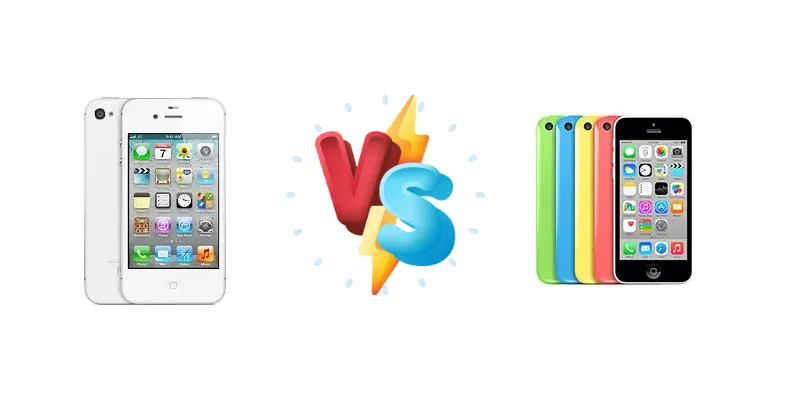
The iPhone 4s and 5c represent a pivotal era in Apple's history, offering a glimpse into the evolution of smartphone technology. Both devices hold a nostalgic appeal, but which one holds up better today? This comprehensive comparison dives deep into their features to help you decide.
🏆 Quick Verdict
The iPhone 5c edges out the 4s with a slightly faster processor, improved sunlight display visibility, and marginally better battery life. However, both offer a classic iOS experience and are viable options for budget-conscious users seeking a reliable, older iPhone.
| Network |
|---|
| 2G bands | GSM 850 / 900 / 1800 / 1900 | GSM 850 / 900 / 1800 / 1900 - all versions |
| 3G bands | HSDPA 850 / 900 / 1900 / 2100 | HSDPA 850 / 900 / 1700 / 1900 / 2100 - A1532 (GSM), A1532 (CDMA), A1456 |
| 4G bands | - | 1, 2, 3, 4, 5, 8, 13, 17, 19, 20, 25 - A1532 GSM, A1532 CDMA |
| Speed | HSPA 14.4/5.76 Mbps | HSPA 42.2/5.76 Mbps, LTE Cat3 100/50 Mbps, EV-DO Rev.A 3.1 Mbps |
| Technology | GSM / CDMA / HSPA / EVDO | GSM / CDMA / HSPA / LTE |
| | CDMA2000 1xEV-DO | 1, 2, 3, 5, 7, 8, 20, 38, 39, 40 - A1529 |
| Launch |
|---|
| Announced | 2011, October 04. Released 2011, October 14 | 2013, September 10. Released 2013, September 20 |
| Status | Discontinued | Discontinued |
| Body |
|---|
| Build | Glass front (Corning-made glass), glass back, stainless steel frame | Glass front, plastic back, plastic frame |
| Dimensions | 115.2 x 58.6 x 9.3 mm (4.54 x 2.31 x 0.37 in) | 124.4 x 59.2 x 9 mm (4.90 x 2.33 x 0.35 in) |
| SIM | Micro-SIM | Nano-SIM |
| Weight | 140 g (4.94 oz) | 132 g (4.66 oz) |
| | Scratch-resistant glass back panel | - |
| Display |
|---|
| Protection | Corning Gorilla Glass, oleophobic coating | - |
| Resolution | 640 x 960 pixels, 3:2 ratio (~330 ppi density) | 640 x 1136 pixels, 16:9 ratio (~326 ppi density) |
| Size | 3.5 inches, 36.5 cm2 (~54.0% screen-to-body ratio) | 4.0 inches, 44.1 cm2 (~59.9% screen-to-body ratio) |
| Type | IPS LCD | IPS LCD |
| Platform |
|---|
| CPU | Dual-core 1.0 GHz Cortex-A9 | Dual-core 1.3 GHz Swift (ARM v7-based) |
| Chipset | Apple A5 (45 nm) | Apple A6 (32 nm) |
| GPU | PowerVR SGX543MP2 | PowerVR SGX 543MP3 (triple-core graphics) |
| OS | iOS 5, upgradable to iOS 9.3.6 | iOS 7, upgradable to iOS 10.3.3 |
| Memory |
|---|
| Card slot | No | No |
| Internal | 8GB 512MB RAM, 16GB 512MB RAM, 32GB 512MB RAM, 64GB 512MB RAM | 8GB 1GB RAM, 16GB 1GB RAM, 32GB 1GB RAM |
| Main Camera |
|---|
| Features | LED flash, panorama, HDR | LED flash, panorama, HDR |
| Single | 8 MP, f/2.4, 35mm (standard), 1/3.2", 1.4µm, AF | 8 MP, f/2.4, 33mm (standard), 1/3.2", 1.4µm, AF |
| Video | 1080p@30fps | 1080p@30fps |
| Selfie camera |
|---|
| Features | - | face detection, FaceTime over Wi-Fi or Cellular |
| Single | VGA, videocalling over Wi-Fi and 3G | 1.2 MP |
| Video | 480p@30fps | 720p@30fps |
| Sound |
|---|
| 3.5mm jack | Yes | Yes |
| 35mm jack | Yes | Yes |
| Loudspeaker | Yes | Yes |
| | - | 16-bit/44.1kHz audio
|
| Comms |
|---|
| Bluetooth | 4.0, A2DP, LE | 4.0, A2DP, LE |
| NFC | - | No |
| Positioning | GPS, A-GPS, GLONASS | GPS, GLONASS |
| Radio | No | No |
| USB | 2.0 | Lightning, USB 2.0 |
| WLAN | Wi-Fi 802.11 b/g/n, hotspot | Wi-Fi 802.11 a/b/g/n, dual-band |
| Features |
|---|
| Sensors | Accelerometer, gyro, proximity, compass | Accelerometer, gyro, proximity, compass |
| Battery |
|---|
| Stand-by | Up to 200 h (3G) | Up to 250 h (3G) |
| Talk time | Up to 8 h (3G) | Up to 10 h (3G) |
| Type | Li-Po 1432 mAh, non-removable (5.3 Wh) | Li-Po 1510 mAh, non-removable (5.73 Wh) |
| Misc |
|---|
| Colors | Black, White | White, Blue, Green, Yellow, Pink |
| Models | A1431, A1387, iPhone4,1 | A1456, A1507, A1516, A1529, A1532, iPhone5,3, iPhone5,4 |
| Price | About 190 EUR | About 300 EUR |
| SAR | 1.18 W/kg (head) 0.98 W/kg (body) | 1.15 W/kg (head) 1.17 W/kg (body) |
| SAR EU | 0.99 W/kg (head) 0.99 W/kg (body) | 1.00 W/kg (head) 0.96 W/kg (body) |
| Tests |
|---|
| Audio quality |
Noise -91.2dB / Crosstalk -93.0dB |
Noise -93.9dB / Crosstalk -80.3dB |
| Battery life |
Endurance rating 45h
|
Endurance rating 52h
|
| Camera |
Photo / Video |
Photo / Video |
| Display |
Contrast ratio: 1261:1 (nominal) / 2.269:1 (sunlight) |
Contrast ratio: 1233:1 (nominal) / 3.512:1 (sunlight) |
| Loudspeaker |
Voice 65dB / Noise 64dB / Ring 74dB
|
Voice 66dB / Noise 65dB / Ring 66dB
|
| Performance | - |
Basemark X: 2225 |
Apple iPhone 4s
- Compact size
- Familiar iOS experience
- Generally more affordable
- Older processor
- Lower sunlight display visibility
- Shorter battery life
- Outdated camera
Apple iPhone 5c
- Slightly faster processor
- Better sunlight display
- Longer battery life
- More modern design
- Still an older device
- Limited app compatibility compared to newer iPhones
- Plastic build may feel less premium
Display Comparison
Both phones feature 4-inch Retina displays, but the iPhone 5c boasts a significantly better contrast ratio in direct sunlight (3.512:1 vs 2.269:1). While the nominal contrast ratio is similar (1261:1 vs 1233:1), the 5c's improved sunlight performance makes it more usable outdoors.
Camera Comparison
While both phones offer Photo/Video capabilities, the iPhone 5c generally produces slightly better image quality, particularly in low-light conditions. The A6 chip's image processing capabilities are a bit more advanced. Both cameras are dated by today's standards, but still capable of capturing decent photos.
Performance
The iPhone 5c's Apple A6 chip (1.3 GHz Dual-core Swift) provides a noticeable performance boost over the iPhone 4s's A5 chip (1.0 GHz Dual-core Cortex-A9). Apps launch faster, and multitasking feels smoother on the 5c. The A6's 32nm process also contributes to slightly better power efficiency.
Battery Life
The iPhone 5c offers a slightly longer endurance rating (52h vs 45h), translating to a bit more usage time between charges. This difference is primarily due to the more efficient A6 chip and a slightly larger battery capacity.
Buying Guide
The iPhone 4s is ideal for users prioritizing a familiar iOS experience and a more compact form factor, while not needing the latest features. The iPhone 5c is a better choice for those wanting slightly improved performance, a brighter display, and a more modern design, even if it's still vintage.
Frequently Asked Questions
❓ Are these iPhones still supported with iOS updates?
No, both the iPhone 4s and 5c have reached the end of their iOS update cycle. They will not receive any further software updates from Apple.
❓ What is the best use case for these older iPhones today?
They are best suited for basic tasks like calling, texting, browsing, and using older apps. They can also be useful as secondary devices or for users who prefer a smaller, more manageable phone.