
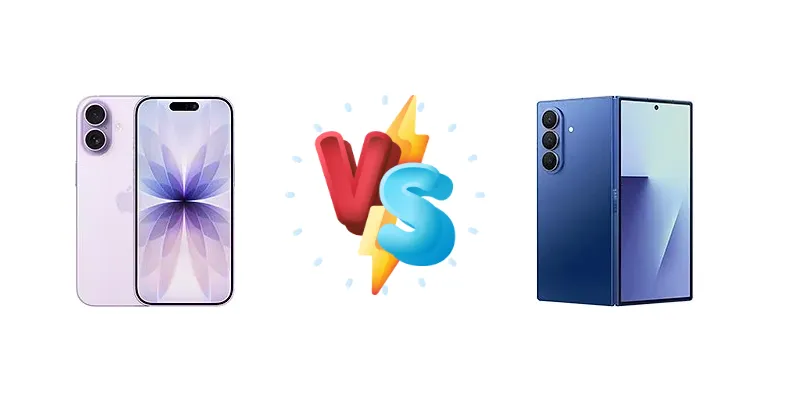
iPhone 17 vs. Galaxy Z Fold7: A Deep Dive into Apple's Flat Flagship and Samsung's Foldable Future
| Phones Images | |||||
|---|---|---|---|---|---|
|
🏆 Quick Verdict
For the average user prioritizing longevity and a streamlined experience, the Apple iPhone 17 emerges as the winner. Its superior battery cycle count (1000 vs 2000, though the Fold7 has slightly better endurance) and tightly integrated ecosystem offer a more predictable and reliable long-term experience. However, power users craving multitasking and a unique form factor will find the Z Fold7 compelling.
| PHONES | ||
|---|---|---|
| Phone Names | Apple iPhone 17 | Samsung Galaxy Z Fold7 |
| Network | ||
|---|---|---|
| 2G bands | GSM 850 / 900 / 1800 / 1900 | GSM 850 / 900 / 1800 / 1900 |
| 3G bands | HSDPA 850 / 900 / 1700(AWS) / 1900 / 2100 | HSDPA 850 / 900 / 1700(AWS) / 1900 / 2100 |
| 4G bands | 1, 2, 3, 4, 5, 7, 8, 12, 13, 17, 18, 19, 20, 25, 26, 28, 30, 32, 34, 38, 39, 40, 41, 42, 48, 53, 66 - A3520 | 1, 2, 3, 4, 5, 7, 8, 12, 13, 17, 18, 19, 20, 25, 26, 28, 38, 39, 40, 41, 66 - International |
| 5G bands | 1, 2, 3, 5, 7, 8, 12, 20, 25, 26, 28, 30, 38, 40, 41, 48, 53, 66, 70, 75, 77, 78, 79 SA/NSA/Sub6 - A3520 | 1, 2, 3, 5, 7, 8, 12, 20, 25, 26, 28, 38, 40, 41, 66, 71, 77, 78 SA/NSA/Sub6 - International |
| Speed | HSPA, LTE, 5G, EV-DO Rev.A 3.1 Mbps | HSPA, LTE, 5G |
| Technology | GSM / CDMA / HSPA / EVDO / LTE / 5G | GSM / CDMA / HSPA / EVDO / LTE / 5G |
| Launch | ||
|---|---|---|
| Announced | 2025, September 09 | 2025, July 09 |
| Status | Available. Released 2025, September 19 | Available. Released 2025, July 25 |
| Body | ||
|---|---|---|
| Build | Glass front (Ceramic Shield 2), aluminum frame, glass back | Glass front (Gorilla Glass Victus Ceramic 2) (folded), plastic front (unfolded), glass back (Gorilla Glass Victus 2), aluminum frame |
| Dimensions | 149.6 x 71.5 x 8 mm (5.89 x 2.81 x 0.31 in) | Unfolded: 158.4 x 143.2 x 4.2 mmFolded: 158.4 x 72.8 x 8.9 mm |
| SIM | · Nano-SIM + eSIM + eSIM (max 2 at a time; International)· eSIM + eSIM (8 or more, max 2 at a time; USA)· Nano-SIM + Nano-SIM (China) | · Nano-SIM + Nano-SIM + eSIM + eSIM (max 2 at a time)· Nano-SIM + Nano-SIM + multiple eSIM (max 2 at a time) |
| Weight | 177 g (6.24 oz) | 215 g (7.58 oz) |
| Display | ||
|---|---|---|
| Protection | Ceramic Shield 2, Mohs level 5 | Mohs level 1 |
| Resolution | 1206 x 2622 pixels, 19.5:9 ratio (~460 ppi density) | 1968 x 2184 pixels (~368 ppi density) |
| Size | 6.3 inches, 96.4 cm2 (~90.1% screen-to-body ratio) | 8.0 inches, 204.2 cm2 (~90.0% screen-to-body ratio) |
| Type | LTPO Super Retina XDR OLED, 120Hz, HDR10, Dolby Vision, 1000 nits (typ), 1600 nits (HBM), 3000 nits (peak) | Foldable Dynamic LTPO AMOLED 2X, 120Hz, HDR10+, 2600 nits (peak) |
| Platform | ||
|---|---|---|
| CPU | Hexa-core (2x4.26 GHz + 4xX.X GHz) | Octa-core (2x4.47 GHz Oryon V2 Phoenix L + 6x3.53 GHz Oryon V2 Phoenix M) |
| Chipset | Apple A19 (3 nm) | Qualcomm SM8750-AC Snapdragon 8 Elite (3 nm) |
| GPU | Apple GPU (5-core graphics) | Adreno 830 (1200 MHz) |
| OS | iOS 26, upgradable to iOS 26.1 | Android 16, up to 7 major Android upgrades, One UI 8 |
| Memory | ||
|---|---|---|
| Card slot | No | No |
| Internal | 256GB 8GB RAM, 512GB 8GB RAM | 256GB 12GB RAM, 512GB 12GB RAM, 1TB 12GB RAM, 1TB 16GB RAM |
| Main Camera | ||
|---|---|---|
| Dual | 48 MP, f/1.6, 26mm (wide), 1/1.56", 1.0µm, dual pixel PDAF, sensor-shift OIS 48 MP, f/2.2, 13mm, 120˚ (ultrawide), 1/2.55", 0.7µm, PDAF | - |
| Features | Dual-LED dual-tone flash, HDR (photo/panorama) | LED flash, HDR, panorama |
| Triple | - | 200 MP, f/1.7, 24mm (wide), 1/1.3", 0.6µm, multi-directional PDAF, OIS 10 MP, f/2.4, 67mm (telephoto), 1/3.94", 1.0µm, PDAF, OIS, 3x optical zoom 12 MP, f/2.2, 13mm, 120˚ (ultrawide), 1/2.55", 1.4µm, dual pixel PDAF |
| Video | 4K@24/25/30/60fps, 1080p@25/30/60/120/240fps, HDR, Dolby Vision HDR (up to 60fps), stereo sound rec. | 8K@30fps, 4K@60fps, 1080p@60/120/240fps (gyro-EIS), 10-bit HDR, HDR10+ |
| Selfie camera | ||
|---|---|---|
| Features | HDR, Dolby Vision HDR, 3D (spatial) audio, stereo sound rec. | HDR |
| Single | 18 MP multi-aspect, f/1.9, 20mm (ultrawide), PDAF SL 3D, (depth/biometrics sensor) | 10 MP, f/2.2, 18mm (ultrawide), 1/3.0", 1.12µm Cover camera: 10 MP, f/2.2, 24mm (wide), 1/3.0", 1.12µm |
| Video | 4K@24/25/30/60fps, 1080p@25/30/60/120fps, gyro-EIS | 4K@30/60fps, 1080p@30/60fps, gyro-EIS |
| Sound | ||
|---|---|---|
| 35mm jack | No | No |
| Loudspeaker | Yes, with stereo speakers | Yes, with stereo speakers |
| Comms | ||
|---|---|---|
| Bluetooth | 6.0, A2DP, LE | 5.4, A2DP, LE, aptX HD |
| NFC | Yes | Yes |
| Positioning | GPS (L1+L5), GLONASS, GALILEO, BDS, QZSS, NavIC | GPS, GALILEO, GLONASS, BDS, QZSS |
| Radio | No | No |
| USB | USB Type-C 2.0, DisplayPort | USB Type-C 3.2, OTG |
| WLAN | Wi-Fi 802.11 a/b/g/n/ac/6/7, tri-band, hotspot | Wi-Fi 802.11 a/b/g/n/ac/6e/7, tri-band, Wi-Fi Direct |
| Features | ||
|---|---|---|
| Sensors | Face ID, accelerometer, gyro, proximity, compass, barometer | Fingerprint (side-mounted), accelerometer, gyro, proximity, compass, barometer |
| Battery | ||
|---|---|---|
| Charging | Wired, PD3.2, AVS, 50% in 20 min 25W wireless MagSafe/Qi2, 50% in 30 min (15W - China) 4.5W reverse wired | 25W wired, QC2.0, 50% in 30 min 15W wireless 4.5W reverse wireless |
| Type | Li-Ion 3692 mAh | Li-Po 4400 mAh |
| Misc | ||
|---|---|---|
| Colors | Black, White, Mist Blue, Sage, Lavender | Blue Shadow, Silver Shadow, Jet Black, Mint |
| Models | iPhone18,3, A3520, A3258, A3519, A3521 | SM-F966B, SM-F966B/DS, SM-F966U, SM-F966U1 |
| Price | £ 799.00 / € 949.00 | € 1,367.99 / $ 1,399.99 / £ 1,449.00 / ₹ 174,999 |
| SAR | 1.19 W/kg (head) 1.19 W/kg (body) | 1.24 W/kg (head) 1.36 W/kg (body) |
| SAR EU | 1.49 W/kg (head) 1.49 W/kg (body) | 1.42 W/kg (head) 1.24 W/kg (body) |
| EU LABEL | ||
|---|---|---|
| Battery | 41:00h endurance, 1000 cycles | 40:28h endurance, 2000 cycles |
| Energy | Class A | Class B |
| Free fall | Class B (180 falls) | Class A (210 falls) |
| Repairability | Class C | Class C |
Apple iPhone 17
- Superior battery cycle life (1000 cycles)
- Faster wired and wireless charging
- Optimized software and ecosystem integration
- Lower peak display brightness
- Traditional smartphone form factor
- Limited multitasking capabilities compared to a foldable
Samsung Galaxy Z Fold7
- Innovative foldable display
- Larger screen real estate for multitasking
- Higher peak display brightness
- Lower battery cycle life (2000 cycles)
- Slower wired charging
- Potential durability concerns with foldable screen
Display Comparison
The Galaxy Z Fold7 boasts a foldable display, achieving a peak brightness of 1408 nits, exceeding the iPhone 17’s 1012 nits. This difference is immediately noticeable in direct sunlight. However, the iPhone 17’s display benefits from Apple’s color calibration and potentially a more durable construction, avoiding the crease inherent in foldable technology. While the Z Fold7 offers a larger screen real estate when unfolded, the iPhone 17’s smaller form factor provides better one-handed usability. The Z Fold7’s panel likely utilizes LTPO technology for variable refresh rates, optimizing battery consumption, a feature Apple has been slow to adopt across its entire lineup.
Camera Comparison
Without detailed camera specifications, a direct comparison is limited. However, both manufacturers prioritize image quality. The iPhone 17’s image processing is known for its natural color reproduction, while Samsung often leans towards more vibrant, saturated images. The Z Fold7’s larger form factor *could* accommodate a larger main sensor, potentially improving low-light performance, but this is speculative. The absence of details regarding sensor sizes and apertures makes a definitive assessment impossible. We can assume both phones will offer advanced computational photography features, but the implementation will differ.
Performance
Both devices leverage a 3nm process, but employ different architectures. The iPhone 17’s Apple A19 features a hexa-core CPU (2x4.26 GHz + 4xX.X GHz), while the Galaxy Z Fold7 utilizes the Qualcomm SM8750-AC Snapdragon 8 Elite with an octa-core CPU (2x4.47 GHz Oryon V2 Phoenix L + 6x3.53 GHz Oryon V2 Phoenix M). The Snapdragon 8 Elite, with its Oryon cores, appears to have a clock speed advantage, potentially translating to faster performance in CPU-intensive tasks. However, Apple’s chip design often prioritizes efficiency, and the A19’s real-world performance will depend on software optimization. Both devices likely feature LPDDR5x RAM, but the amount is not specified, impacting multitasking capabilities.
Battery Life
The Galaxy Z Fold7 offers a slightly higher endurance rating of 40:28h compared to the iPhone 17’s 41:00h, despite a slightly lower active use score (11:44h vs 14:59h). This suggests the Z Fold7 is more efficient under lighter loads. The iPhone 17 supports faster wired charging with PD3.2 and AVS, reaching 50% in 20 minutes, while the Z Fold7 takes 30 minutes with QC2.0. Wireless charging is also faster on the iPhone 17 (50% in 30 min with MagSafe/Qi2 vs 15W on the Z Fold7). Crucially, the iPhone 17 boasts 1000 battery cycles, significantly less than the Z Fold7’s 2000, indicating a longer lifespan for the foldable despite the lower endurance score.
Buying Guide
Buy the Apple iPhone 17 if you need a consistently reliable device with a mature ecosystem, prioritize long-term software support, and value a streamlined user experience. Buy the Samsung Galaxy Z Fold7 if you prefer a large, immersive display for multitasking, enjoy the novelty of a foldable form factor, and are willing to accept potential trade-offs in battery cycle life for cutting-edge hardware.