
iPhone 17 vs Oppo Find X9 Pro: A Deep Dive into Apple's Ecosystem vs Oppo's Innovation
| Phones Images | |||||
|---|---|---|---|---|---|
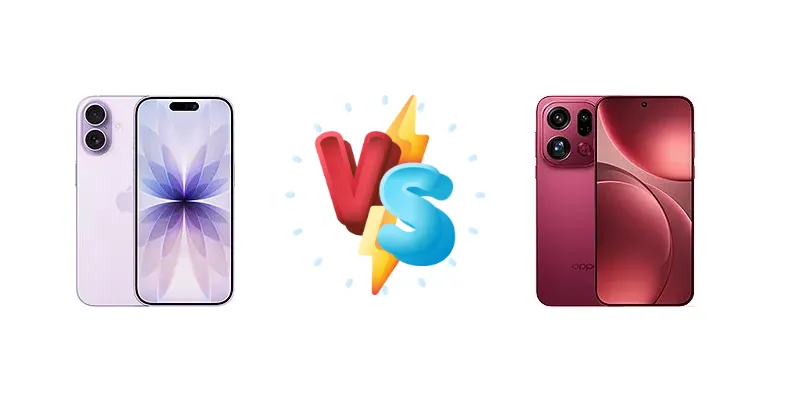
|
🏆 Quick Verdict
For users deeply embedded in the Apple ecosystem prioritizing long-term software support and efficient performance, the iPhone 17 is the better choice. However, the Oppo Find X9 Pro delivers superior battery endurance and significantly faster charging, making it ideal for power users and those less invested in Apple’s walled garden.
| PHONES | ||
|---|---|---|
| Phone Names | Apple iPhone 17 | Oppo Find X9 Pro |
| Network | ||
|---|---|---|
| 2G bands | GSM 850 / 900 / 1800 / 1900 | GSM 850 / 900 / 1800 / 1900 |
| 3G bands | HSDPA 850 / 900 / 1700(AWS) / 1900 / 2100 | HSDPA 800 / 850 / 900 / 1700(AWS) / 1900 / 2100 - International, China |
| 4G bands | 1, 2, 3, 4, 5, 7, 8, 12, 13, 17, 18, 19, 20, 25, 26, 28, 30, 32, 34, 38, 39, 40, 41, 42, 48, 53, 66 - A3520 | 1, 2, 3, 4, 5, 7, 8, 12, 13, 17, 18, 19, 20, 25, 26, 28, 32, 38, 39, 40, 41, 42, 48, 66, 71 - International |
| 5G bands | 1, 2, 3, 5, 7, 8, 12, 20, 25, 26, 28, 30, 38, 40, 41, 48, 53, 66, 70, 75, 77, 78, 79 SA/NSA/Sub6 - A3520 | 1, 2, 3, 5, 7, 8, 12, 20, 25, 26, 28, 38, 40, 41, 48, 66, 71, 75, 76, 77, 78, 79 SA/NSA - International |
| Speed | HSPA, LTE, 5G, EV-DO Rev.A 3.1 Mbps | HSPA, LTE, 5G |
| Technology | GSM / CDMA / HSPA / EVDO / LTE / 5G | GSM / HSPA / LTE / 5G |
| Launch | ||
|---|---|---|
| Announced | 2025, September 09 | 2025, October 16 |
| Status | Available. Released 2025, September 19 | Available. Released 2025, October 22 |
| Body | ||
|---|---|---|
| Build | Glass front (Ceramic Shield 2), aluminum frame, glass back | Glass front (Gorilla Glass Victus 2), glass back, aluminum frame |
| Dimensions | 149.6 x 71.5 x 8 mm (5.89 x 2.81 x 0.31 in) | 161.3 x 76.5 x 8.3 mm (6.35 x 3.01 x 0.33 in) |
| SIM | · Nano-SIM + eSIM + eSIM (max 2 at a time; International)· eSIM + eSIM (8 or more, max 2 at a time; USA)· Nano-SIM + Nano-SIM (China) | · Nano-SIM + eSIM· Nano-SIM + Nano-SIM |
| Weight | 177 g (6.24 oz) | 224 g (7.90 oz) |
| Display | ||
|---|---|---|
| Protection | Ceramic Shield 2, Mohs level 5 | Corning Gorilla Glass Victus 2 |
| Resolution | 1206 x 2622 pixels, 19.5:9 ratio (~460 ppi density) | 1272 x 2772 pixels, 19.5:9 ratio (~450 ppi density) |
| Size | 6.3 inches, 96.4 cm2 (~90.1% screen-to-body ratio) | 6.78 inches, 112.4 cm2 (~91.1% screen-to-body ratio) |
| Type | LTPO Super Retina XDR OLED, 120Hz, HDR10, Dolby Vision, 1000 nits (typ), 1600 nits (HBM), 3000 nits (peak) | LTPO AMOLED, 1B colors, 120Hz, 2160Hz PWM, Dolby Vision, HDR10+, HDR Vivid, 800 nits (typ), 1800 nits (HBM), 3600 nits (peak) |
| Platform | ||
|---|---|---|
| CPU | Hexa-core (2x4.26 GHz + 4xX.X GHz) | Octa-core (1x4.21 GHz C1-Ultra & 3x3.5 GHz C1-Premium & 4x2.7 GHz C1-Pro) |
| Chipset | Apple A19 (3 nm) | Mediatek Dimensity 9500 (3 nm) |
| GPU | Apple GPU (5-core graphics) | Arm G1-Ultra |
| OS | iOS 26, upgradable to iOS 26.1 | Android 16, up to 5 major Android upgrades, ColorOS 16 |
| Memory | ||
|---|---|---|
| Card slot | No | No |
| Internal | 256GB 8GB RAM, 512GB 8GB RAM | 256GB 12GB RAM, 512GB 12GB RAM, 512GB 16GB RAM, 1TB 16GB RAM |
| Main Camera | ||
|---|---|---|
| Dual | 48 MP, f/1.6, 26mm (wide), 1/1.56", 1.0µm, dual pixel PDAF, sensor-shift OIS 48 MP, f/2.2, 13mm, 120˚ (ultrawide), 1/2.55", 0.7µm, PDAF | - |
| Features | Dual-LED dual-tone flash, HDR (photo/panorama) | Laser AF, color spectrum sensor, Hasselblad Color Calibration, LED flash, HDR, panorama, LUT preview |
| Triple | - | 50 MP, f/1.5, 23mm (wide), 1/1.28", 1.22µm, multi-directional PDAF, OIS 200 MP, f/2.1, 70mm (periscope telephoto), 1/1.56", 0.5µm, 3x optical zoom, multi-directional PDAF, OIS 50 MP, f/2.0, 15mm, 120˚ (ultrawide), 1/2.76", 0.64µm, multi-directional PDAF |
| Video | 4K@24/25/30/60fps, 1080p@25/30/60/120/240fps, HDR, Dolby Vision HDR (up to 60fps), stereo sound rec. | 4K@30/60/120fps, 1080p@30/60/240fps; gyro-EIS; HDR, 10‑bit video, Dolby Vision, LOG |
| Selfie camera | ||
|---|---|---|
| Features | HDR, Dolby Vision HDR, 3D (spatial) audio, stereo sound rec. | Panorama |
| Single | 18 MP multi-aspect, f/1.9, 20mm (ultrawide), PDAF SL 3D, (depth/biometrics sensor) | 50 MP, f/2.0, 21mm (wide), 1/2.76", 0.64µm, PDAF |
| Video | 4K@24/25/30/60fps, 1080p@25/30/60/120fps, gyro-EIS | 4K@30/60fps, 1080p@30/60fps, gyro-EIS |
| Sound | ||
|---|---|---|
| 35mm jack | No | No |
| Loudspeaker | Yes, with stereo speakers | Yes, with stereo speakers |
| Comms | ||
|---|---|---|
| Bluetooth | 6.0, A2DP, LE | 6.0, A2DP, LE, aptX HD, LHDC 5 |
| Infrared port | - | Yes |
| NFC | Yes | Yes |
| Positioning | GPS (L1+L5), GLONASS, GALILEO, BDS, QZSS, NavIC | GPS (L1+L5), BDS (B1I+B1c+B2a+B2b), GALILEO (E1+E5a+E5b), QZSS (L1+L5), GLONASS, NavIC (L5) |
| Radio | No | No |
| USB | USB Type-C 2.0, DisplayPort | USB Type-C 3.2, OTG |
| WLAN | Wi-Fi 802.11 a/b/g/n/ac/6/7, tri-band, hotspot | Wi-Fi 802.11 a/b/g/n/ac/6/7, dual-band or tri-band, Wi-Fi Direct |
| Features | ||
|---|---|---|
| Sensors | Face ID, accelerometer, gyro, proximity, compass, barometer | Fingerprint (under display, ultrasonic), accelerometer, gyro, proximity, compass, barometer |
| Battery | ||
|---|---|---|
| Charging | Wired, PD3.2, AVS, 50% in 20 min 25W wireless MagSafe/Qi2, 50% in 30 min (15W - China) 4.5W reverse wired | 80W wired, 80W UFCS, 55W PPS, 11.7W PD 50W wireless 10W reverse wireless |
| Type | Li-Ion 3692 mAh | Si/C Li-Ion 7500 mAh |
| Misc | ||
|---|---|---|
| Colors | Black, White, Mist Blue, Sage, Lavender | Silk White, Titanium Charcoal, Velvet Red |
| Models | iPhone18,3, A3520, A3258, A3519, A3521 | CPH2791, PLG110 |
| Price | £ 799.00 / € 949.00 | $ 1,184.51 / £ 1,149.00 / ₹ 109,999 |
| SAR | 1.19 W/kg (head) 1.19 W/kg (body) | - |
| SAR EU | 1.49 W/kg (head) 1.49 W/kg (body) | - |
| EU LABEL | ||
|---|---|---|
| Battery | 41:00h endurance, 1000 cycles | - |
| Energy | Class A | - |
| Free fall | Class B (180 falls) | - |
| Repairability | Class C | - |
Apple iPhone 17
- Seamless Apple ecosystem integration
- Long-term software support and updates
- Optimized iOS performance and efficiency
- Slower charging speeds compared to Oppo
- Lower battery endurance in active use
- Less flexible Android ecosystem
Oppo Find X9 Pro
- Significantly faster charging speeds (80W wired, 50W wireless)
- Superior battery endurance (21:57h active use)
- More open and customizable Android ecosystem
- Software updates may be less consistent than Apple
- Potential for software bloatware
- Ecosystem lock-in is less strong
Display Comparison
The Oppo Find X9 Pro boasts a brighter display at 1175 nits compared to the iPhone 17’s 1012 nits, offering improved visibility in direct sunlight. While both utilize 3nm chipsets, the display brightness difference is immediately noticeable. Neither specification details panel technology (LTPO or not), but given the flagship status, both are likely to employ adaptive refresh rate technology for power efficiency. The iPhone 17’s color accuracy is likely to be more consistent, adhering to Apple’s stringent calibration standards, while the Oppo may offer more vibrant, though potentially less accurate, colors.
Camera Comparison
Without detailed camera specifications, a direct comparison is difficult. However, the Oppo Find X9 Pro’s focus on innovation suggests a potential emphasis on advanced camera features. Apple typically prioritizes computational photography and video recording quality, delivering consistently excellent results. The absence of sensor size data makes it impossible to determine which phone has the advantage in low-light performance. We can assume both will feature optical image stabilization (OIS) on their main sensors. Ignoring the likely inclusion of low-resolution auxiliary lenses on both devices, the core camera experience will hinge on image processing algorithms and sensor quality.
Performance
Both devices are powered by 3nm chipsets – Apple’s A19 and Mediatek’s Dimensity 9500. The A19 features a hexa-core configuration (2x4.26 GHz + 4xX.X GHz), while the Dimensity 9500 employs an octa-core setup (1x4.21 GHz C1-Ultra & 3x3.5 GHz C1-Premium & 4x2.7 GHz C1-Pro). The Dimensity 9500’s multi-core advantage *could* translate to better multitasking and sustained performance, but Apple’s chip design typically excels in single-core tasks and power efficiency. The iPhone 17’s performance will be optimized for iOS, while the Find X9 Pro’s performance will depend heavily on Oppo’s software optimization. RAM specifications are missing, but both will likely utilize LPDDR5x for fast memory access.
Battery Life
The Oppo Find X9 Pro clearly wins in battery endurance with an active use score of 21:57h, significantly exceeding the iPhone 17’s 14:59h. While the iPhone 17 boasts 1000 battery cycles, indicating longevity, the Find X9 Pro’s larger battery capacity and efficient chipset provide a more immediate benefit. The charging speeds are dramatically different: the Oppo supports 80W wired charging (UFCS, PPS, PD) and 50W wireless, while the iPhone 17 offers 50% charge in 20 minutes wired (PD3.2, AVS) and 50% in 30 minutes wireless (MagSafe/Qi2, 15W in China). The Oppo’s charging speed is a game-changer, allowing for a full charge in under 40 minutes, while the iPhone 17 takes considerably longer. The Oppo also offers 10W reverse wireless charging, compared to the iPhone’s 4.5W.
Buying Guide
Buy the Apple iPhone 17 if you need seamless integration with other Apple devices, prioritize privacy features, and value a polished, consistent software experience. Buy the Oppo Find X9 Pro if you prioritize maximum battery life, blazing-fast charging speeds, and a more open Android ecosystem, and are willing to trade some software polish for raw performance and innovation.