
iPhone 17 Pro vs Xiaomi 15 Pro: The Ultimate Flagship Showdown
| Phones Images | |||||
|---|---|---|---|---|---|
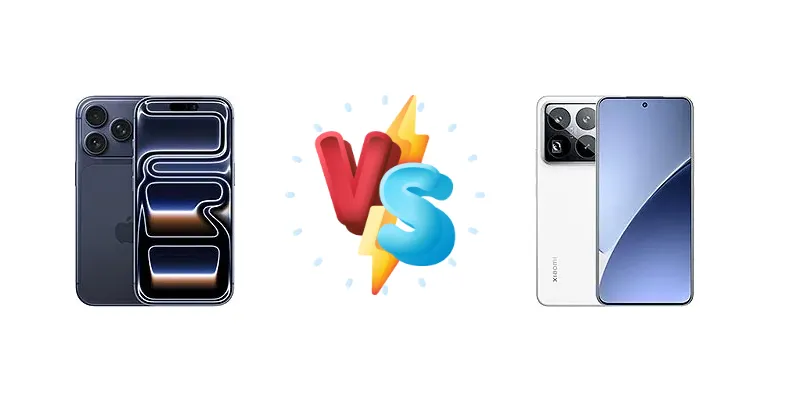
|
🏆 Quick Verdict
For the average user prioritizing longevity and a seamless ecosystem, the iPhone 17 Pro emerges as the winner. Its exceptional 47-hour battery endurance and 1000 cycle lifespan outweigh the Xiaomi 15 Pro’s faster charging, while the A19 Pro offers consistently strong performance. However, power users demanding the absolute fastest charging speeds will favor the Xiaomi 15 Pro.
| PHONES | ||
|---|---|---|
| Phone Names | Apple iPhone 17 Pro | Xiaomi 15 Pro |
| Network | ||
|---|---|---|
| 2G bands | GSM 850 / 900 / 1800 / 1900 | GSM 850 / 900 / 1800 / 1900 |
| 3G bands | HSDPA 850 / 900 / 1700(AWS) / 1900 / 2100 | HSDPA 800 / 850 / 900 / 1700(AWS) / 1900 / 2100 |
| 4G bands | 1, 2, 3, 4, 5, 7, 8, 12, 13, 17, 18, 19, 20, 25, 26, 28, 30, 32, 34, 38, 39, 40, 41, 42, 48, 53, 66 - A3523 | 1, 2, 3, 4, 5, 7, 8, 12, 17, 18, 19, 20, 26, 28, 34, 38, 39, 40, 41, 42, 48, 66 - China |
| 5G bands | 1, 2, 3, 5, 7, 8, 12, 20, 25, 26, 28, 30, 38, 40, 41, 48, 53, 66, 70, 75, 77, 78, 79 SA/NSA/Sub6 - A3523 | 1, 2, 3, 5, 7, 8, 12, 20, 26, 28, 38, 40, 41, 48, 66, 77, 78, 79, 80, 81, 83, 84, 89 SA/NSA - China |
| Speed | HSPA, LTE, 5G, EV-DO Rev.A 3.1 Mbps | HSPA, LTE, 5G |
| Technology | GSM / CDMA / HSPA / EVDO / LTE / 5G | GSM / HSPA / LTE / 5G |
| Launch | ||
|---|---|---|
| Announced | 2025, September 09 | 2024, October 29 |
| Status | Available. Released 2025, September 19 | Available. Released 2024, October 29 |
| Body | ||
|---|---|---|
| Build | Glass front (Ceramic Shield 2), aluminum alloy frame, aluminum alloy back/ glass back (Ceramic Shield) | - |
| Dimensions | 150 x 71.9 x 8.8 mm (5.91 x 2.83 x 0.35 in) | 161.3 x 75.3 x 8.4 mm or 8.7 mm |
| SIM | · Nano-SIM + eSIM + eSIM (max 2 at a time; International)· eSIM + eSIM (8 or more, max 2 at a time; USA)· Nano-SIM + Nano-SIM (China) | Nano-SIM + Nano-SIM |
| Weight | 206 g (7.27 oz) | 213 g or 219 g (7.51 oz) |
| Display | ||
|---|---|---|
| Protection | Ceramic Shield 2, Mohs level 5 | Shatterproof glass (2024 gen) |
| Resolution | 1206 x 2622 pixels, 19.5:9 ratio (~460 ppi density) | 1440 x 3200 pixels, 20:9 ratio (~522 ppi density) |
| Size | 6.3 inches, 96.4 cm2 (~89.4% screen-to-body ratio) | 6.73 inches, 108.9 cm2 (~89.7% screen-to-body ratio) |
| Type | LTPO Super Retina XDR OLED, 120Hz, HDR10, Dolby Vision, 1000 nits (typ), 1600 nits (HBM), 3000 nits (peak) | LTPO AMOLED, 68B colors, 120Hz, 1920Hz PWM, Dolby Vision, HDR10+, 3200 nits (peak) |
| Platform | ||
|---|---|---|
| CPU | Hexa-core (2x4.26 GHz + 4xX.X GHz) | Octa-core (2x4.32 GHz Oryon V2 Phoenix L + 6x3.53 GHz Oryon V2 Phoenix M) |
| Chipset | Apple A19 Pro (3 nm) | Qualcomm SM8750-AB Snapdragon 8 Elite (3 nm) |
| GPU | Apple GPU (6-core graphics) | Adreno 830 |
| OS | iOS 26, upgradable to iOS 26.1 | Android 15, HyperOS 2 |
| Memory | ||
|---|---|---|
| Card slot | No | No |
| Internal | 256GB 12GB RAM, 512GB 12GB RAM, 1TB 12GB RAM | 256GB 12GB RAM, 512GB 16GB RAM, 1TB 16GB RAM |
| Main Camera | ||
|---|---|---|
| Features | Dual-LED dual-tone flash, HDR (photo/panorama) | Laser AF, color spectrum sensor, Leica lens, Dual-LED dual-tone flash, HDR, panorama |
| Triple | 48 MP, f/1.8, 24mm (wide), 1/1.28", 1.22µm, dual pixel PDAF, sensor-shift OIS 48 MP, f/2.8, 100mm (periscope telephoto), 1/2.55", 0.7µm, PDAF, 3D sensor‑shift OIS, 4x optical zoom 48 MP, f/2.2, 13mm, 120˚ (ultrawide), 1/2.55", 0.7µm, PDAF TOF 3D LiDAR scanner (depth) | 50 MP, f/1.4, 23mm (wide), 1/1.31", 1.2µm, dual pixel PDAF, OIS 50 MP, f/2.5, 120mm (periscope telephoto), PDAF (30cm - ∞), OIS, 5x optical zoom 50 MP, f/2.2, 14mm, 115˚ (ultrawide), AF |
| Video | 4K@24/25/30/60/100/120fps, 1080p@25/30/60/120/240fps, 10-bit HDR, Dolby Vision HDR (up to 120fps), ProRes, ProRes RAW (up to 120fps), Apple Log 2, 3D (spatial) video/audio, stereo | 8K@24/30fps (HDR), 4K@24/30/60fps (HDR10+, 10-bit Dolby Vision HDR, 10-bit LOG), 1080p@30/60/120/240/960fps, 720p@1920fps, gyro-EIS |
| Selfie camera | ||
|---|---|---|
| Features | HDR, Dolby Vision HDR, 3D (spatial) audio, stereo sound rec., ProRes RAW, Apple Log 2 | HDR, panorama |
| Single | 18 MP multi-aspect, f/1.9, 20mm (ultrawide), PDAF SL 3D, (depth/biometrics sensor) | 32 MP, f/2.0, 22mm (wide), 0.7µm |
| Video | 4K@24/25/30/60fps, 1080p@25/30/60/120fps, gyro-EIS | 4K@30/60fps, 1080p@30/60fps, gyro-EIS |
| Sound | ||
|---|---|---|
| 35mm jack | No | No |
| Loudspeaker | Yes, with stereo speakers | Yes, with stereo speakers |
| Comms | ||
|---|---|---|
| Bluetooth | 6.0, A2DP, LE | 5.4, A2DP, LE, aptX HD, aptX Adaptive, LHDC 5 |
| Infrared port | - | Yes |
| NFC | Yes | Yes |
| Positioning | GPS (L1+L5), GLONASS, GALILEO, BDS, QZSS, NavIC | GPS (L1+L5), GLONASS (G1), BDS (B1I+B1c+B2a), GALILEO (E1+E5a), QZSS (L1+L5) |
| Radio | No | No |
| USB | USB Type-C 3.2 Gen 2, DisplayPort | USB Type-C 3.2 Gen2, Display Port, OTG |
| WLAN | Wi-Fi 802.11 a/b/g/n/ac/6e/7, tri-band, hotspot | Wi-Fi 802.11 a/b/g/n/ac/6e/7, dual-band or tri-band, Wi-Fi Direct |
| Features | ||
|---|---|---|
| Sensors | Face ID, accelerometer, gyro, proximity, compass, barometer | Fingerprint (under display, ultrasonic), accelerometer, proximity, gyro, compass, barometer |
| Battery | ||
|---|---|---|
| Charging | Wired, PD3.2, AVS, 50% in 20 min 25W wireless MagSafe/Qi2, 50% in 30 min (15W - China) 4.5W reverse wired | 90W wired, PD3.0, QC3+ 50W wireless 10W reverse wireless |
| Type | Market-dependent versions:· Li-Ion 3998 mAh - Nano SIM model· Li-Ion 4252 mAh - eSIM only model | Si/C Li-Ion 6100 mAh |
| Misc | ||
|---|---|---|
| Colors | Silver, Cosmic Orange, Deep Blue | Black, White, Silver, Green |
| Models | iPhone18,1, A3256, A3523, A3522, A3524 | 24101PNB7C, 2410DPN6CC |
| Price | € 1,242.00 / $ 1,400.00 / £ 1,069.00 / ₹ 134,900 | About 690 EUR |
| SAR | 1.19 W/kg (head) 1.19 W/kg (body) | - |
| SAR EU | 1.49 W/kg (head) 1.49 W/kg (body) | - |
| EU LABEL | ||
|---|---|---|
| Battery | 47:00h endurance, 1000 cycles | - |
| Energy | Class A | - |
| Free fall | Class B (180 falls) | - |
| Repairability | Class C | - |
Apple iPhone 17 Pro
- Exceptional 47-hour battery endurance
- Long-term battery health with 1000 cycles
- Optimized software and ecosystem integration
- Slower charging speeds compared to Xiaomi
- Less customization options than Android
Xiaomi 15 Pro
- Blazing-fast 90W wired charging
- Flexible Android operating system
- Potentially more aggressive pricing
- Shorter battery endurance compared to iPhone
- Software updates may be less consistent
Display Comparison
The iPhone 17 Pro boasts a measured peak brightness of 1012 nits, ensuring excellent visibility even in direct sunlight. While Xiaomi doesn’t provide a nits measurement, it’s likely comparable. Both devices utilize 3nm chipsets, which contribute to efficient power consumption and potentially improved display performance. The iPhone’s likely use of LTPO technology allows for variable refresh rates, optimizing battery life. The Xiaomi 15 Pro’s display quality will likely be excellent, but Apple’s color calibration and overall display processing are historically superior, offering a more accurate and pleasing visual experience.
Camera Comparison
Without specific camera specs, we can infer that both phones will feature advanced camera systems. The Xiaomi 15 Pro will likely emphasize high megapixel counts and computational photography, while the iPhone 17 Pro will focus on natural image processing and video quality. The Snapdragon 8 Elite’s ISP (Image Signal Processor) is capable of handling complex image processing tasks, potentially rivaling Apple’s. Optical Image Stabilization (OIS) will be crucial on both devices to ensure sharp images and stable videos. The iPhone’s Cinematic Mode and ProRes video recording capabilities remain a significant advantage for video creators.
Performance
The core of the battle lies in the chipsets: Apple’s A19 Pro (3nm, Hexa-core) versus Qualcomm’s Snapdragon 8 Elite (3nm, Octa-core). The Snapdragon 8 Elite utilizes Oryon V2 Phoenix cores, a design focused on both performance and efficiency. While the Snapdragon has more cores (Octa vs Hexa), Apple’s A-series chips consistently demonstrate superior single-core performance, crucial for responsive app launches and smooth UI navigation. The A19 Pro’s architecture is optimized for Apple’s Metal graphics API, potentially giving it an edge in gaming. Thermal management will be key; the Snapdragon’s octa-core design could generate more heat under sustained load, potentially leading to throttling, though the 3nm process should mitigate this.
Battery Life
The iPhone 17 Pro’s 47-hour endurance and 15:23h active use score are remarkable, indicating exceptional battery optimization. This is further bolstered by the 1000 cycle lifespan, promising long-term battery health. The Xiaomi 15 Pro counters with incredibly fast charging: 90W wired, filling 50% of the battery in under an hour, and 50W wireless. While the Xiaomi’s charging speed is significantly faster, the iPhone’s superior endurance means fewer charging cycles are needed, potentially offsetting the convenience of rapid charging over the phone’s lifespan. The iPhone also offers 4.5W reverse wired charging, while the Xiaomi provides 10W reverse wireless, offering more flexibility.
Buying Guide
Buy the Apple iPhone 17 Pro if you need a phone that will reliably last for years, value a polished software experience with guaranteed updates, and are deeply invested in the Apple ecosystem. Buy the Xiaomi 15 Pro if you prioritize the fastest possible charging speeds, enjoy the flexibility of Android, and want a phone that pushes the boundaries of hardware innovation without the premium Apple price tag.