
iPhone 17 Pro vs. vivo X200 Pro mini: A Deep Dive into Apple's Refinement and vivo's Innovation
| Phones Images | |||||
|---|---|---|---|---|---|
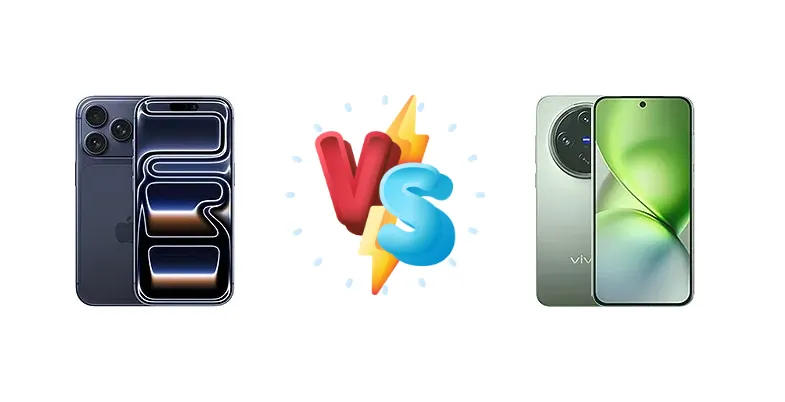
|
🏆 Quick Verdict
For the average user prioritizing longevity and a seamless ecosystem, the iPhone 17 Pro emerges as the winner. Its exceptional 47-hour battery endurance and 1000 charge cycles provide peace of mind. However, power users demanding the fastest charging and potentially higher peak performance will find the vivo X200 Pro mini a compelling alternative.
| PHONES | ||
|---|---|---|
| Phone Names | Apple iPhone 17 Pro | vivo X200 Pro mini |
| Network | ||
|---|---|---|
| 2G bands | GSM 850 / 900 / 1800 / 1900 | GSM 850 / 900 / 1800 / 1900 |
| 3G bands | HSDPA 850 / 900 / 1700(AWS) / 1900 / 2100 | HSDPA 800 / 850 / 900 / 1700(AWS) / 1900 / 2100 |
| 4G bands | 1, 2, 3, 4, 5, 7, 8, 12, 13, 17, 18, 19, 20, 25, 26, 28, 30, 32, 34, 38, 39, 40, 41, 42, 48, 53, 66 - A3523 | 1, 2, 3, 4, 5, 7, 8, 18, 19, 26, 28, 34, 38, 39, 40, 41, 66 |
| 5G bands | 1, 2, 3, 5, 7, 8, 12, 20, 25, 26, 28, 30, 38, 40, 41, 48, 53, 66, 70, 75, 77, 78, 79 SA/NSA/Sub6 - A3523 | 1, 3, 5, 8, 28, 38, 40, 41, 77, 78 SA/NSA |
| Speed | HSPA, LTE, 5G, EV-DO Rev.A 3.1 Mbps | HSPA, LTE, 5G |
| Technology | GSM / CDMA / HSPA / EVDO / LTE / 5G | GSM / HSPA / LTE / 5G |
| Launch | ||
|---|---|---|
| Announced | 2025, September 09 | 2024, October 14 |
| Status | Available. Released 2025, September 19 | Available. Released 2024, October 25 |
| Body | ||
|---|---|---|
| Build | Glass front (Ceramic Shield 2), aluminum alloy frame, aluminum alloy back/ glass back (Ceramic Shield) | Glass front, aluminum alloy frame |
| Dimensions | 150 x 71.9 x 8.8 mm (5.91 x 2.83 x 0.35 in) | 150.8 x 71.8 x 8.2 mm (5.94 x 2.83 x 0.32 in) |
| SIM | · Nano-SIM + eSIM + eSIM (max 2 at a time; International)· eSIM + eSIM (8 or more, max 2 at a time; USA)· Nano-SIM + Nano-SIM (China) | Nano-SIM + Nano-SIM |
| Weight | 206 g (7.27 oz) | 187 g (6.60 oz) |
| Display | ||
|---|---|---|
| Protection | Ceramic Shield 2, Mohs level 5 | - |
| Resolution | 1206 x 2622 pixels, 19.5:9 ratio (~460 ppi density) | 1216 x 2640 pixels, 19.5:9 ratio (~460 ppi density) |
| Size | 6.3 inches, 96.4 cm2 (~89.4% screen-to-body ratio) | 6.31 inches, 98.0 cm2 (~90.5% screen-to-body ratio) |
| Type | LTPO Super Retina XDR OLED, 120Hz, HDR10, Dolby Vision, 1000 nits (typ), 1600 nits (HBM), 3000 nits (peak) | LTPO AMOLED, 1B colors, 120Hz, 2160Hz PWM, HDR10+, 4500 nits (peak) |
| Platform | ||
|---|---|---|
| CPU | Hexa-core (2x4.26 GHz + 4xX.X GHz) | Octa-core (1x3.63 GHz Cortex-X925 & 3x3.3 GHz Cortex-X4 & 4x2.4 GHz Cortex-A720) |
| Chipset | Apple A19 Pro (3 nm) | Mediatek Dimensity 9400 (3 nm) |
| GPU | Apple GPU (6-core graphics) | Immortalis-G925 |
| OS | iOS 26, upgradable to iOS 26.1 | Android 15, OriginOS 5 (China) |
| Memory | ||
|---|---|---|
| Card slot | No | No |
| Internal | 256GB 12GB RAM, 512GB 12GB RAM, 1TB 12GB RAM | 256GB 12GB RAM, 512GB 12GB RAM, 512GB 16GB RAM, 1TB 16GB RAM |
| Main Camera | ||
|---|---|---|
| Features | Dual-LED dual-tone flash, HDR (photo/panorama) | Laser AF, Zeiss optics, Zeiss T* lens coating, LED flash, panorama, HDR |
| Triple | 48 MP, f/1.8, 24mm (wide), 1/1.28", 1.22µm, dual pixel PDAF, sensor-shift OIS 48 MP, f/2.8, 100mm (periscope telephoto), 1/2.55", 0.7µm, PDAF, 3D sensor‑shift OIS, 4x optical zoom 48 MP, f/2.2, 13mm, 120˚ (ultrawide), 1/2.55", 0.7µm, PDAF TOF 3D LiDAR scanner (depth) | 50 MP, f/1.6, 23mm (wide), 1/1.28", 1.22µm, PDAF, OIS 50 MP, f/2.6, 70mm (periscope telephoto), 1/1.95", PDAF, OIS, 3x optical zoom 50 MP, f/2.0, 15mm, 119˚ (ultrawide), 1/2.76", 0.64µm, AF |
| Video | 4K@24/25/30/60/100/120fps, 1080p@25/30/60/120/240fps, 10-bit HDR, Dolby Vision HDR (up to 120fps), ProRes, ProRes RAW (up to 120fps), Apple Log 2, 3D (spatial) video/audio, stereo | 4K@30/60fps, 1080p@30/60/120fps, gyro-EIS, HDR |
| Selfie camera | ||
|---|---|---|
| Features | HDR, Dolby Vision HDR, 3D (spatial) audio, stereo sound rec., ProRes RAW, Apple Log 2 | HDR |
| Single | 18 MP multi-aspect, f/1.9, 20mm (ultrawide), PDAF SL 3D, (depth/biometrics sensor) | 32 MP, f/2.0, 20mm (ultrawide) |
| Video | 4K@24/25/30/60fps, 1080p@25/30/60/120fps, gyro-EIS | 4K, 1080p |
| Sound | ||
|---|---|---|
| 35mm jack | No | No |
| Loudspeaker | Yes, with stereo speakers | Yes, with stereo speakers |
| Comms | ||
|---|---|---|
| Bluetooth | 6.0, A2DP, LE | 5.4, A2DP, LE, aptX HD, LHDC 5 |
| Infrared port | - | Yes |
| NFC | Yes | Yes |
| Positioning | GPS (L1+L5), GLONASS, GALILEO, BDS, QZSS, NavIC | GPS (L1+L5), GLONASS (L1), BDS (B1I+B1c+B2a+B2b), GALILEO (E1+E5a+E5b), QZSS (L1+L5), NavIC (L5) |
| Radio | No | No |
| USB | USB Type-C 3.2 Gen 2, DisplayPort | USB Type-C 2.0, OTG |
| WLAN | Wi-Fi 802.11 a/b/g/n/ac/6e/7, tri-band, hotspot | Wi-Fi 802.11 a/b/g/n/ac/6/7, dual-band |
| Features | ||
|---|---|---|
| Sensors | Face ID, accelerometer, gyro, proximity, compass, barometer | Fingerprint (under display, optical), accelerometer, gyro, proximity, compass |
| Battery | ||
|---|---|---|
| Charging | Wired, PD3.2, AVS, 50% in 20 min 25W wireless MagSafe/Qi2, 50% in 30 min (15W - China) 4.5W reverse wired | 90W wired 30W wireless Reverse wired |
| Type | Market-dependent versions:· Li-Ion 3998 mAh - Nano SIM model· Li-Ion 4252 mAh - eSIM only model | Si/C Li-Ion 5700 mAh |
| Misc | ||
|---|---|---|
| Colors | Silver, Cosmic Orange, Deep Blue | Black, White, Green, Pink |
| Models | iPhone18,1, A3256, A3523, A3522, A3524 | V2419A |
| Price | € 1,242.00 / $ 1,400.00 / £ 1,069.00 / ₹ 134,900 | About 610 EUR |
| SAR | 1.19 W/kg (head) 1.19 W/kg (body) | - |
| SAR EU | 1.49 W/kg (head) 1.49 W/kg (body) | - |
| EU LABEL | ||
|---|---|---|
| Battery | 47:00h endurance, 1000 cycles | - |
| Energy | Class A | - |
| Free fall | Class B (180 falls) | - |
| Repairability | Class C | - |
Apple iPhone 17 Pro
- Exceptional battery endurance (47 hours)
- Long-term battery health (1000 cycles)
- Seamless Apple ecosystem integration
- Slower charging speeds compared to vivo
- Potentially less peak CPU performance
vivo X200 Pro mini
- Ultra-fast 90W wired charging
- Potentially higher peak CPU performance (Dimensity 9400)
- Compact form factor
- Battery endurance likely lower than iPhone
- Software ecosystem less mature than Apple's
Display Comparison
The iPhone 17 Pro boasts a measured peak brightness of 1012 nits, ensuring excellent visibility even in direct sunlight. While the X200 Pro mini’s brightness isn’t specified, vivo typically employs high-quality AMOLED panels. The iPhone’s likely use of LTPO technology suggests adaptive refresh rates for improved efficiency, a feature commonly found in flagship Android devices as well. The key difference will likely be color calibration; Apple aims for color accuracy, while vivo often leans towards more vibrant, saturated colors. Bezels are expected to be minimal on both, but the iPhone’s design language typically prioritizes a more uniform aesthetic.
Camera Comparison
Without detailed camera specs, a direct comparison is difficult. However, the focus should be on sensor size and image processing. Apple typically emphasizes natural-looking images with accurate color reproduction, while vivo often employs more aggressive image processing for vibrant, social media-ready results. The presence of Optical Image Stabilization (OIS) is expected on both devices. The X200 Pro mini’s potential for a larger main sensor (though unconfirmed) could give it an edge in low-light performance. We can safely assume both will offer excellent image quality, but the user experience will differ based on processing preferences.
Performance
Both the Apple A19 Pro and the Mediatek Dimensity 9400 are fabricated on a 3nm process, promising significant efficiency gains. However, their architectures differ substantially. The A19 Pro’s hexa-core configuration (2x4.26 GHz + 4xX.X GHz) likely prioritizes sustained performance and efficiency, while the Dimensity 9400’s octa-core setup (1x3.63 GHz Cortex-X925 & 3x3.3 GHz Cortex-X4 & 4x2.4 GHz Cortex-A720) suggests a focus on peak performance, leveraging the latest ARM cores. The Dimensity 9400’s Cortex-X925 core is expected to deliver a substantial performance uplift over previous generations. The iPhone’s advantage lies in Apple’s tight software-hardware integration, optimizing performance across the entire system. RAM speed (likely LPDDR5x on both) will also play a role, but the chipset architecture is the primary differentiator.
Battery Life
The iPhone 17 Pro’s 47-hour endurance and 1000 charge cycles are a significant advantage, indicating a focus on long-term battery health. While the X200 Pro mini’s battery capacity is unknown, its 90W wired charging is substantially faster than the iPhone’s 50% in 20 minutes (PD3.2, AVS) charging. The X200 Pro mini’s 30W wireless charging also surpasses the iPhone’s 25W MagSafe/Qi2 (15W in China). This means the X200 Pro mini can quickly top up its battery, but the iPhone 17 Pro will likely last significantly longer between charges. The iPhone also offers 4.5W reverse wired charging, a feature present on the vivo as well, for emergency top-ups of accessories.
Buying Guide
Buy the Apple iPhone 17 Pro if you need a phone that reliably lasts throughout the day and beyond, integrates seamlessly with other Apple devices, and offers a polished, long-supported software experience. Buy the vivo X200 Pro mini if you prioritize blazing-fast charging (90W wired), potentially higher CPU performance for demanding tasks, and a more compact form factor, even if it means potentially shorter battery lifespan and a less established software ecosystem.