
iPhone 17 Pro vs. Sony Xperia 1 VII: The Ultimate Flagship Comparison
| Phones Images | |||||
|---|---|---|---|---|---|
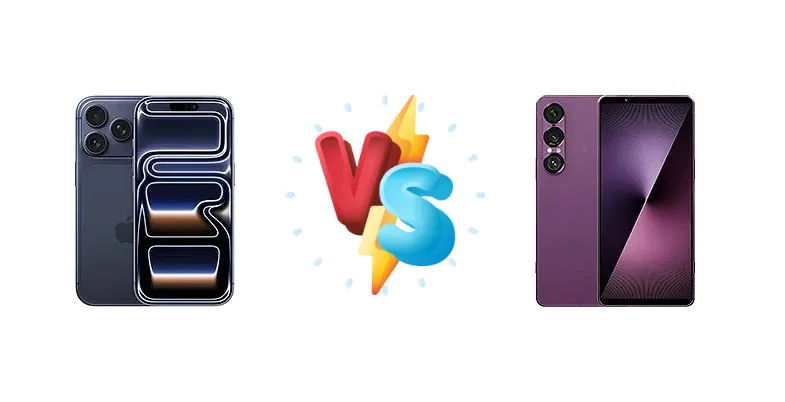
|
🏆 Quick Verdict
For the average user prioritizing seamless integration and long-term software support, the iPhone 17 Pro is the better choice. Its 47-hour endurance and optimized A19 Pro chip offer a polished experience. However, the Xperia 1 VII appeals to power users and content creators who value customization and a brighter display.
| PHONES | ||
|---|---|---|
| Phone Names | Apple iPhone 17 Pro | Sony Xperia 1 VII |
| Network | ||
|---|---|---|
| 2G bands | GSM 850 / 900 / 1800 / 1900 | GSM 850 / 900 / 1800 / 1900 |
| 3G bands | HSDPA 850 / 900 / 1700(AWS) / 1900 / 2100 | HSDPA 800 / 850 / 900 / 1700(AWS) / 1900 / 2100 |
| 4G bands | 1, 2, 3, 4, 5, 7, 8, 12, 13, 17, 18, 19, 20, 25, 26, 28, 30, 32, 34, 38, 39, 40, 41, 42, 48, 53, 66 - A3523 | 1, 2, 3, 4, 5, 7, 8, 12, 13, 17, 19, 20, 25, 26, 28, 32, 34, 38, 39, 40, 41, 66 - Europe |
| 5G bands | 1, 2, 3, 5, 7, 8, 12, 20, 25, 26, 28, 30, 38, 40, 41, 48, 53, 66, 70, 75, 77, 78, 79 SA/NSA/Sub6 - A3523 | 1, 3, 5, 7, 8, 20, 28, 38, 40, 41, 75, 77, 78 SA/NSA/Sub6 - Europe |
| Speed | HSPA, LTE, 5G, EV-DO Rev.A 3.1 Mbps | HSPA, LTE, 5G |
| Technology | GSM / CDMA / HSPA / EVDO / LTE / 5G | GSM / HSPA / LTE / 5G |
| Launch | ||
|---|---|---|
| Announced | 2025, September 09 | 2025, May 13 |
| Status | Available. Released 2025, September 19 | Available. Released 2025, June 04 |
| Body | ||
|---|---|---|
| Build | Glass front (Ceramic Shield 2), aluminum alloy frame, aluminum alloy back/ glass back (Ceramic Shield) | Glass front (Gorilla Glass Victus 2), glass back (Gorilla Glass Victus), aluminum frame |
| Dimensions | 150 x 71.9 x 8.8 mm (5.91 x 2.83 x 0.35 in) | 162 x 74 x 8.2 mm (6.38 x 2.91 x 0.32 in) |
| SIM | · Nano-SIM + eSIM + eSIM (max 2 at a time; International)· eSIM + eSIM (8 or more, max 2 at a time; USA)· Nano-SIM + Nano-SIM (China) | · Nano-SIM + eSIM· Nano-SIM + Nano-SIM |
| Weight | 206 g (7.27 oz) | 197 g (6.95 oz) |
| Display | ||
|---|---|---|
| Protection | Ceramic Shield 2, Mohs level 5 | Corning Gorilla Glass Victus 2, Mohs level 5 |
| Resolution | 1206 x 2622 pixels, 19.5:9 ratio (~460 ppi density) | 1080 x 2340 pixels, 19.5:9 ratio (~396 ppi density) |
| Size | 6.3 inches, 96.4 cm2 (~89.4% screen-to-body ratio) | 6.5 inches, 103.7 cm2 (~86.5% screen-to-body ratio) |
| Type | LTPO Super Retina XDR OLED, 120Hz, HDR10, Dolby Vision, 1000 nits (typ), 1600 nits (HBM), 3000 nits (peak) | LTPO OLED, 1B colors, 120Hz, HDR BT.2020 |
| Platform | ||
|---|---|---|
| CPU | Hexa-core (2x4.26 GHz + 4xX.X GHz) | Octa-core (2x4.32 GHz Oryon V2 Phoenix L + 6x3.53 GHz Oryon V2 Phoenix M) |
| Chipset | Apple A19 Pro (3 nm) | Qualcomm SM8750-AB Snapdragon 8 Elite (3 nm) |
| GPU | Apple GPU (6-core graphics) | Adreno 830 |
| OS | iOS 26, upgradable to iOS 26.1 | Android 15, up to 4 major Android upgrades |
| Memory | ||
|---|---|---|
| Card slot | No | microSDXC (uses shared SIM slot) |
| Internal | 256GB 12GB RAM, 512GB 12GB RAM, 1TB 12GB RAM | 256GB 12GB RAM, 512GB 12GB RAM |
| Main Camera | ||
|---|---|---|
| Features | Dual-LED dual-tone flash, HDR (photo/panorama) | Zeiss optics, Zeiss T* lens coating, color spectrum sensor, LED flash, panorama, HDR, eye tracking |
| Triple | 48 MP, f/1.8, 24mm (wide), 1/1.28", 1.22µm, dual pixel PDAF, sensor-shift OIS 48 MP, f/2.8, 100mm (periscope telephoto), 1/2.55", 0.7µm, PDAF, 3D sensor‑shift OIS, 4x optical zoom 48 MP, f/2.2, 13mm, 120˚ (ultrawide), 1/2.55", 0.7µm, PDAF TOF 3D LiDAR scanner (depth) | 48 MP, f/1.9, 24mm (wide), 1/1.35", 1.12µm, dual pixel PDAF, OIS 12 MP, f/2.3, 85mm (telephoto), f/3.5, 170mm (telephoto), 1/3.5", 1.0µm, dual pixel PDAF, 3.5x-7.1x continuous optical zoom, OIS, 4cm macro @ 120mm, no AF 48 MP, f/2.0, 16mm (ultrawide), 1/1.56", 1.0µm, PDAF |
| Video | 4K@24/25/30/60/100/120fps, 1080p@25/30/60/120/240fps, 10-bit HDR, Dolby Vision HDR (up to 120fps), ProRes, ProRes RAW (up to 120fps), Apple Log 2, 3D (spatial) video/audio, stereo | 4K@24/30/60/120fps HDR, 1080p@30/60/120fps; 5-axis gyro-EIS, OIS |
| Selfie camera | ||
|---|---|---|
| Features | HDR, Dolby Vision HDR, 3D (spatial) audio, stereo sound rec., ProRes RAW, Apple Log 2 | HDR |
| Single | 18 MP multi-aspect, f/1.9, 20mm (ultrawide), PDAF SL 3D, (depth/biometrics sensor) | 12 MP, f/2.0, 24mm (wide), 1/2.9", 1.22µm |
| Video | 4K@24/25/30/60fps, 1080p@25/30/60/120fps, gyro-EIS | 4K@30/60fps, 1080p@30/60fps, 5-axis gyro-EIS |
| Sound | ||
|---|---|---|
| 35mm jack | No | Yes |
| Loudspeaker | Yes, with stereo speakers | Yes, with stereo speakers |
| Comms | ||
|---|---|---|
| Bluetooth | 6.0, A2DP, LE | 6.0, A2DP, LE Audio, aptX HD, aptX Adaptive, aptX Lossless |
| NFC | Yes | Yes |
| Positioning | GPS (L1+L5), GLONASS, GALILEO, BDS, QZSS, NavIC | GPS, GLONASS, BDS, GALILEO, QZSS |
| Radio | No | No |
| USB | USB Type-C 3.2 Gen 2, DisplayPort | USB Type-C 3.2, OTG, video output |
| WLAN | Wi-Fi 802.11 a/b/g/n/ac/6e/7, tri-band, hotspot | Wi-Fi 802.11 a/b/g/n/ac/6e/7, tri-band, Wi-Fi Direct, DLNA |
| Features | ||
|---|---|---|
| Sensors | Face ID, accelerometer, gyro, proximity, compass, barometer | Fingerprint (side-mounted), accelerometer, gyro, proximity, barometer, compass |
| Battery | ||
|---|---|---|
| Charging | Wired, PD3.2, AVS, 50% in 20 min 25W wireless MagSafe/Qi2, 50% in 30 min (15W - China) 4.5W reverse wired | 30W wired, PD3.0, PPS, 50% in 30 min 15W wireless Reverse wireless |
| Type | Market-dependent versions:· Li-Ion 3998 mAh - Nano SIM model· Li-Ion 4252 mAh - eSIM only model | 5000 mAh |
| Misc | ||
|---|---|---|
| Colors | Silver, Cosmic Orange, Deep Blue | Moss Green, Orchid Purple, Slate Black |
| Models | iPhone18,1, A3256, A3523, A3522, A3524 | XQ-FS54, XQFS54EUKCG.GC, XQFS54EUKCV.GC, XQFS54EUKCB.GC, PDX256 |
| Price | € 1,242.00 / $ 1,400.00 / £ 1,069.00 / ₹ 134,900 | € 1,338.99 / $ 1,394.99 / £ 1,149.94 |
| SAR | 1.19 W/kg (head) 1.19 W/kg (body) | - |
| SAR EU | 1.49 W/kg (head) 1.49 W/kg (body) | - |
| EU LABEL | ||
|---|---|---|
| Battery | 47:00h endurance, 1000 cycles | 43:30h endurance, 1400 cycles |
| Energy | Class A | Class B |
| Free fall | Class B (180 falls) | Class B (181 falls) |
| Repairability | Class C | Class D |
Apple iPhone 17 Pro
- Longer battery endurance (47:00h)
- Faster wired charging (50% in 20 min)
- Seamless Apple ecosystem integration
- Lower peak display brightness (1012 nits)
- Less customization options compared to Android
Sony Xperia 1 VII
- Brighter display (1475 nits)
- More battery charge cycles (1400)
- Android’s open platform and customization
- Slightly shorter battery endurance (43:30h)
- Slower wired charging (50% in 30 min)
Display Comparison
The Sony Xperia 1 VII boasts a significantly brighter display at 1475 nits, compared to the iPhone 17 Pro’s 1012 nits. This difference translates to superior visibility in direct sunlight. While both utilize 3nm chipsets, the Xperia 1 VII’s brightness advantage is crucial for photographers and videographers reviewing footage on the go. Apple’s display technology is likely to retain its color accuracy and LTPO efficiency, but Sony’s peak brightness is a clear win for outdoor use. The lack of specific refresh rate data for either device means we can only assume both will offer adaptive refresh rates to balance smoothness and battery life.
Camera Comparison
Without detailed camera specifications, a direct comparison is limited. However, Sony’s history suggests a focus on larger sensors and manual controls, catering to photography enthusiasts. The Xperia 1 VII likely prioritizes image fidelity and dynamic range, offering extensive customization options. Apple typically emphasizes computational photography and ease of use, delivering consistently good results with minimal user input. The absence of information regarding sensor sizes and lens apertures makes a definitive judgment impossible, but the Xperia 1 VII’s brand identity points towards a more professional-grade camera experience.
Performance
Both devices leverage 3nm chipsets, but their architectures differ significantly. The iPhone 17 Pro’s Apple A19 Pro features a hexa-core CPU (2x4.26 GHz + 4xX.X GHz), while the Xperia 1 VII utilizes the Qualcomm SM8750-AB Snapdragon 8 Elite with an octa-core configuration (2x4.32 GHz Oryon V2 Phoenix L + 6x3.53 GHz Oryon V2 Phoenix M). The Snapdragon’s Oryon cores, designed by Qualcomm, aim to deliver desktop-class performance. While clock speeds are similar, the Snapdragon’s core count suggests potential advantages in multi-threaded tasks. However, Apple’s tight software optimization often allows it to extract more performance from fewer cores. The iPhone’s advantage lies in its optimized Neural Engine for AI tasks.
Battery Life
The iPhone 17 Pro offers 47:00h of endurance and an active use score of 15:23h, while the Xperia 1 VII provides 43:30h endurance and 15:32h of active use. Despite a slightly smaller battery, the Xperia 1 VII’s active use score is marginally higher, suggesting more efficient power management. The iPhone 17 Pro supports 50% charge in 20 minutes with wired PD3.2 and AVS, and 50% in 30 minutes wirelessly (15W in China). The Xperia 1 VII charges to 50% in 30 minutes with 30W wired PD3.0/PPS and 15W wirelessly. The iPhone 17 Pro also offers 4.5W reverse wired charging, while the Xperia 1 VII provides reverse wireless charging. The iPhone’s faster wired charging and reverse wired capability give it a slight edge.
Buying Guide
Buy the Apple iPhone 17 Pro if you need a phone that 'just works' with minimal setup, value long-term software updates, and are heavily invested in the Apple ecosystem. Buy the Sony Xperia 1 VII if you prefer Android’s open nature, prioritize a brighter display for outdoor visibility, and require advanced creative features like manual camera controls and video recording options.