
iPhone 17 Pro vs Oppo Find X9 Pro: The Ultimate Flagship Showdown
| Phones Images | |||||
|---|---|---|---|---|---|
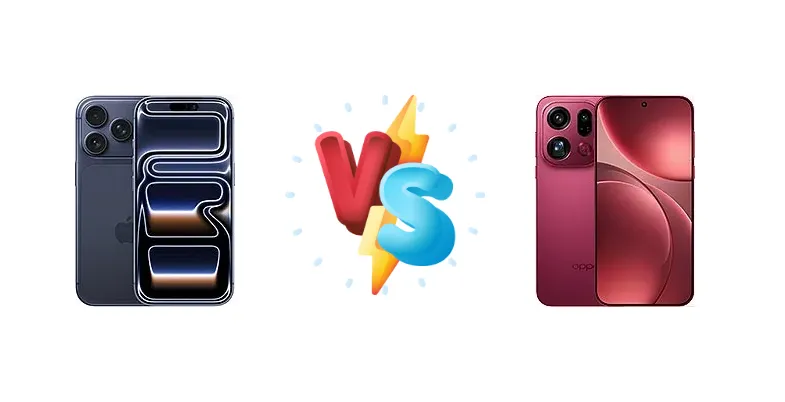
|
🏆 Quick Verdict
For the average user prioritizing ecosystem integration and consistent performance, the iPhone 17 Pro is the safer bet. However, the Oppo Find X9 Pro’s significantly faster charging and superior active use battery life make it the clear winner for power users who demand minimal downtime.
| PHONES | ||
|---|---|---|
| Phone Names | Apple iPhone 17 Pro | Oppo Find X9 Pro |
| Network | ||
|---|---|---|
| 2G bands | GSM 850 / 900 / 1800 / 1900 | GSM 850 / 900 / 1800 / 1900 |
| 3G bands | HSDPA 850 / 900 / 1700(AWS) / 1900 / 2100 | HSDPA 800 / 850 / 900 / 1700(AWS) / 1900 / 2100 - International, China |
| 4G bands | 1, 2, 3, 4, 5, 7, 8, 12, 13, 17, 18, 19, 20, 25, 26, 28, 30, 32, 34, 38, 39, 40, 41, 42, 48, 53, 66 - A3523 | 1, 2, 3, 4, 5, 7, 8, 12, 13, 17, 18, 19, 20, 25, 26, 28, 32, 38, 39, 40, 41, 42, 48, 66, 71 - International |
| 5G bands | 1, 2, 3, 5, 7, 8, 12, 20, 25, 26, 28, 30, 38, 40, 41, 48, 53, 66, 70, 75, 77, 78, 79 SA/NSA/Sub6 - A3523 | 1, 2, 3, 5, 7, 8, 12, 20, 25, 26, 28, 38, 40, 41, 48, 66, 71, 75, 76, 77, 78, 79 SA/NSA - International |
| Speed | HSPA, LTE, 5G, EV-DO Rev.A 3.1 Mbps | HSPA, LTE, 5G |
| Technology | GSM / CDMA / HSPA / EVDO / LTE / 5G | GSM / HSPA / LTE / 5G |
| Launch | ||
|---|---|---|
| Announced | 2025, September 09 | 2025, October 16 |
| Status | Available. Released 2025, September 19 | Available. Released 2025, October 22 |
| Body | ||
|---|---|---|
| Build | Glass front (Ceramic Shield 2), aluminum alloy frame, aluminum alloy back/ glass back (Ceramic Shield) | Glass front (Gorilla Glass Victus 2), glass back, aluminum frame |
| Dimensions | 150 x 71.9 x 8.8 mm (5.91 x 2.83 x 0.35 in) | 161.3 x 76.5 x 8.3 mm (6.35 x 3.01 x 0.33 in) |
| SIM | · Nano-SIM + eSIM + eSIM (max 2 at a time; International)· eSIM + eSIM (8 or more, max 2 at a time; USA)· Nano-SIM + Nano-SIM (China) | · Nano-SIM + eSIM· Nano-SIM + Nano-SIM |
| Weight | 206 g (7.27 oz) | 224 g (7.90 oz) |
| Display | ||
|---|---|---|
| Protection | Ceramic Shield 2, Mohs level 5 | Corning Gorilla Glass Victus 2 |
| Resolution | 1206 x 2622 pixels, 19.5:9 ratio (~460 ppi density) | 1272 x 2772 pixels, 19.5:9 ratio (~450 ppi density) |
| Size | 6.3 inches, 96.4 cm2 (~89.4% screen-to-body ratio) | 6.78 inches, 112.4 cm2 (~91.1% screen-to-body ratio) |
| Type | LTPO Super Retina XDR OLED, 120Hz, HDR10, Dolby Vision, 1000 nits (typ), 1600 nits (HBM), 3000 nits (peak) | LTPO AMOLED, 1B colors, 120Hz, 2160Hz PWM, Dolby Vision, HDR10+, HDR Vivid, 800 nits (typ), 1800 nits (HBM), 3600 nits (peak) |
| Platform | ||
|---|---|---|
| CPU | Hexa-core (2x4.26 GHz + 4xX.X GHz) | Octa-core (1x4.21 GHz C1-Ultra & 3x3.5 GHz C1-Premium & 4x2.7 GHz C1-Pro) |
| Chipset | Apple A19 Pro (3 nm) | Mediatek Dimensity 9500 (3 nm) |
| GPU | Apple GPU (6-core graphics) | Arm G1-Ultra |
| OS | iOS 26, upgradable to iOS 26.1 | Android 16, up to 5 major Android upgrades, ColorOS 16 |
| Memory | ||
|---|---|---|
| Card slot | No | No |
| Internal | 256GB 12GB RAM, 512GB 12GB RAM, 1TB 12GB RAM | 256GB 12GB RAM, 512GB 12GB RAM, 512GB 16GB RAM, 1TB 16GB RAM |
| Main Camera | ||
|---|---|---|
| Features | Dual-LED dual-tone flash, HDR (photo/panorama) | Laser AF, color spectrum sensor, Hasselblad Color Calibration, LED flash, HDR, panorama, LUT preview |
| Triple | 48 MP, f/1.8, 24mm (wide), 1/1.28", 1.22µm, dual pixel PDAF, sensor-shift OIS 48 MP, f/2.8, 100mm (periscope telephoto), 1/2.55", 0.7µm, PDAF, 3D sensor‑shift OIS, 4x optical zoom 48 MP, f/2.2, 13mm, 120˚ (ultrawide), 1/2.55", 0.7µm, PDAF TOF 3D LiDAR scanner (depth) | 50 MP, f/1.5, 23mm (wide), 1/1.28", 1.22µm, multi-directional PDAF, OIS 200 MP, f/2.1, 70mm (periscope telephoto), 1/1.56", 0.5µm, 3x optical zoom, multi-directional PDAF, OIS 50 MP, f/2.0, 15mm, 120˚ (ultrawide), 1/2.76", 0.64µm, multi-directional PDAF |
| Video | 4K@24/25/30/60/100/120fps, 1080p@25/30/60/120/240fps, 10-bit HDR, Dolby Vision HDR (up to 120fps), ProRes, ProRes RAW (up to 120fps), Apple Log 2, 3D (spatial) video/audio, stereo | 4K@30/60/120fps, 1080p@30/60/240fps; gyro-EIS; HDR, 10‑bit video, Dolby Vision, LOG |
| Selfie camera | ||
|---|---|---|
| Features | HDR, Dolby Vision HDR, 3D (spatial) audio, stereo sound rec., ProRes RAW, Apple Log 2 | Panorama |
| Single | 18 MP multi-aspect, f/1.9, 20mm (ultrawide), PDAF SL 3D, (depth/biometrics sensor) | 50 MP, f/2.0, 21mm (wide), 1/2.76", 0.64µm, PDAF |
| Video | 4K@24/25/30/60fps, 1080p@25/30/60/120fps, gyro-EIS | 4K@30/60fps, 1080p@30/60fps, gyro-EIS |
| Sound | ||
|---|---|---|
| 35mm jack | No | No |
| Loudspeaker | Yes, with stereo speakers | Yes, with stereo speakers |
| Comms | ||
|---|---|---|
| Bluetooth | 6.0, A2DP, LE | 6.0, A2DP, LE, aptX HD, LHDC 5 |
| Infrared port | - | Yes |
| NFC | Yes | Yes |
| Positioning | GPS (L1+L5), GLONASS, GALILEO, BDS, QZSS, NavIC | GPS (L1+L5), BDS (B1I+B1c+B2a+B2b), GALILEO (E1+E5a+E5b), QZSS (L1+L5), GLONASS, NavIC (L5) |
| Radio | No | No |
| USB | USB Type-C 3.2 Gen 2, DisplayPort | USB Type-C 3.2, OTG |
| WLAN | Wi-Fi 802.11 a/b/g/n/ac/6e/7, tri-band, hotspot | Wi-Fi 802.11 a/b/g/n/ac/6/7, dual-band or tri-band, Wi-Fi Direct |
| Features | ||
|---|---|---|
| Sensors | Face ID, accelerometer, gyro, proximity, compass, barometer | Fingerprint (under display, ultrasonic), accelerometer, gyro, proximity, compass, barometer |
| Battery | ||
|---|---|---|
| Charging | Wired, PD3.2, AVS, 50% in 20 min 25W wireless MagSafe/Qi2, 50% in 30 min (15W - China) 4.5W reverse wired | 80W wired, 80W UFCS, 55W PPS, 11.7W PD 50W wireless 10W reverse wireless |
| Type | Market-dependent versions:· Li-Ion 3998 mAh - Nano SIM model· Li-Ion 4252 mAh - eSIM only model | Si/C Li-Ion 7500 mAh |
| Misc | ||
|---|---|---|
| Colors | Silver, Cosmic Orange, Deep Blue | Silk White, Titanium Charcoal, Velvet Red |
| Models | iPhone18,1, A3256, A3523, A3522, A3524 | CPH2791, PLG110 |
| Price | € 1,242.00 / $ 1,400.00 / £ 1,069.00 / ₹ 134,900 | $ 1,184.51 / £ 1,149.00 / ₹ 109,999 |
| SAR | 1.19 W/kg (head) 1.19 W/kg (body) | - |
| SAR EU | 1.49 W/kg (head) 1.49 W/kg (body) | - |
| EU LABEL | ||
|---|---|---|
| Battery | 47:00h endurance, 1000 cycles | - |
| Energy | Class A | - |
| Free fall | Class B (180 falls) | - |
| Repairability | Class C | - |
Apple iPhone 17 Pro
- Mature iOS ecosystem and software support
- Potentially superior single-core performance
- Long battery lifespan (1000 cycles)
- Shorter active use battery life
- Slower charging speeds compared to Oppo
- Less flexible charging standards
Oppo Find X9 Pro
- Significantly longer active use battery life
- Blazing-fast 80W wired and 50W wireless charging
- More versatile charging standards (UFCS, PPS, PD)
- Android ecosystem may not appeal to all users
- Potential for software bloat
- Long-term software support may be shorter than Apple
Display Comparison
The Oppo Find X9 Pro boasts a brighter display at 1175 nits measured, compared to the iPhone 17 Pro’s 1012 nits. While both utilize 3nm chipsets, the Oppo’s brighter panel will offer better visibility in direct sunlight. Details regarding panel technology (LTPO, refresh rate) are missing, but given the flagship status, both are expected to feature adaptive refresh rates. The iPhone’s color accuracy is historically excellent, but the Oppo’s higher peak brightness provides a tangible advantage for outdoor use.
Camera Comparison
Without detailed camera specs, a direct comparison is limited. However, the focus should be on sensor size and image processing. Apple historically prioritizes natural image processing, while Oppo often leans towards more vibrant, saturated colors. The absence of details regarding sensor sizes makes it difficult to assess low-light performance. The inclusion of OIS is expected on both devices, but the aperture of the main lens will be a critical factor in determining image quality.
Performance
Both devices are powered by 3nm chipsets – Apple’s A19 Pro (Hexa-core, up to 4.26 GHz) and MediaTek’s Dimensity 9500 (Octa-core, up to 4.21 GHz). The Dimensity 9500’s octa-core configuration, with its tiered core setup (1x4.21 GHz C1-Ultra, 3x3.5 GHz C1-Premium, 4x2.7 GHz C1-Pro), suggests a focus on sustained performance and efficiency, potentially handling multi-threaded tasks more effectively than the A19 Pro’s hexa-core design. However, Apple’s chip design and software optimization typically deliver superior single-core performance. RAM specifications are missing, but both will likely utilize LPDDR5x for fast memory access.
Battery Life
The Oppo Find X9 Pro shines in battery performance, achieving an active use score of 21:57h, significantly exceeding the iPhone 17 Pro’s 15:23h. While the iPhone 17 Pro boasts a 1000-cycle battery lifespan, the Oppo’s superior active use endurance is more immediately impactful. The charging speeds are drastically different: Oppo’s 80W wired (UFCS, PPS, PD) and 50W wireless charging are far faster than Apple’s 25W MagSafe/Qi2 and 50% in 30 minutes (15W in China). The Oppo’s 80W wired charging can reach 50% in a mere 20 minutes, while the iPhone takes the same time for MagSafe. The Oppo also offers 10W reverse wireless charging, compared to the iPhone’s 4.5W.
Buying Guide
Buy the Apple iPhone 17 Pro if you need seamless integration with other Apple devices, a mature software ecosystem, and long-term software support. Buy the Oppo Find X9 Pro if you prioritize incredibly fast charging, extended battery life during active use, and are comfortable with the Android operating system and its customization options.