
iPhone 17 Pro vs Google Pixel 10 Pro Fold: A Deep Dive Comparison
| Phones Images | |||||
|---|---|---|---|---|---|
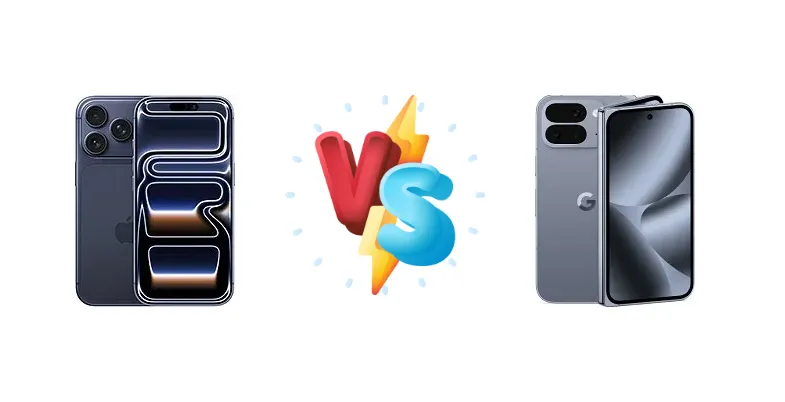
|
🏆 Quick Verdict
For users prioritizing raw processing power and a streamlined experience, the iPhone 17 Pro emerges as the winner. Its A19 Pro chip and optimized software deliver unmatched speed. However, the Pixel 10 Pro Fold’s innovative foldable design and competitive battery life make it a compelling alternative for those seeking versatility.
| PHONES | ||
|---|---|---|
| Phone Names | Apple iPhone 17 Pro | Google Pixel 10 Pro Fold |
| Network | ||
|---|---|---|
| 2G bands | GSM 850 / 900 / 1800 / 1900 | GSM 850 / 900 / 1800 / 1900 |
| 3G bands | HSDPA 850 / 900 / 1700(AWS) / 1900 / 2100 | HSDPA 800 / 850 / 900 / 1700(AWS) / 1900 / 2100 |
| 4G bands | 1, 2, 3, 4, 5, 7, 8, 12, 13, 17, 18, 19, 20, 25, 26, 28, 30, 32, 34, 38, 39, 40, 41, 42, 48, 53, 66 - A3523 | 1, 2, 3, 4, 5, 7, 8, 12, 13, 14, 17, 18, 19, 20, 21, 25, 26, 29, 30, 32, 38, 39, 40, 42, 48, 66, 71, 75 - GU0NP International |
| 5G bands | 1, 2, 3, 5, 7, 8, 12, 20, 25, 26, 28, 30, 38, 40, 41, 48, 53, 66, 70, 75, 77, 78, 79 SA/NSA/Sub6 - A3523 | 1, 2, 3, 5, 7, 8, 12, 14, 20, 25, 26, 28, 29, 30, 40, 48, 66, 70, 71, 75, 77, 78, 79, 257, 258, 260, 261 SA/NSA/Sub6 - GU0NP International |
| Speed | HSPA, LTE, 5G, EV-DO Rev.A 3.1 Mbps | HSPA, LTE, 5G |
| Technology | GSM / CDMA / HSPA / EVDO / LTE / 5G | GSM / HSPA / LTE / 5G |
| Launch | ||
|---|---|---|
| Announced | 2025, September 09 | 2025, August 20 |
| Status | Available. Released 2025, September 19 | Available. Released 2025, October 09 |
| Body | ||
|---|---|---|
| Build | Glass front (Ceramic Shield 2), aluminum alloy frame, aluminum alloy back/ glass back (Ceramic Shield) | Glass front (Gorilla Glass Victus 2) (folded), plastic front (unfolded), glass back (Gorilla Glass Victus 2), aluminum frame |
| Dimensions | 150 x 71.9 x 8.8 mm (5.91 x 2.83 x 0.35 in) | Unfolded: 155.2 x 150.4 x 5.2 mmFolded: 155.2 x 76.3 x 10.8 mm |
| SIM | · Nano-SIM + eSIM + eSIM (max 2 at a time; International)· eSIM + eSIM (8 or more, max 2 at a time; USA)· Nano-SIM + Nano-SIM (China) | Nano-SIM + eSIM |
| Weight | 206 g (7.27 oz) | 258 g (9.10 oz) |
| Display | ||
|---|---|---|
| Protection | Ceramic Shield 2, Mohs level 5 | Mohs level 5 |
| Resolution | 1206 x 2622 pixels, 19.5:9 ratio (~460 ppi density) | 2076 x 2152 pixels, 1:1 ratio (~374 ppi density) |
| Size | 6.3 inches, 96.4 cm2 (~89.4% screen-to-body ratio) | 8.0 inches, 206.3 cm2 (~88.4% screen-to-body ratio) |
| Type | LTPO Super Retina XDR OLED, 120Hz, HDR10, Dolby Vision, 1000 nits (typ), 1600 nits (HBM), 3000 nits (peak) | Foldable LTPO OLED, 120Hz, HDR10+, 1800 nits (HBM), 3000 nits (peak) |
| Platform | ||
|---|---|---|
| CPU | Hexa-core (2x4.26 GHz + 4xX.X GHz) | Octa-core (1x3.78 GHz Cortex-X4 & 5x3.05 GHz Cortex-A725 & 2x2.25 GHz Cortex-A520) |
| Chipset | Apple A19 Pro (3 nm) | Google Tensor G5 (3 nm) |
| GPU | Apple GPU (6-core graphics) | PowerVR DXT-48-1536 |
| OS | iOS 26, upgradable to iOS 26.1 | Android 16, up to 7 major Android upgrades |
| Memory | ||
|---|---|---|
| Card slot | No | No |
| Internal | 256GB 12GB RAM, 512GB 12GB RAM, 1TB 12GB RAM | 256GB 16GB RAM, 512GB 16GB RAM, 1TB 16GB RAM |
| Main Camera | ||
|---|---|---|
| Features | Dual-LED dual-tone flash, HDR (photo/panorama) | Multi-zone Laser AF, LED flash, Pixel Shift, Ultra-HDR, panorama, Best Take, Zoom Enhance |
| Triple | 48 MP, f/1.8, 24mm (wide), 1/1.28", 1.22µm, dual pixel PDAF, sensor-shift OIS 48 MP, f/2.8, 100mm (periscope telephoto), 1/2.55", 0.7µm, PDAF, 3D sensor‑shift OIS, 4x optical zoom 48 MP, f/2.2, 13mm, 120˚ (ultrawide), 1/2.55", 0.7µm, PDAF TOF 3D LiDAR scanner (depth) | 48 MP, f/1.7, 25mm (wide), 1/2.0", 0.8µm, dual pixel PDAF, OIS 10.8 MP, f/3.1, 112mm (telephoto), 1/3.2", dual pixel PDAF, OIS, 5x optical zoom 10.5 MP, f/2.2, 127˚ (ultrawide), 1/3.4", PDAF |
| Video | 4K@24/25/30/60/100/120fps, 1080p@25/30/60/120/240fps, 10-bit HDR, Dolby Vision HDR (up to 120fps), ProRes, ProRes RAW (up to 120fps), Apple Log 2, 3D (spatial) video/audio, stereo | 4K@24/30/60fps, 1080p@24/30/60/120/240fps, 10-bit HDR, gyro-EIS, OIS |
| Selfie camera | ||
|---|---|---|
| Features | HDR, Dolby Vision HDR, 3D (spatial) audio, stereo sound rec., ProRes RAW, Apple Log 2 | HDR, panorama |
| Single | 18 MP multi-aspect, f/1.9, 20mm (ultrawide), PDAF SL 3D, (depth/biometrics sensor) | 10 MP, f/2.2, 23mm (wide), 1/3.94", PDAF Cover camera: 10 MP, f/2.2, 23mm (wide), 1/3.94", PDAF |
| Video | 4K@24/25/30/60fps, 1080p@25/30/60/120fps, gyro-EIS | 4K@30/60fps, 1080p@30/60fps |
| Sound | ||
|---|---|---|
| 35mm jack | No | No |
| Loudspeaker | Yes, with stereo speakers | Yes, with stereo speakers |
| Comms | ||
|---|---|---|
| Bluetooth | 6.0, A2DP, LE | 6.0, A2DP, LE, aptX HD |
| NFC | Yes | Yes |
| Positioning | GPS (L1+L5), GLONASS, GALILEO, BDS, QZSS, NavIC | GPS (L1+L5), GLONASS, GALILEO, BDS, QZSS, NavIC |
| Radio | No | No |
| USB | USB Type-C 3.2 Gen 2, DisplayPort | USB Type-C 3.2 |
| WLAN | Wi-Fi 802.11 a/b/g/n/ac/6e/7, tri-band, hotspot | Wi-Fi 802.11 a/b/g/n/ac/6e/7, tri-band |
| Features | ||
|---|---|---|
| Sensors | Face ID, accelerometer, gyro, proximity, compass, barometer | Fingerprint (side-mounted), accelerometer, gyro, proximity, compass, barometer |
| Battery | ||
|---|---|---|
| Charging | Wired, PD3.2, AVS, 50% in 20 min 25W wireless MagSafe/Qi2, 50% in 30 min (15W - China) 4.5W reverse wired | 30W wired, PPS, 50% in 30 min 15W wireless (magnetic), Qi2 Bypass charging |
| Type | Market-dependent versions:· Li-Ion 3998 mAh - Nano SIM model· Li-Ion 4252 mAh - eSIM only model | 5015 mAh |
| Misc | ||
|---|---|---|
| Colors | Silver, Cosmic Orange, Deep Blue | Moonstone, Jade |
| Models | iPhone18,1, A3256, A3523, A3522, A3524 | GU0NP, GM66V |
| Price | € 1,242.00 / $ 1,400.00 / £ 1,069.00 / ₹ 134,900 | $ 1,499.00 / C$ 2,119.99 / £ 1,749.00 / € 1,757.00 |
| SAR | 1.19 W/kg (head) 1.19 W/kg (body) | 0.99 W/kg (head) 0.99 W/kg (body) |
| SAR EU | 1.49 W/kg (head) 1.49 W/kg (body) | 0.99 W/kg (head) 1.39 W/kg (body) |
| EU LABEL | ||
|---|---|---|
| Battery | 47:00h endurance, 1000 cycles | 47:55h endurance, 1000 cycles |
| Energy | Class A | Class B |
| Free fall | Class B (180 falls) | Class A (210 falls) |
| Repairability | Class C | Class C |
Apple iPhone 17 Pro
- Unmatched processing power with the A19 Pro chip
- Faster wired and wireless charging speeds
- Optimized software ecosystem and long-term support
- Traditional smartphone form factor lacks versatility
- Potentially higher price point
Google Pixel 10 Pro Fold
- Innovative foldable design for enhanced multitasking
- Competitive battery endurance and bypass charging
- Google’s AI-powered features and software experience
- Slower charging speeds compared to the iPhone
- Foldable display crease may be noticeable
Display Comparison
The iPhone 17 Pro boasts a measured peak brightness of 1012 nits, ensuring excellent visibility even in direct sunlight. While the Pixel 10 Pro Fold’s brightness isn’t specified, foldable displays typically prioritize color accuracy and viewing angles over sheer luminance. The key differentiator is the form factor; the Pixel offers a significantly larger screen real estate when unfolded, ideal for multitasking and immersive media consumption. Both support Qi2 wireless charging, but the foldable’s larger panel may require more power, potentially impacting battery life during extended use. The iPhone’s likely higher pixel density will result in sharper images, while the Pixel’s foldable nature introduces a crease, a common trade-off.
Camera Comparison
Without detailed camera specs, we can infer based on brand history. Apple typically focuses on natural image processing and video quality, while Google excels in computational photography. The Pixel 10 Pro Fold will likely leverage the Tensor G5’s AI capabilities for features like Magic Eraser and Super Res Zoom. The larger sensor size (assumed for the Pixel, given its Pro designation) will improve low-light performance. The iPhone’s video recording capabilities are traditionally best-in-class, benefiting from the A19 Pro’s image signal processor. The absence of a dedicated telephoto lens spec on either device suggests reliance on digital zoom or a periscope lens (likely on the Pixel).
Performance
Apple’s A19 Pro, built on a 3nm process, is expected to deliver substantial performance gains over its predecessor. Its hexa-core configuration (2x4.26 GHz + 4xX.X GHz) suggests a focus on both high-performance and efficiency. Conversely, the Google Tensor G5 utilizes an octa-core setup (1x3.78 GHz Cortex-X4 & 5x3.05 GHz Cortex-A725 & 2x2.25 GHz Cortex-A520), prioritizing AI and machine learning tasks. While the Tensor G5’s core count is higher, the A19 Pro’s architectural advantages and 3nm fabrication likely translate to superior single-core and sustained performance. The iPhone’s LPDDR5X RAM (spec not provided, but expected) will further enhance responsiveness. The Tensor G5’s strength lies in its dedicated AI cores, enabling features like real-time translation and advanced image processing.
Battery Life
Both devices exhibit impressive battery endurance, with the Pixel 10 Pro Fold slightly edging out the iPhone 17 Pro at 47:55h versus 47:00h. However, endurance is a composite score. The iPhone 17 Pro offers faster wired charging (50% in 20 min via PD3.2, AVS) and a more robust wireless charging solution with 25W MagSafe/Qi2 (50% in 30 min, 15W in China). The Pixel 10 Pro Fold’s 30W wired charging (PPS) and 15W wireless charging are competitive, but slower. The iPhone also includes 4.5W reverse wired charging, a feature absent on the Pixel. The Pixel’s ‘bypass charging’ feature, which allows direct power to the device bypassing the battery during charging, will help reduce battery degradation over time.
Buying Guide
Buy the Apple iPhone 17 Pro if you need uncompromising performance for demanding tasks like video editing, gaming, or professional workflows, and value a mature, polished software ecosystem. Buy the Google Pixel 10 Pro Fold if you prioritize a larger, adaptable screen for multitasking, content consumption, and appreciate Google’s AI-powered features and unique foldable form factor.