
Apple iPhone 16e vs vivo X200 Pro mini: A Head-to-Head Comparison of Compact Powerhouses
| Phones Images | |||||
|---|---|---|---|---|---|
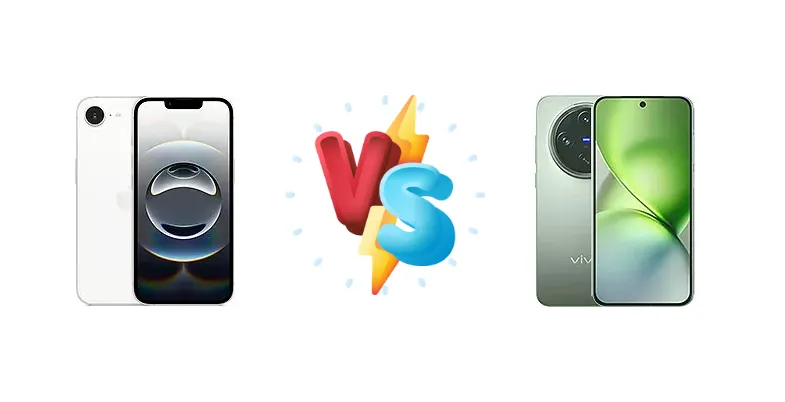
|
🏆 Quick Verdict
For the average user prioritizing long-term reliability and ecosystem integration, the iPhone 16e is the safer bet, thanks to its exceptional 41-hour battery endurance and Apple's software support. However, power users demanding the fastest charging and potentially higher peak performance will find the vivo X200 Pro mini more appealing.
| PHONES | ||
|---|---|---|
| Phone Names | Apple iPhone 16e | vivo X200 Pro mini |
| Network | ||
|---|---|---|
| 2G bands | GSM 850 / 900 / 1800 / 1900 | GSM 850 / 900 / 1800 / 1900 |
| 3G bands | HSDPA 850 / 900 / 1700(AWS) / 1900 / 2100 | HSDPA 800 / 850 / 900 / 1700(AWS) / 1900 / 2100 |
| 4G bands | 1, 2, 3, 4, 5, 7, 8, 12, 13, 14, 17, 18, 19, 20, 25, 26, 28, 29, 30, 32, 34, 38, 39, 40, 41, 42, 48, 53, 66, 71 - A3212, A3408 | 1, 2, 3, 4, 5, 7, 8, 18, 19, 26, 28, 34, 38, 39, 40, 41, 66 |
| 5G bands | 1, 2, 3, 5, 7, 8, 12, 14, 20, 25, 26, 28, 29, 30, 38, 40, 41, 48, 53, 66, 70, 71, 75, 76, 77, 78, 79 SA/NSA/Sub6 - A3212, A3408 | 1, 3, 5, 8, 28, 38, 40, 41, 77, 78 SA/NSA |
| Speed | HSPA, LTE, 5G | HSPA, LTE, 5G |
| Technology | GSM / HSPA / LTE / 5G | GSM / HSPA / LTE / 5G |
| Launch | ||
|---|---|---|
| Announced | 2025, February 19 | 2024, October 14 |
| Status | Available. Released 2025, February 28 | Available. Released 2024, October 25 |
| Body | ||
|---|---|---|
| Build | Glass front (Ceramic Shield), glass back, aluminum frame | Glass front, aluminum alloy frame |
| Dimensions | 146.7 x 71.5 x 7.8 mm (5.78 x 2.81 x 0.31 in) | 150.8 x 71.8 x 8.2 mm (5.94 x 2.83 x 0.32 in) |
| SIM | · Nano-SIM + eSIM + eSIM (max 2 at a time; International)· eSIM + eSIM (8 or more, max 2 at a time; USA)· Nano-SIM + Nano-SIM (China) | Nano-SIM + Nano-SIM |
| Weight | 167 g (5.89 oz) | 187 g (6.60 oz) |
| Display | ||
|---|---|---|
| Protection | Ceramic Shield glass, Mohs level 4 | - |
| Resolution | 1170 x 2532 pixels, 19.5:9 ratio (~460 ppi density) | 1216 x 2640 pixels, 19.5:9 ratio (~460 ppi density) |
| Size | 6.1 inches, 90.2 cm2 (~86.0% screen-to-body ratio) | 6.31 inches, 98.0 cm2 (~90.5% screen-to-body ratio) |
| Type | Super Retina XDR OLED, HDR10, 800 nits (HBM), 1200 nits (peak) | LTPO AMOLED, 1B colors, 120Hz, 2160Hz PWM, HDR10+, 4500 nits (peak) |
| Platform | ||
|---|---|---|
| CPU | Hexa-core (2x4.04 GHz + 4x2.20 GHz) | Octa-core (1x3.63 GHz Cortex-X925 & 3x3.3 GHz Cortex-X4 & 4x2.4 GHz Cortex-A720) |
| Chipset | Apple A18 (3 nm) | Mediatek Dimensity 9400 (3 nm) |
| GPU | Apple GPU (4-core graphics) | Immortalis-G925 |
| OS | iOS 18.3.1, upgradable to iOS 26.1 | Android 15, OriginOS 5 (China) |
| Memory | ||
|---|---|---|
| Card slot | No | No |
| Internal | 128GB 8GB RAM, 256GB 8GB RAM, 512GB 8GB RAM | 256GB 12GB RAM, 512GB 12GB RAM, 512GB 16GB RAM, 1TB 16GB RAM |
| Main Camera | ||
|---|---|---|
| Features | Dual-LED dual-tone flash, HDR, panorama, 3D (spatial) audio | Laser AF, Zeiss optics, Zeiss T* lens coating, LED flash, panorama, HDR |
| Single | 48 MP, f/1.6, 26mm (wide), 1/2.55", 0.7µm, PDAF, OIS | - |
| Triple | - | 50 MP, f/1.6, 23mm (wide), 1/1.28", 1.22µm, PDAF, OIS 50 MP, f/2.6, 70mm (periscope telephoto), 1/1.95", PDAF, OIS, 3x optical zoom 50 MP, f/2.0, 15mm, 119˚ (ultrawide), 1/2.76", 0.64µm, AF |
| Video | 4K@24/25/30/60fps, 1080p@25/30/60/120/240fps, Dolby Vision HDR, OIS, stereo sound rec. | 4K@30/60fps, 1080p@30/60/120fps, gyro-EIS, HDR |
| Selfie camera | ||
|---|---|---|
| Features | HDR, Dolby Vision HDR, 3D (spatial) audio, stereo sound rec. | HDR |
| Single | 12 MP, f/1.9, 23mm (wide), 1/3.6", 1.0µm, PDAF SL 3D, (depth/biometrics sensor) | 32 MP, f/2.0, 20mm (ultrawide) |
| Video | 4K@24/25/30/60fps, 1080p@25/30/60/120fps, HDR | 4K, 1080p |
| Sound | ||
|---|---|---|
| 35mm jack | No | No |
| Loudspeaker | Yes, with stereo speakers | Yes, with stereo speakers |
| Comms | ||
|---|---|---|
| Bluetooth | 5.3, A2DP, LE | 5.4, A2DP, LE, aptX HD, LHDC 5 |
| Infrared port | - | Yes |
| NFC | Yes | Yes |
| Positioning | GPS, GLONASS, GALILEO, BDS, QZSS, NavIC | GPS (L1+L5), GLONASS (L1), BDS (B1I+B1c+B2a+B2b), GALILEO (E1+E5a+E5b), QZSS (L1+L5), NavIC (L5) |
| Radio | No | No |
| USB | USB Type-C 2.0 | USB Type-C 2.0, OTG |
| WLAN | Wi-Fi 802.11 a/b/g/n/ac/6, dual-band, hotspot | Wi-Fi 802.11 a/b/g/n/ac/6/7, dual-band |
| Features | ||
|---|---|---|
| Sensors | Face ID, accelerometer, gyro, proximity, compass, barometer | Fingerprint (under display, optical), accelerometer, gyro, proximity, compass |
| Battery | ||
|---|---|---|
| Charging | Wired, 50% in 30 min 7.5W wireless (Qi) | 90W wired 30W wireless Reverse wired |
| Type | Li-Ion 4005 mAh | Si/C Li-Ion 5700 mAh |
| Misc | ||
|---|---|---|
| Colors | Black, White | Black, White, Green, Pink |
| Models | A3212, A3409, A3410, A3408, iPhone17,5 | V2419A |
| Price | $ 384.65 / C$ 670.75 / £ 460.00 / € 534.00 / ₹ 51,499 | About 610 EUR |
| SAR | 1.19 W/kg (head) 1.20 W/kg (body) | - |
| SAR EU | 1.48 W/kg (head) 1.49 W/kg (body) | - |
| EU LABEL | ||
|---|---|---|
| Battery | 41:00h endurance, 1000 cycles | - |
| Energy | Class B | - |
| Free fall | Class C (90 falls) | - |
| Repairability | Class C | - |
Apple iPhone 16e
- Exceptional 41-hour battery endurance
- Apple ecosystem integration
- Long-term software support
- Slower charging speeds
- Potentially less powerful GPU
vivo X200 Pro mini
- Blazing-fast 90W wired charging
- Potentially higher peak performance with Dimensity 9400
- Android customization options
- Battery endurance is unknown
- Potential for thermal throttling under heavy load
Display Comparison
The iPhone 16e boasts a 799-nit display, providing good visibility outdoors, but lacks specifics on panel technology like LTPO. The vivo X200 Pro mini’s display specs are currently unknown, but given vivo’s history with flagship devices, we anticipate a high refresh rate and potentially superior color accuracy. The iPhone’s brightness is a solid baseline, but the X200 Pro mini could potentially offer a more visually immersive experience if it incorporates advanced display features.
Camera Comparison
Without detailed camera specifications for either device, a direct comparison is difficult. However, given the market positioning, the vivo X200 Pro mini is likely to prioritize camera capabilities, potentially featuring a larger main sensor and more advanced image processing algorithms. Apple typically focuses on computational photography and consistent image quality. The absence of details on the iPhone 16e’s camera system suggests a focus on maintaining cost efficiency, potentially resulting in a less sophisticated camera experience compared to the X200 Pro mini.
Performance
Both devices utilize 3nm chipsets, but their architectures differ significantly. The iPhone 16e’s Apple A18 features a hexa-core configuration (2x4.04 GHz + 4x2.20 GHz), optimized for Apple’s software. The vivo X200 Pro mini’s Mediatek Dimensity 9400 employs an octa-core setup (1x3.63 GHz Cortex-X925 & 3x3.3 GHz Cortex-X4 & 4x2.4 GHz Cortex-A720), potentially offering superior multi-core performance. While the A18 excels in single-core tasks and software optimization, the Dimensity 9400’s Cortex-X925 core could provide a performance edge in demanding applications and gaming. The X200 Pro mini’s chipset is likely to generate more heat under sustained load, however.
Battery Life
The iPhone 16e’s 41-hour endurance and 1000 charge cycles are a significant advantage, indicating exceptional battery longevity and sustained performance over time. While the vivo X200 Pro mini lacks endurance data, its 90W wired charging dwarfs the iPhone’s 50% in 30-minute charging. The X200 Pro mini’s 30W wireless charging also surpasses the iPhone’s 7.5W Qi wireless charging. The X200 Pro mini prioritizes rapid replenishment, while the iPhone 16e focuses on maximizing time between charges.
Buying Guide
Buy the Apple iPhone 16e if you need a phone that lasts all day and beyond, values seamless integration with other Apple devices, and prioritizes a polished, predictable software experience. Buy the vivo X200 Pro mini if you prefer a more customizable Android experience, demand the fastest possible charging speeds (90W wired), and want to leverage the latest Mediatek Dimensity 9400 chipset for demanding tasks.