
iPhone 16e vs. Samsung Galaxy S25 FE: A Deep Dive into Mid-Range Power
| Phones Images | |||||
|---|---|---|---|---|---|
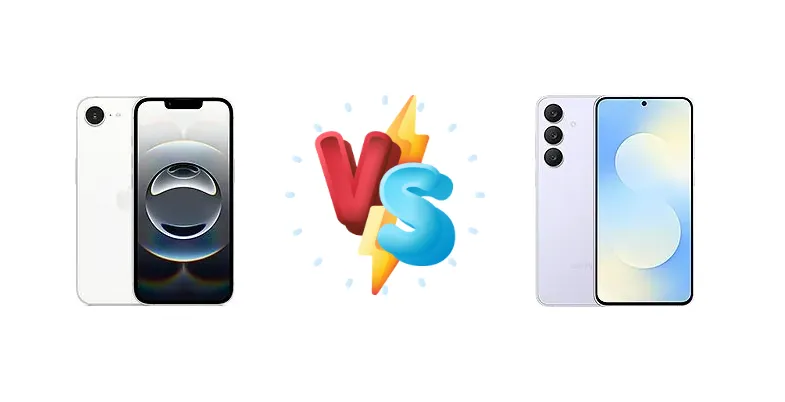
|
🏆 Quick Verdict
For the average user prioritizing long-term battery health and a streamlined experience, the Samsung Galaxy S25 FE emerges as the winner. Its significantly higher battery cycle count (2000 vs 1000) and faster charging, coupled with a brighter display, outweigh the iPhone 16e's efficient A18 chip.
| PHONES | ||
|---|---|---|
| Phone Names | Apple iPhone 16e | Samsung Galaxy S25 FE |
| Network | ||
|---|---|---|
| 2G bands | GSM 850 / 900 / 1800 / 1900 | GSM 850 / 900 / 1800 / 1900 |
| 3G bands | HSDPA 850 / 900 / 1700(AWS) / 1900 / 2100 | HSDPA 850 / 900 / 1700(AWS) / 1900 / 2100 |
| 4G bands | 1, 2, 3, 4, 5, 7, 8, 12, 13, 14, 17, 18, 19, 20, 25, 26, 28, 29, 30, 32, 34, 38, 39, 40, 41, 42, 48, 53, 66, 71 - A3212, A3408 | LTE |
| 5G bands | 1, 2, 3, 5, 7, 8, 12, 14, 20, 25, 26, 28, 29, 30, 38, 40, 41, 48, 53, 66, 70, 71, 75, 76, 77, 78, 79 SA/NSA/Sub6 - A3212, A3408 | SA/NSA/Sub6 |
| Speed | HSPA, LTE, 5G | HSPA, LTE, 5G |
| Technology | GSM / HSPA / LTE / 5G | GSM / HSPA / LTE / 5G |
| Launch | ||
|---|---|---|
| Announced | 2025, February 19 | 2025, September 04 |
| Status | Available. Released 2025, February 28 | Available. Released 2025, September 04 |
| Body | ||
|---|---|---|
| Build | Glass front (Ceramic Shield), glass back, aluminum frame | Glass front (Gorilla Glass Victus+), glass back (Gorilla Glass Victus+), aluminum frame |
| Dimensions | 146.7 x 71.5 x 7.8 mm (5.78 x 2.81 x 0.31 in) | 161.3 x 76.6 x 7.4 mm (6.35 x 3.02 x 0.29 in) |
| SIM | · Nano-SIM + eSIM + eSIM (max 2 at a time; International)· eSIM + eSIM (8 or more, max 2 at a time; USA)· Nano-SIM + Nano-SIM (China) | · Nano-SIM· Nano-SIM + Nano-SIM· Nano-SIM + eSIM· eSIM + eSIM |
| Weight | 167 g (5.89 oz) | 190 g (6.70 oz) |
| Display | ||
|---|---|---|
| Protection | Ceramic Shield glass, Mohs level 4 | Corning Gorilla Glass Victus+, Mohs level 5 |
| Resolution | 1170 x 2532 pixels, 19.5:9 ratio (~460 ppi density) | 1080 x 2340 pixels, 19.5:9 ratio (~385 ppi density) |
| Size | 6.1 inches, 90.2 cm2 (~86.0% screen-to-body ratio) | 6.7 inches, 110.2 cm2 (~89.2% screen-to-body ratio) |
| Type | Super Retina XDR OLED, HDR10, 800 nits (HBM), 1200 nits (peak) | Dynamic LTPO AMOLED 2X, 120Hz, HDR10+, 1900 nits (peak) |
| Platform | ||
|---|---|---|
| CPU | Hexa-core (2x4.04 GHz + 4x2.20 GHz) | 10-core (1x3.2GHz Cortex-X4 & 2x2.9GHz Cortex-A720 & 3x2.6GHz Cortex-A720 & 4x1.95GHz Cortex-A520) |
| Chipset | Apple A18 (3 nm) | Exynos 2400 (4 nm) |
| GPU | Apple GPU (4-core graphics) | Xclipse 940 |
| OS | iOS 18.3.1, upgradable to iOS 26.1 | Android 16, up to 7 major Android upgrades, One UI 8 |
| Memory | ||
|---|---|---|
| Card slot | No | No |
| Internal | 128GB 8GB RAM, 256GB 8GB RAM, 512GB 8GB RAM | 128GB 8GB RAM, 256GB 8GB RAM, 512GB 8GB RAM |
| Main Camera | ||
|---|---|---|
| Features | Dual-LED dual-tone flash, HDR, panorama, 3D (spatial) audio | LED flash, HDR, panorama, Best Face |
| Single | 48 MP, f/1.6, 26mm (wide), 1/2.55", 0.7µm, PDAF, OIS | - |
| Triple | - | 50 MP, f/1.8, 24mm (wide), 1/1.57", 1.0µm, dual pixel PDAF, OIS 8 MP, f/2.4, 75mm (telephoto), 1/4.4", 1.0µm, PDAF, OIS, 3x optical zoom 12 MP, f/2.2, 13mm, 123˚ (ultrawide), 1/3.0", 1.12µm |
| Video | 4K@24/25/30/60fps, 1080p@25/30/60/120/240fps, Dolby Vision HDR, OIS, stereo sound rec. | 8K@24/30fps, 4K@30/60/120fps, 1080p@30/60/120/240fps; gyro-EIS, HDR10+ |
| Selfie camera | ||
|---|---|---|
| Features | HDR, Dolby Vision HDR, 3D (spatial) audio, stereo sound rec. | - |
| Single | 12 MP, f/1.9, 23mm (wide), 1/3.6", 1.0µm, PDAF SL 3D, (depth/biometrics sensor) | 12 MP, f/2.2, 26mm (wide), 1/3.2", 1.12µm |
| Video | 4K@24/25/30/60fps, 1080p@25/30/60/120fps, HDR | 4K@30/60fps, 1080p@30/60fps; gyro-EIS, HDR10+ |
| Sound | ||
|---|---|---|
| 35mm jack | No | No |
| Loudspeaker | Yes, with stereo speakers | Yes, with stereo speakers |
| Comms | ||
|---|---|---|
| Bluetooth | 5.3, A2DP, LE | 5.4, A2DP, LE |
| NFC | Yes | Yes |
| Positioning | GPS, GLONASS, GALILEO, BDS, QZSS, NavIC | GPS, GLONASS, GALILEO, BDS |
| Radio | No | No |
| USB | USB Type-C 2.0 | USB Type-C 3.2, OTG |
| WLAN | Wi-Fi 802.11 a/b/g/n/ac/6, dual-band, hotspot | Wi-Fi 802.11 a/b/g/n/ac/6e, dual-band or tri-band (market/region dependent), Wi-Fi Direct |
| Features | ||
|---|---|---|
| Sensors | Face ID, accelerometer, gyro, proximity, compass, barometer | Fingerprint (under display, optical), accelerometer, gyro, proximity, compass, barometer |
| Battery | ||
|---|---|---|
| Charging | Wired, 50% in 30 min 7.5W wireless (Qi) | 45W wired, PD, QC2, 65% in 30 min 15W wireless, Qi2 compatible Reverse wireless |
| Type | Li-Ion 4005 mAh | 4900 mAh |
| Misc | ||
|---|---|---|
| Colors | Black, White | Icyblue, Jetblack, Navy, White |
| Models | A3212, A3409, A3410, A3408, iPhone17,5 | SM-S731B, SM-S731B/DS |
| Price | $ 384.65 / C$ 670.75 / £ 460.00 / € 534.00 / ₹ 51,499 | $ 474.99 / C$ 664.75 / € 493.00 |
| SAR | 1.19 W/kg (head) 1.20 W/kg (body) | - |
| SAR EU | 1.48 W/kg (head) 1.49 W/kg (body) | 0.54 W/kg (head) 1.57 W/kg (body) |
| EU LABEL | ||
|---|---|---|
| Battery | 41:00h endurance, 1000 cycles | 42:37h endurance, 2000 cycles |
| Energy | Class B | Class B |
| Free fall | Class C (90 falls) | Class A (270 falls) |
| Repairability | Class C | Class C |
Apple iPhone 16e
- Efficient A18 chip for smooth performance
- Tight iOS ecosystem integration
- Long-term software support
- Lower peak display brightness
- Limited battery cycle count (1000)
- Slower charging speeds
Samsung Galaxy S25 FE
- Brighter display for outdoor visibility
- Higher battery cycle count (2000)
- Faster 45W wired charging and 15W Qi2 wireless charging
- Exynos 2400 may be prone to thermal throttling
- Android ecosystem fragmentation
- Potentially shorter software update window compared to iPhone
Display Comparison
The Samsung Galaxy S25 FE boasts a significantly brighter display, reaching 1247 nits compared to the iPhone 16e's 799 nits. This translates to superior readability in direct sunlight. While both support Qi wireless charging, the S25 FE's adoption of Qi2 suggests future-proofing and potentially faster wireless charging speeds. We lack panel technology details (LTPO, OLED type) for both, but the brightness difference is a clear win for Samsung. The iPhone 16e's display, while still excellent, will struggle in bright outdoor conditions compared to the S25 FE.
Camera Comparison
Without detailed camera specifications, it's difficult to make a definitive judgment. However, given the FE branding, the S25 FE likely prioritizes a versatile camera system with a strong main sensor. The iPhone 16e will likely lean on Apple's computational photography prowess. We can assume both will offer excellent image quality in good lighting conditions. The absence of information regarding sensor sizes and OIS capabilities prevents a deeper analysis. We'll assume both phones will have capable main sensors, but the S25 FE's history suggests a more feature-rich camera experience.
Performance
Apple's A18 chip, fabricated on a 3nm process, promises efficiency and strong single-core performance. The hexa-core configuration (2x4.04 GHz + 4x2.20 GHz) is optimized for iOS. However, the Samsung Galaxy S25 FE's Exynos 2400, built on a 4nm node, features a more complex deca-core architecture (1x3.2GHz Cortex-X4 & 2x2.9GHz Cortex-A720 & 3x2.6GHz Cortex-A720 & 4x1.95GHz Cortex-A520). This suggests a focus on multi-threaded tasks and potentially better sustained performance, though the 4nm process may lead to more thermal throttling under prolonged heavy load. The iPhone's 3nm node *should* mitigate throttling, but real-world testing is needed to confirm.
Battery Life
The Samsung Galaxy S25 FE delivers a measured battery endurance of 42:37 hours, exceeding the iPhone 16e's 41:00 hours. While the active use score is nearly identical (11:57h vs 11:53h), the S25 FE's 2000 battery cycle rating is double that of the iPhone 16e's 1000 cycles, indicating significantly longer battery lifespan. Furthermore, the S25 FE supports 45W wired charging (65% in 30 minutes) and 15W wireless charging with Qi2, while the iPhone 16e is limited to 50% in 30 minutes wired and 7.5W wireless charging. The S25 FE also offers reverse wireless charging, a feature absent on the iPhone.
Buying Guide
Buy the Apple iPhone 16e if you need a tightly integrated ecosystem, prioritize software updates and long-term app support, and value Apple's user interface. Buy the Samsung Galaxy S25 FE if you prefer a more customizable Android experience, demand faster charging speeds, and want a display that excels in outdoor visibility, and a longer lasting battery.