
iPhone 16e vs. Oppo Find X9 Pro: A Deep Dive into Battery, Performance, and Charging
| Phones Images | |||||
|---|---|---|---|---|---|
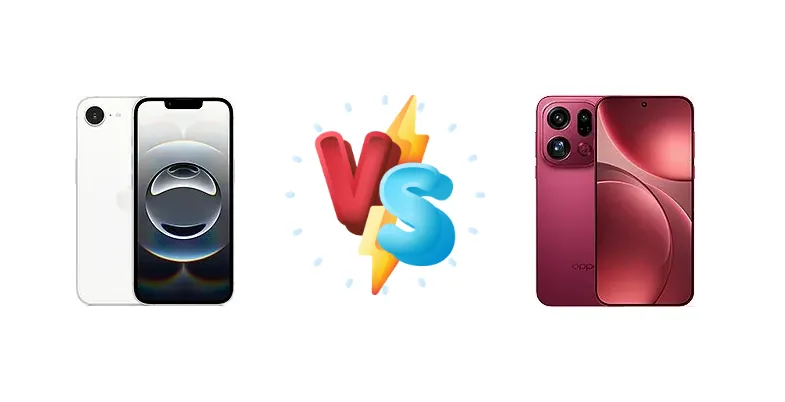
|
🏆 Quick Verdict
For the average user prioritizing long-term reliability and software ecosystem, the iPhone 16e is the better choice. Its A18 chip and exceptional 41-hour battery endurance outweigh the Oppo Find X9 Pro’s faster charging, though power users will appreciate the X9 Pro’s raw performance.
| PHONES | ||
|---|---|---|
| Phone Names | Apple iPhone 16e | Oppo Find X9 Pro |
| Network | ||
|---|---|---|
| 2G bands | GSM 850 / 900 / 1800 / 1900 | GSM 850 / 900 / 1800 / 1900 |
| 3G bands | HSDPA 850 / 900 / 1700(AWS) / 1900 / 2100 | HSDPA 800 / 850 / 900 / 1700(AWS) / 1900 / 2100 - International, China |
| 4G bands | 1, 2, 3, 4, 5, 7, 8, 12, 13, 14, 17, 18, 19, 20, 25, 26, 28, 29, 30, 32, 34, 38, 39, 40, 41, 42, 48, 53, 66, 71 - A3212, A3408 | 1, 2, 3, 4, 5, 7, 8, 12, 13, 17, 18, 19, 20, 25, 26, 28, 32, 38, 39, 40, 41, 42, 48, 66, 71 - International |
| 5G bands | 1, 2, 3, 5, 7, 8, 12, 14, 20, 25, 26, 28, 29, 30, 38, 40, 41, 48, 53, 66, 70, 71, 75, 76, 77, 78, 79 SA/NSA/Sub6 - A3212, A3408 | 1, 2, 3, 5, 7, 8, 12, 20, 25, 26, 28, 38, 40, 41, 48, 66, 71, 75, 76, 77, 78, 79 SA/NSA - International |
| Speed | HSPA, LTE, 5G | HSPA, LTE, 5G |
| Technology | GSM / HSPA / LTE / 5G | GSM / HSPA / LTE / 5G |
| Launch | ||
|---|---|---|
| Announced | 2025, February 19 | 2025, October 16 |
| Status | Available. Released 2025, February 28 | Available. Released 2025, October 22 |
| Body | ||
|---|---|---|
| Build | Glass front (Ceramic Shield), glass back, aluminum frame | Glass front (Gorilla Glass Victus 2), glass back, aluminum frame |
| Dimensions | 146.7 x 71.5 x 7.8 mm (5.78 x 2.81 x 0.31 in) | 161.3 x 76.5 x 8.3 mm (6.35 x 3.01 x 0.33 in) |
| SIM | · Nano-SIM + eSIM + eSIM (max 2 at a time; International)· eSIM + eSIM (8 or more, max 2 at a time; USA)· Nano-SIM + Nano-SIM (China) | · Nano-SIM + eSIM· Nano-SIM + Nano-SIM |
| Weight | 167 g (5.89 oz) | 224 g (7.90 oz) |
| Display | ||
|---|---|---|
| Protection | Ceramic Shield glass, Mohs level 4 | Corning Gorilla Glass Victus 2 |
| Resolution | 1170 x 2532 pixels, 19.5:9 ratio (~460 ppi density) | 1272 x 2772 pixels, 19.5:9 ratio (~450 ppi density) |
| Size | 6.1 inches, 90.2 cm2 (~86.0% screen-to-body ratio) | 6.78 inches, 112.4 cm2 (~91.1% screen-to-body ratio) |
| Type | Super Retina XDR OLED, HDR10, 800 nits (HBM), 1200 nits (peak) | LTPO AMOLED, 1B colors, 120Hz, 2160Hz PWM, Dolby Vision, HDR10+, HDR Vivid, 800 nits (typ), 1800 nits (HBM), 3600 nits (peak) |
| Platform | ||
|---|---|---|
| CPU | Hexa-core (2x4.04 GHz + 4x2.20 GHz) | Octa-core (1x4.21 GHz C1-Ultra & 3x3.5 GHz C1-Premium & 4x2.7 GHz C1-Pro) |
| Chipset | Apple A18 (3 nm) | Mediatek Dimensity 9500 (3 nm) |
| GPU | Apple GPU (4-core graphics) | Arm G1-Ultra |
| OS | iOS 18.3.1, upgradable to iOS 26.1 | Android 16, up to 5 major Android upgrades, ColorOS 16 |
| Memory | ||
|---|---|---|
| Card slot | No | No |
| Internal | 128GB 8GB RAM, 256GB 8GB RAM, 512GB 8GB RAM | 256GB 12GB RAM, 512GB 12GB RAM, 512GB 16GB RAM, 1TB 16GB RAM |
| Main Camera | ||
|---|---|---|
| Features | Dual-LED dual-tone flash, HDR, panorama, 3D (spatial) audio | Laser AF, color spectrum sensor, Hasselblad Color Calibration, LED flash, HDR, panorama, LUT preview |
| Single | 48 MP, f/1.6, 26mm (wide), 1/2.55", 0.7µm, PDAF, OIS | - |
| Triple | - | 50 MP, f/1.5, 23mm (wide), 1/1.28", 1.22µm, multi-directional PDAF, OIS 200 MP, f/2.1, 70mm (periscope telephoto), 1/1.56", 0.5µm, 3x optical zoom, multi-directional PDAF, OIS 50 MP, f/2.0, 15mm, 120˚ (ultrawide), 1/2.76", 0.64µm, multi-directional PDAF |
| Video | 4K@24/25/30/60fps, 1080p@25/30/60/120/240fps, Dolby Vision HDR, OIS, stereo sound rec. | 4K@30/60/120fps, 1080p@30/60/240fps; gyro-EIS; HDR, 10‑bit video, Dolby Vision, LOG |
| Selfie camera | ||
|---|---|---|
| Features | HDR, Dolby Vision HDR, 3D (spatial) audio, stereo sound rec. | Panorama |
| Single | 12 MP, f/1.9, 23mm (wide), 1/3.6", 1.0µm, PDAF SL 3D, (depth/biometrics sensor) | 50 MP, f/2.0, 21mm (wide), 1/2.76", 0.64µm, PDAF |
| Video | 4K@24/25/30/60fps, 1080p@25/30/60/120fps, HDR | 4K@30/60fps, 1080p@30/60fps, gyro-EIS |
| Sound | ||
|---|---|---|
| 35mm jack | No | No |
| Loudspeaker | Yes, with stereo speakers | Yes, with stereo speakers |
| Comms | ||
|---|---|---|
| Bluetooth | 5.3, A2DP, LE | 6.0, A2DP, LE, aptX HD, LHDC 5 |
| Infrared port | - | Yes |
| NFC | Yes | Yes |
| Positioning | GPS, GLONASS, GALILEO, BDS, QZSS, NavIC | GPS (L1+L5), BDS (B1I+B1c+B2a+B2b), GALILEO (E1+E5a+E5b), QZSS (L1+L5), GLONASS, NavIC (L5) |
| Radio | No | No |
| USB | USB Type-C 2.0 | USB Type-C 3.2, OTG |
| WLAN | Wi-Fi 802.11 a/b/g/n/ac/6, dual-band, hotspot | Wi-Fi 802.11 a/b/g/n/ac/6/7, dual-band or tri-band, Wi-Fi Direct |
| Features | ||
|---|---|---|
| Sensors | Face ID, accelerometer, gyro, proximity, compass, barometer | Fingerprint (under display, ultrasonic), accelerometer, gyro, proximity, compass, barometer |
| Battery | ||
|---|---|---|
| Charging | Wired, 50% in 30 min 7.5W wireless (Qi) | 80W wired, 80W UFCS, 55W PPS, 11.7W PD 50W wireless 10W reverse wireless |
| Type | Li-Ion 4005 mAh | Si/C Li-Ion 7500 mAh |
| Misc | ||
|---|---|---|
| Colors | Black, White | Silk White, Titanium Charcoal, Velvet Red |
| Models | A3212, A3409, A3410, A3408, iPhone17,5 | CPH2791, PLG110 |
| Price | $ 384.65 / C$ 670.75 / £ 460.00 / € 534.00 / ₹ 51,499 | $ 1,184.51 / £ 1,149.00 / ₹ 109,999 |
| SAR | 1.19 W/kg (head) 1.20 W/kg (body) | - |
| SAR EU | 1.48 W/kg (head) 1.49 W/kg (body) | - |
| EU LABEL | ||
|---|---|---|
| Battery | 41:00h endurance, 1000 cycles | - |
| Energy | Class B | - |
| Free fall | Class C (90 falls) | - |
| Repairability | Class C | - |
Apple iPhone 16e
- Exceptional 41-hour battery endurance
- Long-lasting battery with 1000 cycles
- Optimized A18 chip for efficiency
- Seamless iOS ecosystem integration
- Lower peak display brightness
- Slower charging speeds compared to Oppo
Oppo Find X9 Pro
- Blazing-fast 80W wired and 50W wireless charging
- Brighter 1175 nit display for outdoor visibility
- Powerful Dimensity 9500 chipset for demanding tasks
- Versatile charging protocols (UFCS, PPS, PD)
- Significantly shorter battery life (21:57h active use)
- Potential for faster battery degradation
Display Comparison
The Oppo Find X9 Pro boasts a significantly brighter display at 1175 nits compared to the iPhone 16e’s 799 nits, making it more legible outdoors under direct sunlight. While both utilize 3nm chipsets, the display brightness difference suggests Oppo is prioritizing visual clarity in bright environments. The iPhone 16e’s display specs don’t indicate LTPO technology, potentially impacting its variable refresh rate efficiency compared to what Oppo likely implements, though this is speculative. The higher brightness of the Oppo will be particularly beneficial for users who consume a lot of HDR content.
Camera Comparison
Without detailed camera specifications, a direct comparison is limited. However, the Oppo Find X9 Pro’s brand positioning suggests a focus on camera innovation, potentially including larger sensors and advanced image processing algorithms. Apple typically prioritizes natural image reproduction, while Oppo often leans towards more vibrant and saturated colors. The absence of specific camera details for the iPhone 16e suggests Apple may be maintaining a similar camera system to the iPhone 15, focusing on software improvements rather than hardware upgrades. Users prioritizing computational photography and consistent results may lean towards the iPhone, while those seeking cutting-edge camera features might prefer the Oppo.
Performance
Both devices leverage 3nm fabrication, but their CPU architectures differ significantly. The iPhone 16e’s hexa-core A18 (2x4.04 GHz + 4x2.20 GHz) focuses on a balance of performance and efficiency, typical of Apple’s silicon. The Oppo Find X9 Pro’s octa-core Dimensity 9500 (1x4.21 GHz C1-Ultra & 3x3.5 GHz C1-Premium & 4x2.7 GHz C1-Pro) employs a more complex, tiered core configuration, suggesting a greater emphasis on peak performance. The Dimensity 9500’s higher clock speed on its prime core indicates a potential advantage in single-threaded tasks, while the A18’s optimized architecture may excel in sustained workloads. The iPhone 16e’s 1000 battery cycles suggest a longer lifespan, mitigating potential performance degradation over time.
Battery Life
The Oppo Find X9 Pro’s charging capabilities are a clear standout, offering 80W wired, 80W UFCS, 55W PPS, 11.7W PD, and 50W wireless charging – a stark contrast to the iPhone 16e’s 50% in 30 min wired and 7.5W Qi wireless. This means the Oppo can fully charge in a fraction of the time. However, the iPhone 16e compensates with exceptional battery endurance, achieving 41 hours of use versus the Oppo’s 21:57h active use score. This difference highlights a trade-off: the Oppo offers rapid replenishment, while the iPhone prioritizes minimizing the need to charge in the first place. The 1000 charge cycles of the iPhone 16e also suggest a longer battery lifespan.
Buying Guide
Buy the Apple iPhone 16e if you need a phone that consistently delivers all-day battery life, seamless iOS integration, and a predictable software experience. Buy the Oppo Find X9 Pro if you prioritize peak performance for demanding tasks, require the fastest possible charging speeds, and prefer the flexibility of Android with Oppo’s ColorOS.