
iPhone 16 vs. Sony Xperia 1 VII: A Head-to-Head Flagship Showdown
| Phones Images | |||||
|---|---|---|---|---|---|
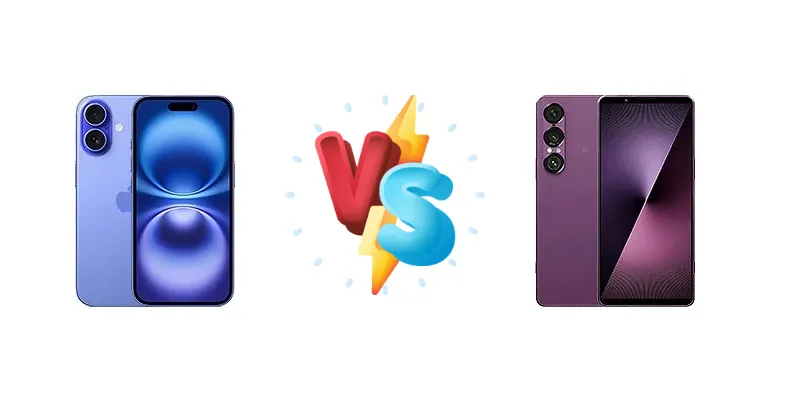
|
🏆 Quick Verdict
For the average user deeply embedded in the Apple ecosystem, the iPhone 16 offers a seamless experience with strong performance and a bright display. However, the Sony Xperia 1 VII edges ahead for power users prioritizing battery endurance and faster wired charging, despite a slightly lower peak brightness.
| PHONES | ||
|---|---|---|
| Phone Names | Apple iPhone 16 | Sony Xperia 1 VII |
| Network | ||
|---|---|---|
| 2G bands | GSM 850 / 900 / 1800 / 1900 | GSM 850 / 900 / 1800 / 1900 |
| 3G bands | HSDPA 850 / 900 / 1700(AWS) / 1900 / 2100 | HSDPA 800 / 850 / 900 / 1700(AWS) / 1900 / 2100 |
| 4G bands | 1, 2, 3, 4, 5, 7, 8, 12, 13, 17, 18, 19, 20, 25, 26, 28, 30, 32, 34, 38, 39, 40, 41, 42, 48, 53, 66 - A3287 | 1, 2, 3, 4, 5, 7, 8, 12, 13, 17, 19, 20, 25, 26, 28, 32, 34, 38, 39, 40, 41, 66 - Europe |
| 5G bands | 1, 2, 3, 5, 7, 8, 12, 20, 25, 26, 28, 30, 38, 40, 41, 48, 53, 66, 70, 75, 76, 77, 78, 79 SA/NSA/Sub6 - A3287 | 1, 3, 5, 7, 8, 20, 28, 38, 40, 41, 75, 77, 78 SA/NSA/Sub6 - Europe |
| Speed | HSPA, LTE, 5G, EV-DO Rev.A 3.1 Mbps | HSPA, LTE, 5G |
| Technology | GSM / CDMA / HSPA / EVDO / LTE / 5G | GSM / HSPA / LTE / 5G |
| Launch | ||
|---|---|---|
| Announced | 2024, September 09 | 2025, May 13 |
| Status | Available. Released 2024, September 20 | Available. Released 2025, June 04 |
| Body | ||
|---|---|---|
| Build | Glass front (Ceramic Shield), glass back, aluminum frame | Glass front (Gorilla Glass Victus 2), glass back (Gorilla Glass Victus), aluminum frame |
| Dimensions | 147.6 x 71.6 x 7.8 mm (5.81 x 2.82 x 0.31 in) | 162 x 74 x 8.2 mm (6.38 x 2.91 x 0.32 in) |
| SIM | · Nano-SIM + eSIM + eSIM (max 2 at a time; International)· eSIM + eSIM (8 or more, max 2 at a time; USA)· Nano-SIM + Nano-SIM (China) | · Nano-SIM + eSIM· Nano-SIM + Nano-SIM |
| Weight | 170 g (6.00 oz) | 197 g (6.95 oz) |
| Display | ||
|---|---|---|
| Protection | Ceramic Shield glass (2024 gen), Mohs level 4 | Corning Gorilla Glass Victus 2, Mohs level 5 |
| Resolution | 1179 x 2556 pixels, 19.5:9 ratio (~460 ppi density) | 1080 x 2340 pixels, 19.5:9 ratio (~396 ppi density) |
| Size | 6.1 inches, 91.7 cm2 (~86.8% screen-to-body ratio) | 6.5 inches, 103.7 cm2 (~86.5% screen-to-body ratio) |
| Type | Super Retina XDR OLED, HDR10, Dolby Vision, 1000 nits (typ), 2000 nits (HBM) | LTPO OLED, 1B colors, 120Hz, HDR BT.2020 |
| Platform | ||
|---|---|---|
| CPU | Hexa-core (2x4.04 GHz + 4x2.20 GHz) | Octa-core (2x4.32 GHz Oryon V2 Phoenix L + 6x3.53 GHz Oryon V2 Phoenix M) |
| Chipset | Apple A18 (3 nm) | Qualcomm SM8750-AB Snapdragon 8 Elite (3 nm) |
| GPU | Apple GPU (5-core graphics) | Adreno 830 |
| OS | iOS 18, upgradable to iOS 26.1 | Android 15, up to 4 major Android upgrades |
| Memory | ||
|---|---|---|
| Card slot | No | microSDXC (uses shared SIM slot) |
| Internal | 128GB 8GB RAM, 256GB 8GB RAM, 512GB 8GB RAM | 256GB 12GB RAM, 512GB 12GB RAM |
| Main Camera | ||
|---|---|---|
| Dual | 48 MP, f/1.6, 26mm (wide), 1/1.56", 1.0µm, dual pixel PDAF, sensor-shift OIS 12 MP, f/2.2, 13mm, 120˚ (ultrawide), 0.7µm, dual pixel PDAF | - |
| Features | Dual-LED dual-tone flash, HDR (photo/panorama) | Zeiss optics, Zeiss T* lens coating, color spectrum sensor, LED flash, panorama, HDR, eye tracking |
| Triple | - | 48 MP, f/1.9, 24mm (wide), 1/1.35", 1.12µm, dual pixel PDAF, OIS 12 MP, f/2.3, 85mm (telephoto), f/3.5, 170mm (telephoto), 1/3.5", 1.0µm, dual pixel PDAF, 3.5x-7.1x continuous optical zoom, OIS, 4cm macro @ 120mm, no AF 48 MP, f/2.0, 16mm (ultrawide), 1/1.56", 1.0µm, PDAF |
| Video | 4K@24/25/30/60fps, 1080p@25/30/60/120/240fps, HDR, Dolby Vision HDR (up to 60fps), stereo sound rec. | 4K@24/30/60/120fps HDR, 1080p@30/60/120fps; 5-axis gyro-EIS, OIS |
| Selfie camera | ||
|---|---|---|
| Features | HDR, Dolby Vision HDR, 3D (spatial) audio, stereo sound rec. | HDR |
| Single | 12 MP, f/1.9, 23mm (wide), 1/3.6", 1.0µm, PDAF SL 3D, (depth/biometrics sensor) | 12 MP, f/2.0, 24mm (wide), 1/2.9", 1.22µm |
| Video | 4K@24/25/30/60fps, 1080p@25/30/60/120fps, gyro-EIS | 4K@30/60fps, 1080p@30/60fps, 5-axis gyro-EIS |
| Sound | ||
|---|---|---|
| 35mm jack | No | Yes |
| Loudspeaker | Yes, with stereo speakers | Yes, with stereo speakers |
| Comms | ||
|---|---|---|
| Bluetooth | 5.3, A2DP, LE | 6.0, A2DP, LE Audio, aptX HD, aptX Adaptive, aptX Lossless |
| NFC | Yes | Yes |
| Positioning | GPS, GLONASS, GALILEO, BDS, QZSS | GPS, GLONASS, BDS, GALILEO, QZSS |
| Radio | No | No |
| USB | USB Type-C 2.0, DisplayPort | USB Type-C 3.2, OTG, video output |
| WLAN | Wi-Fi 802.11 a/b/g/n/ac/6/7, tri-band, hotspot | Wi-Fi 802.11 a/b/g/n/ac/6e/7, tri-band, Wi-Fi Direct, DLNA |
| Features | ||
|---|---|---|
| Sensors | Face ID, accelerometer, gyro, proximity, compass, barometer | Fingerprint (side-mounted), accelerometer, gyro, proximity, barometer, compass |
| Battery | ||
|---|---|---|
| Charging | Wired, PD2.0, 50% in 30 min 25W wireless (MagSafe), 15W wireless (China only) 15W wireless (Qi2) 4.5W reverse wired | 30W wired, PD3.0, PPS, 50% in 30 min 15W wireless Reverse wireless |
| Type | Li-Ion 3561 mAh | 5000 mAh |
| Misc | ||
|---|---|---|
| Colors | Black, White, Pink, Teal, Ultramarine | Moss Green, Orchid Purple, Slate Black |
| Models | A3287, A3081, A3286, A3288, iPhone17,3 | XQ-FS54, XQFS54EUKCG.GC, XQFS54EUKCV.GC, XQFS54EUKCB.GC, PDX256 |
| Price | $ 494.93 / C$ 945.75 / £ 569.99 / € 678.57 / ₹ 66,900 | € 1,338.99 / $ 1,394.99 / £ 1,149.94 |
| SAR | 1.08 W/kg (head) 1.17 W/kg (body) | - |
| SAR EU | 1.24 W/kg (head) 1.41 W/kg (body) | - |
| EU LABEL | ||
|---|---|---|
| Battery | 37:00h endurance, 1000 cycles | 43:30h endurance, 1400 cycles |
| Energy | Class B | Class B |
| Free fall | Class C (90 falls) | Class B (181 falls) |
| Repairability | Class C | Class D |
Apple iPhone 16
- Brighter display for outdoor visibility (1708 nits)
- Seamless integration with Apple ecosystem
- Convenience of MagSafe wireless charging
- Lower battery endurance (37:00h)
- Slower wired charging compared to Xperia 1 VII
- Limited customization options compared to Android
Sony Xperia 1 VII
- Superior battery endurance (43:30h)
- Faster wired charging (30W)
- More customizable Android experience
- Slightly dimmer display (1475 nits)
- Less seamless integration with non-Android devices
- Potentially more complex user interface
Display Comparison
Both the iPhone 16 and Xperia 1 VII boast excellent displays, utilizing 3nm chipsets to drive them efficiently. The iPhone 16 achieves a measured peak brightness of 1708 nits, surpassing the Xperia 1 VII’s 1475 nits, making it slightly more visible in direct sunlight. While both likely employ LTPO technology for variable refresh rates (based on brand history), this isn’t specified. The Xperia 1 VII’s display, while dimmer, benefits from Sony’s renowned color science, potentially offering more accurate color reproduction for professional photo and video editing. The iPhone 16’s higher brightness is a boon for outdoor visibility.
Camera Comparison
Context data lacks camera specifics, forcing analysis based on brand reputation. Sony’s Xperia line historically emphasizes camera capabilities, and the 1 VII likely features a sophisticated imaging system with a large main sensor and advanced image processing. Apple typically prioritizes computational photography and ease of use. The Xperia 1 VII will likely offer more manual control and customization options, appealing to photography enthusiasts. Without sensor size or aperture data, it’s difficult to definitively declare a winner, but Sony’s expertise in image sensor technology gives it a potential edge. We can assume both will offer excellent video recording capabilities.
Performance
The performance battle is intriguing. Apple’s A18, a 3nm hexa-core chip with peak clock speeds of 4.04 GHz, faces off against Qualcomm’s Snapdragon 8 Elite (SM8750-AB), also 3nm, featuring an octa-core configuration with Oryon V2 Phoenix cores reaching 4.32 GHz. The Xperia 1 VII’s octa-core CPU, with its two high-performance and six efficiency cores, suggests a potential advantage in multi-threaded tasks. However, Apple’s tight software integration and optimized silicon often translate to superior real-world responsiveness. Both devices utilize LPDDR5x RAM, but the specific capacity isn’t provided. Thermal management will be crucial; the Snapdragon 8 Elite’s architecture aims for efficiency, but sustained loads will reveal its true capabilities.
Battery Life
The Sony Xperia 1 VII takes a clear lead in battery endurance with a measured 43:30h compared to the iPhone 16’s 37:00h. While both achieve a 50% charge in 30 minutes with their respective fast charging technologies (PD3.0/PPS for Sony, PD2.0 for Apple), the Xperia 1 VII’s 30W wired charging is faster than the iPhone 16’s 25W wireless (MagSafe) and 15W Qi2. The Xperia 1 VII also offers reverse wireless charging, a feature absent on the iPhone 16. The Xperia 1 VII’s 1400 cycle lifespan also exceeds the iPhone 16’s 1000 cycles, suggesting greater long-term battery health.
Buying Guide
Buy the Apple iPhone 16 if you need effortless integration with other Apple devices, prioritize a polished software experience, and value the convenience of MagSafe wireless charging. Buy the Sony Xperia 1 VII if you prefer a more customizable Android experience, demand exceptional battery life for extended use, and require the fastest possible wired charging speeds.