
iPhone 16 vs. Galaxy Z Fold7: A Head-to-Head Comparison of Apple's Flagship and Samsung's Foldable
| Phones Images | |||||
|---|---|---|---|---|---|
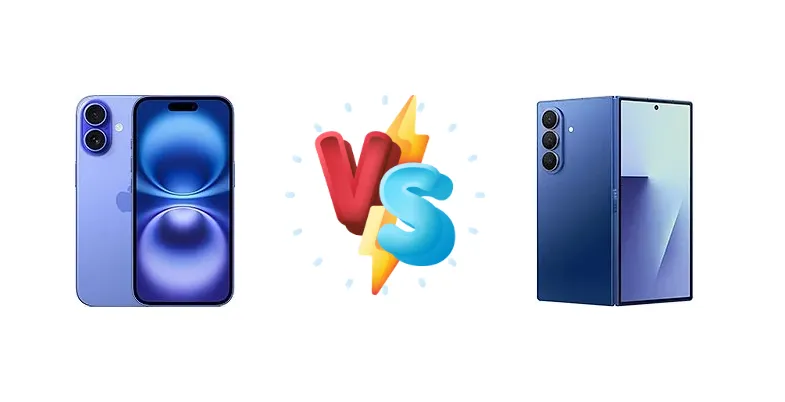
|
🏆 Quick Verdict
For the average user prioritizing a polished, bright display and seamless software integration, the iPhone 16 is the stronger choice. However, the Galaxy Z Fold7’s superior battery endurance and multitasking capabilities make it ideal for power users and those seeking a truly innovative mobile experience.
| PHONES | ||
|---|---|---|
| Phone Names | Apple iPhone 16 | Samsung Galaxy Z Fold7 |
| Network | ||
|---|---|---|
| 2G bands | GSM 850 / 900 / 1800 / 1900 | GSM 850 / 900 / 1800 / 1900 |
| 3G bands | HSDPA 850 / 900 / 1700(AWS) / 1900 / 2100 | HSDPA 850 / 900 / 1700(AWS) / 1900 / 2100 |
| 4G bands | 1, 2, 3, 4, 5, 7, 8, 12, 13, 17, 18, 19, 20, 25, 26, 28, 30, 32, 34, 38, 39, 40, 41, 42, 48, 53, 66 - A3287 | 1, 2, 3, 4, 5, 7, 8, 12, 13, 17, 18, 19, 20, 25, 26, 28, 38, 39, 40, 41, 66 - International |
| 5G bands | 1, 2, 3, 5, 7, 8, 12, 20, 25, 26, 28, 30, 38, 40, 41, 48, 53, 66, 70, 75, 76, 77, 78, 79 SA/NSA/Sub6 - A3287 | 1, 2, 3, 5, 7, 8, 12, 20, 25, 26, 28, 38, 40, 41, 66, 71, 77, 78 SA/NSA/Sub6 - International |
| Speed | HSPA, LTE, 5G, EV-DO Rev.A 3.1 Mbps | HSPA, LTE, 5G |
| Technology | GSM / CDMA / HSPA / EVDO / LTE / 5G | GSM / CDMA / HSPA / EVDO / LTE / 5G |
| Launch | ||
|---|---|---|
| Announced | 2024, September 09 | 2025, July 09 |
| Status | Available. Released 2024, September 20 | Available. Released 2025, July 25 |
| Body | ||
|---|---|---|
| Build | Glass front (Ceramic Shield), glass back, aluminum frame | Glass front (Gorilla Glass Victus Ceramic 2) (folded), plastic front (unfolded), glass back (Gorilla Glass Victus 2), aluminum frame |
| Dimensions | 147.6 x 71.6 x 7.8 mm (5.81 x 2.82 x 0.31 in) | Unfolded: 158.4 x 143.2 x 4.2 mmFolded: 158.4 x 72.8 x 8.9 mm |
| SIM | · Nano-SIM + eSIM + eSIM (max 2 at a time; International)· eSIM + eSIM (8 or more, max 2 at a time; USA)· Nano-SIM + Nano-SIM (China) | · Nano-SIM + Nano-SIM + eSIM + eSIM (max 2 at a time)· Nano-SIM + Nano-SIM + multiple eSIM (max 2 at a time) |
| Weight | 170 g (6.00 oz) | 215 g (7.58 oz) |
| Display | ||
|---|---|---|
| Protection | Ceramic Shield glass (2024 gen), Mohs level 4 | Mohs level 1 |
| Resolution | 1179 x 2556 pixels, 19.5:9 ratio (~460 ppi density) | 1968 x 2184 pixels (~368 ppi density) |
| Size | 6.1 inches, 91.7 cm2 (~86.8% screen-to-body ratio) | 8.0 inches, 204.2 cm2 (~90.0% screen-to-body ratio) |
| Type | Super Retina XDR OLED, HDR10, Dolby Vision, 1000 nits (typ), 2000 nits (HBM) | Foldable Dynamic LTPO AMOLED 2X, 120Hz, HDR10+, 2600 nits (peak) |
| Platform | ||
|---|---|---|
| CPU | Hexa-core (2x4.04 GHz + 4x2.20 GHz) | Octa-core (2x4.47 GHz Oryon V2 Phoenix L + 6x3.53 GHz Oryon V2 Phoenix M) |
| Chipset | Apple A18 (3 nm) | Qualcomm SM8750-AC Snapdragon 8 Elite (3 nm) |
| GPU | Apple GPU (5-core graphics) | Adreno 830 (1200 MHz) |
| OS | iOS 18, upgradable to iOS 26.1 | Android 16, up to 7 major Android upgrades, One UI 8 |
| Memory | ||
|---|---|---|
| Card slot | No | No |
| Internal | 128GB 8GB RAM, 256GB 8GB RAM, 512GB 8GB RAM | 256GB 12GB RAM, 512GB 12GB RAM, 1TB 12GB RAM, 1TB 16GB RAM |
| Main Camera | ||
|---|---|---|
| Dual | 48 MP, f/1.6, 26mm (wide), 1/1.56", 1.0µm, dual pixel PDAF, sensor-shift OIS 12 MP, f/2.2, 13mm, 120˚ (ultrawide), 0.7µm, dual pixel PDAF | - |
| Features | Dual-LED dual-tone flash, HDR (photo/panorama) | LED flash, HDR, panorama |
| Triple | - | 200 MP, f/1.7, 24mm (wide), 1/1.3", 0.6µm, multi-directional PDAF, OIS 10 MP, f/2.4, 67mm (telephoto), 1/3.94", 1.0µm, PDAF, OIS, 3x optical zoom 12 MP, f/2.2, 13mm, 120˚ (ultrawide), 1/2.55", 1.4µm, dual pixel PDAF |
| Video | 4K@24/25/30/60fps, 1080p@25/30/60/120/240fps, HDR, Dolby Vision HDR (up to 60fps), stereo sound rec. | 8K@30fps, 4K@60fps, 1080p@60/120/240fps (gyro-EIS), 10-bit HDR, HDR10+ |
| Selfie camera | ||
|---|---|---|
| Features | HDR, Dolby Vision HDR, 3D (spatial) audio, stereo sound rec. | HDR |
| Single | 12 MP, f/1.9, 23mm (wide), 1/3.6", 1.0µm, PDAF SL 3D, (depth/biometrics sensor) | 10 MP, f/2.2, 18mm (ultrawide), 1/3.0", 1.12µm Cover camera: 10 MP, f/2.2, 24mm (wide), 1/3.0", 1.12µm |
| Video | 4K@24/25/30/60fps, 1080p@25/30/60/120fps, gyro-EIS | 4K@30/60fps, 1080p@30/60fps, gyro-EIS |
| Sound | ||
|---|---|---|
| 35mm jack | No | No |
| Loudspeaker | Yes, with stereo speakers | Yes, with stereo speakers |
| Comms | ||
|---|---|---|
| Bluetooth | 5.3, A2DP, LE | 5.4, A2DP, LE, aptX HD |
| NFC | Yes | Yes |
| Positioning | GPS, GLONASS, GALILEO, BDS, QZSS | GPS, GALILEO, GLONASS, BDS, QZSS |
| Radio | No | No |
| USB | USB Type-C 2.0, DisplayPort | USB Type-C 3.2, OTG |
| WLAN | Wi-Fi 802.11 a/b/g/n/ac/6/7, tri-band, hotspot | Wi-Fi 802.11 a/b/g/n/ac/6e/7, tri-band, Wi-Fi Direct |
| Features | ||
|---|---|---|
| Sensors | Face ID, accelerometer, gyro, proximity, compass, barometer | Fingerprint (side-mounted), accelerometer, gyro, proximity, compass, barometer |
| Battery | ||
|---|---|---|
| Charging | Wired, PD2.0, 50% in 30 min 25W wireless (MagSafe), 15W wireless (China only) 15W wireless (Qi2) 4.5W reverse wired | 25W wired, QC2.0, 50% in 30 min 15W wireless 4.5W reverse wireless |
| Type | Li-Ion 3561 mAh | Li-Po 4400 mAh |
| Misc | ||
|---|---|---|
| Colors | Black, White, Pink, Teal, Ultramarine | Blue Shadow, Silver Shadow, Jet Black, Mint |
| Models | A3287, A3081, A3286, A3288, iPhone17,3 | SM-F966B, SM-F966B/DS, SM-F966U, SM-F966U1 |
| Price | $ 494.93 / C$ 945.75 / £ 569.99 / € 678.57 / ₹ 66,900 | € 1,367.99 / $ 1,399.99 / £ 1,449.00 / ₹ 174,999 |
| SAR | 1.08 W/kg (head) 1.17 W/kg (body) | 1.24 W/kg (head) 1.36 W/kg (body) |
| SAR EU | 1.24 W/kg (head) 1.41 W/kg (body) | 1.42 W/kg (head) 1.24 W/kg (body) |
| EU LABEL | ||
|---|---|---|
| Battery | 37:00h endurance, 1000 cycles | 40:28h endurance, 2000 cycles |
| Energy | Class B | Class B |
| Free fall | Class C (90 falls) | Class A (210 falls) |
| Repairability | Class C | Class C |
Apple iPhone 16
- Brighter, more color-accurate display
- Optimized software experience
- Compact and pocketable design
- Lower battery endurance compared to Z Fold7
- Fewer multitasking capabilities
- Limited customization options
Samsung Galaxy Z Fold7
- Exceptional battery life and charge cycles
- Large, immersive foldable display
- Enhanced multitasking capabilities
- Lower peak display brightness
- Potential for crease visibility and panel uniformity issues
- Larger and less pocketable form factor
Display Comparison
The iPhone 16 boasts a peak brightness of 1708 nits, significantly exceeding the Galaxy Z Fold7’s 1408 nits, making it more visible in direct sunlight. While both utilize 3nm chipsets, the Z Fold7’s foldable display introduces complexities in panel uniformity and crease visibility, areas where the iPhone 16’s flat panel excels. The Z Fold7’s larger screen real estate is a clear advantage for multitasking, but the iPhone 16’s color accuracy and brightness provide a superior viewing experience for media consumption.
Camera Comparison
While detailed camera specs are absent, the focus should be on image processing. Apple typically prioritizes natural-looking images, while Samsung often boosts saturation and contrast. The Z Fold7’s larger size could accommodate a larger main sensor, potentially improving low-light performance, but without specific sensor size data, this remains speculative. The iPhone 16’s computational photography capabilities, driven by the A18 chip, are likely to deliver consistently high-quality results across various shooting conditions.
Performance
Both devices are powered by 3nm chipsets, but their architectures differ significantly. The iPhone 16’s Apple A18 features a hexa-core CPU (2x4.04 GHz + 4x2.20 GHz), while the Galaxy Z Fold7 utilizes the Qualcomm SM8750-AC Snapdragon 8 Elite with an octa-core CPU (2x4.47 GHz Oryon V2 Phoenix L + 6x3.53 GHz Oryon V2 Phoenix M). The Z Fold7’s Oryon cores, while numerous, may not translate to a consistently faster experience than the A18 due to Apple’s tight software optimization. The Z Fold7’s larger form factor may also present thermal challenges, potentially leading to throttling under sustained load.
Battery Life
The Galaxy Z Fold7’s 40:28h endurance and 2000 charge cycles significantly outperform the iPhone 16’s 37:00h endurance and 1000 cycles. Despite the iPhone 16’s faster 30-minute-to-50% wired charging, the Z Fold7’s larger battery capacity and superior endurance provide a more reliable experience for heavy users. The active use score of 15:42h for the iPhone 16 versus 11:44h for the Z Fold7 suggests the iPhone is more efficient *during* active use, but the Z Fold7’s overall capacity wins out.
Buying Guide
Buy the Apple iPhone 16 if you need a consistently bright, color-accurate display, a streamlined user experience, and prioritize a compact form factor. Buy the Samsung Galaxy Z Fold7 if you prefer a larger screen for productivity, demand exceptional battery life, and are willing to embrace the unique advantages of a foldable device.