
iPhone 16 vs Google Pixel 10 Pro Fold: A Deep Dive into Flagship Power and Form Factor
| Phones Images | |||||
|---|---|---|---|---|---|
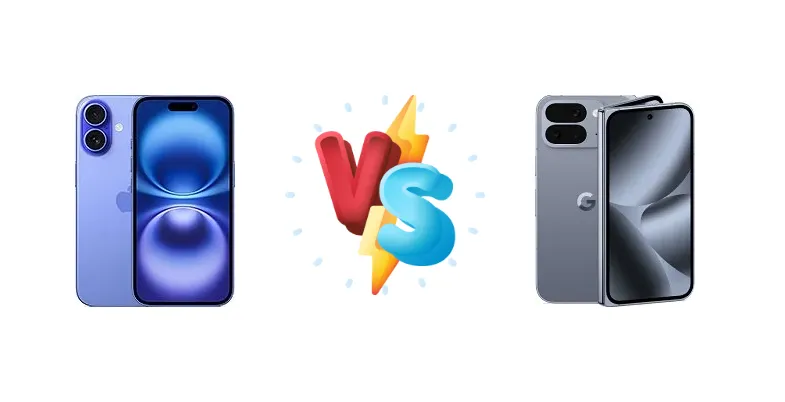
|
🏆 Quick Verdict
For the average user prioritizing seamless performance and a mature ecosystem, the iPhone 16 is the stronger choice. Its A18 chip and optimized software deliver a consistently smooth experience. However, the Pixel 10 Pro Fold’s significantly longer battery endurance and innovative foldable design make it compelling for power users and those seeking a truly different smartphone experience.
| PHONES | ||
|---|---|---|
| Phone Names | Apple iPhone 16 | Google Pixel 10 Pro Fold |
| Network | ||
|---|---|---|
| 2G bands | GSM 850 / 900 / 1800 / 1900 | GSM 850 / 900 / 1800 / 1900 |
| 3G bands | HSDPA 850 / 900 / 1700(AWS) / 1900 / 2100 | HSDPA 800 / 850 / 900 / 1700(AWS) / 1900 / 2100 |
| 4G bands | 1, 2, 3, 4, 5, 7, 8, 12, 13, 17, 18, 19, 20, 25, 26, 28, 30, 32, 34, 38, 39, 40, 41, 42, 48, 53, 66 - A3287 | 1, 2, 3, 4, 5, 7, 8, 12, 13, 14, 17, 18, 19, 20, 21, 25, 26, 29, 30, 32, 38, 39, 40, 42, 48, 66, 71, 75 - GU0NP International |
| 5G bands | 1, 2, 3, 5, 7, 8, 12, 20, 25, 26, 28, 30, 38, 40, 41, 48, 53, 66, 70, 75, 76, 77, 78, 79 SA/NSA/Sub6 - A3287 | 1, 2, 3, 5, 7, 8, 12, 14, 20, 25, 26, 28, 29, 30, 40, 48, 66, 70, 71, 75, 77, 78, 79, 257, 258, 260, 261 SA/NSA/Sub6 - GU0NP International |
| Speed | HSPA, LTE, 5G, EV-DO Rev.A 3.1 Mbps | HSPA, LTE, 5G |
| Technology | GSM / CDMA / HSPA / EVDO / LTE / 5G | GSM / HSPA / LTE / 5G |
| Launch | ||
|---|---|---|
| Announced | 2024, September 09 | 2025, August 20 |
| Status | Available. Released 2024, September 20 | Available. Released 2025, October 09 |
| Body | ||
|---|---|---|
| Build | Glass front (Ceramic Shield), glass back, aluminum frame | Glass front (Gorilla Glass Victus 2) (folded), plastic front (unfolded), glass back (Gorilla Glass Victus 2), aluminum frame |
| Dimensions | 147.6 x 71.6 x 7.8 mm (5.81 x 2.82 x 0.31 in) | Unfolded: 155.2 x 150.4 x 5.2 mmFolded: 155.2 x 76.3 x 10.8 mm |
| SIM | · Nano-SIM + eSIM + eSIM (max 2 at a time; International)· eSIM + eSIM (8 or more, max 2 at a time; USA)· Nano-SIM + Nano-SIM (China) | Nano-SIM + eSIM |
| Weight | 170 g (6.00 oz) | 258 g (9.10 oz) |
| Display | ||
|---|---|---|
| Protection | Ceramic Shield glass (2024 gen), Mohs level 4 | Mohs level 5 |
| Resolution | 1179 x 2556 pixels, 19.5:9 ratio (~460 ppi density) | 2076 x 2152 pixels, 1:1 ratio (~374 ppi density) |
| Size | 6.1 inches, 91.7 cm2 (~86.8% screen-to-body ratio) | 8.0 inches, 206.3 cm2 (~88.4% screen-to-body ratio) |
| Type | Super Retina XDR OLED, HDR10, Dolby Vision, 1000 nits (typ), 2000 nits (HBM) | Foldable LTPO OLED, 120Hz, HDR10+, 1800 nits (HBM), 3000 nits (peak) |
| Platform | ||
|---|---|---|
| CPU | Hexa-core (2x4.04 GHz + 4x2.20 GHz) | Octa-core (1x3.78 GHz Cortex-X4 & 5x3.05 GHz Cortex-A725 & 2x2.25 GHz Cortex-A520) |
| Chipset | Apple A18 (3 nm) | Google Tensor G5 (3 nm) |
| GPU | Apple GPU (5-core graphics) | PowerVR DXT-48-1536 |
| OS | iOS 18, upgradable to iOS 26.1 | Android 16, up to 7 major Android upgrades |
| Memory | ||
|---|---|---|
| Card slot | No | No |
| Internal | 128GB 8GB RAM, 256GB 8GB RAM, 512GB 8GB RAM | 256GB 16GB RAM, 512GB 16GB RAM, 1TB 16GB RAM |
| Main Camera | ||
|---|---|---|
| Dual | 48 MP, f/1.6, 26mm (wide), 1/1.56", 1.0µm, dual pixel PDAF, sensor-shift OIS 12 MP, f/2.2, 13mm, 120˚ (ultrawide), 0.7µm, dual pixel PDAF | - |
| Features | Dual-LED dual-tone flash, HDR (photo/panorama) | Multi-zone Laser AF, LED flash, Pixel Shift, Ultra-HDR, panorama, Best Take, Zoom Enhance |
| Triple | - | 48 MP, f/1.7, 25mm (wide), 1/2.0", 0.8µm, dual pixel PDAF, OIS 10.8 MP, f/3.1, 112mm (telephoto), 1/3.2", dual pixel PDAF, OIS, 5x optical zoom 10.5 MP, f/2.2, 127˚ (ultrawide), 1/3.4", PDAF |
| Video | 4K@24/25/30/60fps, 1080p@25/30/60/120/240fps, HDR, Dolby Vision HDR (up to 60fps), stereo sound rec. | 4K@24/30/60fps, 1080p@24/30/60/120/240fps, 10-bit HDR, gyro-EIS, OIS |
| Selfie camera | ||
|---|---|---|
| Features | HDR, Dolby Vision HDR, 3D (spatial) audio, stereo sound rec. | HDR, panorama |
| Single | 12 MP, f/1.9, 23mm (wide), 1/3.6", 1.0µm, PDAF SL 3D, (depth/biometrics sensor) | 10 MP, f/2.2, 23mm (wide), 1/3.94", PDAF Cover camera: 10 MP, f/2.2, 23mm (wide), 1/3.94", PDAF |
| Video | 4K@24/25/30/60fps, 1080p@25/30/60/120fps, gyro-EIS | 4K@30/60fps, 1080p@30/60fps |
| Sound | ||
|---|---|---|
| 35mm jack | No | No |
| Loudspeaker | Yes, with stereo speakers | Yes, with stereo speakers |
| Comms | ||
|---|---|---|
| Bluetooth | 5.3, A2DP, LE | 6.0, A2DP, LE, aptX HD |
| NFC | Yes | Yes |
| Positioning | GPS, GLONASS, GALILEO, BDS, QZSS | GPS (L1+L5), GLONASS, GALILEO, BDS, QZSS, NavIC |
| Radio | No | No |
| USB | USB Type-C 2.0, DisplayPort | USB Type-C 3.2 |
| WLAN | Wi-Fi 802.11 a/b/g/n/ac/6/7, tri-band, hotspot | Wi-Fi 802.11 a/b/g/n/ac/6e/7, tri-band |
| Features | ||
|---|---|---|
| Sensors | Face ID, accelerometer, gyro, proximity, compass, barometer | Fingerprint (side-mounted), accelerometer, gyro, proximity, compass, barometer |
| Battery | ||
|---|---|---|
| Charging | Wired, PD2.0, 50% in 30 min 25W wireless (MagSafe), 15W wireless (China only) 15W wireless (Qi2) 4.5W reverse wired | 30W wired, PPS, 50% in 30 min 15W wireless (magnetic), Qi2 Bypass charging |
| Type | Li-Ion 3561 mAh | 5015 mAh |
| Misc | ||
|---|---|---|
| Colors | Black, White, Pink, Teal, Ultramarine | Moonstone, Jade |
| Models | A3287, A3081, A3286, A3288, iPhone17,3 | GU0NP, GM66V |
| Price | $ 494.93 / C$ 945.75 / £ 569.99 / € 678.57 / ₹ 66,900 | $ 1,499.00 / C$ 2,119.99 / £ 1,749.00 / € 1,757.00 |
| SAR | 1.08 W/kg (head) 1.17 W/kg (body) | 0.99 W/kg (head) 0.99 W/kg (body) |
| SAR EU | 1.24 W/kg (head) 1.41 W/kg (body) | 0.99 W/kg (head) 1.39 W/kg (body) |
| EU LABEL | ||
|---|---|---|
| Battery | 37:00h endurance, 1000 cycles | 47:55h endurance, 1000 cycles |
| Energy | Class B | Class B |
| Free fall | Class C (90 falls) | Class A (210 falls) |
| Repairability | Class C | Class C |
Apple iPhone 16
- Exceptional performance with the A18 chip
- Bright and color-accurate display
- Mature and polished iOS ecosystem
- Shorter battery life compared to the Pixel 10 Pro Fold
- Less innovative form factor
Google Pixel 10 Pro Fold
- Outstanding battery endurance
- Immersive foldable display for multitasking
- Advanced AI and machine learning capabilities
- Potential durability concerns with a foldable screen
- Performance may lag behind the A18 in some tasks
Display Comparison
The iPhone 16 boasts a peak brightness of 1708 nits, ensuring excellent visibility even in direct sunlight. While the Pixel 10 Pro Fold’s display specifications are not provided, foldable displays typically prioritize color accuracy and viewing angles over absolute peak brightness. The iPhone 16’s likely use of LTPO technology will contribute to power efficiency, dynamically adjusting refresh rates. The Pixel 10 Pro Fold’s larger, foldable screen offers a significantly different user experience, ideal for multitasking and content creation, but may be more susceptible to crease visibility and durability concerns. The iPhone 16’s smaller form factor will appeal to those who prefer a more pocketable device.
Camera Comparison
Without specific camera details for either device, we can infer based on brand history. Apple typically prioritizes natural-looking images with accurate color reproduction, while Google’s Pixel line is renowned for its computational photography prowess, particularly in low-light conditions. The Pixel 10 Pro Fold’s larger form factor *could* accommodate a larger main sensor, potentially capturing more light and detail. However, the iPhone 16’s image processing pipeline is highly refined, and its video recording capabilities are consistently top-tier. Both devices will likely feature advanced image stabilization and a suite of AI-powered features.
Performance
Apple’s A18 chip, fabricated on a 3nm process, promises substantial performance gains over its predecessor. Its hexa-core configuration (2x4.04 GHz + 4x2.20 GHz) is geared towards both peak performance and efficiency. The Google Pixel 10 Pro Fold counters with the Tensor G5, also built on a 3nm process, featuring an octa-core setup (1x3.78 GHz Cortex-X4 & 5x3.05 GHz Cortex-A725 & 2x2.25 GHz Cortex-A520). While the Tensor G5’s core count is higher, the A18’s architectural advantages and Apple’s tight software integration typically translate to superior real-world performance, particularly in demanding tasks like gaming and video editing. The Pixel 10 Pro Fold’s focus is likely on AI and machine learning tasks, leveraging the Tensor G5’s dedicated processing units.
Battery Life
The Pixel 10 Pro Fold significantly outpaces the iPhone 16 in battery endurance, offering 47:55 hours compared to the iPhone 16’s 37:00 hours. This difference is substantial and suggests the Pixel 10 Pro Fold is designed for all-day – and potentially multi-day – use. The iPhone 16 offers a respectable 15:42 hours of active use. While both devices support 50% charging in 30 minutes, the Pixel 10 Pro Fold’s 30W wired charging with PPS is slightly more efficient than the iPhone 16’s PD2.0. The iPhone 16 offers versatile wireless charging options with 25W MagSafe and 15W Qi2, while the Pixel 10 Pro Fold provides 15W magnetic wireless and Qi2, plus bypass charging which allows charging while in use.
Buying Guide
Buy the Apple iPhone 16 if you need a consistently fast and reliable smartphone with a polished user experience, strong app support, and a focus on privacy. Buy the Google Pixel 10 Pro Fold if you prioritize maximum battery life, a large, immersive display for multitasking and media consumption, and are willing to embrace the unique benefits – and potential quirks – of a foldable form factor.