
iPhone 16 Pro vs. vivo X200 Pro mini: Battle of the Compact Powerhouses
| Phones Images | |||||
|---|---|---|---|---|---|
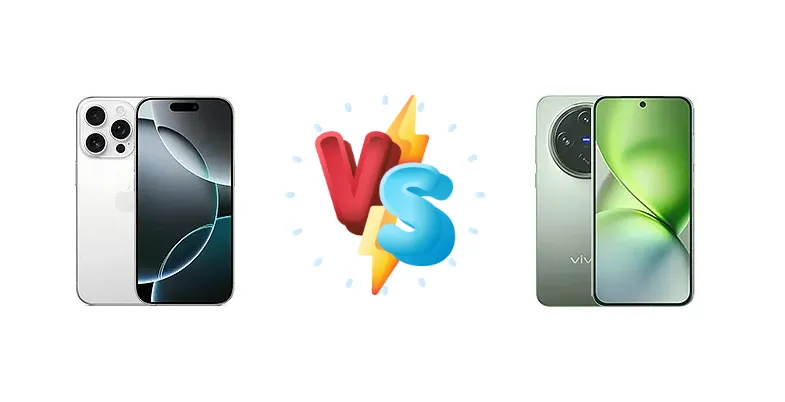
|
🏆 Quick Verdict
For the average user deeply embedded in the Apple ecosystem, the iPhone 16 Pro offers a seamless experience and long-term software support. However, the vivo X200 Pro mini wins for users prioritizing charging speed and raw performance, offering a compelling alternative with its Dimensity 9400 chipset.
| PHONES | ||
|---|---|---|
| Phone Names | Apple iPhone 16 Pro | vivo X200 Pro mini |
| Network | ||
|---|---|---|
| 2G bands | GSM 850 / 900 / 1800 / 1900 | GSM 850 / 900 / 1800 / 1900 |
| 3G bands | HSDPA 850 / 900 / 1700(AWS) / 1900 / 2100 | HSDPA 800 / 850 / 900 / 1700(AWS) / 1900 / 2100 |
| 4G bands | 1, 2, 3, 4, 5, 7, 8, 12, 13, 17, 18, 19, 20, 25, 26, 28, 30, 32, 34, 38, 39, 40, 41, 42, 48, 53, 66 - A3293 | 1, 2, 3, 4, 5, 7, 8, 18, 19, 26, 28, 34, 38, 39, 40, 41, 66 |
| 5G bands | 1, 2, 3, 5, 7, 8, 12, 20, 25, 26, 28, 30, 38, 40, 41, 48, 53, 66, 70, 75, 76, 77, 78, 79 SA/NSA/Sub6 - A3293 | 1, 3, 5, 8, 28, 38, 40, 41, 77, 78 SA/NSA |
| Speed | HSPA, LTE, 5G, EV-DO Rev.A 3.1 Mbps | HSPA, LTE, 5G |
| Technology | GSM / CDMA / HSPA / EVDO / LTE / 5G | GSM / HSPA / LTE / 5G |
| Launch | ||
|---|---|---|
| Announced | 2024, September 09 | 2024, October 14 |
| Status | Available. Released 2024, September 20 | Available. Released 2024, October 25 |
| Body | ||
|---|---|---|
| Build | Glass front (Ceramic Shield), glass back, titanium frame (grade 5) | Glass front, aluminum alloy frame |
| Dimensions | 149.6 x 71.5 x 8.3 mm (5.89 x 2.81 x 0.33 in) | 150.8 x 71.8 x 8.2 mm (5.94 x 2.83 x 0.32 in) |
| SIM | · Nano-SIM + eSIM + eSIM (max 2 at a time; International)· eSIM + eSIM (8 or more, max 2 at a time; USA)· Nano-SIM + Nano-SIM (China) | Nano-SIM + Nano-SIM |
| Weight | 199 g (7.02 oz) | 187 g (6.60 oz) |
| Display | ||
|---|---|---|
| Protection | Ceramic Shield glass (2024 gen), Mohs level 4 | - |
| Resolution | 1206 x 2622 pixels, 19.5:9 ratio (~460 ppi density) | 1216 x 2640 pixels, 19.5:9 ratio (~460 ppi density) |
| Size | 6.3 inches, 96.4 cm2 (~90.1% screen-to-body ratio) | 6.31 inches, 98.0 cm2 (~90.5% screen-to-body ratio) |
| Type | LTPO Super Retina XDR OLED, 120Hz, HDR10, Dolby Vision, 1000 nits (typ), 2000 nits (HBM) | LTPO AMOLED, 1B colors, 120Hz, 2160Hz PWM, HDR10+, 4500 nits (peak) |
| Platform | ||
|---|---|---|
| CPU | Hexa-core (2x4.05 GHz + 4x2.42 GHz) | Octa-core (1x3.63 GHz Cortex-X925 & 3x3.3 GHz Cortex-X4 & 4x2.4 GHz Cortex-A720) |
| Chipset | Apple A18 Pro (3 nm) | Mediatek Dimensity 9400 (3 nm) |
| GPU | Apple GPU (6-core graphics) | Immortalis-G925 |
| OS | iOS 18, upgradable to iOS 26.1 | Android 15, OriginOS 5 (China) |
| Memory | ||
|---|---|---|
| Card slot | No | No |
| Internal | 128GB 8GB RAM, 256GB 8GB RAM, 512GB 8GB RAM, 1TB 8GB RAM | 256GB 12GB RAM, 512GB 12GB RAM, 512GB 16GB RAM, 1TB 16GB RAM |
| Main Camera | ||
|---|---|---|
| Features | Dual-LED dual-tone flash, HDR (photo/panorama) | Laser AF, Zeiss optics, Zeiss T* lens coating, LED flash, panorama, HDR |
| Triple | 48 MP, f/1.8, 24mm (wide), 1/1.28", 1.22µm, dual pixel PDAF, sensor-shift OIS 12 MP, f/2.8, 120mm (periscope telephoto), 1/3.06", 1.12µm, dual pixel PDAF, 3D sensor‑shift OIS, 5x optical zoom 48 MP, f/2.2, 13mm (ultrawide), 1/2.55", 0.7µm, PDAF TOF 3D LiDAR scanner (depth) | 50 MP, f/1.6, 23mm (wide), 1/1.28", 1.22µm, PDAF, OIS 50 MP, f/2.6, 70mm (periscope telephoto), 1/1.95", PDAF, OIS, 3x optical zoom 50 MP, f/2.0, 15mm, 119˚ (ultrawide), 1/2.76", 0.64µm, AF |
| Video | 4K@24/25/30/60/100/120fps, 1080p@25/30/60/120/240fps, 10-bit HDR, Dolby Vision HDR (up to 60fps), ProRes, 3D (spatial) video/audio, stereo sound rec. | 4K@30/60fps, 1080p@30/60/120fps, gyro-EIS, HDR |
| Selfie camera | ||
|---|---|---|
| Features | HDR, Dolby Vision HDR, 3D (spatial) audio, stereo sound rec. | HDR |
| Single | 12 MP, f/1.9, 23mm (wide), 1/3.6", 1.0µm, PDAF, OIS SL 3D, (depth/biometrics sensor) | 32 MP, f/2.0, 20mm (ultrawide) |
| Video | 4K@24/25/30/60fps, 1080p@25/30/60/120fps, gyro-EIS | 4K, 1080p |
| Sound | ||
|---|---|---|
| 35mm jack | No | No |
| Loudspeaker | Yes, with stereo speakers | Yes, with stereo speakers |
| Comms | ||
|---|---|---|
| Bluetooth | 5.3, A2DP, LE | 5.4, A2DP, LE, aptX HD, LHDC 5 |
| Infrared port | - | Yes |
| NFC | Yes | Yes |
| Positioning | GPS (L1+L5), GLONASS, GALILEO, BDS, QZSS, NavIC | GPS (L1+L5), GLONASS (L1), BDS (B1I+B1c+B2a+B2b), GALILEO (E1+E5a+E5b), QZSS (L1+L5), NavIC (L5) |
| Radio | No | No |
| USB | USB Type-C 3.2 Gen 2, DisplayPort | USB Type-C 2.0, OTG |
| WLAN | Wi-Fi 802.11 a/b/g/n/ac/6e/7, tri-band, hotspot | Wi-Fi 802.11 a/b/g/n/ac/6/7, dual-band |
| Features | ||
|---|---|---|
| Sensors | Face ID, accelerometer, gyro, proximity, compass, barometer | Fingerprint (under display, optical), accelerometer, gyro, proximity, compass |
| Battery | ||
|---|---|---|
| Charging | Wired, PD2.0, 50% in 30 min 25W wireless (MagSafe), 15W wireless (China only) 15W wireless (Qi2) 4.5W reverse wired | 90W wired 30W wireless Reverse wired |
| Type | Li-Ion 3582 mAh | Si/C Li-Ion 5700 mAh |
| Misc | ||
|---|---|---|
| Colors | Black Titanium, White Titanium, Natural Titanium, Desert Titanium | Black, White, Green, Pink |
| Models | A3293, A3083, A3292, A3294, iPhone17,1 | V2419A |
| Price | € 884.23 / $ 574.09 / £ 685.80 | About 610 EUR |
| SAR | 1.09 W/kg (head) 1.19 W/kg (body) | - |
| SAR EU | 1.24 W/kg (head) 1.48 W/kg (body) | - |
| EU LABEL | ||
|---|---|---|
| Battery | 37:00h endurance, 1000 cycles | - |
| Energy | Class B | - |
| Free fall | Class C (90 falls) | - |
| Repairability | Class C | - |
Apple iPhone 16 Pro
- Exceptional ecosystem integration
- Long-term software support
- Industry-leading video recording
- Slower charging speeds
- Less customization options
- Potentially higher price
vivo X200 Pro mini
- Blazing-fast 90W wired charging
- Potentially superior raw performance
- Compact form factor
- Shorter software support lifespan
- Less established brand reputation
- Potential thermal throttling under sustained load
Display Comparison
The iPhone 16 Pro boasts a measured peak brightness of 1764 nits, ensuring excellent visibility even in direct sunlight. While vivo doesn’t provide nits data, their displays typically prioritize color accuracy. Both are likely to utilize LTPO technology for adaptive refresh rates, conserving battery. The iPhone’s display benefits from Apple’s color calibration, while the X200 Pro mini may offer more customization options. The iPhone’s size is likely to be larger, given Apple’s design language, making the X200 Pro mini the clear choice for one-handed use.
Camera Comparison
Without detailed camera specs, it’s difficult to make a definitive judgment. However, Apple typically excels in computational photography and video stabilization. The X200 Pro mini, leveraging Mediatek’s ISP and vivo’s image processing expertise, will likely focus on delivering vibrant, detailed images. Sensor size and lens apertures will be key differentiators. Given vivo’s history, expect a strong emphasis on zoom capabilities. The iPhone’s video recording capabilities are generally considered best-in-class, a potential advantage for content creators.
Performance
The core battle lies between Apple’s A18 Pro (3nm) and Mediatek’s Dimensity 9400 (3nm). The A18 Pro’s hexa-core configuration (2x4.05 GHz + 4x2.42 GHz) focuses on a balance of performance and efficiency. The Dimensity 9400’s octa-core setup (1x3.63 GHz Cortex-X925 & 3x3.3 GHz Cortex-X4 & 4x2.4 GHz Cortex-A720) leans towards raw power, particularly with its Cortex-X925 prime core. While both are built on 3nm, the Dimensity 9400’s architecture suggests a potential edge in multi-threaded workloads and gaming. Thermal management will be crucial; Mediatek has improved significantly, but Apple’s chip design is renowned for efficiency.
Battery Life
The iPhone 16 Pro claims 37 hours of endurance and 14.17 hours of active use, backed by 1000 charge cycles, indicating long-term battery health. The vivo X200 Pro mini’s battery capacity is unknown, but its 90W wired charging is a game-changer, significantly faster than the iPhone’s 50% in 30 minutes (PD2.0, 25W). The X200 Pro mini also offers 30W wireless charging, surpassing the iPhone’s 25W MagSafe and 15W Qi2. While the iPhone may offer longer overall endurance, the X200 Pro mini’s rapid charging minimizes downtime.
Buying Guide
Buy the Apple iPhone 16 Pro if you need a phone with guaranteed software updates for years to come, a tightly integrated ecosystem of devices, and prioritize video recording quality. Buy the vivo X200 Pro mini if you prefer a more open Android experience, demand the fastest possible charging speeds, and want a compact phone that maximizes processing power for gaming and demanding tasks.