
iPhone 16 Pro vs. Sony Xperia 1 VII: A Deep Dive for Power Users
| Phones Images | |||||
|---|---|---|---|---|---|
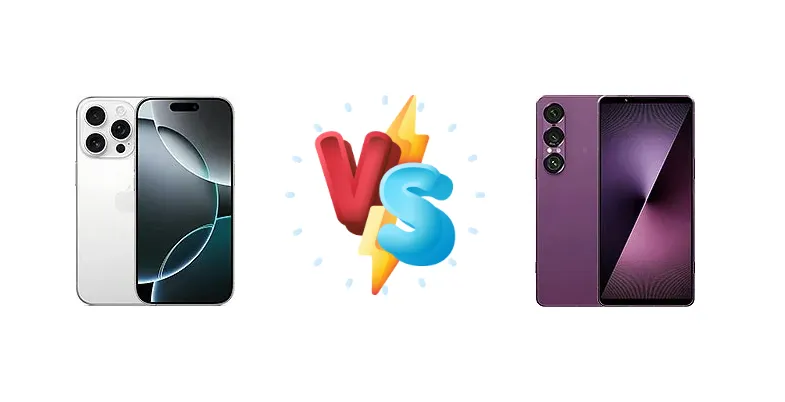
|
🏆 Quick Verdict
For the average user prioritizing seamless ecosystem integration and consistently optimized performance, the iPhone 16 Pro emerges as the winner. However, the Sony Xperia 1 VII’s superior battery endurance and potentially more flexible charging options make it a compelling alternative for those prioritizing longevity and a more open Android experience.
| PHONES | ||
|---|---|---|
| Phone Names | Apple iPhone 16 Pro | Sony Xperia 1 VII |
| Network | ||
|---|---|---|
| 2G bands | GSM 850 / 900 / 1800 / 1900 | GSM 850 / 900 / 1800 / 1900 |
| 3G bands | HSDPA 850 / 900 / 1700(AWS) / 1900 / 2100 | HSDPA 800 / 850 / 900 / 1700(AWS) / 1900 / 2100 |
| 4G bands | 1, 2, 3, 4, 5, 7, 8, 12, 13, 17, 18, 19, 20, 25, 26, 28, 30, 32, 34, 38, 39, 40, 41, 42, 48, 53, 66 - A3293 | 1, 2, 3, 4, 5, 7, 8, 12, 13, 17, 19, 20, 25, 26, 28, 32, 34, 38, 39, 40, 41, 66 - Europe |
| 5G bands | 1, 2, 3, 5, 7, 8, 12, 20, 25, 26, 28, 30, 38, 40, 41, 48, 53, 66, 70, 75, 76, 77, 78, 79 SA/NSA/Sub6 - A3293 | 1, 3, 5, 7, 8, 20, 28, 38, 40, 41, 75, 77, 78 SA/NSA/Sub6 - Europe |
| Speed | HSPA, LTE, 5G, EV-DO Rev.A 3.1 Mbps | HSPA, LTE, 5G |
| Technology | GSM / CDMA / HSPA / EVDO / LTE / 5G | GSM / HSPA / LTE / 5G |
| Launch | ||
|---|---|---|
| Announced | 2024, September 09 | 2025, May 13 |
| Status | Available. Released 2024, September 20 | Available. Released 2025, June 04 |
| Body | ||
|---|---|---|
| Build | Glass front (Ceramic Shield), glass back, titanium frame (grade 5) | Glass front (Gorilla Glass Victus 2), glass back (Gorilla Glass Victus), aluminum frame |
| Dimensions | 149.6 x 71.5 x 8.3 mm (5.89 x 2.81 x 0.33 in) | 162 x 74 x 8.2 mm (6.38 x 2.91 x 0.32 in) |
| SIM | · Nano-SIM + eSIM + eSIM (max 2 at a time; International)· eSIM + eSIM (8 or more, max 2 at a time; USA)· Nano-SIM + Nano-SIM (China) | · Nano-SIM + eSIM· Nano-SIM + Nano-SIM |
| Weight | 199 g (7.02 oz) | 197 g (6.95 oz) |
| Display | ||
|---|---|---|
| Protection | Ceramic Shield glass (2024 gen), Mohs level 4 | Corning Gorilla Glass Victus 2, Mohs level 5 |
| Resolution | 1206 x 2622 pixels, 19.5:9 ratio (~460 ppi density) | 1080 x 2340 pixels, 19.5:9 ratio (~396 ppi density) |
| Size | 6.3 inches, 96.4 cm2 (~90.1% screen-to-body ratio) | 6.5 inches, 103.7 cm2 (~86.5% screen-to-body ratio) |
| Type | LTPO Super Retina XDR OLED, 120Hz, HDR10, Dolby Vision, 1000 nits (typ), 2000 nits (HBM) | LTPO OLED, 1B colors, 120Hz, HDR BT.2020 |
| Platform | ||
|---|---|---|
| CPU | Hexa-core (2x4.05 GHz + 4x2.42 GHz) | Octa-core (2x4.32 GHz Oryon V2 Phoenix L + 6x3.53 GHz Oryon V2 Phoenix M) |
| Chipset | Apple A18 Pro (3 nm) | Qualcomm SM8750-AB Snapdragon 8 Elite (3 nm) |
| GPU | Apple GPU (6-core graphics) | Adreno 830 |
| OS | iOS 18, upgradable to iOS 26.1 | Android 15, up to 4 major Android upgrades |
| Memory | ||
|---|---|---|
| Card slot | No | microSDXC (uses shared SIM slot) |
| Internal | 128GB 8GB RAM, 256GB 8GB RAM, 512GB 8GB RAM, 1TB 8GB RAM | 256GB 12GB RAM, 512GB 12GB RAM |
| Main Camera | ||
|---|---|---|
| Features | Dual-LED dual-tone flash, HDR (photo/panorama) | Zeiss optics, Zeiss T* lens coating, color spectrum sensor, LED flash, panorama, HDR, eye tracking |
| Triple | 48 MP, f/1.8, 24mm (wide), 1/1.28", 1.22µm, dual pixel PDAF, sensor-shift OIS 12 MP, f/2.8, 120mm (periscope telephoto), 1/3.06", 1.12µm, dual pixel PDAF, 3D sensor‑shift OIS, 5x optical zoom 48 MP, f/2.2, 13mm (ultrawide), 1/2.55", 0.7µm, PDAF TOF 3D LiDAR scanner (depth) | 48 MP, f/1.9, 24mm (wide), 1/1.35", 1.12µm, dual pixel PDAF, OIS 12 MP, f/2.3, 85mm (telephoto), f/3.5, 170mm (telephoto), 1/3.5", 1.0µm, dual pixel PDAF, 3.5x-7.1x continuous optical zoom, OIS, 4cm macro @ 120mm, no AF 48 MP, f/2.0, 16mm (ultrawide), 1/1.56", 1.0µm, PDAF |
| Video | 4K@24/25/30/60/100/120fps, 1080p@25/30/60/120/240fps, 10-bit HDR, Dolby Vision HDR (up to 60fps), ProRes, 3D (spatial) video/audio, stereo sound rec. | 4K@24/30/60/120fps HDR, 1080p@30/60/120fps; 5-axis gyro-EIS, OIS |
| Selfie camera | ||
|---|---|---|
| Features | HDR, Dolby Vision HDR, 3D (spatial) audio, stereo sound rec. | HDR |
| Single | 12 MP, f/1.9, 23mm (wide), 1/3.6", 1.0µm, PDAF, OIS SL 3D, (depth/biometrics sensor) | 12 MP, f/2.0, 24mm (wide), 1/2.9", 1.22µm |
| Video | 4K@24/25/30/60fps, 1080p@25/30/60/120fps, gyro-EIS | 4K@30/60fps, 1080p@30/60fps, 5-axis gyro-EIS |
| Sound | ||
|---|---|---|
| 35mm jack | No | Yes |
| Loudspeaker | Yes, with stereo speakers | Yes, with stereo speakers |
| Comms | ||
|---|---|---|
| Bluetooth | 5.3, A2DP, LE | 6.0, A2DP, LE Audio, aptX HD, aptX Adaptive, aptX Lossless |
| NFC | Yes | Yes |
| Positioning | GPS (L1+L5), GLONASS, GALILEO, BDS, QZSS, NavIC | GPS, GLONASS, BDS, GALILEO, QZSS |
| Radio | No | No |
| USB | USB Type-C 3.2 Gen 2, DisplayPort | USB Type-C 3.2, OTG, video output |
| WLAN | Wi-Fi 802.11 a/b/g/n/ac/6e/7, tri-band, hotspot | Wi-Fi 802.11 a/b/g/n/ac/6e/7, tri-band, Wi-Fi Direct, DLNA |
| Features | ||
|---|---|---|
| Sensors | Face ID, accelerometer, gyro, proximity, compass, barometer | Fingerprint (side-mounted), accelerometer, gyro, proximity, barometer, compass |
| Battery | ||
|---|---|---|
| Charging | Wired, PD2.0, 50% in 30 min 25W wireless (MagSafe), 15W wireless (China only) 15W wireless (Qi2) 4.5W reverse wired | 30W wired, PD3.0, PPS, 50% in 30 min 15W wireless Reverse wireless |
| Type | Li-Ion 3582 mAh | 5000 mAh |
| Misc | ||
|---|---|---|
| Colors | Black Titanium, White Titanium, Natural Titanium, Desert Titanium | Moss Green, Orchid Purple, Slate Black |
| Models | A3293, A3083, A3292, A3294, iPhone17,1 | XQ-FS54, XQFS54EUKCG.GC, XQFS54EUKCV.GC, XQFS54EUKCB.GC, PDX256 |
| Price | € 884.23 / $ 574.09 / £ 685.80 | € 1,338.99 / $ 1,394.99 / £ 1,149.94 |
| SAR | 1.09 W/kg (head) 1.19 W/kg (body) | - |
| SAR EU | 1.24 W/kg (head) 1.48 W/kg (body) | - |
| EU LABEL | ||
|---|---|---|
| Battery | 37:00h endurance, 1000 cycles | 43:30h endurance, 1400 cycles |
| Energy | Class B | Class B |
| Free fall | Class C (90 falls) | Class B (181 falls) |
| Repairability | Class C | Class D |
Apple iPhone 16 Pro
- Superior ecosystem integration with Apple devices.
- Optimized performance through hardware and software synergy.
- High peak display brightness for outdoor visibility.
- Lower battery endurance compared to the Xperia 1 VII.
- Limited customization options compared to Android.
- No reverse wireless charging.
Sony Xperia 1 VII
- Exceptional battery life and longevity (1400 cycles).
- Faster and more efficient charging with PD3.0 and PPS.
- More customizable Android experience.
- Slightly lower peak display brightness.
- Potential for thermal throttling under sustained load.
- Software updates may be less frequent than on iOS.
Display Comparison
Both the iPhone 16 Pro and Xperia 1 VII boast high-end displays, but differ in their approach. The iPhone 16 Pro achieves a measured peak brightness of 1764 nits, exceeding the Xperia 1 VII’s 1475 nits, making it slightly more visible in direct sunlight. While both likely utilize LTPO technology for adaptive refresh rates (though not explicitly stated), the iPhone’s tighter integration allows for potentially more efficient power management. Sony’s displays are known for color accuracy, but the iPhone’s calibration is generally considered a benchmark in the industry. The absence of specific information on panel type (OLED vs. other) for both devices leaves room for further investigation, but both are expected to deliver excellent visual experiences.
Camera Comparison
Without detailed camera specifications, analysis relies on brand reputation. Sony’s Xperia line is renowned for its imaging prowess, and the 1 VII likely features a sophisticated camera system with a focus on manual controls and video recording. The iPhone 16 Pro, while often criticized for its image processing style, consistently delivers high-quality photos and videos with excellent dynamic range. The absence of sensor size information is a significant omission. Sony’s expertise in image sensors suggests a potentially larger main sensor, which would benefit low-light performance. The Xperia 1 VII’s emphasis on professional features likely includes advanced video codecs and recording options, catering to content creators. We can assume both phones will feature robust optical image stabilization (OIS).
Performance
The core of these phones lies in their chipsets. Apple’s A18 Pro, built on a 3nm process, features a hexa-core CPU with a split configuration (2x4.05 GHz + 4x2.42 GHz). The Xperia 1 VII counters with the Qualcomm SM8750-AB Snapdragon 8 Elite, also 3nm, but employing an octa-core CPU (2x4.32 GHz Oryon V2 Phoenix L + 6x3.53 GHz Oryon V2 Phoenix M). The Snapdragon’s Oryon cores, designed by Qualcomm, aim to deliver desktop-class performance. While clock speeds favor the Snapdragon, Apple’s chip design and software optimization often translate to superior real-world performance, particularly in tasks optimized for the Neural Engine. Both devices utilize LPDDR5x RAM, but the specific speed isn’t provided. Thermal management will be crucial; the Snapdragon’s octa-core design could potentially generate more heat under sustained load, though Qualcomm’s advancements in thermal architecture aim to mitigate this.
Battery Life
The Xperia 1 VII takes a clear lead in battery endurance, boasting 43:30h compared to the iPhone 16 Pro’s 37:00h. This translates to an active use score of 15:32h for the Xperia versus 14:17h for the iPhone. While the iPhone supports 50% charge in 30 minutes with PD2.0, and 25W MagSafe wireless charging, the Xperia 1 VII utilizes PD3.0 and PPS for potentially faster and more efficient wired charging, also reaching 50% in 30 minutes with 30W. The Xperia 1 VII also offers reverse wireless charging, a feature absent on the iPhone. The iPhone’s battery is rated for 1000 cycles, while the Xperia 1 VII boasts 1400 cycles, indicating a longer lifespan before significant capacity degradation.
Buying Guide
Buy the Apple iPhone 16 Pro if you need a phone that 'just works' with a vast ecosystem of accessories, prioritize consistently high performance in everyday tasks and creative workflows, and value Apple’s software support. Buy the Sony Xperia 1 VII if you prefer a more customizable Android experience, demand exceptional battery life for extended use, and appreciate Sony’s focus on audio and video recording capabilities.