
iPhone 16 Pro vs Oppo Find X9 Pro: The Ultimate Flagship Showdown
| Phones Images | |||||
|---|---|---|---|---|---|
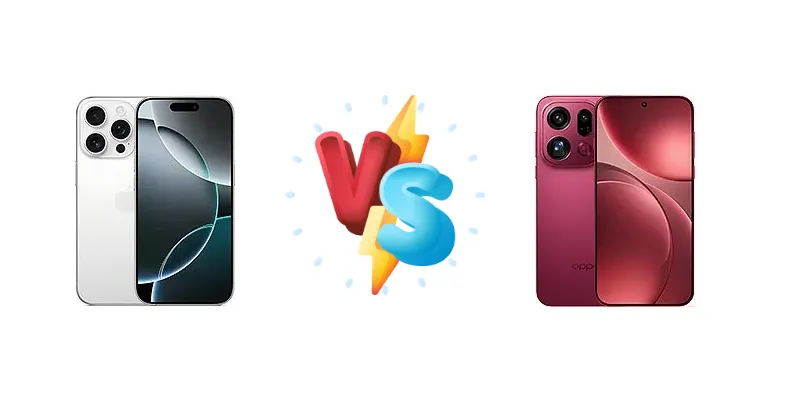
|
🏆 Quick Verdict
For the average user prioritizing long-term software support and a seamless user experience, the iPhone 16 Pro is the better choice. However, the Oppo Find X9 Pro’s significantly faster charging and superior active use battery life make it ideal for power users who demand maximum uptime and don't mind a different software experience.
| PHONES | ||
|---|---|---|
| Phone Names | Apple iPhone 16 Pro | Oppo Find X9 Pro |
| Network | ||
|---|---|---|
| 2G bands | GSM 850 / 900 / 1800 / 1900 | GSM 850 / 900 / 1800 / 1900 |
| 3G bands | HSDPA 850 / 900 / 1700(AWS) / 1900 / 2100 | HSDPA 800 / 850 / 900 / 1700(AWS) / 1900 / 2100 - International, China |
| 4G bands | 1, 2, 3, 4, 5, 7, 8, 12, 13, 17, 18, 19, 20, 25, 26, 28, 30, 32, 34, 38, 39, 40, 41, 42, 48, 53, 66 - A3293 | 1, 2, 3, 4, 5, 7, 8, 12, 13, 17, 18, 19, 20, 25, 26, 28, 32, 38, 39, 40, 41, 42, 48, 66, 71 - International |
| 5G bands | 1, 2, 3, 5, 7, 8, 12, 20, 25, 26, 28, 30, 38, 40, 41, 48, 53, 66, 70, 75, 76, 77, 78, 79 SA/NSA/Sub6 - A3293 | 1, 2, 3, 5, 7, 8, 12, 20, 25, 26, 28, 38, 40, 41, 48, 66, 71, 75, 76, 77, 78, 79 SA/NSA - International |
| Speed | HSPA, LTE, 5G, EV-DO Rev.A 3.1 Mbps | HSPA, LTE, 5G |
| Technology | GSM / CDMA / HSPA / EVDO / LTE / 5G | GSM / HSPA / LTE / 5G |
| Launch | ||
|---|---|---|
| Announced | 2024, September 09 | 2025, October 16 |
| Status | Available. Released 2024, September 20 | Available. Released 2025, October 22 |
| Body | ||
|---|---|---|
| Build | Glass front (Ceramic Shield), glass back, titanium frame (grade 5) | Glass front (Gorilla Glass Victus 2), glass back, aluminum frame |
| Dimensions | 149.6 x 71.5 x 8.3 mm (5.89 x 2.81 x 0.33 in) | 161.3 x 76.5 x 8.3 mm (6.35 x 3.01 x 0.33 in) |
| SIM | · Nano-SIM + eSIM + eSIM (max 2 at a time; International)· eSIM + eSIM (8 or more, max 2 at a time; USA)· Nano-SIM + Nano-SIM (China) | · Nano-SIM + eSIM· Nano-SIM + Nano-SIM |
| Weight | 199 g (7.02 oz) | 224 g (7.90 oz) |
| Display | ||
|---|---|---|
| Protection | Ceramic Shield glass (2024 gen), Mohs level 4 | Corning Gorilla Glass Victus 2 |
| Resolution | 1206 x 2622 pixels, 19.5:9 ratio (~460 ppi density) | 1272 x 2772 pixels, 19.5:9 ratio (~450 ppi density) |
| Size | 6.3 inches, 96.4 cm2 (~90.1% screen-to-body ratio) | 6.78 inches, 112.4 cm2 (~91.1% screen-to-body ratio) |
| Type | LTPO Super Retina XDR OLED, 120Hz, HDR10, Dolby Vision, 1000 nits (typ), 2000 nits (HBM) | LTPO AMOLED, 1B colors, 120Hz, 2160Hz PWM, Dolby Vision, HDR10+, HDR Vivid, 800 nits (typ), 1800 nits (HBM), 3600 nits (peak) |
| Platform | ||
|---|---|---|
| CPU | Hexa-core (2x4.05 GHz + 4x2.42 GHz) | Octa-core (1x4.21 GHz C1-Ultra & 3x3.5 GHz C1-Premium & 4x2.7 GHz C1-Pro) |
| Chipset | Apple A18 Pro (3 nm) | Mediatek Dimensity 9500 (3 nm) |
| GPU | Apple GPU (6-core graphics) | Arm G1-Ultra |
| OS | iOS 18, upgradable to iOS 26.1 | Android 16, up to 5 major Android upgrades, ColorOS 16 |
| Memory | ||
|---|---|---|
| Card slot | No | No |
| Internal | 128GB 8GB RAM, 256GB 8GB RAM, 512GB 8GB RAM, 1TB 8GB RAM | 256GB 12GB RAM, 512GB 12GB RAM, 512GB 16GB RAM, 1TB 16GB RAM |
| Main Camera | ||
|---|---|---|
| Features | Dual-LED dual-tone flash, HDR (photo/panorama) | Laser AF, color spectrum sensor, Hasselblad Color Calibration, LED flash, HDR, panorama, LUT preview |
| Triple | 48 MP, f/1.8, 24mm (wide), 1/1.28", 1.22µm, dual pixel PDAF, sensor-shift OIS 12 MP, f/2.8, 120mm (periscope telephoto), 1/3.06", 1.12µm, dual pixel PDAF, 3D sensor‑shift OIS, 5x optical zoom 48 MP, f/2.2, 13mm (ultrawide), 1/2.55", 0.7µm, PDAF TOF 3D LiDAR scanner (depth) | 50 MP, f/1.5, 23mm (wide), 1/1.28", 1.22µm, multi-directional PDAF, OIS 200 MP, f/2.1, 70mm (periscope telephoto), 1/1.56", 0.5µm, 3x optical zoom, multi-directional PDAF, OIS 50 MP, f/2.0, 15mm, 120˚ (ultrawide), 1/2.76", 0.64µm, multi-directional PDAF |
| Video | 4K@24/25/30/60/100/120fps, 1080p@25/30/60/120/240fps, 10-bit HDR, Dolby Vision HDR (up to 60fps), ProRes, 3D (spatial) video/audio, stereo sound rec. | 4K@30/60/120fps, 1080p@30/60/240fps; gyro-EIS; HDR, 10‑bit video, Dolby Vision, LOG |
| Selfie camera | ||
|---|---|---|
| Features | HDR, Dolby Vision HDR, 3D (spatial) audio, stereo sound rec. | Panorama |
| Single | 12 MP, f/1.9, 23mm (wide), 1/3.6", 1.0µm, PDAF, OIS SL 3D, (depth/biometrics sensor) | 50 MP, f/2.0, 21mm (wide), 1/2.76", 0.64µm, PDAF |
| Video | 4K@24/25/30/60fps, 1080p@25/30/60/120fps, gyro-EIS | 4K@30/60fps, 1080p@30/60fps, gyro-EIS |
| Sound | ||
|---|---|---|
| 35mm jack | No | No |
| Loudspeaker | Yes, with stereo speakers | Yes, with stereo speakers |
| Comms | ||
|---|---|---|
| Bluetooth | 5.3, A2DP, LE | 6.0, A2DP, LE, aptX HD, LHDC 5 |
| Infrared port | - | Yes |
| NFC | Yes | Yes |
| Positioning | GPS (L1+L5), GLONASS, GALILEO, BDS, QZSS, NavIC | GPS (L1+L5), BDS (B1I+B1c+B2a+B2b), GALILEO (E1+E5a+E5b), QZSS (L1+L5), GLONASS, NavIC (L5) |
| Radio | No | No |
| USB | USB Type-C 3.2 Gen 2, DisplayPort | USB Type-C 3.2, OTG |
| WLAN | Wi-Fi 802.11 a/b/g/n/ac/6e/7, tri-band, hotspot | Wi-Fi 802.11 a/b/g/n/ac/6/7, dual-band or tri-band, Wi-Fi Direct |
| Features | ||
|---|---|---|
| Sensors | Face ID, accelerometer, gyro, proximity, compass, barometer | Fingerprint (under display, ultrasonic), accelerometer, gyro, proximity, compass, barometer |
| Battery | ||
|---|---|---|
| Charging | Wired, PD2.0, 50% in 30 min 25W wireless (MagSafe), 15W wireless (China only) 15W wireless (Qi2) 4.5W reverse wired | 80W wired, 80W UFCS, 55W PPS, 11.7W PD 50W wireless 10W reverse wireless |
| Type | Li-Ion 3582 mAh | Si/C Li-Ion 7500 mAh |
| Misc | ||
|---|---|---|
| Colors | Black Titanium, White Titanium, Natural Titanium, Desert Titanium | Silk White, Titanium Charcoal, Velvet Red |
| Models | A3293, A3083, A3292, A3294, iPhone17,1 | CPH2791, PLG110 |
| Price | € 884.23 / $ 574.09 / £ 685.80 | $ 1,184.51 / £ 1,149.00 / ₹ 109,999 |
| SAR | 1.09 W/kg (head) 1.19 W/kg (body) | - |
| SAR EU | 1.24 W/kg (head) 1.48 W/kg (body) | - |
| EU LABEL | ||
|---|---|---|
| Battery | 37:00h endurance, 1000 cycles | - |
| Energy | Class B | - |
| Free fall | Class C (90 falls) | - |
| Repairability | Class C | - |
Apple iPhone 16 Pro
- Superior peak display brightness for outdoor visibility
- Optimized software and long-term software support
- Strong ecosystem integration and privacy features
- Slower charging speeds compared to Oppo
- Shorter active use battery life
Oppo Find X9 Pro
- Significantly faster wired and wireless charging
- Longer active use battery life
- Potentially higher multi-core performance
- Less mature software ecosystem
- Potentially shorter software update lifespan
Display Comparison
The iPhone 16 Pro boasts a measured peak brightness of 1764 nits, significantly outshining the Oppo Find X9 Pro’s 1175 nits. This translates to superior visibility in direct sunlight. While both utilize 3nm chipsets, the iPhone’s display is likely to benefit more from the A18 Pro’s image signal processor for color accuracy. Oppo’s display, while still excellent, will likely focus more on vibrant color profiles typical of the brand. We expect both to feature LTPO technology for adaptive refresh rates, but Apple’s ProMotion technology is known for its smoothness and efficiency.
Camera Comparison
Without detailed camera specs, analysis relies on brand tendencies. Apple typically focuses on natural image processing and computational photography, prioritizing accurate colors and dynamic range. Oppo, conversely, often leans towards more vibrant and saturated images. The Dimensity 9500’s ISP capabilities are unknown, but Mediatek has been making strides in image processing. The iPhone’s advantage likely lies in its sophisticated video recording capabilities and seamless integration with Apple’s ecosystem. Sensor size and lens apertures will be critical differentiators, but without that data, it’s difficult to definitively declare a winner.
Performance
Both devices leverage 3nm chipsets, but their architectures differ significantly. The iPhone 16 Pro’s Apple A18 Pro employs a hexa-core configuration (2x4.05 GHz + 4x2.42 GHz), prioritizing single-core performance crucial for responsive app launches and everyday tasks. The Oppo Find X9 Pro’s Mediatek Dimensity 9500 utilizes an octa-core setup (1x4.21 GHz C1-Ultra & 3x3.5 GHz C1-Premium & 4x2.7 GHz C1-Pro), potentially offering superior multi-core performance for demanding tasks like video editing. However, the A18 Pro’s tightly integrated hardware and software optimization often translate to real-world performance advantages despite lower clock speeds. Thermal management will be key; the Dimensity 9500’s more complex core configuration could lead to higher temperatures under sustained load.
Battery Life
The Oppo Find X9 Pro clearly wins in active use battery life, achieving 21:57h compared to the iPhone 16 Pro’s 14:17h. While the iPhone 16 Pro boasts a respectable 37:00h endurance and 1000 cycles, suggesting longevity, the Oppo’s superior active use score indicates a more efficient power draw during typical usage. The charging speeds are drastically different: Oppo’s 80W wired charging (with UFCS, PPS, and PD support) and 50W wireless charging dwarf Apple’s 50% in 30 min wired (PD2.0), 25W MagSafe, and 15W Qi2. This means the Oppo can be fully charged in a fraction of the time, a significant advantage for users who frequently run low on battery.
Buying Guide
Buy the Apple iPhone 16 Pro if you need a phone with guaranteed software updates for years to come, a mature app ecosystem, and value privacy and security above all else. Buy the Oppo Find X9 Pro if you prioritize blazing-fast charging, extended battery life during heavy use, and are comfortable with Oppo’s ColorOS, potentially gaining access to cutting-edge features before the competition.