
iPhone 16 Plus vs Xiaomi 15 Pro: Which Flagship Reigns Supreme?
| Phones Images | |||||
|---|---|---|---|---|---|
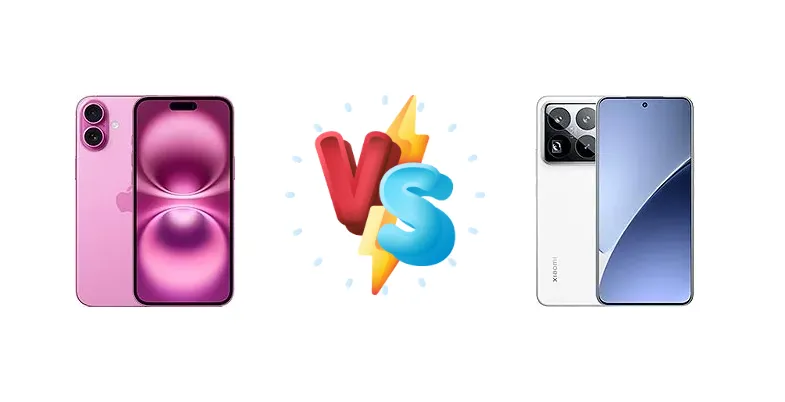
|
🏆 Quick Verdict
For the average user prioritizing ecosystem integration and long-term software support, the iPhone 16 Plus remains a strong choice. However, the Xiaomi 15 Pro delivers a compelling package with significantly faster charging – 90W wired versus 50% in 30 minutes for the iPhone – and a potentially more powerful CPU, making it the winner for power users and gamers.
| PHONES | ||
|---|---|---|
| Phone Names | Apple iPhone 16 Plus | Xiaomi 15 Pro |
| Network | ||
|---|---|---|
| 2G bands | GSM 850 / 900 / 1800 / 1900 | GSM 850 / 900 / 1800 / 1900 |
| 3G bands | HSDPA 850 / 900 / 1700(AWS) / 1900 / 2100 | HSDPA 800 / 850 / 900 / 1700(AWS) / 1900 / 2100 |
| 4G bands | 1, 2, 3, 4, 5, 7, 8, 12, 13, 17, 18, 19, 20, 25, 26, 28, 30, 32, 34, 38, 39, 40, 41, 42, 48, 53, 66 - A3290 | 1, 2, 3, 4, 5, 7, 8, 12, 17, 18, 19, 20, 26, 28, 34, 38, 39, 40, 41, 42, 48, 66 - China |
| 5G bands | 1, 2, 3, 5, 7, 8, 12, 20, 25, 26, 28, 30, 38, 40, 41, 48, 53, 66, 70, 75, 76, 77, 78, 79 SA/NSA/Sub6 - A3290 | 1, 2, 3, 5, 7, 8, 12, 20, 26, 28, 38, 40, 41, 48, 66, 77, 78, 79, 80, 81, 83, 84, 89 SA/NSA - China |
| Speed | HSPA, LTE, 5G, EV-DO Rev.A 3.1 Mbps | HSPA, LTE, 5G |
| Technology | GSM / CDMA / HSPA / EVDO / LTE / 5G | GSM / HSPA / LTE / 5G |
| Launch | ||
|---|---|---|
| Announced | 2024, September 09 | 2024, October 29 |
| Status | Available. Released 2024, September 20 | Available. Released 2024, October 29 |
| Body | ||
|---|---|---|
| Build | Glass front (Ceramic Shield), glass back, aluminum frame | - |
| Dimensions | 160.9 x 77.8 x 7.8 mm (6.33 x 3.06 x 0.31 in) | 161.3 x 75.3 x 8.4 mm or 8.7 mm |
| SIM | · Nano-SIM + eSIM + eSIM (max 2 at a time; International)· eSIM + eSIM (8 or more, max 2 at a time; USA)· Nano-SIM + Nano-SIM (China) | Nano-SIM + Nano-SIM |
| Weight | 199 g (7.02 oz) | 213 g or 219 g (7.51 oz) |
| Display | ||
|---|---|---|
| Protection | Ceramic Shield glass (2024 gen), Mohs level 4 | Shatterproof glass (2024 gen) |
| Resolution | 1290 x 2796 pixels, 19.5:9 ratio (~460 ppi density) | 1440 x 3200 pixels, 20:9 ratio (~522 ppi density) |
| Size | 6.7 inches, 110.2 cm2 (~88.0% screen-to-body ratio) | 6.73 inches, 108.9 cm2 (~89.7% screen-to-body ratio) |
| Type | Super Retina XDR OLED, HDR10, Dolby Vision, 1000 nits (typ), 2000 nits (HBM) | LTPO AMOLED, 68B colors, 120Hz, 1920Hz PWM, Dolby Vision, HDR10+, 3200 nits (peak) |
| Platform | ||
|---|---|---|
| CPU | Hexa-core (2x4.04 GHz + 4x2.20 GHz) | Octa-core (2x4.32 GHz Oryon V2 Phoenix L + 6x3.53 GHz Oryon V2 Phoenix M) |
| Chipset | Apple A18 (3 nm) | Qualcomm SM8750-AB Snapdragon 8 Elite (3 nm) |
| GPU | Apple GPU (5-core graphics) | Adreno 830 |
| OS | iOS 18, upgradable to iOS 26.1 | Android 15, HyperOS 2 |
| Memory | ||
|---|---|---|
| Card slot | No | No |
| Internal | 128GB 8GB RAM, 256GB 8GB RAM, 512GB 8GB RAM | 256GB 12GB RAM, 512GB 16GB RAM, 1TB 16GB RAM |
| Main Camera | ||
|---|---|---|
| Dual | 48 MP, f/1.6, 26mm (wide), 1/1.56", 1.0µm, dual pixel PDAF, sensor-shift OIS 12 MP, f/2.2, 13mm, 120˚ (ultrawide), 0.7µm, dual pixel PDAF | - |
| Features | Dual-LED dual-tone flash, HDR (photo/panorama) | Laser AF, color spectrum sensor, Leica lens, Dual-LED dual-tone flash, HDR, panorama |
| Triple | - | 50 MP, f/1.4, 23mm (wide), 1/1.31", 1.2µm, dual pixel PDAF, OIS 50 MP, f/2.5, 120mm (periscope telephoto), PDAF (30cm - ∞), OIS, 5x optical zoom 50 MP, f/2.2, 14mm, 115˚ (ultrawide), AF |
| Video | 4K@24/25/30/60fps, 1080p@25/30/60/120/240fps, HDR, Dolby Vision HDR (up to 60fps), stereo sound rec. | 8K@24/30fps (HDR), 4K@24/30/60fps (HDR10+, 10-bit Dolby Vision HDR, 10-bit LOG), 1080p@30/60/120/240/960fps, 720p@1920fps, gyro-EIS |
| Selfie camera | ||
|---|---|---|
| Features | HDR, Dolby Vision HDR, 3D (spatial) audio, stereo sound rec. | HDR, panorama |
| Single | 12 MP, f/1.9, 23mm (wide), 1/3.6", 1.0µm, PDAF SL 3D, (depth/biometrics sensor) | 32 MP, f/2.0, 22mm (wide), 0.7µm |
| Video | 4K@24/25/30/60fps, 1080p@25/30/60/120fps, gyro-EIS | 4K@30/60fps, 1080p@30/60fps, gyro-EIS |
| Sound | ||
|---|---|---|
| 35mm jack | No | No |
| Loudspeaker | Yes, with stereo speakers | Yes, with stereo speakers |
| Comms | ||
|---|---|---|
| Bluetooth | 5.3, A2DP, LE | 5.4, A2DP, LE, aptX HD, aptX Adaptive, LHDC 5 |
| Infrared port | - | Yes |
| NFC | Yes | Yes |
| Positioning | GPS, GLONASS, GALILEO, BDS, QZSS | GPS (L1+L5), GLONASS (G1), BDS (B1I+B1c+B2a), GALILEO (E1+E5a), QZSS (L1+L5) |
| Radio | No | No |
| USB | USB Type-C 2.0, DisplayPort | USB Type-C 3.2 Gen2, Display Port, OTG |
| WLAN | Wi-Fi 802.11 a/b/g/n/ac/6/7, tri-band, hotspot | Wi-Fi 802.11 a/b/g/n/ac/6e/7, dual-band or tri-band, Wi-Fi Direct |
| Features | ||
|---|---|---|
| Sensors | Face ID, accelerometer, gyro, proximity, compass, barometer | Fingerprint (under display, ultrasonic), accelerometer, proximity, gyro, compass, barometer |
| Battery | ||
|---|---|---|
| Charging | Wired, PD2.0, 50% in 30 min 25W wireless (MagSafe), 15W wireless (China only) 15W wireless (Qi2) 4.5W reverse wired | 90W wired, PD3.0, QC3+ 50W wireless 10W reverse wireless |
| Type | Li-Ion 4674 mAh | Si/C Li-Ion 6100 mAh |
| Misc | ||
|---|---|---|
| Colors | Black, White, Pink, Teal, Ultramarine | Black, White, Silver, Green |
| Models | A3290, A3082, A3289, A3291, iPhone17,4 | 24101PNB7C, 2410DPN6CC |
| Price | € 700.00 / $ 498.74 / £ 599.99 / ₹ 76,490 | About 690 EUR |
| SAR | 1.13 W/kg (head) 1.16 W/kg (body) | - |
| SAR EU | 1.24 W/kg (head) 1.33 W/kg (body) | - |
| EU LABEL | ||
|---|---|---|
| Battery | 48:00h endurance, 1000 cycles | - |
| Energy | Class B | - |
| Free fall | Class C (90 falls) | - |
| Repairability | Class C | - |
Apple iPhone 16 Plus
- Excellent long-term battery health (1000 cycles)
- Seamless Apple ecosystem integration
- High peak display brightness (1823 nits)
- Slower charging speeds compared to Xiaomi
- Less customization options in iOS
- Potentially lower multi-threaded performance
Xiaomi 15 Pro
- Significantly faster 90W wired charging
- Potentially higher CPU performance with octa-core design
- More open and customizable Android OS
- Battery health longevity is unknown
- Software updates may be less consistent than Apple
- Ecosystem lock-in is less strong
Display Comparison
The iPhone 16 Plus boasts a peak brightness of 1823 nits, ensuring excellent visibility even in direct sunlight. While Xiaomi doesn’t provide this metric, their flagship displays typically excel in color accuracy. Both devices likely utilize LTPO technology for adaptive refresh rates, conserving battery life. The iPhone’s display benefits from Apple’s color calibration, while Xiaomi often focuses on maximizing screen-to-body ratio. The difference will likely be subtle, but the iPhone’s measured brightness gives it a slight edge for outdoor use.
Camera Comparison
Without detailed camera specs, a direct comparison is difficult. However, Xiaomi flagships typically prioritize high megapixel counts and large sensors. The iPhone traditionally excels in computational photography and video recording. The image processing philosophies differ significantly; Apple aims for natural-looking images, while Xiaomi often boosts saturation and contrast. The absence of a telephoto lens specification for either phone makes it hard to assess zoom capabilities. The focus should be on the main sensor size and aperture, as these directly impact low-light performance.
Performance
Both the Apple A18 (3nm) and the Qualcomm Snapdragon 8 Elite (3nm) are built on cutting-edge 3nm processes, promising significant efficiency gains. However, the Snapdragon 8 Elite features an octa-core configuration (2x4.32 GHz Oryon V2 Phoenix L + 6x3.53 GHz Oryon V2 Phoenix M) compared to the iPhone’s hexa-core (2x4.04 GHz + 4x2.20 GHz). This core count advantage *could* translate to better multi-threaded performance for tasks like video editing and 3D rendering. The Oryon V2 cores are also designed for high single-core performance, potentially surpassing the A18 in specific benchmarks. Thermal management will be crucial; the Snapdragon’s higher peak clock speeds may require more aggressive cooling.
Battery Life
The iPhone 16 Plus offers a claimed 48-hour endurance and 18.49 hours of active use, alongside 1000 charge cycles, indicating excellent long-term battery health. The Xiaomi 15 Pro, while lacking endurance figures, compensates with significantly faster charging: 90W wired (PD3.0, QC3+) versus the iPhone’s 50% in 30 minutes. This means the Xiaomi can go from near-empty to full much quicker. The 50W wireless charging on the Xiaomi also surpasses the iPhone’s 25W MagSafe and 15W Qi2 options. The iPhone’s 4.5W reverse wired charging is a niche feature, while the Xiaomi offers 10W reverse wireless.
Buying Guide
Buy the Apple iPhone 16 Plus if you need seamless integration with other Apple devices, prioritize a mature and reliable software experience with guaranteed updates, and value the MagSafe ecosystem. Buy the Xiaomi 15 Pro if you prefer faster charging speeds, a potentially more powerful CPU for demanding tasks, and a more open Android operating system with greater customization options.