
iPhone 16 Plus vs. Samsung Galaxy Z Fold7: A Head-to-Head Comparison of Power and Form Factor
| Phones Images | |||||
|---|---|---|---|---|---|
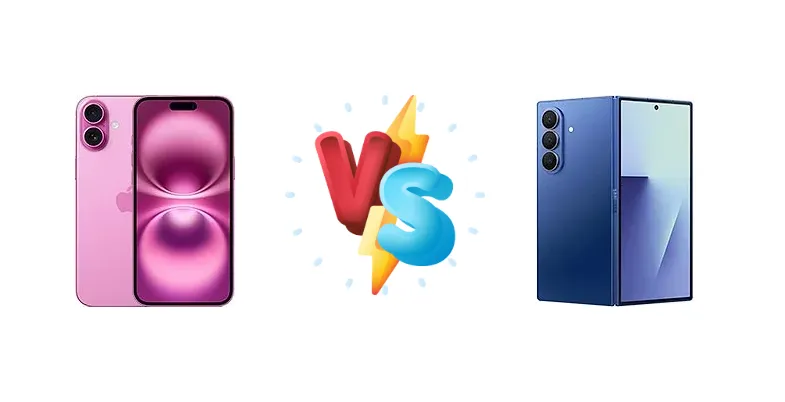
|
🏆 Quick Verdict
For the average user prioritizing raw performance and a brighter, more color-accurate display, the iPhone 16 Plus is the superior choice. However, the Galaxy Z Fold7’s significantly longer battery endurance and unique foldable experience make it ideal for power users and those seeking a versatile, productivity-focused device.
| PHONES | ||
|---|---|---|
| Phone Names | Apple iPhone 16 Plus | Samsung Galaxy Z Fold7 |
| Network | ||
|---|---|---|
| 2G bands | GSM 850 / 900 / 1800 / 1900 | GSM 850 / 900 / 1800 / 1900 |
| 3G bands | HSDPA 850 / 900 / 1700(AWS) / 1900 / 2100 | HSDPA 850 / 900 / 1700(AWS) / 1900 / 2100 |
| 4G bands | 1, 2, 3, 4, 5, 7, 8, 12, 13, 17, 18, 19, 20, 25, 26, 28, 30, 32, 34, 38, 39, 40, 41, 42, 48, 53, 66 - A3290 | 1, 2, 3, 4, 5, 7, 8, 12, 13, 17, 18, 19, 20, 25, 26, 28, 38, 39, 40, 41, 66 - International |
| 5G bands | 1, 2, 3, 5, 7, 8, 12, 20, 25, 26, 28, 30, 38, 40, 41, 48, 53, 66, 70, 75, 76, 77, 78, 79 SA/NSA/Sub6 - A3290 | 1, 2, 3, 5, 7, 8, 12, 20, 25, 26, 28, 38, 40, 41, 66, 71, 77, 78 SA/NSA/Sub6 - International |
| Speed | HSPA, LTE, 5G, EV-DO Rev.A 3.1 Mbps | HSPA, LTE, 5G |
| Technology | GSM / CDMA / HSPA / EVDO / LTE / 5G | GSM / CDMA / HSPA / EVDO / LTE / 5G |
| Launch | ||
|---|---|---|
| Announced | 2024, September 09 | 2025, July 09 |
| Status | Available. Released 2024, September 20 | Available. Released 2025, July 25 |
| Body | ||
|---|---|---|
| Build | Glass front (Ceramic Shield), glass back, aluminum frame | Glass front (Gorilla Glass Victus Ceramic 2) (folded), plastic front (unfolded), glass back (Gorilla Glass Victus 2), aluminum frame |
| Dimensions | 160.9 x 77.8 x 7.8 mm (6.33 x 3.06 x 0.31 in) | Unfolded: 158.4 x 143.2 x 4.2 mmFolded: 158.4 x 72.8 x 8.9 mm |
| SIM | · Nano-SIM + eSIM + eSIM (max 2 at a time; International)· eSIM + eSIM (8 or more, max 2 at a time; USA)· Nano-SIM + Nano-SIM (China) | · Nano-SIM + Nano-SIM + eSIM + eSIM (max 2 at a time)· Nano-SIM + Nano-SIM + multiple eSIM (max 2 at a time) |
| Weight | 199 g (7.02 oz) | 215 g (7.58 oz) |
| Display | ||
|---|---|---|
| Protection | Ceramic Shield glass (2024 gen), Mohs level 4 | Mohs level 1 |
| Resolution | 1290 x 2796 pixels, 19.5:9 ratio (~460 ppi density) | 1968 x 2184 pixels (~368 ppi density) |
| Size | 6.7 inches, 110.2 cm2 (~88.0% screen-to-body ratio) | 8.0 inches, 204.2 cm2 (~90.0% screen-to-body ratio) |
| Type | Super Retina XDR OLED, HDR10, Dolby Vision, 1000 nits (typ), 2000 nits (HBM) | Foldable Dynamic LTPO AMOLED 2X, 120Hz, HDR10+, 2600 nits (peak) |
| Platform | ||
|---|---|---|
| CPU | Hexa-core (2x4.04 GHz + 4x2.20 GHz) | Octa-core (2x4.47 GHz Oryon V2 Phoenix L + 6x3.53 GHz Oryon V2 Phoenix M) |
| Chipset | Apple A18 (3 nm) | Qualcomm SM8750-AC Snapdragon 8 Elite (3 nm) |
| GPU | Apple GPU (5-core graphics) | Adreno 830 (1200 MHz) |
| OS | iOS 18, upgradable to iOS 26.1 | Android 16, up to 7 major Android upgrades, One UI 8 |
| Memory | ||
|---|---|---|
| Card slot | No | No |
| Internal | 128GB 8GB RAM, 256GB 8GB RAM, 512GB 8GB RAM | 256GB 12GB RAM, 512GB 12GB RAM, 1TB 12GB RAM, 1TB 16GB RAM |
| Main Camera | ||
|---|---|---|
| Dual | 48 MP, f/1.6, 26mm (wide), 1/1.56", 1.0µm, dual pixel PDAF, sensor-shift OIS 12 MP, f/2.2, 13mm, 120˚ (ultrawide), 0.7µm, dual pixel PDAF | - |
| Features | Dual-LED dual-tone flash, HDR (photo/panorama) | LED flash, HDR, panorama |
| Triple | - | 200 MP, f/1.7, 24mm (wide), 1/1.3", 0.6µm, multi-directional PDAF, OIS 10 MP, f/2.4, 67mm (telephoto), 1/3.94", 1.0µm, PDAF, OIS, 3x optical zoom 12 MP, f/2.2, 13mm, 120˚ (ultrawide), 1/2.55", 1.4µm, dual pixel PDAF |
| Video | 4K@24/25/30/60fps, 1080p@25/30/60/120/240fps, HDR, Dolby Vision HDR (up to 60fps), stereo sound rec. | 8K@30fps, 4K@60fps, 1080p@60/120/240fps (gyro-EIS), 10-bit HDR, HDR10+ |
| Selfie camera | ||
|---|---|---|
| Features | HDR, Dolby Vision HDR, 3D (spatial) audio, stereo sound rec. | HDR |
| Single | 12 MP, f/1.9, 23mm (wide), 1/3.6", 1.0µm, PDAF SL 3D, (depth/biometrics sensor) | 10 MP, f/2.2, 18mm (ultrawide), 1/3.0", 1.12µm Cover camera: 10 MP, f/2.2, 24mm (wide), 1/3.0", 1.12µm |
| Video | 4K@24/25/30/60fps, 1080p@25/30/60/120fps, gyro-EIS | 4K@30/60fps, 1080p@30/60fps, gyro-EIS |
| Sound | ||
|---|---|---|
| 35mm jack | No | No |
| Loudspeaker | Yes, with stereo speakers | Yes, with stereo speakers |
| Comms | ||
|---|---|---|
| Bluetooth | 5.3, A2DP, LE | 5.4, A2DP, LE, aptX HD |
| NFC | Yes | Yes |
| Positioning | GPS, GLONASS, GALILEO, BDS, QZSS | GPS, GALILEO, GLONASS, BDS, QZSS |
| Radio | No | No |
| USB | USB Type-C 2.0, DisplayPort | USB Type-C 3.2, OTG |
| WLAN | Wi-Fi 802.11 a/b/g/n/ac/6/7, tri-band, hotspot | Wi-Fi 802.11 a/b/g/n/ac/6e/7, tri-band, Wi-Fi Direct |
| Features | ||
|---|---|---|
| Sensors | Face ID, accelerometer, gyro, proximity, compass, barometer | Fingerprint (side-mounted), accelerometer, gyro, proximity, compass, barometer |
| Battery | ||
|---|---|---|
| Charging | Wired, PD2.0, 50% in 30 min 25W wireless (MagSafe), 15W wireless (China only) 15W wireless (Qi2) 4.5W reverse wired | 25W wired, QC2.0, 50% in 30 min 15W wireless 4.5W reverse wireless |
| Type | Li-Ion 4674 mAh | Li-Po 4400 mAh |
| Misc | ||
|---|---|---|
| Colors | Black, White, Pink, Teal, Ultramarine | Blue Shadow, Silver Shadow, Jet Black, Mint |
| Models | A3290, A3082, A3289, A3291, iPhone17,4 | SM-F966B, SM-F966B/DS, SM-F966U, SM-F966U1 |
| Price | € 700.00 / $ 498.74 / £ 599.99 / ₹ 76,490 | € 1,367.99 / $ 1,399.99 / £ 1,449.00 / ₹ 174,999 |
| SAR | 1.13 W/kg (head) 1.16 W/kg (body) | 1.24 W/kg (head) 1.36 W/kg (body) |
| SAR EU | 1.24 W/kg (head) 1.33 W/kg (body) | 1.42 W/kg (head) 1.24 W/kg (body) |
| EU LABEL | ||
|---|---|---|
| Battery | 48:00h endurance, 1000 cycles | 40:28h endurance, 2000 cycles |
| Energy | Class B | Class B |
| Free fall | Class C (90 falls) | Class A (210 falls) |
| Repairability | Class C | Class C |
Apple iPhone 16 Plus
- Brighter, more vibrant display (1823 nits)
- Potentially faster and more efficient processor (Apple A18)
- Seamless Apple ecosystem integration
- Lower battery endurance (48:00h)
- Fewer charge cycles (1000)
- Less versatile form factor
Samsung Galaxy Z Fold7
- Exceptional battery life (40:28h endurance)
- More charge cycles (2000)
- Unique foldable design for multitasking
- Lower peak display brightness (1408 nits)
- Potential for thermal throttling
- Crease in the foldable display
Display Comparison
The iPhone 16 Plus boasts a peak brightness of 1823 nits, significantly outshining the Galaxy Z Fold7’s 1408 nits. This translates to superior visibility in direct sunlight. While the Z Fold7’s foldable display is innovative, it inherently involves a crease and potentially lower durability. Both devices utilize a 3nm chipset, but the iPhone’s brighter display will draw more power. The Z Fold7’s larger screen real estate, when unfolded, is a boon for multitasking, but the iPhone’s more traditional display offers potentially better color accuracy and viewing angles.
Camera Comparison
Context data lacks specific camera details, but given the market positioning, we can infer differences. The iPhone 16 Plus will likely prioritize computational photography and video recording quality, leveraging Apple’s image processing pipeline. The Z Fold7, while capable, may focus more on versatility with its foldable form factor enabling unique shooting angles. Both will likely feature advanced OIS and multi-lens systems, but the iPhone is expected to have a larger main sensor, resulting in better low-light performance. We anticipate both phones will omit or downplay 2MP macro lenses.
Performance
Both devices leverage 3nm chipsets, but with different architectures. The iPhone 16 Plus features Apple’s A18, a hexa-core processor clocked up to 4.04 GHz. The Galaxy Z Fold7 utilizes the Qualcomm SM8750-AC Snapdragon 8 Elite, an octa-core processor with Oryon V2 Phoenix cores reaching 4.47 GHz. While core count favors the Snapdragon, Apple’s tight hardware-software integration often translates to superior real-world performance and efficiency. The Z Fold7’s larger form factor may present thermal challenges, potentially leading to throttling under sustained load, despite the Snapdragon 8 Elite’s efficiency gains.
Battery Life
The Galaxy Z Fold7’s 40:28h endurance and 2000 charge cycles significantly surpass the iPhone 16 Plus’s 48:00h endurance and 1000 cycles. However, the iPhone 16 Plus offers a faster active use score of 18:49h compared to the Z Fold7’s 11:44h. This suggests the iPhone is more efficient *during* active use, but the Z Fold7 excels in standby time. Both support 50% charging in 30 minutes with wired charging, and 15W wireless charging, but the Z Fold7’s larger battery capacity provides a substantial advantage for users who frequently use their phones throughout the day.
Buying Guide
Buy the Apple iPhone 16 Plus if you need a consistently fast and responsive experience, a stunningly bright display for outdoor use, and seamless integration within the Apple ecosystem. Buy the Samsung Galaxy Z Fold7 if you prioritize all-day battery life, a larger screen for multitasking and content consumption, and are willing to embrace the innovative foldable design, even with its inherent compromises.