
iPhone 16 Plus vs Oppo Find X8 Pro: A Deep Dive into Battery, Performance, and Charging
| Phones Images | |||||
|---|---|---|---|---|---|
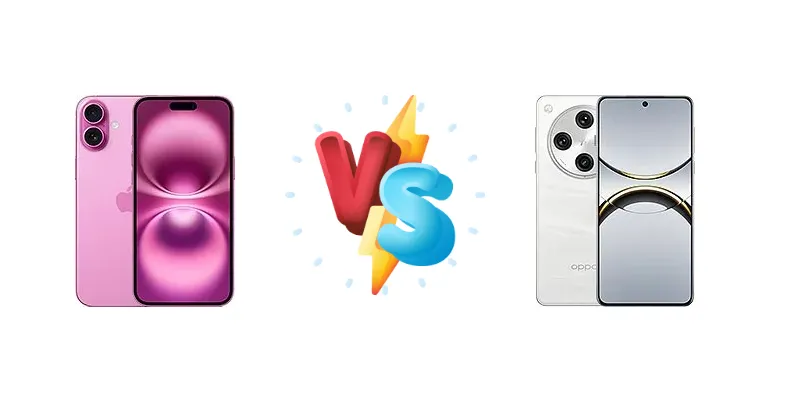
|
🏆 Quick Verdict
For the average user prioritizing longevity and ecosystem integration, the iPhone 16 Plus is the stronger choice, offering a remarkable 48-hour battery endurance. However, the Oppo Find X8 Pro’s 80W charging and potentially more flexible software experience make it compelling for power users who value rapid replenishment.
| PHONES | ||
|---|---|---|
| Phone Names | Apple iPhone 16 Plus | Oppo Find X8 Pro |
| Network | ||
|---|---|---|
| 2G bands | GSM 850 / 900 / 1800 / 1900 | GSM 850 / 900 / 1800 / 1900 |
| 3G bands | HSDPA 850 / 900 / 1700(AWS) / 1900 / 2100 | HSDPA 800 / 850 / 900 / 1700(AWS) / 1900 / 2100 |
| 4G bands | 1, 2, 3, 4, 5, 7, 8, 12, 13, 17, 18, 19, 20, 25, 26, 28, 30, 32, 34, 38, 39, 40, 41, 42, 48, 53, 66 - A3290 | 1, 2, 3, 4, 5, 7, 8, 12, 13, 17, 18, 19, 20, 25, 26, 28, 32, 38, 39, 40, 41, 66 - International |
| 5G bands | 1, 2, 3, 5, 7, 8, 12, 20, 25, 26, 28, 30, 38, 40, 41, 48, 53, 66, 70, 75, 76, 77, 78, 79 SA/NSA/Sub6 - A3290 | 1, 2, 3, 5, 7, 8, 12, 20, 25, 26, 28, 38, 40, 41, 66, 75, 77, 78 SA/NSA - International |
| Speed | HSPA, LTE, 5G, EV-DO Rev.A 3.1 Mbps | HSPA, LTE, 5G |
| Technology | GSM / CDMA / HSPA / EVDO / LTE / 5G | GSM / HSPA / LTE / 5G |
| Launch | ||
|---|---|---|
| Announced | 2024, September 09 | 2024, October 24 |
| Status | Available. Released 2024, September 20 | Available. Released 2024, October 30 |
| Body | ||
|---|---|---|
| Build | Glass front (Ceramic Shield), glass back, aluminum frame | Glass front (Gorilla Glass 7i), glass back (Gorilla Glass 7i), aluminum frame |
| Dimensions | 160.9 x 77.8 x 7.8 mm (6.33 x 3.06 x 0.31 in) | 162.3 x 76.7 x 8.2 mm (6.39 x 3.02 x 0.32 in) |
| SIM | · Nano-SIM + eSIM + eSIM (max 2 at a time; International)· eSIM + eSIM (8 or more, max 2 at a time; USA)· Nano-SIM + Nano-SIM (China) | · Nano-SIM + eSIM· Nano-SIM + Nano-SIM |
| Weight | 199 g (7.02 oz) | 215 g (7.58 oz) |
| Display | ||
|---|---|---|
| Protection | Ceramic Shield glass (2024 gen), Mohs level 4 | Corning Gorilla Glass 7i |
| Resolution | 1290 x 2796 pixels, 19.5:9 ratio (~460 ppi density) | 1264 x 2780 pixels (~450 ppi density) |
| Size | 6.7 inches, 110.2 cm2 (~88.0% screen-to-body ratio) | 6.78 inches, 111.7 cm2 (~89.8% screen-to-body ratio) |
| Type | Super Retina XDR OLED, HDR10, Dolby Vision, 1000 nits (typ), 2000 nits (HBM) | LTPO AMOLED, 1B colors, 120Hz, 2160Hz PWM, Dolby Vision, HDR10+, 800 nits (typ), 1600 nits (HBM), 4500 nits (peak) |
| Platform | ||
|---|---|---|
| CPU | Hexa-core (2x4.04 GHz + 4x2.20 GHz) | Octa-core (1x3.63 GHz Cortex-X925 & 3x3.3 GHz Cortex-X4 & 4x2.4 GHz Cortex-A720) |
| Chipset | Apple A18 (3 nm) | Mediatek Dimensity 9400 (3 nm) |
| GPU | Apple GPU (5-core graphics) | Immortalis-G925 |
| OS | iOS 18, upgradable to iOS 26.1 | Android 15, up to 5 major Android upgrades, ColorOS 15 |
| Memory | ||
|---|---|---|
| Card slot | No | No |
| Internal | 128GB 8GB RAM, 256GB 8GB RAM, 512GB 8GB RAM | 256GB 12GB RAM, 512GB 12GB RAM, 512GB 16GB RAM, 1TB 16GB RAM |
| Main Camera | ||
|---|---|---|
| Dual | 48 MP, f/1.6, 26mm (wide), 1/1.56", 1.0µm, dual pixel PDAF, sensor-shift OIS 12 MP, f/2.2, 13mm, 120˚ (ultrawide), 0.7µm, dual pixel PDAF | - |
| Features | Dual-LED dual-tone flash, HDR (photo/panorama) | Laser AF, color spectrum sensor, Hasselblad Color Calibration, LED flash, HDR, panorama |
| Quad | - | 50 MP, f/1.6, 23mm (wide), 1/1.4", 1.12µm, multi-directional PDAF, OIS 50 MP, f/2.6, 73mm (periscope telephoto), 1/1.95", 0.61µm, 3x optical zoom, multi-directional PDAF, OIS 50 MP, f/4.3, 135mm (periscope telephoto), 1/2.51", 0.7µm, 6x optical zoom, dual pixel PDAF (35cm - ∞), OIS 50 MP, f/2.0, 15mm, 120˚ (ultrawide), 1/2.75", 0.64µm, multi-directional PDAF |
| Video | 4K@24/25/30/60fps, 1080p@25/30/60/120/240fps, HDR, Dolby Vision HDR (up to 60fps), stereo sound rec. | 4K@30/60fps, 1080p@30/60/240fps; gyro-EIS; HDR, 10‑bit video, Dolby Vision |
| Selfie camera | ||
|---|---|---|
| Features | HDR, Dolby Vision HDR, 3D (spatial) audio, stereo sound rec. | Panorama |
| Single | 12 MP, f/1.9, 23mm (wide), 1/3.6", 1.0µm, PDAF SL 3D, (depth/biometrics sensor) | 32 MP, f/2.4, 21mm (wide), 1/2.74", 0.8µm |
| Video | 4K@24/25/30/60fps, 1080p@25/30/60/120fps, gyro-EIS | 4K@30/60fps, 1080p@30/60fps, gyro-EIS |
| Sound | ||
|---|---|---|
| 35mm jack | No | No |
| Loudspeaker | Yes, with stereo speakers | Yes, with stereo speakers |
| Comms | ||
|---|---|---|
| Bluetooth | 5.3, A2DP, LE | 5.4, A2DP, LE, aptX HD, LHDC 5 |
| Infrared port | - | Yes |
| NFC | Yes | Yes |
| Positioning | GPS, GLONASS, GALILEO, BDS, QZSS | GPS (L1+L5), BDS (B1I+B1c+B2a+B2b), GALILEO (E1+E5a+E5b), QZSS (L1+L5), GLONASS, NavIC (L5) |
| Radio | No | No |
| USB | USB Type-C 2.0, DisplayPort | USB Type-C 3.2, OTG |
| WLAN | Wi-Fi 802.11 a/b/g/n/ac/6/7, tri-band, hotspot | Wi-Fi 802.11 a/b/g/n/ac/6/7, dual-band or tri-band, Wi-Fi Direct |
| Features | ||
|---|---|---|
| Sensors | Face ID, accelerometer, gyro, proximity, compass, barometer | Fingerprint (under display, optical), accelerometer, gyro, proximity, compass |
| Battery | ||
|---|---|---|
| Charging | Wired, PD2.0, 50% in 30 min 25W wireless (MagSafe), 15W wireless (China only) 15W wireless (Qi2) 4.5W reverse wired | 80W wired, PD 55W, PPS, UFCS 50W wireless 10W reverse wireless |
| Type | Li-Ion 4674 mAh | Si/C Li-Ion 5910 mAh |
| Misc | ||
|---|---|---|
| Colors | Black, White, Pink, Teal, Ultramarine | Space Black, Pearl White, Blue |
| Models | A3290, A3082, A3289, A3291, iPhone17,4 | CPH2659, PKC110, PKC130 |
| Price | € 700.00 / $ 498.74 / £ 599.99 / ₹ 76,490 | € 1,014.99 / $ 1,349.00 / ₹ 92,990 |
| SAR | 1.13 W/kg (head) 1.16 W/kg (body) | - |
| SAR EU | 1.24 W/kg (head) 1.33 W/kg (body) | - |
| EU LABEL | ||
|---|---|---|
| Battery | 48:00h endurance, 1000 cycles | - |
| Energy | Class B | - |
| Free fall | Class C (90 falls) | - |
| Repairability | Class C | - |
Apple iPhone 16 Plus
- Exceptional 48-hour battery life
- Superior peak display brightness
- Optimized software and ecosystem integration
- Slower charging speeds compared to Oppo
- Less customizable software experience
Oppo Find X8 Pro
- Blazing-fast 80W wired charging
- Potentially more flexible Android software
- Advanced charging standards (PPS, UFCS)
- Shorter battery life than iPhone 16 Plus
- Less established brand recognition in some markets
Display Comparison
The iPhone 16 Plus boasts a measured peak brightness of 1823 nits, significantly outshining the Oppo Find X8 Pro’s 1333 nits. This translates to superior visibility in direct sunlight. While both likely employ LTPO technology for adaptive refresh rates (not specified in the data), the iPhone’s higher brightness is a clear advantage for outdoor use. Color accuracy and panel technology details are missing, but Apple typically excels in color calibration, while Oppo often focuses on vibrant, punchy displays.
Camera Comparison
The provided data doesn’t offer camera specifics beyond the chipsets’ image signal processors. However, given the flagship status of both devices, we can expect advanced camera systems. The Oppo Find X8 Pro, historically, has pushed boundaries in camera technology, and may feature larger sensors or more advanced computational photography. The iPhone 16 Plus will likely prioritize natural-looking images with excellent dynamic range. Without sensor size or aperture information, a definitive camera comparison is impossible, but Oppo’s history suggests a more aggressive approach to camera innovation.
Performance
Both devices leverage 3nm chipsets – Apple’s A18 and Mediatek’s Dimensity 9400. The A18 employs a hexa-core configuration (2x4.04 GHz + 4x2.20 GHz), while the Dimensity 9400 utilizes an octa-core setup (1x3.63 GHz Cortex-X925 & 3x3.3 GHz Cortex-X4 & 4x2.4 GHz Cortex-A720). The Dimensity 9400’s core arrangement suggests a focus on multi-threaded performance, potentially benefiting demanding tasks like video editing. However, Apple’s A-series chips are renowned for their single-core performance and optimized software integration. The lack of RAM specifications makes a direct comparison difficult, but both will likely utilize LPDDR5x. Thermal management will be crucial; the A18’s efficiency could give it an edge in sustained workloads.
Battery Life
The iPhone 16 Plus delivers a remarkable 48-hour battery endurance, backed by an active use score of 18:49 hours. This is a significant advantage over the Oppo Find X8 Pro’s 15:18-hour active use score. However, the Oppo compensates with significantly faster charging: 80W wired (with PD 55W, PPS, and UFCS support) versus the iPhone’s 50% charge in 30 minutes via PD2.0. The Oppo also offers 50W wireless charging, dwarfing the iPhone’s 25W MagSafe and 15W Qi2. While the iPhone boasts 1000 charge cycles, the Oppo’s faster charging mitigates concerns about battery degradation for many users. The 4.5W reverse wired charging on the iPhone is a niche feature, while the Oppo’s 10W reverse wireless charging is more practical.
Buying Guide
Buy the Apple iPhone 16 Plus if you need exceptional battery life, seamless integration with the Apple ecosystem, and a proven track record of software support. Buy the Oppo Find X8 Pro if you prioritize the fastest possible charging speeds, a potentially more customizable Android experience, and are comfortable with a brand less established in some markets.