
iPhone 16 Plus vs OnePlus 13s: A Deep Dive into Apple's Efficiency and OnePlus's Power
| Phones Images | |||||
|---|---|---|---|---|---|
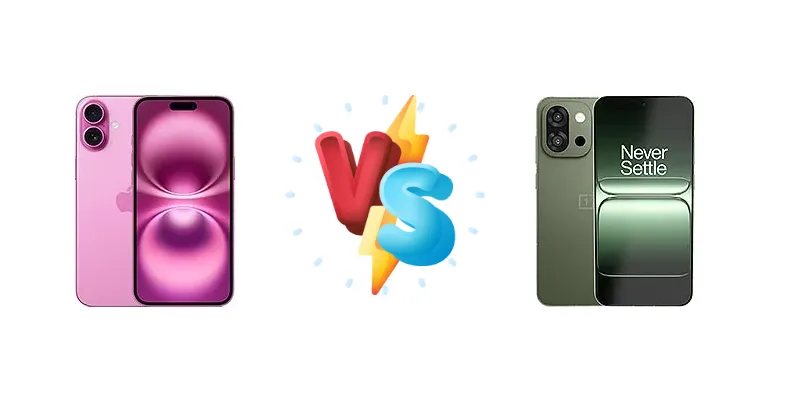
|
🏆 Quick Verdict
For the average user prioritizing long-term software support and a seamless ecosystem, the iPhone 16 Plus is the better choice. Its 48-hour battery endurance and optimized A18 chip offer a consistently smooth experience. However, power users and gamers will find the OnePlus 13s’ Snapdragon 8 Elite and 80W charging more compelling.
| PHONES | ||
|---|---|---|
| Phone Names | Apple iPhone 16 Plus | OnePlus 13s |
| Network | ||
|---|---|---|
| 2G bands | GSM 850 / 900 / 1800 / 1900 | GSM 850 / 900 / 1800 / 1900 |
| 3G bands | HSDPA 850 / 900 / 1700(AWS) / 1900 / 2100 | HSDPA 850 / 900 / 1900 / 2100 |
| 4G bands | 1, 2, 3, 4, 5, 7, 8, 12, 13, 17, 18, 19, 20, 25, 26, 28, 30, 32, 34, 38, 39, 40, 41, 42, 48, 53, 66 - A3290 | 1, 3, 4, 5, 8, 18, 19, 26, 28, 34, 38, 39, 40, 41, 42, 48, 66 |
| 5G bands | 1, 2, 3, 5, 7, 8, 12, 20, 25, 26, 28, 30, 38, 40, 41, 48, 53, 66, 70, 75, 76, 77, 78, 79 SA/NSA/Sub6 - A3290 | 1, 3, 5, 8, 26, 28, 38, 40, 41, 48, 66, 77, 78 SA/NSA |
| Speed | HSPA, LTE, 5G, EV-DO Rev.A 3.1 Mbps | HSPA, LTE, 5G |
| Technology | GSM / CDMA / HSPA / EVDO / LTE / 5G | GSM / HSPA / LTE / 5G |
| Launch | ||
|---|---|---|
| Announced | 2024, September 09 | 2025, June 05 |
| Status | Available. Released 2024, September 20 | Available. Released 2025, June 12 |
| Body | ||
|---|---|---|
| Build | Glass front (Ceramic Shield), glass back, aluminum frame | Glass front, aluminum alloy frame |
| Dimensions | 160.9 x 77.8 x 7.8 mm (6.33 x 3.06 x 0.31 in) | 150.8 x 71.7 x 8.2 mm (5.94 x 2.82 x 0.32 in) |
| SIM | · Nano-SIM + eSIM + eSIM (max 2 at a time; International)· eSIM + eSIM (8 or more, max 2 at a time; USA)· Nano-SIM + Nano-SIM (China) | Nano-SIM + Nano-SIM + eSIM (max 2 at a time) |
| Weight | 199 g (7.02 oz) | 185 g (6.53 oz) |
| Display | ||
|---|---|---|
| Protection | Ceramic Shield glass (2024 gen), Mohs level 4 | Crystal Shield Glass |
| Resolution | 1290 x 2796 pixels, 19.5:9 ratio (~460 ppi density) | 1216 x 2640 pixels, 19.5:9 ratio (~460 ppi density) |
| Size | 6.7 inches, 110.2 cm2 (~88.0% screen-to-body ratio) | 6.32 inches, 97.9 cm2 (~90.6% screen-to-body ratio) |
| Type | Super Retina XDR OLED, HDR10, Dolby Vision, 1000 nits (typ), 2000 nits (HBM) | LTPO AMOLED, 1B colors, 120Hz, 2160Hz PWM, Dolby Vision, HDR10+, HDR Vivid, 1600 nits (HBM) |
| Platform | ||
|---|---|---|
| CPU | Hexa-core (2x4.04 GHz + 4x2.20 GHz) | Octa-core (2x4.32 GHz Oryon V2 Phoenix L + 6x3.53 GHz Oryon V2 Phoenix M) |
| Chipset | Apple A18 (3 nm) | Qualcomm SM8750-AB Snapdragon 8 Elite (3 nm) |
| GPU | Apple GPU (5-core graphics) | Adreno 830 |
| OS | iOS 18, upgradable to iOS 26.1 | Android 15, OxygenOS 15 |
| Memory | ||
|---|---|---|
| Card slot | No | No |
| Internal | 128GB 8GB RAM, 256GB 8GB RAM, 512GB 8GB RAM | 256GB 12GB RAM, 512GB 12GB RAM |
| Main Camera | ||
|---|---|---|
| Dual | 48 MP, f/1.6, 26mm (wide), 1/1.56", 1.0µm, dual pixel PDAF, sensor-shift OIS 12 MP, f/2.2, 13mm, 120˚ (ultrawide), 0.7µm, dual pixel PDAF | 50 MP, f/1.8, 24mm (wide), 1/1.56", 1.0µm, multi-directional PDAF, OIS 50 MP, f/2.0, (telephoto), 1/2.75", 0.64µm, 2x optical zoom, PDAF |
| Features | Dual-LED dual-tone flash, HDR (photo/panorama) | Color spectrum sensor, LED flash, HDR, panorama |
| Video | 4K@24/25/30/60fps, 1080p@25/30/60/120/240fps, HDR, Dolby Vision HDR (up to 60fps), stereo sound rec. | 4K@30/60fps, 1080p@30/60/240fps, gyro-EIS, OIS, Dolby Vision HDR |
| Selfie camera | ||
|---|---|---|
| Features | HDR, Dolby Vision HDR, 3D (spatial) audio, stereo sound rec. | HDR, panorama |
| Single | 12 MP, f/1.9, 23mm (wide), 1/3.6", 1.0µm, PDAF SL 3D, (depth/biometrics sensor) | 32 MP, f/2.0, 21mm (wide), 1/3.1", 0.7µm, AF |
| Video | 4K@24/25/30/60fps, 1080p@25/30/60/120fps, gyro-EIS | 4K@30fps, 1080p@30fps, gyro-EIS |
| Sound | ||
|---|---|---|
| 35mm jack | No | No |
| Loudspeaker | Yes, with stereo speakers | Yes, with stereo speakers |
| Comms | ||
|---|---|---|
| Bluetooth | 5.3, A2DP, LE | 6.0, A2DP, LE, aptX HD, LHDC 5 |
| Infrared port | - | Yes |
| NFC | Yes | Yes |
| Positioning | GPS, GLONASS, GALILEO, BDS, QZSS | GPS (L1+L5), BDS (B1I+B1C+B2a), GALILEO (E1+E5a), QZSS (L1+L5), NavIC (L5), GLONASS |
| Radio | No | No |
| USB | USB Type-C 2.0, DisplayPort | USB Type-C 2.0, OTG |
| WLAN | Wi-Fi 802.11 a/b/g/n/ac/6/7, tri-band, hotspot | Wi-Fi 802.11 a/b/g/n/ac/6/7, dual-band, Wi-Fi Direct |
| Features | ||
|---|---|---|
| Sensors | Face ID, accelerometer, gyro, proximity, compass, barometer | Fingerprint (under display, optical), accelerometer, gyro, proximity, compass |
| Battery | ||
|---|---|---|
| Charging | Wired, PD2.0, 50% in 30 min 25W wireless (MagSafe), 15W wireless (China only) 15W wireless (Qi2) 4.5W reverse wired | 80W wired, 33W PPS, 18W PD, 18W QC 5W reverse wired |
| Type | Li-Ion 4674 mAh | 5850 mAh |
| Misc | ||
|---|---|---|
| Colors | Black, White, Pink, Teal, Ultramarine | Green Silk, Black Velvet, Pink Satin |
| Models | A3290, A3082, A3289, A3291, iPhone17,4 | CPH2723 |
| Price | € 700.00 / $ 498.74 / £ 599.99 / ₹ 76,490 | ₹ 52,999 |
| SAR | 1.13 W/kg (head) 1.16 W/kg (body) | - |
| SAR EU | 1.24 W/kg (head) 1.33 W/kg (body) | - |
| EU LABEL | ||
|---|---|---|
| Battery | 48:00h endurance, 1000 cycles | - |
| Energy | Class B | - |
| Free fall | Class C (90 falls) | - |
| Repairability | Class C | - |
Apple iPhone 16 Plus
- Exceptional 48-hour battery endurance
- Optimized A18 chip for efficiency
- Long-term software support and ecosystem integration
- Slower charging speeds compared to OnePlus
- Less customization options than Android
OnePlus 13s
- Blazing-fast 80W wired charging
- Powerful Snapdragon 8 Elite processor
- Android’s flexibility and customization
- Potentially shorter battery life than iPhone
- Software update support may be less consistent
Display Comparison
The iPhone 16 Plus boasts a measured peak brightness of 1823 nits, ensuring excellent visibility even in direct sunlight. While the OnePlus 13s’ display specs are currently unavailable, OnePlus typically employs high-quality AMOLED panels. The iPhone’s advantage likely lies in its color accuracy and potentially a higher PWM dimming rate, benefiting users sensitive to flicker. Apple’s continued refinement of its display technology, coupled with the brightness figure, suggests a superior viewing experience, though a direct comparison requires the OnePlus 13s’ full display specifications.
Camera Comparison
Without detailed camera specifications for either device, a direct comparison is limited. However, both manufacturers are known for producing high-quality camera systems. The iPhone traditionally excels in computational photography and video recording, offering natural-looking images and excellent dynamic range. OnePlus has significantly improved its camera performance in recent generations, focusing on color science and detail. The presence of OIS on both devices is expected, but sensor size and lens apertures will be crucial differentiators. We anticipate both phones will offer excellent image quality, but the iPhone’s software processing may provide a more consistent experience across various lighting conditions.
Performance
The core battleground is the Apple A18 (3nm) versus the Qualcomm Snapdragon 8 Elite (3nm). The A18’s hexa-core configuration (2x4.04 GHz + 4x2.20 GHz) focuses on efficiency, while the Snapdragon 8 Elite’s octa-core setup (2x4.32 GHz Oryon V2 Phoenix L + 6x3.53 GHz Oryon V2 Phoenix M) prioritizes sustained performance. The Oryon cores in the Snapdragon 8 Elite are designed for high single-core and multi-core performance, potentially giving it an edge in demanding tasks. However, Apple’s chip design often excels in real-world responsiveness and power efficiency, meaning the A18 could feel faster despite lower clock speeds. Both chips utilize a 3nm process, suggesting comparable thermal efficiency, but the Snapdragon’s more aggressive core configuration may lead to slightly higher temperatures under sustained load.
Battery Life
The iPhone 16 Plus claims a remarkable 48-hour endurance and 18:49 hours of active use, backed by 1000 charge cycles, indicating long-term battery health. The OnePlus 13s counters with an impressive 80W wired charging, capable of rapidly replenishing the battery. While the iPhone offers 25W MagSafe wireless charging and 15W Qi2, the OnePlus 13s’ 80W wired charging significantly reduces downtime. The iPhone’s longevity and efficiency are compelling, but the OnePlus 13s’ charging speed is a significant advantage for users who frequently need to top up their battery quickly.
Buying Guide
Buy the Apple iPhone 16 Plus if you need a phone with exceptional battery life, guaranteed software updates for years to come, and deep integration with the Apple ecosystem. Buy the OnePlus 13s if you prioritize peak performance for demanding tasks like gaming, require the fastest possible charging speeds, and prefer the flexibility of Android.