
iPhone 16 Plus vs. Google Pixel 10 Pro Fold: A Deep Dive Comparison
| Phones Images | |||||
|---|---|---|---|---|---|
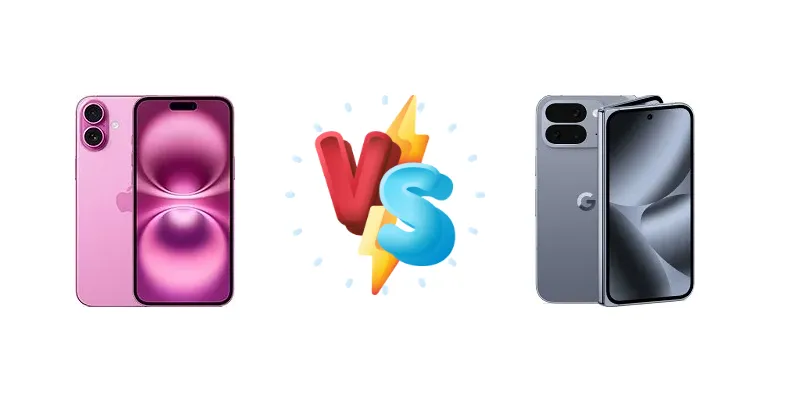
|
🏆 Quick Verdict
For the average user prioritizing longevity and a polished ecosystem, the iPhone 16 Plus emerges as the winner. Its slightly lower endurance is offset by the A18’s superior CPU performance and the established reliability of iOS. However, the Pixel 10 Pro Fold’s innovative form factor and unique features appeal to early adopters.
| PHONES | ||
|---|---|---|
| Phone Names | Apple iPhone 16 Plus | Google Pixel 10 Pro Fold |
| Network | ||
|---|---|---|
| 2G bands | GSM 850 / 900 / 1800 / 1900 | GSM 850 / 900 / 1800 / 1900 |
| 3G bands | HSDPA 850 / 900 / 1700(AWS) / 1900 / 2100 | HSDPA 800 / 850 / 900 / 1700(AWS) / 1900 / 2100 |
| 4G bands | 1, 2, 3, 4, 5, 7, 8, 12, 13, 17, 18, 19, 20, 25, 26, 28, 30, 32, 34, 38, 39, 40, 41, 42, 48, 53, 66 - A3290 | 1, 2, 3, 4, 5, 7, 8, 12, 13, 14, 17, 18, 19, 20, 21, 25, 26, 29, 30, 32, 38, 39, 40, 42, 48, 66, 71, 75 - GU0NP International |
| 5G bands | 1, 2, 3, 5, 7, 8, 12, 20, 25, 26, 28, 30, 38, 40, 41, 48, 53, 66, 70, 75, 76, 77, 78, 79 SA/NSA/Sub6 - A3290 | 1, 2, 3, 5, 7, 8, 12, 14, 20, 25, 26, 28, 29, 30, 40, 48, 66, 70, 71, 75, 77, 78, 79, 257, 258, 260, 261 SA/NSA/Sub6 - GU0NP International |
| Speed | HSPA, LTE, 5G, EV-DO Rev.A 3.1 Mbps | HSPA, LTE, 5G |
| Technology | GSM / CDMA / HSPA / EVDO / LTE / 5G | GSM / HSPA / LTE / 5G |
| Launch | ||
|---|---|---|
| Announced | 2024, September 09 | 2025, August 20 |
| Status | Available. Released 2024, September 20 | Available. Released 2025, October 09 |
| Body | ||
|---|---|---|
| Build | Glass front (Ceramic Shield), glass back, aluminum frame | Glass front (Gorilla Glass Victus 2) (folded), plastic front (unfolded), glass back (Gorilla Glass Victus 2), aluminum frame |
| Dimensions | 160.9 x 77.8 x 7.8 mm (6.33 x 3.06 x 0.31 in) | Unfolded: 155.2 x 150.4 x 5.2 mmFolded: 155.2 x 76.3 x 10.8 mm |
| SIM | · Nano-SIM + eSIM + eSIM (max 2 at a time; International)· eSIM + eSIM (8 or more, max 2 at a time; USA)· Nano-SIM + Nano-SIM (China) | Nano-SIM + eSIM |
| Weight | 199 g (7.02 oz) | 258 g (9.10 oz) |
| Display | ||
|---|---|---|
| Protection | Ceramic Shield glass (2024 gen), Mohs level 4 | Mohs level 5 |
| Resolution | 1290 x 2796 pixels, 19.5:9 ratio (~460 ppi density) | 2076 x 2152 pixels, 1:1 ratio (~374 ppi density) |
| Size | 6.7 inches, 110.2 cm2 (~88.0% screen-to-body ratio) | 8.0 inches, 206.3 cm2 (~88.4% screen-to-body ratio) |
| Type | Super Retina XDR OLED, HDR10, Dolby Vision, 1000 nits (typ), 2000 nits (HBM) | Foldable LTPO OLED, 120Hz, HDR10+, 1800 nits (HBM), 3000 nits (peak) |
| Platform | ||
|---|---|---|
| CPU | Hexa-core (2x4.04 GHz + 4x2.20 GHz) | Octa-core (1x3.78 GHz Cortex-X4 & 5x3.05 GHz Cortex-A725 & 2x2.25 GHz Cortex-A520) |
| Chipset | Apple A18 (3 nm) | Google Tensor G5 (3 nm) |
| GPU | Apple GPU (5-core graphics) | PowerVR DXT-48-1536 |
| OS | iOS 18, upgradable to iOS 26.1 | Android 16, up to 7 major Android upgrades |
| Memory | ||
|---|---|---|
| Card slot | No | No |
| Internal | 128GB 8GB RAM, 256GB 8GB RAM, 512GB 8GB RAM | 256GB 16GB RAM, 512GB 16GB RAM, 1TB 16GB RAM |
| Main Camera | ||
|---|---|---|
| Dual | 48 MP, f/1.6, 26mm (wide), 1/1.56", 1.0µm, dual pixel PDAF, sensor-shift OIS 12 MP, f/2.2, 13mm, 120˚ (ultrawide), 0.7µm, dual pixel PDAF | - |
| Features | Dual-LED dual-tone flash, HDR (photo/panorama) | Multi-zone Laser AF, LED flash, Pixel Shift, Ultra-HDR, panorama, Best Take, Zoom Enhance |
| Triple | - | 48 MP, f/1.7, 25mm (wide), 1/2.0", 0.8µm, dual pixel PDAF, OIS 10.8 MP, f/3.1, 112mm (telephoto), 1/3.2", dual pixel PDAF, OIS, 5x optical zoom 10.5 MP, f/2.2, 127˚ (ultrawide), 1/3.4", PDAF |
| Video | 4K@24/25/30/60fps, 1080p@25/30/60/120/240fps, HDR, Dolby Vision HDR (up to 60fps), stereo sound rec. | 4K@24/30/60fps, 1080p@24/30/60/120/240fps, 10-bit HDR, gyro-EIS, OIS |
| Selfie camera | ||
|---|---|---|
| Features | HDR, Dolby Vision HDR, 3D (spatial) audio, stereo sound rec. | HDR, panorama |
| Single | 12 MP, f/1.9, 23mm (wide), 1/3.6", 1.0µm, PDAF SL 3D, (depth/biometrics sensor) | 10 MP, f/2.2, 23mm (wide), 1/3.94", PDAF Cover camera: 10 MP, f/2.2, 23mm (wide), 1/3.94", PDAF |
| Video | 4K@24/25/30/60fps, 1080p@25/30/60/120fps, gyro-EIS | 4K@30/60fps, 1080p@30/60fps |
| Sound | ||
|---|---|---|
| 35mm jack | No | No |
| Loudspeaker | Yes, with stereo speakers | Yes, with stereo speakers |
| Comms | ||
|---|---|---|
| Bluetooth | 5.3, A2DP, LE | 6.0, A2DP, LE, aptX HD |
| NFC | Yes | Yes |
| Positioning | GPS, GLONASS, GALILEO, BDS, QZSS | GPS (L1+L5), GLONASS, GALILEO, BDS, QZSS, NavIC |
| Radio | No | No |
| USB | USB Type-C 2.0, DisplayPort | USB Type-C 3.2 |
| WLAN | Wi-Fi 802.11 a/b/g/n/ac/6/7, tri-band, hotspot | Wi-Fi 802.11 a/b/g/n/ac/6e/7, tri-band |
| Features | ||
|---|---|---|
| Sensors | Face ID, accelerometer, gyro, proximity, compass, barometer | Fingerprint (side-mounted), accelerometer, gyro, proximity, compass, barometer |
| Battery | ||
|---|---|---|
| Charging | Wired, PD2.0, 50% in 30 min 25W wireless (MagSafe), 15W wireless (China only) 15W wireless (Qi2) 4.5W reverse wired | 30W wired, PPS, 50% in 30 min 15W wireless (magnetic), Qi2 Bypass charging |
| Type | Li-Ion 4674 mAh | 5015 mAh |
| Misc | ||
|---|---|---|
| Colors | Black, White, Pink, Teal, Ultramarine | Moonstone, Jade |
| Models | A3290, A3082, A3289, A3291, iPhone17,4 | GU0NP, GM66V |
| Price | € 700.00 / $ 498.74 / £ 599.99 / ₹ 76,490 | $ 1,499.00 / C$ 2,119.99 / £ 1,749.00 / € 1,757.00 |
| SAR | 1.13 W/kg (head) 1.16 W/kg (body) | 0.99 W/kg (head) 0.99 W/kg (body) |
| SAR EU | 1.24 W/kg (head) 1.33 W/kg (body) | 0.99 W/kg (head) 1.39 W/kg (body) |
| EU LABEL | ||
|---|---|---|
| Battery | 48:00h endurance, 1000 cycles | 47:55h endurance, 1000 cycles |
| Energy | Class B | Class B |
| Free fall | Class C (90 falls) | Class A (210 falls) |
| Repairability | Class C | Class C |
Apple iPhone 16 Plus
- Superior CPU performance with the A18 chip
- Brighter display for outdoor visibility
- Mature and reliable iOS ecosystem
- Traditional form factor lacks the versatility of a foldable
- MagSafe charging is proprietary
Google Pixel 10 Pro Fold
- Innovative foldable design for enhanced productivity
- Bypass charging for cooler temperatures and battery health
- Potential for advanced AI features with the Tensor G5
- Foldable displays are inherently more fragile
- Performance may lag behind the A18 in certain tasks
Display Comparison
The iPhone 16 Plus boasts a peak brightness of 1823 nits, ensuring excellent visibility even in direct sunlight. While the Pixel 10 Pro Fold’s display specifications are not provided, foldable displays typically prioritize color accuracy and flexibility over absolute peak brightness. The iPhone’s traditional display likely offers a more consistent viewing experience, while the Pixel’s foldable screen provides a significantly larger canvas for productivity. The Pixel 10 Pro Fold benefits from Qi2 wireless charging, but the iPhone 16 Plus’s MagSafe offers a more secure and potentially faster 25W wireless charging experience.
Camera Comparison
Without specific camera details for the Pixel 10 Pro Fold, it’s reasonable to expect Google to leverage its computational photography prowess. However, the iPhone 16 Plus’s image processing benefits from the A18’s Neural Engine, enabling faster and more efficient image analysis. The focus should be on the main sensor and OIS capabilities, as these are the most impactful factors for image quality. The Pixel’s strength lies in its software algorithms, while the iPhone excels in video recording and overall consistency.
Performance
The Apple A18, fabricated on a 3nm process, features a hexa-core CPU (2x4.04 GHz + 4x2.20 GHz) designed for peak performance. In contrast, the Google Tensor G5 utilizes an octa-core configuration (1x3.78 GHz Cortex-X4 & 5x3.05 GHz Cortex-A725 & 2x2.25 GHz Cortex-A520) also on a 3nm node. While the Tensor G5’s core count is higher, the A18’s higher clock speeds and Apple’s architectural optimizations likely translate to superior single-core performance, crucial for responsive app launches and smooth UI navigation. The Pixel’s Tensor G5 focuses on AI and machine learning tasks, potentially excelling in areas like image processing and voice recognition.
Battery Life
Both devices offer impressive battery endurance, with the iPhone 16 Plus achieving 48:00h and the Pixel 10 Pro Fold at 47:55h. The iPhone 16 Plus offers 50% charge in 30 minutes with wired PD2.0 charging, while the Pixel 10 Pro Fold also achieves 50% in 30 minutes with PPS. The Pixel 10 Pro Fold’s inclusion of bypass charging allows for cooler temperatures during charging, potentially extending battery lifespan. The iPhone 16 Plus offers 4.5W reverse wired charging, a feature absent in the provided Pixel 10 Pro Fold specs.
Buying Guide
Buy the Apple iPhone 16 Plus if you need a consistently reliable device with a mature software ecosystem, prioritizing long-term support and seamless integration with other Apple products. Buy the Google Pixel 10 Pro Fold if you prefer a cutting-edge, versatile device with a larger screen real estate for multitasking and media consumption, and are willing to embrace the foldable experience.