
iPhone 15 vs OnePlus 12R: A Deep Dive into Performance, Battery, and Value
| Phones Images | |||||
|---|---|---|---|---|---|
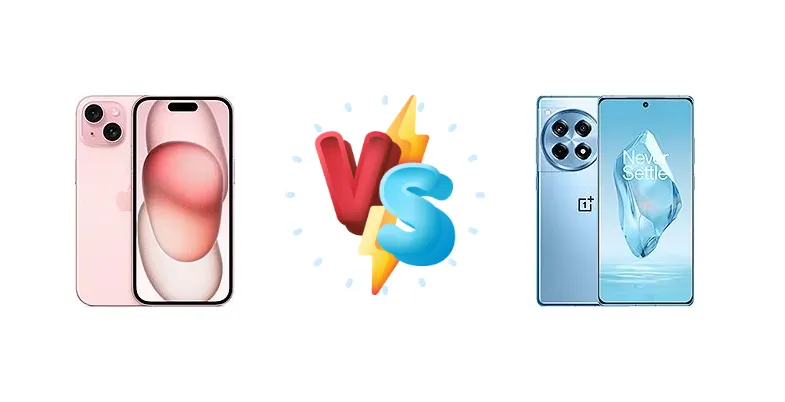
|
🏆 Quick Verdict
For users deeply embedded in the Apple ecosystem prioritizing seamless integration and a refined camera experience, the iPhone 15 remains a strong choice. However, the OnePlus 12R delivers comparable performance with significantly faster charging and superior battery endurance, making it the winner for Android enthusiasts and power users.
| PHONES | ||
|---|---|---|
| Phone Names | Apple iPhone 15 | OnePlus 12R |
| Network | ||
|---|---|---|
| 2G bands | GSM 850 / 900 / 1800 / 1900 | GSM 850 / 900 / 1800 / 1900 |
| 3G bands | HSDPA 850 / 900 / 1700(AWS) / 1900 / 2100 | HSDPA 850 / 900 / 1700(AWS) / 1900 / 2100 |
| 4G bands | 1, 2, 3, 4, 5, 7, 8, 12, 13, 17, 18, 19, 20, 25, 26, 28, 30, 32, 34, 38, 39, 40, 41, 42, 46, 48, 53, 66 - A3090 | 1, 2, 3, 4, 5, 7, 8, 12, 17, 18, 19, 20, 26, 28, 32, 38, 39, 40, 41, 66 |
| 5G bands | 1, 2, 3, 5, 7, 8, 12, 20, 25, 26, 28, 30, 38, 40, 41, 48, 53, 66, 70, 77, 78, 79 SA/NSA/Sub6 - A3090 | 1, 2, 3, 5, 7, 8, 12, 20, 28, 38, 40, 41, 66, 77, 78 SA/NSA |
| Speed | HSPA, LTE, 5G, EV-DO Rev.A 3.1 Mbps | HSPA, LTE, 5G |
| Technology | GSM / CDMA / HSPA / EVDO / LTE / 5G | GSM / CDMA / HSPA / LTE / 5G |
| Launch | ||
|---|---|---|
| Announced | 2023, September 12 | 2024, January 23 |
| Status | Available. Released 2023, September 22 | Available. Released 2024, February 06 |
| Body | ||
|---|---|---|
| Build | Glass front, glass back, aluminum frame | Glass front (Gorilla Glass Victus 2), aluminum frame, glass back |
| Dimensions | 147.6 x 71.6 x 7.8 mm (5.81 x 2.82 x 0.31 in) | 163.3 x 75.3 x 8.8 mm (6.43 x 2.96 x 0.35 in) |
| SIM | · Nano-SIM + eSIM + eSIM (max 2 at a time; International)· eSIM + eSIM (8 or more, max 2 at a time; USA)· Nano-SIM + Nano-SIM (China) | · Nano-SIM + Nano-SIM + eSIM (max 2 at a time)· Nano-SIM + Nano-SIM |
| Weight | 171 g (6.03 oz) | 207 g (7.30 oz) |
| Display | ||
|---|---|---|
| Protection | Ceramic Shield glass | Corning Gorilla Glass Victus 2 |
| Resolution | 1179 x 2556 pixels, 19.5:9 ratio (~461 ppi density) | 1264 x 2780 pixels (~450 ppi density) |
| Size | 6.1 inches, 91.3 cm2 (~86.4% screen-to-body ratio) | 6.78 inches, 111.7 cm2 (~90.9% screen-to-body ratio) |
| Type | Super Retina XDR OLED, HDR10, Dolby Vision, 1000 nits (HBM), 2000 nits (peak) | LTPO4 AMOLED, 1B colors, 120Hz, HDR10+, Dolby Vision, 1600 nits (HBM), 4500 nits (peak) |
| Platform | ||
|---|---|---|
| CPU | Hexa-core (2x3.46 GHz Everest + 4x2.02 GHz Sawtooth) | Octa-core (1x3.2 GHz Cortex-X3 & 2x2.8 GHz Cortex-A715 & 2x2.8 GHz Cortex-A710 & 3x2.0 GHz Cortex-A510) |
| Chipset | Apple A16 Bionic (4 nm) | Qualcomm SM8550-AB Snapdragon 8 Gen 2 (4 nm) |
| GPU | Apple GPU (5-core graphics) | Adreno 740 |
| OS | iOS 17, upgradable to iOS 26.1 | Android 14, up to 3 major Android upgrades, OxygenOS 15 |
| Memory | ||
|---|---|---|
| Card slot | No | No |
| Internal | 128GB 6GB RAM, 256GB 6GB RAM, 512GB 6GB RAM | 128GB 8GB RAM, 256GB 8GB RAM, 256GB 12GB RAM, 256GB 16GB RAM |
| Main Camera | ||
|---|---|---|
| Dual | 48 MP, f/1.6, 26mm (wide), 1/1.56", 1.0µm, dual pixel PDAF, sensor-shift OIS 12 MP, f/2.4, 13mm, 120˚ (ultrawide), 0.7µm | - |
| Features | Dual-LED dual-tone flash, HDR (photo/panorama) | Laser AF, color spectrum sensor, LED flash, HDR, panorama |
| Triple | - | 50 MP, f/1.8, 24mm (wide), 1/1.56", 1.0µm, multi-directional PDAF, OIS 8 MP, f/2.2, 16mm, 112˚ (ultrawide), 1/4.0", 1.12µm 2 MP (macro) |
| Video | 4K@24/25/30/60fps, 1080p@25/30/60/120/240fps, HDR, Dolby Vision HDR (up to 60fps), stereo sound rec. | 4K@30/60fps, 1080p@30/60/120/240fps, gyro-EIS, OIS |
| Selfie camera | ||
|---|---|---|
| Features | HDR, Dolby Vision HDR | HDR, panorama |
| Single | 12 MP, f/1.9, 23mm (wide), 1/3.6", 1.0µm, PDAF SL 3D, (depth/biometrics sensor) | 16 MP, f/2.4, 26mm (wide), 1/3", 1.0µm |
| Video | 4K@24/25/30/60fps, 1080p@25/30/60/120fps, gyro-EIS | 1080p@30fps, gyro-EIS |
| Sound | ||
|---|---|---|
| 35mm jack | No | No |
| Loudspeaker | Yes, with stereo speakers | Yes, with stereo speakers |
| Comms | ||
|---|---|---|
| Bluetooth | 5.3, A2DP, LE | 5.3, A2DP, LE, aptX HD |
| Infrared port | - | Yes |
| NFC | Yes | Yes |
| Positioning | GPS, GLONASS, GALILEO, BDS, QZSS | GPS, GALILEO, GLONASS, BDS, QZSS |
| Radio | No | No |
| USB | USB Type-C 2.0, DisplayPort | USB Type-C 2.0 |
| WLAN | Wi-Fi 802.11 a/b/g/n/ac/6, dual-band, hotspot | Wi-Fi 802.11 a/b/g/n/ac/6/7, dual-band |
| Features | ||
|---|---|---|
| Sensors | Face ID, accelerometer, gyro, proximity, compass, barometer | Fingerprint (under display, optical), accelerometer, gyro, proximity, compass |
| Battery | ||
|---|---|---|
| Charging | Wired, PD2.0, 50% in 30 min 15W wireless (MagSafe) 15W wireless (Qi2) - requires iOS 17.2 update 4.5W reverse wired | 100W wired, 100% in 26 min |
| Type | Li-Ion 3349 mAh | Li-Ion 5500 mAh |
| Misc | ||
|---|---|---|
| Colors | Black, Blue, Green, Yellow, Pink | Iron Gray, Cool Blue, Electric Violet, Sunset Dune |
| Models | A3090, A2846, A3089, A3092, iPhone15,4 | CPH2609, CPH2585, CPH2611 |
| Price | € 519.00 / $ 396.00 / £ 449.99 / ₹ 50,990 | € 410.84 / $ 399.95 / £ 649.00 |
| SAR | 1.12 W/kg (head) 1.14 W/kg (body) | 1.19 W/kg (head) 0.82 W/kg (body) |
| SAR EU | 0.98 W/kg (head) 0.98 W/kg (body) | - |
Apple iPhone 15
- Superior peak display brightness for outdoor visibility
- Optimized software and ecosystem integration
- Strong video recording capabilities (assumed)
- Slower charging speeds compared to OnePlus 12R
- Lower battery endurance in active use
- Ecosystem lock-in
OnePlus 12R
- Blazing-fast 100W wired charging
- Longer battery life in real-world usage
- More affordable price point
- Lower peak display brightness
- Android ecosystem fragmentation
- Wireless charging absent
Display Comparison
The iPhone 15 boasts a peak brightness of 1643 nits, significantly outshining the OnePlus 12R’s 1181 nits. This translates to superior visibility in direct sunlight. While both utilize OLED technology, the iPhone 15’s display is likely to offer more accurate color reproduction, a hallmark of Apple’s displays. The OnePlus 12R, however, benefits from a larger screen size (assumed, based on typical OnePlus offerings) which may appeal to media consumers. The iPhone 15’s support for Qi2 wireless charging is a future-proofing step, though it requires iOS 17.2.
Camera Comparison
The context data only indicates 'Photo / Video' capabilities for the iPhone 15, lacking specific sensor details. However, Apple typically prioritizes computational photography and video quality. The OnePlus 12R’s camera specifications are also absent, but OnePlus generally focuses on delivering versatile camera systems. Without detailed sensor information, it’s difficult to definitively declare a winner. However, Apple’s image processing pipeline is renowned for its natural-looking results, while OnePlus often leans towards more vibrant, saturated colors. The absence of details on OIS and aperture sizes hinders a complete assessment.
Performance
The OnePlus 12R leverages the Qualcomm Snapdragon 8 Gen 2 (4nm), an octa-core processor with a Cortex-X3 prime core clocked at 3.2 GHz. This contrasts with the iPhone 15’s Apple A16 Bionic (4nm), a hexa-core chip. While core count differs, both are built on a 4nm process, ensuring excellent efficiency. The Snapdragon 8 Gen 2 is known for its strong GPU performance, potentially giving the OnePlus 12R an edge in graphically demanding games. However, Apple’s A16 Bionic excels in single-core performance and optimized software integration, leading to a fluid user experience. The iPhone 15’s RAM configuration is not specified, but the OnePlus 12R likely features LPDDR5x RAM, contributing to faster data transfer speeds.
Battery Life
The OnePlus 12R demonstrates a clear advantage in battery endurance with an active use score of 14:32h, exceeding the iPhone 15’s 13:20h. More significantly, the 12R’s 100W wired charging allows for a full charge in just 26 minutes, a stark contrast to the iPhone 15’s 30-minute 50% charge. The iPhone 15 offers 15W wireless charging via MagSafe and Qi2, but the OnePlus 12R lacks wireless charging. The OnePlus 12R also includes 4.5W reverse wired charging, a feature absent on the iPhone 15.
Buying Guide
Buy the Apple iPhone 15 if you need a tightly integrated ecosystem, prioritize video recording quality, and value Apple's software support. Buy the OnePlus 12R if you prefer Android's customization options, demand blazing-fast 100W charging, and prioritize maximizing battery life without sacrificing performance.