
Honor Magic6 Pro vs. Apple iPhone 15: A Head-to-Head Comparison of Flagship Power
| Phones Images | |||||
|---|---|---|---|---|---|
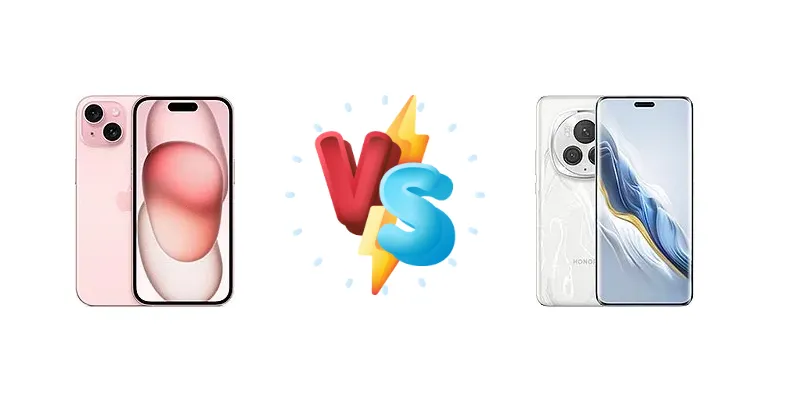
|
🏆 Quick Verdict
For the average user prioritizing ecosystem integration and a polished software experience, the iPhone 15 remains a strong choice. However, the Honor Magic6 Pro delivers superior battery life, significantly faster charging, and competitive performance, making it the winner for those prioritizing those features and open to Android.
| PHONES | ||
|---|---|---|
| Phone Names | Apple iPhone 15 | Honor Magic6 Pro |
| Network | ||
|---|---|---|
| 2G bands | GSM 850 / 900 / 1800 / 1900 | GSM 850 / 900 / 1800 / 1900 |
| 3G bands | HSDPA 850 / 900 / 1700(AWS) / 1900 / 2100 | HSDPA 800 / 850 / 900 / 1700(AWS) / 1900 / 2100 |
| 4G bands | 1, 2, 3, 4, 5, 7, 8, 12, 13, 17, 18, 19, 20, 25, 26, 28, 30, 32, 34, 38, 39, 40, 41, 42, 46, 48, 53, 66 - A3090 | LTE |
| 5G bands | 1, 2, 3, 5, 7, 8, 12, 20, 25, 26, 28, 30, 38, 40, 41, 48, 53, 66, 70, 77, 78, 79 SA/NSA/Sub6 - A3090 | SA/NSA |
| Speed | HSPA, LTE, 5G, EV-DO Rev.A 3.1 Mbps | HSPA, LTE, 5G |
| Technology | GSM / CDMA / HSPA / EVDO / LTE / 5G | GSM / CDMA / HSPA / CDMA2000 / LTE / 5G |
| Launch | ||
|---|---|---|
| Announced | 2023, September 12 | 2024, January 11 |
| Status | Available. Released 2023, September 22 | Available. Released 2024, January 18 |
| Body | ||
|---|---|---|
| Build | Glass front, glass back, aluminum frame | Glass front (NanoCrystal Shield), glass back or silicone polymer back (eco leather) |
| Dimensions | 147.6 x 71.6 x 7.8 mm (5.81 x 2.82 x 0.31 in) | 162.5 x 75.8 x 8.9 mm (6.40 x 2.98 x 0.35 in) |
| SIM | · Nano-SIM + eSIM + eSIM (max 2 at a time; International)· eSIM + eSIM (8 or more, max 2 at a time; USA)· Nano-SIM + Nano-SIM (China) | · Nano-SIM + eSIM· Nano-SIM + Nano-SIM |
| Weight | 171 g (6.03 oz) | 225 g or 229 g (7.94 oz) |
| Display | ||
|---|---|---|
| Protection | Ceramic Shield glass | NanoCrystal Shield |
| Resolution | 1179 x 2556 pixels, 19.5:9 ratio (~461 ppi density) | 1280 x 2800 pixels, 19.5:9 ratio (~453 ppi density) |
| Size | 6.1 inches, 91.3 cm2 (~86.4% screen-to-body ratio) | 6.8 inches, 112.8 cm2 (~91.6% screen-to-body ratio) |
| Type | Super Retina XDR OLED, HDR10, Dolby Vision, 1000 nits (HBM), 2000 nits (peak) | LTPO OLED, 1B colors, 120Hz, Dolby Vision, HDR, 1600 nits (HBM), 5000 nits (peak) |
| Platform | ||
|---|---|---|
| CPU | Hexa-core (2x3.46 GHz Everest + 4x2.02 GHz Sawtooth) | Octa-core (1x3.3 GHz Cortex-X4 & 3x3.2 GHz Cortex-A720 & 2x3.0 GHz Cortex-A720 & 2x2.3 GHz Cortex-A520) |
| Chipset | Apple A16 Bionic (4 nm) | Qualcomm SM8650-AB Snapdragon 8 Gen 3 (4 nm) |
| GPU | Apple GPU (5-core graphics) | Adreno 750 |
| OS | iOS 17, upgradable to iOS 26.1 | Android 14, up to 4 major Android upgrades, MagicOS 8 |
| Memory | ||
|---|---|---|
| Card slot | No | No |
| Internal | 128GB 6GB RAM, 256GB 6GB RAM, 512GB 6GB RAM | 256GB 12GB RAM, 256GB 16GB RAM, 512GB 12GB RAM, 512GB 16GB RAM, 1TB 16GB RAM |
| Main Camera | ||
|---|---|---|
| Dual | 48 MP, f/1.6, 26mm (wide), 1/1.56", 1.0µm, dual pixel PDAF, sensor-shift OIS 12 MP, f/2.4, 13mm, 120˚ (ultrawide), 0.7µm | - |
| Features | Dual-LED dual-tone flash, HDR (photo/panorama) | Laser AF, color spectrum sensor, LED flash, HDR, panorama |
| Triple | - | 50 MP, f/1.4-2.0, 23mm (wide), 1/1.3", 1.2µm, PDAF, OIS 180 MP, f/2.6, (periscope telephoto), 1/1.49", 0.56µm, PDAF, OIS, 2.5x optical zoom 50 MP, f/2.0, 13mm, 122˚ (ultrawide), 1/2.88", 0.61µm, AF |
| Video | 4K@24/25/30/60fps, 1080p@25/30/60/120/240fps, HDR, Dolby Vision HDR (up to 60fps), stereo sound rec. | 4K@24/30/60fps, 1080p@30/60/120/240fps, gyro-EIS, OIS, HDR, 10-bit video |
| Selfie camera | ||
|---|---|---|
| Features | HDR, Dolby Vision HDR | - |
| Single | 12 MP, f/1.9, 23mm (wide), 1/3.6", 1.0µm, PDAF SL 3D, (depth/biometrics sensor) | 50 MP, f/2.0, 22mm (wide), 1/2.93", 0.6µm, AF TOF 3D, (depth/biometrics sensor) |
| Video | 4K@24/25/30/60fps, 1080p@25/30/60/120fps, gyro-EIS | 4K@30fps, 1080p@30/60fps, gyro-EIS |
| Sound | ||
|---|---|---|
| 35mm jack | No | No |
| Loudspeaker | Yes, with stereo speakers | Yes, with stereo speakers |
| Comms | ||
|---|---|---|
| Bluetooth | 5.3, A2DP, LE | 5.3, A2DP, LE, aptX HD |
| Infrared port | - | Yes |
| NFC | Yes | Yes |
| Positioning | GPS, GLONASS, GALILEO, BDS, QZSS | GPS (L1+L5), GLONASS, BDS (B1I+B1c+B2a), GALILEO (E1+E5a) |
| Radio | No | No |
| USB | USB Type-C 2.0, DisplayPort | USB Type-C 3.2, DisplayPort 1.2, OTG |
| WLAN | Wi-Fi 802.11 a/b/g/n/ac/6, dual-band, hotspot | Wi-Fi 802.11 a/b/g/n/ac/6/7, dual-band, Wi-Fi Direct |
| Features | ||
|---|---|---|
| Sensors | Face ID, accelerometer, gyro, proximity, compass, barometer | Fingerprint (under display, optical), Face ID, accelerometer, gyro, proximity, compass |
| Battery | ||
|---|---|---|
| Charging | Wired, PD2.0, 50% in 30 min 15W wireless (MagSafe) 15W wireless (Qi2) - requires iOS 17.2 update 4.5W reverse wired | 80W wired 66W wireless Reverse wireless 5W reverse wired |
| Type | Li-Ion 3349 mAh | Si/C Li-Ion 5600 mAh |
| Misc | ||
|---|---|---|
| Colors | Black, Blue, Green, Yellow, Pink | Black, Green, Blue, Purple, White |
| Models | A3090, A2846, A3089, A3092, iPhone15,4 | BVL-AN16, BVL-N49 |
| Price | € 519.00 / $ 396.00 / £ 449.99 / ₹ 50,990 | € 455.54 / $ 899.00 / £ 598.99 |
| SAR | 1.12 W/kg (head) 1.14 W/kg (body) | - |
| SAR EU | 0.98 W/kg (head) 0.98 W/kg (body) | - |
Apple iPhone 15
- Seamless Apple ecosystem integration
- Polished and user-friendly iOS software
- Strong resale value
- Slower charging speeds
- Shorter battery life compared to Magic6 Pro
- Limited customization options
Honor Magic6 Pro
- Exceptional battery life
- Ultra-fast 80W wired and 66W wireless charging
- More open and customizable Android experience
- Android ecosystem fragmentation
- Potential software bloatware
- Resale value may be lower
Display Comparison
Both the iPhone 15 and Honor Magic6 Pro feature high-quality displays, but with subtle differences. The iPhone 15 reaches a measured peak brightness of 1643 nits, slightly exceeding the Magic6 Pro’s 1578 nits. While the difference is noticeable, both are easily viewable outdoors. Neither specification details refresh rate or panel type, but given the flagship status, both likely employ LTPO technology for variable refresh rates. The iPhone 15’s display benefits from Apple’s color calibration expertise, while the Magic6 Pro’s display is likely tuned for vibrant colors, a common trait in Honor devices. Bezels appear comparable based on available imagery, suggesting a similar immersive experience.
Camera Comparison
Both phones are equipped with advanced camera systems, but details are limited. The context data only indicates 'Photo / Video' capabilities for the iPhone 15, making a detailed comparison difficult. The Honor Magic6 Pro’s camera specifications are also absent, but Honor has a history of incorporating large sensors and advanced image processing. The absence of sensor size information is a significant omission. The iPhone 15’s strength lies in its computational photography and video recording capabilities, while the Magic6 Pro likely focuses on delivering high-resolution images with strong dynamic range. We can assume both phones offer optical image stabilization (OIS) on their main sensors. The lack of detail regarding secondary cameras (ultrawide, telephoto) prevents a comprehensive assessment.
Performance
The core of the performance difference lies in the chipsets. The iPhone 15 utilizes Apple’s A16 Bionic (4nm), a hexa-core processor with a focus on efficiency and single-core performance. The Honor Magic6 Pro, however, is powered by the Qualcomm Snapdragon 8 Gen 3 (4nm), an octa-core processor designed for sustained multi-core performance. The Snapdragon’s configuration – 1x3.3 GHz Cortex-X4, 3x3.2 GHz Cortex-A720, 2x3.0 GHz Cortex-A720, and 2x2.3 GHz Cortex-A520 – suggests a broader range of processing capabilities. While the A16 excels in tasks optimized for Apple’s silicon, the Snapdragon 8 Gen 3 offers a more versatile approach, potentially benefiting demanding applications and gaming. Both devices likely utilize LPDDR5X RAM, but specific speeds are not provided. Thermal management will be crucial for sustained performance, and the Snapdragon’s larger die size may present a greater cooling challenge.
Battery Life
The Honor Magic6 Pro demonstrably leads in battery endurance. Its active use score of 14:06h surpasses the iPhone 15’s 13:20h. This advantage is further amplified by the Magic6 Pro’s charging capabilities: 80W wired, 66W wireless, and 5W reverse wired, compared to the iPhone 15’s 50% in 30 minutes wired, 15W MagSafe/Qi2 wireless, and 4.5W reverse wired. The Magic6 Pro’s charging speed is significantly faster, allowing for a full charge in under 40 minutes, while the iPhone 15 takes considerably longer. The iPhone 15 has an endurance rating of 98h, but this is a theoretical metric; the active use score provides a more realistic assessment. The Honor Magic6 Pro’s combination of battery life and charging speed is a clear advantage for users who demand all-day power and quick top-ups.
Buying Guide
Buy the Apple iPhone 15 if you need seamless integration with other Apple devices, a mature and user-friendly operating system, and a strong resale value. Buy the Honor Magic6 Pro if you prioritize exceptional battery life, blazing-fast 80W charging, and a more open Android experience, all at a potentially lower price point.