
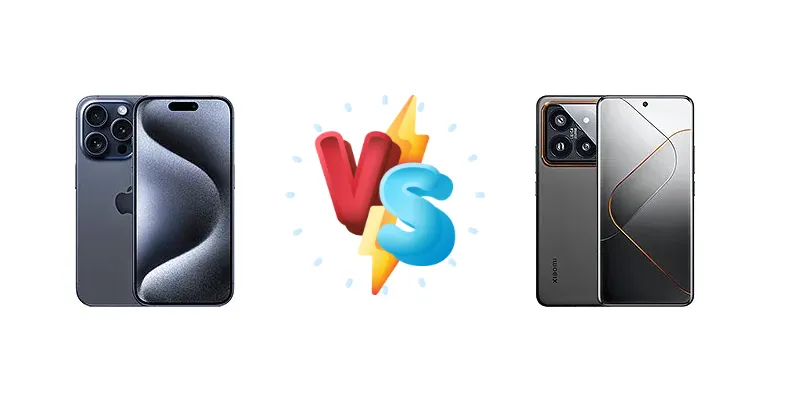
iPhone 15 Pro vs Xiaomi 14 Pro: The Definitive Flagship Comparison
| Phones Images | |||||
|---|---|---|---|---|---|
|
🏆 Quick Verdict
For the average user prioritizing long-term software support and a seamless user experience, the iPhone 15 Pro emerges as the winner. However, the Xiaomi 14 Pro’s significantly faster charging – reaching 100% in just 18 minutes – and competitive performance make it a compelling alternative for power users.
| PHONES | ||
|---|---|---|
| Phone Names | Apple iPhone 15 Pro | Xiaomi 14 Pro |
| Network | ||
|---|---|---|
| 2G bands | GSM 850 / 900 / 1800 / 1900 | GSM 850 / 900 / 1800 / 1900 |
| 3G bands | HSDPA 850 / 900 / 1700(AWS) / 1900 / 2100 | HSDPA 800 / 850 / 900 / 1700(AWS) / 1900 / 2100 |
| 4G bands | 1, 2, 3, 4, 5, 7, 8, 12, 13, 17, 18, 19, 20, 25, 26, 28, 30, 32, 34, 38, 39, 40, 41, 42, 46, 48, 53, 66 - A3102 | 1, 3, 4, 5, 7, 8, 18, 19, 26, 28, 34, 38, 39, 40, 41, 42, 48, 66 |
| 5G bands | 1, 2, 3, 5, 7, 8, 12, 20, 25, 26, 28, 30, 38, 40, 41, 48, 53, 66, 70, 77, 78, 79 SA/NSA/Sub6 - A3102 | 1, 3, 5, 7, 8, 28, 38, 40, 41, 48, 66, 77, 78, 79 SA/NSA |
| Speed | HSPA, LTE, 5G, EV-DO Rev.A 3.1 Mbps | HSPA, LTE, 5G |
| Technology | GSM / CDMA / HSPA / EVDO / LTE / 5G | GSM / CDMA / HSPA / CDMA2000 / LTE / 5G |
| Launch | ||
|---|---|---|
| Announced | 2023, September 12 | 2023, October 26 |
| Status | Available. Released 2023, September 22 | Available. Released 2023, November 01 |
| Body | ||
|---|---|---|
| Build | Glass front, glass back, titanium frame (grade 5) | Glass front, aluminum frame or titanium frame, glass back |
| Dimensions | 146.6 x 70.6 x 8.3 mm (5.77 x 2.78 x 0.33 in) | 161.4 x 75.3 x 8.5 mm |
| SIM | · Nano-SIM + eSIM + eSIM (max 2 at a time; International)· eSIM + eSIM (8 or more, max 2 at a time; USA)· Nano-SIM + Nano-SIM (China) | Nano-SIM + Nano-SIM |
| Weight | 187 g (6.60 oz) | 223 g or 230 g (7.87 oz) |
| Display | ||
|---|---|---|
| Protection | Ceramic Shield glass | Shatterproof glass |
| Resolution | 1179 x 2556 pixels, 19.5:9 ratio (~461 ppi density) | 1440 x 3200 pixels, 20:9 ratio (~522 ppi density) |
| Size | 6.1 inches, 91.3 cm2 (~88.2% screen-to-body ratio) | 6.73 inches, 108.9 cm2 (~89.6% screen-to-body ratio) |
| Type | LTPO Super Retina XDR OLED, 120Hz, HDR10, Dolby Vision, 1000 nits (typ), 2000 nits (HBM) | LTPO AMOLED, 68B colors, 120Hz, Dolby Vision, HDR10+, 3000 nits (peak) |
| Platform | ||
|---|---|---|
| CPU | Hexa-core (2x3.78 GHz + 4x2.11 GHz) | Octa-core (1x3.3 GHz Cortex-X4 & 3x3.2 GHz Cortex-A720 & 2x3.0 GHz Cortex-A720 & 2x2.3 GHz Cortex-A520) |
| Chipset | Apple A17 Pro (3 nm) | Qualcomm SM8650-AB Snapdragon 8 Gen 3 (4 nm) |
| GPU | Apple GPU (6-core graphics) | Adreno 750 |
| OS | iOS 17, upgradable to iOS 26.1 | Android 14, HyperOS |
| Memory | ||
|---|---|---|
| Card slot | No | No |
| Internal | 128GB 8GB RAM, 256GB 8GB RAM, 512GB 8GB RAM, 1TB 8GB RAM | 256GB 12GB RAM, 512GB 16GB RAM, 1TB 16GB RAM |
| Main Camera | ||
|---|---|---|
| Features | Dual-LED dual-tone flash, HDR (photo/panorama) | Laser AF, color spectrum sensor, Leica lens, Dual-LED dual-tone flash, HDR, panorama |
| Triple | 48 MP, f/1.8, 24mm (wide), 1/1.28", 1.22µm, dual pixel PDAF, sensor-shift OIS 12 MP, f/2.8, 77mm (telephoto), 1/3.5", 1.0µm, PDAF, OIS, 3x optical zoom 12 MP, f/2.2, 13mm, 120˚ (ultrawide), 1/2.55", 1.4µm, dual pixel PDAF TOF 3D LiDAR scanner (depth) | 50 MP, f/1.4-f/4.0, 23mm (wide), 1/1.31", 1.2µm, dual pixel PDAF, OIS 50 MP, f/2.0, 75mm (telephoto), PDAF (10cm - ∞), OIS, 3.2x optical zoom 50 MP, f/2.2, 14mm, 115˚ (ultrawide), AF |
| Video | 4K@24/25/30/60fps, 1080p@25/30/60/120/240fps, 10-bit HDR, Dolby Vision HDR (up to 60fps), ProRes, 3D (spatial) video, stereo sound rec. | 8K@24fps (HDR), 4K@24/30/60fps (HDR10+, 10-bit Dolby Vision HDR, 10-bit LOG), 1080p@30/60/120/240/960fps, 720p@1920fps, gyro-EIS |
| Selfie camera | ||
|---|---|---|
| Features | HDR, Dolby Vision HDR | HDR, panorama |
| Single | 12 MP, f/1.9, 23mm (wide), 1/3.6", 1.0µm, PDAF, OIS SL 3D, (depth/biometrics sensor) | 32 MP, f/2.0, 22mm (wide), 0.7µm |
| Video | 4K@24/25/30/60fps, 1080p@25/30/60/120fps, gyro-EIS | 4K@30/60fps, 1080p@30/60fps, gyro-EIS |
| Sound | ||
|---|---|---|
| 35mm jack | No | No |
| Loudspeaker | Yes, with stereo speakers | Yes, with stereo speakers |
| Comms | ||
|---|---|---|
| Bluetooth | 5.3, A2DP, LE | 5.4, A2DP, LE, aptX HD, aptX Adaptive |
| Infrared port | - | Yes |
| NFC | Yes | Yes |
| Positioning | GPS (L1+L5), GLONASS, GALILEO, BDS, QZSS, NavIC | GPS (L1+L5), GLONASS (G1), BDS (B1I+B1c+B2a), GALILEO (E1+E5a), QZSS (L1+L5), NavIC (L5) |
| Radio | No | No |
| USB | USB Type-C 3.2 Gen 2, DisplayPort | USB Type-C 3.2 Gen 2, OTG |
| WLAN | Wi-Fi 802.11 a/b/g/n/ac/6e, tri-band, hotspot | Wi-Fi 802.11 a/b/g/n/ac/6e/7, dual-band, Wi-Fi Direct |
| Features | ||
|---|---|---|
| Sensors | Face ID, accelerometer, gyro, proximity, compass, barometer | Fingerprint (under display, optical), accelerometer, proximity, gyro, compass, barometer |
| Battery | ||
|---|---|---|
| Charging | Wired, PD2.0, 50% in 30 min 15W wireless (MagSafe) 15W wireless (Qi2) - requires iOS 17.2 update 4.5W reverse wired | 120W wired, PD3.0, QC4, 100% in 18 min 50W wireless, 100% in 40 min 10W reverse wireless |
| Type | Li-Ion 3274 mAh | Li-Po 4880 mAh |
| Misc | ||
|---|---|---|
| Colors | Black Titanium, White Titanium, Blue Titanium, Natural Titanium | Black, Silver, Titanium, Green |
| Models | A2848, A3101, A3102, A3104, iPhone16,1 | 23116PN5BC |
| Price | $ 489.68 / C$ 849.99 / £ 559.99 / € 648.47 | About 650 EUR |
| SAR | 1.14 W/kg (head) 1.16 W/kg (body) | - |
| SAR EU | 0.98 W/kg (head) 0.98 W/kg (body) | - |
Apple iPhone 15 Pro
- Exceptional single-core performance with the A17 Pro chip
- Industry-leading video recording capabilities
- Long-term software support and ecosystem integration
- Slower charging speeds compared to Xiaomi 14 Pro
- Less customizable operating system (iOS)
Xiaomi 14 Pro
- Incredibly fast 120W wired charging
- More open and customizable Android operating system
- Potentially more competitive pricing
- Software update longevity may be shorter than iPhone
- Image processing may not appeal to all users
Display Comparison
The iPhone 15 Pro boasts a measured peak brightness of 1786 nits, ensuring excellent visibility even in direct sunlight. While Xiaomi doesn’t provide a measured peak brightness, their displays typically excel in color accuracy. Both likely utilize LTPO technology for adaptive refresh rates, conserving battery life. The iPhone’s tighter integration with its display panel allows for precise color calibration, crucial for professional photo and video editing. The absence of detailed Xiaomi display specs makes a direct comparison challenging, but the iPhone’s measured brightness gives it a clear advantage in outdoor usability.
Camera Comparison
Both phones are expected to deliver exceptional camera performance, but their approaches differ. Apple traditionally focuses on computational photography and natural-looking images, while Xiaomi often leans towards vibrant, saturated colors. Without detailed sensor specifications for the Xiaomi 14 Pro, it’s difficult to make a direct comparison. However, the iPhone 15 Pro’s advanced image processing pipeline and ProRes video recording capabilities cater to professional content creators. The focus here is on the overall system, not just megapixel count. The iPhone’s video capabilities are a significant differentiator.
Performance
The core of the debate lies in the chipsets: Apple’s 3nm A17 Pro versus Qualcomm’s 4nm Snapdragon 8 Gen 3. The A17 Pro’s hexa-core configuration (2x3.78 GHz + 4x2.11 GHz) is optimized for single-core performance, crucial for responsive app launches and smooth scrolling. The Snapdragon 8 Gen 3’s octa-core setup (1x3.3 GHz Cortex-X4 & 3x3.2 GHz Cortex-A720 & 2x3.0 GHz Cortex-A720 & 2x2.3 GHz Cortex-A520) prioritizes multi-core performance, potentially benefiting demanding tasks like video encoding and heavy multitasking. While the A17 Pro’s architecture is more efficient, the Snapdragon 8 Gen 3’s 4nm process offers improved thermal efficiency, potentially mitigating throttling during extended gaming sessions. Both devices will likely offer flagship-level performance, but the A17 Pro holds an edge in single-core tasks.
Battery Life
The iPhone 15 Pro achieves an impressive 12:58h active use score and an endurance rating of 86h, indicating excellent battery optimization. The Xiaomi 14 Pro, however, compensates for potentially lower battery capacity with its blazing-fast 120W wired charging (100% in 18 minutes) and 50W wireless charging (100% in 40 minutes). The iPhone’s charging is comparatively slower at 50% in 30 minutes with wired PD2.0, 15W MagSafe, and 15W Qi2 (requiring iOS 17.2). The Xiaomi 14 Pro’s charging speed is a game-changer for users who frequently need to top up their battery quickly. The 4.5W reverse wired charging on the iPhone is a niche feature, while the Xiaomi 14 Pro offers 10W reverse wireless charging.
Buying Guide
Buy the Apple iPhone 15 Pro if you need a phone with guaranteed software updates for years to come, a mature app ecosystem, and prioritize video recording quality. Buy the Xiaomi 14 Pro if you prefer a more customizable Android experience, demand the absolute fastest charging speeds available, and value a potentially lower price point for comparable performance.