
iPhone 15 Pro vs. Samsung Galaxy S24+: Which Flagship Reigns Supreme?
| Phones Images | |||||
|---|---|---|---|---|---|
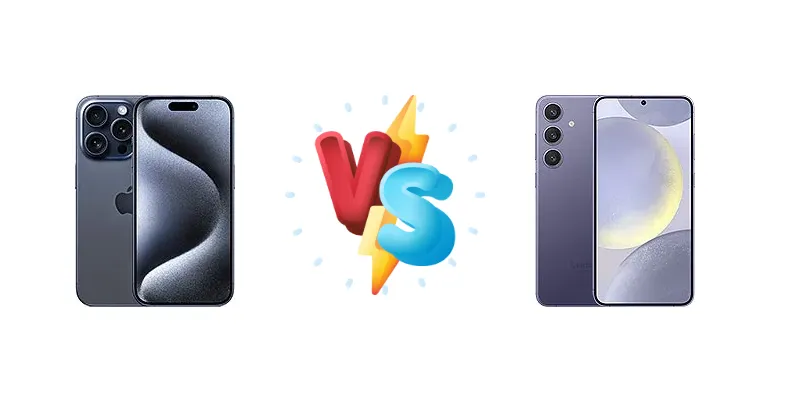
|
🏆 Quick Verdict
For users deeply embedded in the Apple ecosystem and prioritizing consistent performance and video recording, the iPhone 15 Pro is the better choice. However, the Galaxy S24+ offers faster charging, a brighter display, and broader software customization, making it a compelling alternative, especially for Android enthusiasts.
| PHONES | ||
|---|---|---|
| Phone Names | Apple iPhone 15 Pro | Samsung Galaxy S24+ |
| Network | ||
|---|---|---|
| 2G bands | GSM 850 / 900 / 1800 / 1900 | GSM 850 / 900 / 1800 / 1900 |
| 3G bands | HSDPA 850 / 900 / 1700(AWS) / 1900 / 2100 | HSDPA 850 / 900 / 1700(AWS) / 1900 / 2100 |
| 4G bands | 1, 2, 3, 4, 5, 7, 8, 12, 13, 17, 18, 19, 20, 25, 26, 28, 30, 32, 34, 38, 39, 40, 41, 42, 46, 48, 53, 66 - A3102 | 1, 2, 3, 4, 5, 7, 8, 12, 13, 17, 18, 19, 20, 25, 26, 28, 32, 38, 39, 40, 41, 66 - International |
| 5G bands | 1, 2, 3, 5, 7, 8, 12, 20, 25, 26, 28, 30, 38, 40, 41, 48, 53, 66, 70, 77, 78, 79 SA/NSA/Sub6 - A3102 | 1, 2, 3, 5, 7, 8, 12, 20, 25, 26, 28, 38, 40, 41, 66, 75, 77, 78 SA/NSA/Sub6 - International |
| Speed | HSPA, LTE, 5G, EV-DO Rev.A 3.1 Mbps | HSPA, LTE (up to 7CA), 5G |
| Technology | GSM / CDMA / HSPA / EVDO / LTE / 5G | GSM / CDMA / HSPA / EVDO / LTE / 5G |
| Launch | ||
|---|---|---|
| Announced | 2023, September 12 | 2024, January 17 |
| Status | Available. Released 2023, September 22 | Available. Released 2024, January 24 |
| Body | ||
|---|---|---|
| Build | Glass front, glass back, titanium frame (grade 5) | Glass front (Gorilla Glass Victus 2), glass back (Gorilla Glass Victus 2), aluminum frame |
| Dimensions | 146.6 x 70.6 x 8.3 mm (5.77 x 2.78 x 0.33 in) | 158.5 x 75.9 x 7.7 mm (6.24 x 2.99 x 0.30 in) |
| SIM | · Nano-SIM + eSIM + eSIM (max 2 at a time; International)· eSIM + eSIM (8 or more, max 2 at a time; USA)· Nano-SIM + Nano-SIM (China) | · Nano-SIM + Nano-SIM + eSIM + eSIM (max 2 at a time) - INT· Nano-SIM + eSIM + eSIM (max 2 at a time) - USA· Nano-SIM + Nano-SIM - CN |
| Weight | 187 g (6.60 oz) | 196 g or 197 g (6.91 oz) |
| Display | ||
|---|---|---|
| Protection | Ceramic Shield glass | Corning Gorilla Glass Victus 2 |
| Resolution | 1179 x 2556 pixels, 19.5:9 ratio (~461 ppi density) | 1440 x 3120 pixels, 19.5:9 ratio (~513 ppi density) |
| Size | 6.1 inches, 91.3 cm2 (~88.2% screen-to-body ratio) | 6.7 inches, 110.2 cm2 (~91.6% screen-to-body ratio) |
| Type | LTPO Super Retina XDR OLED, 120Hz, HDR10, Dolby Vision, 1000 nits (typ), 2000 nits (HBM) | Dynamic LTPO AMOLED 2X, 120Hz, HDR10+, 2600 nits (peak) |
| Platform | ||
|---|---|---|
| CPU | Hexa-core (2x3.78 GHz + 4x2.11 GHz) | 8-core (1x3.39GHz Cortex-X4 & 3x3.1GHz Cortex-A720 & 2x2.9GHz Cortex-A720 & 2x2.2GHz Cortex-A520)10-core (1x3.2GHz Cortex-X4 & 2x2.9GHz Cortex-A720 & 3x2.6GHz Cortex-A720 & 4x1.95GHz Cortex-A520) |
| Chipset | Apple A17 Pro (3 nm) | Qualcomm SM8650-AC Snapdragon 8 Gen 3 (4 nm) - USA/Canada/ChinaExynos 2400 (4 nm) - International |
| GPU | Apple GPU (6-core graphics) | Adreno 750 (1 GHz) - USA/Canada/ChinaXclipse 940 - International |
| OS | iOS 17, upgradable to iOS 26.1 | Android 14, up to 7 major Android upgrades, One UI 8.0 |
| Memory | ||
|---|---|---|
| Card slot | No | No |
| Internal | 128GB 8GB RAM, 256GB 8GB RAM, 512GB 8GB RAM, 1TB 8GB RAM | 256GB 12GB RAM, 512GB 12GB RAM |
| Main Camera | ||
|---|---|---|
| Features | Dual-LED dual-tone flash, HDR (photo/panorama) | LED flash, auto-HDR, panorama |
| Triple | 48 MP, f/1.8, 24mm (wide), 1/1.28", 1.22µm, dual pixel PDAF, sensor-shift OIS 12 MP, f/2.8, 77mm (telephoto), 1/3.5", 1.0µm, PDAF, OIS, 3x optical zoom 12 MP, f/2.2, 13mm, 120˚ (ultrawide), 1/2.55", 1.4µm, dual pixel PDAF TOF 3D LiDAR scanner (depth) | 50 MP, f/1.8, 24mm (wide), 1/1.56", 1.0µm, dual pixel PDAF, OIS 10 MP, f/2.4, 67mm (telephoto), 1/3.94", 1.0µm, PDAF, OIS, 3x optical zoom 12 MP, f/2.2, 13mm, 120˚ (ultrawide), 1/2.55" 1.4µm, Super Steady video |
| Video | 4K@24/25/30/60fps, 1080p@25/30/60/120/240fps, 10-bit HDR, Dolby Vision HDR (up to 60fps), ProRes, 3D (spatial) video, stereo sound rec. | 8K@24/30fps, 4K@30/60fps, 1080p@30/60/120/240fps, HDR10+, stereo sound rec., gyro-EIS |
| Selfie camera | ||
|---|---|---|
| Features | HDR, Dolby Vision HDR | HDR, HDR10+ |
| Single | 12 MP, f/1.9, 23mm (wide), 1/3.6", 1.0µm, PDAF, OIS SL 3D, (depth/biometrics sensor) | 12 MP, f/2.2, 26mm (wide), 1/3.2", 1.12µm, dual pixel PDAF |
| Video | 4K@24/25/30/60fps, 1080p@25/30/60/120fps, gyro-EIS | 4K@30/60fps, 1080p@30fps |
| Sound | ||
|---|---|---|
| 35mm jack | No | No |
| Loudspeaker | Yes, with stereo speakers | Yes, with stereo speakers |
| Comms | ||
|---|---|---|
| Bluetooth | 5.3, A2DP, LE | 5.3, A2DP, LE |
| NFC | Yes | Yes |
| Positioning | GPS (L1+L5), GLONASS, GALILEO, BDS, QZSS, NavIC | GPS, GLONASS, BDS, GALILEO, QZSS |
| Radio | No | No |
| USB | USB Type-C 3.2 Gen 2, DisplayPort | USB Type-C 3.2, DisplayPort 1.2, OTG |
| WLAN | Wi-Fi 802.11 a/b/g/n/ac/6e, tri-band, hotspot | Wi-Fi 802.11 a/b/g/n/ac/6e, tri-band, Wi-Fi Direct |
| Features | ||
|---|---|---|
| Sensors | Face ID, accelerometer, gyro, proximity, compass, barometer | Fingerprint (under display, ultrasonic), accelerometer, gyro, proximity, compass, barometer |
| Battery | ||
|---|---|---|
| Charging | Wired, PD2.0, 50% in 30 min 15W wireless (MagSafe) 15W wireless (Qi2) - requires iOS 17.2 update 4.5W reverse wired | 45W wired, PD3.0, 65% in 30 min 15W wireless (Qi) 4.5W reverse wireless |
| Type | Li-Ion 3274 mAh | Li-Ion 4900 mAh |
| Misc | ||
|---|---|---|
| Colors | Black Titanium, White Titanium, Blue Titanium, Natural Titanium | Onyx Black, Marble Grey, Cobalt Violet, Amber Yellow, Jade Green, Sandstone Orange, Sapphire Blue |
| Models | A2848, A3101, A3102, A3104, iPhone16,1 | SM-S926B, SM-S926B/DS, SM-S926U, SM-S926U1, SM-S926W, SM-S926N, SM-S9260, SM-S926E, SM-S926E/DS |
| Price | $ 489.68 / C$ 849.99 / £ 559.99 / € 648.47 | $ 429.50 / € 549.00 / £ 445.98 |
| SAR | 1.14 W/kg (head) 1.16 W/kg (body) | 1.16 W/kg (head) 0.84 W/kg (body) |
| SAR EU | 0.98 W/kg (head) 0.98 W/kg (body) | 0.74 W/kg (head) 1.25 W/kg (body) |
Apple iPhone 15 Pro
- Superior video recording capabilities with ProRes
- A17 Pro chip delivers consistent high performance
- Long-term software support and ecosystem integration
- Slower wired charging speed
- Less customization options compared to Android
Samsung Galaxy S24+
- Faster 45W wired charging
- Brighter display for outdoor visibility
- More flexible Android operating system
- Exynos variant may exhibit thermal throttling
- Image processing can be overly saturated for some users
Display Comparison
The iPhone 15 Pro boasts a peak brightness of 1786 nits, while the Galaxy S24+ reaches 1452 nits. While the iPhone is brighter, the difference isn't massive. Both displays are excellent, but the S24+’s higher peak brightness provides a slight advantage in direct sunlight. Neither specification details refresh rate, but both are expected to have adaptive refresh rates. The S24+’s larger screen size may appeal to users who consume more video content, but the iPhone 15 Pro’s color accuracy is typically lauded by professionals.
Camera Comparison
Both devices are equipped with capable camera systems, focusing on photo and video. Without detailed sensor information, it’s difficult to make a definitive judgment. However, Apple’s computational photography is renowned for its natural-looking images and exceptional video stabilization. Samsung typically leans towards more vibrant, saturated colors. The iPhone 15 Pro’s ProRes video recording capabilities cater to professional videographers, a feature not explicitly matched by the S24+. The absence of detailed sensor specs makes it difficult to assess low-light performance, but Apple’s larger sensors in recent years have given it an edge.
Performance
The core of the debate lies in the chipsets. The iPhone 15 Pro’s 3nm Apple A17 Pro (hexa-core) is a powerhouse, but the Snapdragon 8 Gen 3 (octa-core) in the S24+ (USA/Canada/China) is a formidable competitor. International versions of the S24+ utilize the Exynos 2400 (decacore), which historically has lagged behind Snapdragon in thermal efficiency. The A17 Pro’s architecture, with its 2 high-performance cores clocked at 3.78 GHz, is designed for bursty workloads, while the Snapdragon’s multi-core setup excels in sustained tasks. Both phones utilize LPDDR5X RAM, but the real-world impact of this is minimal. The A17 Pro’s integrated GPU is likely to offer superior graphics performance, but the Snapdragon 8 Gen 3’s Adreno GPU is no slouch.
Battery Life
The Galaxy S24+ edges out the iPhone 15 Pro in active use battery life, achieving 12:30h compared to the iPhone’s 12:58h. However, the iPhone 15 Pro boasts a superior endurance rating of 86h, suggesting better standby efficiency. The S24+’s 45W wired charging (PD3.0, 65% in 30 min) is significantly faster than the iPhone 15 Pro’s 50% in 30 min charging. Both support 15W wireless charging, but the iPhone 15 Pro gains an advantage with Qi2 support (requiring iOS 17.2), offering potentially more efficient wireless charging. Both offer 4.5W reverse wired charging.
Buying Guide
Buy the Apple iPhone 15 Pro if you need a seamless iOS experience, professional-grade video capabilities, and long-term software support. Its A17 Pro chip delivers consistent performance for demanding tasks. Buy the Samsung Galaxy S24+ if you prefer the flexibility of Android, faster charging speeds, and a brighter display for outdoor visibility, and value the broader ecosystem of Samsung devices.