
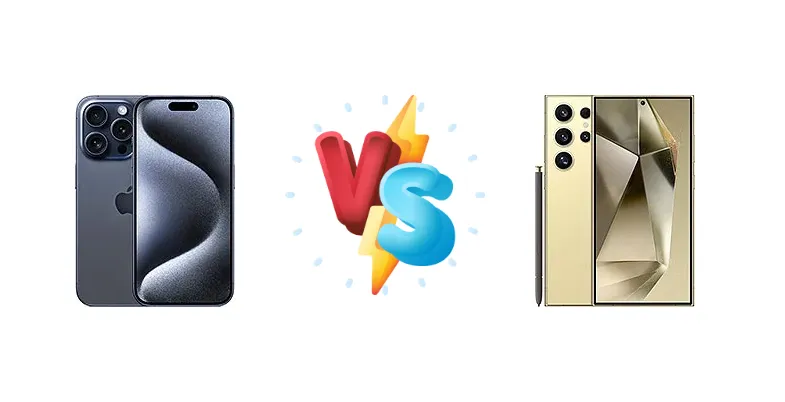
iPhone 15 Pro vs. Samsung Galaxy S24 Ultra: A Deep Dive Comparison
| Phones Images | |||||
|---|---|---|---|---|---|
|
🏆 Quick Verdict
For the average user prioritizing raw performance and a streamlined ecosystem, the iPhone 15 Pro edges out the Galaxy S24 Ultra. However, the S24 Ultra’s superior battery life and more versatile charging options, coupled with its brighter display, make it a compelling choice for power users and Android enthusiasts.
| PHONES | ||
|---|---|---|
| Phone Names | Apple iPhone 15 Pro | Samsung Galaxy S24 Ultra |
| Network | ||
|---|---|---|
| 2G bands | GSM 850 / 900 / 1800 / 1900 | GSM 850 / 900 / 1800 / 1900 |
| 3G bands | HSDPA 850 / 900 / 1700(AWS) / 1900 / 2100 | HSDPA 850 / 900 / 1700(AWS) / 1900 / 2100 |
| 4G bands | 1, 2, 3, 4, 5, 7, 8, 12, 13, 17, 18, 19, 20, 25, 26, 28, 30, 32, 34, 38, 39, 40, 41, 42, 46, 48, 53, 66 - A3102 | 1, 2, 3, 4, 5, 7, 8, 12, 13, 17, 18, 19, 20, 25, 26, 28, 32, 38, 39, 40, 41, 66 - International |
| 5G bands | 1, 2, 3, 5, 7, 8, 12, 20, 25, 26, 28, 30, 38, 40, 41, 48, 53, 66, 70, 77, 78, 79 SA/NSA/Sub6 - A3102 | 1, 2, 3, 5, 7, 8, 12, 20, 25, 26, 28, 38, 40, 41, 66, 75, 77, 78 SA/NSA/Sub6 - International |
| Speed | HSPA, LTE, 5G, EV-DO Rev.A 3.1 Mbps | HSPA, LTE (up to 7CA), 5G |
| Technology | GSM / CDMA / HSPA / EVDO / LTE / 5G | GSM / CDMA / HSPA / EVDO / LTE / 5G |
| Launch | ||
|---|---|---|
| Announced | 2023, September 12 | 2024, January 17 |
| Status | Available. Released 2023, September 22 | Available. Released 2024, January 24 |
| Body | ||
|---|---|---|
| Build | Glass front, glass back, titanium frame (grade 5) | Glass front (Corning Gorilla Armor), glass back (Corning Gorilla Armor), titanium frame (grade 2) |
| Dimensions | 146.6 x 70.6 x 8.3 mm (5.77 x 2.78 x 0.33 in) | 162.3 x 79 x 8.6 mm (6.39 x 3.11 x 0.34 in) |
| SIM | · Nano-SIM + eSIM + eSIM (max 2 at a time; International)· eSIM + eSIM (8 or more, max 2 at a time; USA)· Nano-SIM + Nano-SIM (China) | · Nano-SIM + Nano-SIM + eSIM + eSIM (max 2 at a time) - INT· Nano-SIM + eSIM + eSIM (max 2 at a time) - USA· Nano-SIM + Nano-SIM - CN |
| Weight | 187 g (6.60 oz) | 232 g or 233 g (8.18 oz) |
| Display | ||
|---|---|---|
| Protection | Ceramic Shield glass | Corning Gorilla Armor |
| Resolution | 1179 x 2556 pixels, 19.5:9 ratio (~461 ppi density) | 1440 x 3120 pixels, 19.5:9 ratio (~505 ppi density) |
| Size | 6.1 inches, 91.3 cm2 (~88.2% screen-to-body ratio) | 6.8 inches, 113.5 cm2 (~88.5% screen-to-body ratio) |
| Type | LTPO Super Retina XDR OLED, 120Hz, HDR10, Dolby Vision, 1000 nits (typ), 2000 nits (HBM) | Dynamic LTPO AMOLED 2X, 120Hz, HDR10+, 2600 nits (peak) |
| Platform | ||
|---|---|---|
| CPU | Hexa-core (2x3.78 GHz + 4x2.11 GHz) | 8-core (1x3.39GHz Cortex-X4 & 3x3.1GHz Cortex-A720 & 2x2.9GHz Cortex-A720 & 2x2.2GHz Cortex-A520) |
| Chipset | Apple A17 Pro (3 nm) | Qualcomm SM8650-AC Snapdragon 8 Gen 3 (4 nm) |
| GPU | Apple GPU (6-core graphics) | Adreno 750 (1 GHz) |
| OS | iOS 17, upgradable to iOS 26.1 | Android 14, up to 7 major Android upgrades, One UI 8.0 |
| Memory | ||
|---|---|---|
| Card slot | No | No |
| Internal | 128GB 8GB RAM, 256GB 8GB RAM, 512GB 8GB RAM, 1TB 8GB RAM | 256GB 12GB RAM, 512GB 12GB RAM, 1TB 12GB RAM |
| Main Camera | ||
|---|---|---|
| Features | Dual-LED dual-tone flash, HDR (photo/panorama) | Laser AF, LED flash, auto-HDR, panorama |
| Quad | - | 200 MP, f/1.7, 24mm (wide), 1/1.3", 0.6µm, multi-directional PDAF, OIS 10 MP, f/2.4, 67mm (telephoto), 1/3.52", 1.12µm, PDAF, OIS, 3x optical zoom 50 MP, f/3.4, 111mm (periscope telephoto), 1/2.52", 0.7µm, PDAF, OIS, 5x optical zoom 12 MP, f/2.2, 13mm, 120˚ (ultrawide), 1/2.55", 1.4µm, dual pixel PDAF, Super Steady video |
| Triple | 48 MP, f/1.8, 24mm (wide), 1/1.28", 1.22µm, dual pixel PDAF, sensor-shift OIS 12 MP, f/2.8, 77mm (telephoto), 1/3.5", 1.0µm, PDAF, OIS, 3x optical zoom 12 MP, f/2.2, 13mm, 120˚ (ultrawide), 1/2.55", 1.4µm, dual pixel PDAF TOF 3D LiDAR scanner (depth) | - |
| Video | 4K@24/25/30/60fps, 1080p@25/30/60/120/240fps, 10-bit HDR, Dolby Vision HDR (up to 60fps), ProRes, 3D (spatial) video, stereo sound rec. | 8K@24/30fps, 4K@30/60/120fps, 1080p@30/60/120/240fps, HDR10+, stereo sound rec., gyro-EIS |
| Selfie camera | ||
|---|---|---|
| Features | HDR, Dolby Vision HDR | HDR, HDR10+ |
| Single | 12 MP, f/1.9, 23mm (wide), 1/3.6", 1.0µm, PDAF, OIS SL 3D, (depth/biometrics sensor) | 12 MP, f/2.2, 26mm (wide), 1/3.2", 1.12µm, dual pixel PDAF |
| Video | 4K@24/25/30/60fps, 1080p@25/30/60/120fps, gyro-EIS | 4K@30/60fps, 1080p@30fps |
| Sound | ||
|---|---|---|
| 35mm jack | No | No |
| Loudspeaker | Yes, with stereo speakers | Yes, with stereo speakers |
| Comms | ||
|---|---|---|
| Bluetooth | 5.3, A2DP, LE | 5.3, A2DP, LE |
| NFC | Yes | Yes |
| Positioning | GPS (L1+L5), GLONASS, GALILEO, BDS, QZSS, NavIC | GPS, GLONASS, BDS, GALILEO, QZSS |
| Radio | No | No |
| USB | USB Type-C 3.2 Gen 2, DisplayPort | USB Type-C 3.2, DisplayPort 1.2, OTG |
| WLAN | Wi-Fi 802.11 a/b/g/n/ac/6e, tri-band, hotspot | Wi-Fi 802.11 a/b/g/n/ac/6e/7, tri-band, Wi-Fi Direct |
| Features | ||
|---|---|---|
| Sensors | Face ID, accelerometer, gyro, proximity, compass, barometer | Fingerprint (under display, ultrasonic), accelerometer, gyro, proximity, compass, barometer |
| Battery | ||
|---|---|---|
| Charging | Wired, PD2.0, 50% in 30 min 15W wireless (MagSafe) 15W wireless (Qi2) - requires iOS 17.2 update 4.5W reverse wired | 45W wired, PD3.0, 65% in 30 min 15W wireless (Qi) 4.5W reverse wireless |
| Type | Li-Ion 3274 mAh | Li-Ion 5000 mAh |
| Misc | ||
|---|---|---|
| Colors | Black Titanium, White Titanium, Blue Titanium, Natural Titanium | Titanium Black, Titanium Gray, Titanium Violet, Titanium Yellow, Titanium Blue, Titanium Green, Titanium Orange |
| Models | A2848, A3101, A3102, A3104, iPhone16,1 | SM-S928B, SM-S928B/DS, SM-S928U, SM-S928U1, SM-S928W, SM-S928N, SM-S9280, SM-S928E, SM-S928E/DS |
| Price | $ 489.68 / C$ 849.99 / £ 559.99 / € 648.47 | $ 514.94 / C$ 929.99 / £ 630.00 / € 658.53 / ₹ 84,999 |
| SAR | 1.14 W/kg (head) 1.16 W/kg (body) | 1.26 W/kg (head) 0.62 W/kg (body) |
| SAR EU | 0.98 W/kg (head) 0.98 W/kg (body) | 1.06 W/kg (head) 1.30 W/kg (body) |
Apple iPhone 15 Pro
- Superior single-core performance with the A17 Pro chip.
- Brighter display for better outdoor visibility.
- Exceptional video recording quality.
- Seamless integration with the Apple ecosystem.
- Shorter battery life compared to the S24 Ultra.
- Slower wired charging speed.
Samsung Galaxy S24 Ultra
- Longer battery life for all-day use.
- Faster wired charging with 45W support.
- More versatile camera system with advanced zoom.
- Android’s customization options.
- Slightly dimmer display in direct sunlight.
- Potential for software bloat and updates can be slower.
Display Comparison
The Galaxy S24 Ultra’s display, while measuring 1447 nits peak brightness, falls short of the iPhone 15 Pro’s impressive 1786 nits. This difference is noticeable in direct sunlight, giving the iPhone a slight edge in outdoor visibility. Both utilize advanced panel technologies, but the S24 Ultra’s larger size and potentially higher refresh rate (not specified in data, but standard for the Ultra line) could benefit users consuming a lot of video content. The iPhone 15 Pro’s color accuracy is renowned, but Samsung’s displays are consistently excellent, and the S24 Ultra likely offers more customizable color profiles.
Camera Comparison
Both devices excel in photography and videography, but approach it differently. The context data doesn’t provide sensor details, but both are expected to feature large sensors. The S24 Ultra’s camera system is known for its versatility, particularly its advanced zoom capabilities, which are not mentioned for the iPhone 15 Pro. Apple traditionally prioritizes natural-looking images and exceptional video quality, while Samsung often boosts colors and contrast. The iPhone 15 Pro’s video recording capabilities are widely considered best-in-class. The lack of detail on sensor sizes prevents a definitive camera winner, but the S24 Ultra’s multi-camera system offers more flexibility.
Performance
The core of the performance debate lies between Apple’s A17 Pro (3nm) and Qualcomm’s Snapdragon 8 Gen 3 (4nm). While the A17 Pro’s hexa-core configuration (2x3.78 GHz + 4x2.11 GHz) appears less complex than the S24 Ultra’s octa-core (1x3.39GHz Cortex-X4 & 3x3.1GHz Cortex-A720 & 2x2.9GHz Cortex-A720 & 2x2.2GHz Cortex-A520), Apple’s chip design and software optimization typically deliver superior single-core performance. The 4nm process of the Snapdragon 8 Gen 3 offers improved thermal efficiency compared to previous generations, potentially mitigating throttling during sustained workloads. However, the A17 Pro’s 3nm fabrication should provide even greater efficiency. Both phones will handle any task thrown at them, but the A17 Pro likely holds a slight lead in demanding applications.
Battery Life
The Galaxy S24 Ultra demonstrates a clear advantage in battery endurance, achieving an active use score of 13:49h compared to the iPhone 15 Pro’s 12:58h. While the iPhone 15 Pro has an endurance rating of 86h, this is a different metric than active use. The S24 Ultra also boasts faster wired charging at 45W (65% in 30 min) versus the iPhone 15 Pro’s 50% in 30 min. Both support 15W wireless charging, but the iPhone 15 Pro gains Qi2 support with the iOS 17.2 update, offering potentially improved efficiency. The inclusion of 4.5W reverse wired charging on both devices is a minor convenience feature.
Buying Guide
Buy the Apple iPhone 15 Pro if you need a seamlessly integrated ecosystem, prioritize video recording quality, and value Apple’s software experience. Buy the Samsung Galaxy S24 Ultra if you prefer Android’s customization, demand the longest possible battery life, and want a more versatile camera system with advanced zoom capabilities.