
iPhone 15 Pro vs. Samsung Galaxy S23 Ultra: Which Flagship Reigns Supreme?
| Phones Images | |||||
|---|---|---|---|---|---|
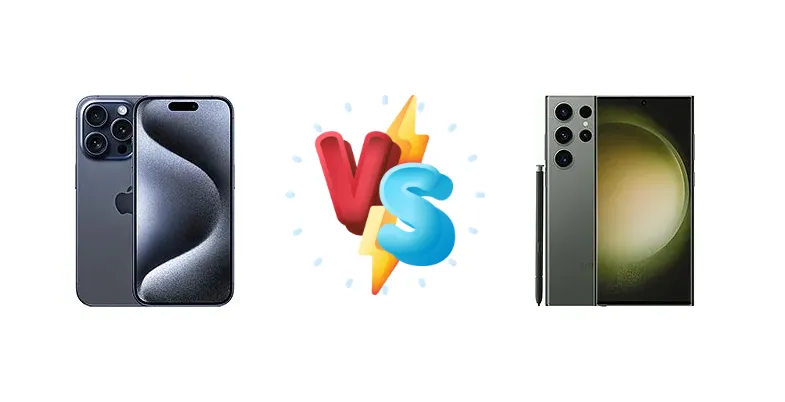
|
🏆 Quick Verdict
For the average user prioritizing all-day battery life and camera versatility, the Samsung Galaxy S23 Ultra edges out the iPhone 15 Pro. However, the iPhone 15 Pro’s A17 Pro chip delivers superior single-core performance and a smoother software experience for demanding tasks.
| PHONES | ||
|---|---|---|
| Phone Names | Apple iPhone 15 Pro | Samsung Galaxy S23 Ultra |
| Network | ||
|---|---|---|
| 2G bands | GSM 850 / 900 / 1800 / 1900 | GSM 850 / 900 / 1800 / 1900 |
| 3G bands | HSDPA 850 / 900 / 1700(AWS) / 1900 / 2100 | HSDPA 850 / 900 / 1700(AWS) / 1900 / 2100 |
| 4G bands | 1, 2, 3, 4, 5, 7, 8, 12, 13, 17, 18, 19, 20, 25, 26, 28, 30, 32, 34, 38, 39, 40, 41, 42, 46, 48, 53, 66 - A3102 | 1, 2, 3, 4, 5, 7, 8, 12, 13, 17, 18, 19, 20, 25, 26, 28, 32, 38, 39, 40, 41, 66 - International |
| 5G bands | 1, 2, 3, 5, 7, 8, 12, 20, 25, 26, 28, 30, 38, 40, 41, 48, 53, 66, 70, 77, 78, 79 SA/NSA/Sub6 - A3102 | 1, 2, 3, 5, 7, 8, 12, 20, 25, 28, 38, 40, 41, 66, 75, 77, 78 SA/NSA/Sub6 - International |
| Speed | HSPA, LTE, 5G, EV-DO Rev.A 3.1 Mbps | HSPA, LTE (up to 7CA), 5G |
| Technology | GSM / CDMA / HSPA / EVDO / LTE / 5G | GSM / CDMA / HSPA / EVDO / LTE / 5G |
| - | 1, 7, 28, 41, 66, 71, 78, 258, 260, 261 SA/NSA/Sub6/mmWave - USA | |
| Launch | ||
|---|---|---|
| Announced | 2023, September 12 | 2023, February 01 |
| Status | Available. Released 2023, September 22 | Available. Released 2023, February 17 |
| Body | ||
|---|---|---|
| Build | Glass front, glass back, titanium frame (grade 5) | Glass front (Gorilla Glass Victus 2), glass back (Gorilla Glass Victus 2), aluminum frame |
| Dimensions | 146.6 x 70.6 x 8.3 mm (5.77 x 2.78 x 0.33 in) | 163.4 x 78.1 x 8.9 mm (6.43 x 3.07 x 0.35 in) |
| SIM | · Nano-SIM + eSIM + eSIM (max 2 at a time; International)· eSIM + eSIM (8 or more, max 2 at a time; USA)· Nano-SIM + Nano-SIM (China) | · Nano-SIM + eSIM· Nano-SIM + Nano-SIM + eSIM (max 2 at a time) |
| Weight | 187 g (6.60 oz) | 234 g (8.25 oz) |
| - | IP68 dust/water resistant (up to 1.5m for 30 min) Armor aluminum frame with tougher drop and scratch resistance (advertised) Stylus (Bluetooth integration, accelerometer, gyro) | |
| Display | ||
|---|---|---|
| Protection | Ceramic Shield glass | Corning Gorilla Glass Victus 2 |
| Resolution | 1179 x 2556 pixels, 19.5:9 ratio (~461 ppi density) | 1440 x 3088 pixels, 19.3:9 ratio (~500 ppi density) |
| Size | 6.1 inches, 91.3 cm2 (~88.2% screen-to-body ratio) | 6.8 inches, 114.7 cm2 (~89.9% screen-to-body ratio) |
| Type | LTPO Super Retina XDR OLED, 120Hz, HDR10, Dolby Vision, 1000 nits (typ), 2000 nits (HBM) | Dynamic AMOLED 2X, 120Hz, HDR10+, 1200 nits (HBM), 1750 nits (peak) |
| - | Always-on display | |
| Platform | ||
|---|---|---|
| CPU | Hexa-core (2x3.78 GHz + 4x2.11 GHz) | Octa-core (1x3.36 GHz Cortex-X3 & 2x2.8 GHz Cortex-A715 & 2x2.8 GHz Cortex-A710 & 3x2.0 GHz Cortex-A510) |
| Chipset | Apple A17 Pro (3 nm) | Qualcomm SM8550-AC Snapdragon 8 Gen 2 (4 nm) |
| GPU | Apple GPU (6-core graphics) | Adreno 740 |
| OS | iOS 17, upgradable to iOS 26.1 | Android 13, up to 4 major Android upgrades, One UI 8 |
| Memory | ||
|---|---|---|
| Card slot | No | No |
| Internal | 128GB 8GB RAM, 256GB 8GB RAM, 512GB 8GB RAM, 1TB 8GB RAM | 256GB 8GB RAM, 256GB 12GB RAM, 512GB 12GB RAM, 1TB 12GB RAM |
| - | UFS 4.0 | |
| Main Camera | ||
|---|---|---|
| Features | Dual-LED dual-tone flash, HDR (photo/panorama) | Laser AF, LED flash, auto-HDR, panorama |
| Quad | - | 200 MP, f/1.7, 24mm (wide), 1/1.3", 0.6µm, multi-directional PDAF, OIS 10 MP, f/2.4, 70mm (telephoto), 1/3.52", 1.12µm, PDAF, OIS, 3x optical zoom 10 MP, f/4.9, 230mm (periscope telephoto), 1/3.52", 1.12µm, PDAF, OIS, 10x optical zoom 12 MP, f/2.2, 13mm, 120˚ (ultrawide), 1/2.55", 1.4µm, dual pixel PDAF, Super Steady video |
| Single | - | 12 MP, f/2.2, 26mm (wide), Dual Pixel PDAF |
| Triple | 48 MP, f/1.8, 24mm (wide), 1/1.28", 1.22µm, dual pixel PDAF, sensor-shift OIS 12 MP, f/2.8, 77mm (telephoto), 1/3.5", 1.0µm, PDAF, OIS, 3x optical zoom 12 MP, f/2.2, 13mm, 120˚ (ultrawide), 1/2.55", 1.4µm, dual pixel PDAF TOF 3D LiDAR scanner (depth) | - |
| Video | 4K@24/25/30/60fps, 1080p@25/30/60/120/240fps, 10-bit HDR, Dolby Vision HDR (up to 60fps), ProRes, 3D (spatial) video, stereo sound rec. | 8K@24/30fps, 4K@30/60fps, 1080p@30/60/120/240fps, HDR10+, stereo sound rec., gyro-EIS |
| Selfie camera | ||
|---|---|---|
| Features | HDR, Dolby Vision HDR | HDR, HDR10+ |
| Single | 12 MP, f/1.9, 23mm (wide), 1/3.6", 1.0µm, PDAF, OIS SL 3D, (depth/biometrics sensor) | 12 MP, f/2.2, 26mm (wide), 1/3.2", 1.12µm, dual pixel PDAF |
| Video | 4K@24/25/30/60fps, 1080p@25/30/60/120fps, gyro-EIS | 4K@30/60fps, 1080p@30fps |
| Sound | ||
|---|---|---|
| 3.5mm jack | - | No |
| 35mm jack | No | No |
| Loudspeaker | Yes, with stereo speakers | Yes, with stereo speakers |
| - | 32-bit/384kHz audio Tuned by AKG | |
| Comms | ||
|---|---|---|
| Bluetooth | 5.3, A2DP, LE | 5.3, A2DP, LE |
| NFC | Yes | Yes |
| Positioning | GPS (L1+L5), GLONASS, GALILEO, BDS, QZSS, NavIC | GPS, GALILEO, GLONASS, BDS, QZSS |
| Radio | No | No |
| USB | USB Type-C 3.2 Gen 2, DisplayPort | USB Type-C 3.2, OTG |
| WLAN | Wi-Fi 802.11 a/b/g/n/ac/6e, tri-band, hotspot | Wi-Fi 802.11 a/b/g/n/ac/6e, tri-band, Wi-Fi Direct |
| Features | ||
|---|---|---|
| Sensors | Face ID, accelerometer, gyro, proximity, compass, barometer | Fingerprint (under display, ultrasonic), accelerometer, gyro, proximity, compass, barometer |
| - | Samsung DeX, Samsung Wireless DeX (desktop experience support) Bixby natural language commands and dictation Samsung Pay (Visa, MasterCard certified) Ultra Wideband (UWB) support | |
| Battery | ||
|---|---|---|
| Charging | Wired, PD2.0, 50% in 30 min 15W wireless (MagSafe) 15W wireless (Qi2) - requires iOS 17.2 update 4.5W reverse wired | 45W wired, PD3.0, 65% in 30 min 15W wireless (Qi) 4.5W reverse wireless |
| Type | Li-Ion 3274 mAh | Li-Ion 5000 mAh |
| Misc | ||
|---|---|---|
| Colors | Black Titanium, White Titanium, Blue Titanium, Natural Titanium | Phantom Black, Green, Cream, Lavender, Graphite, Sky Blue, Lime, Red, BMW M Edition |
| Models | A2848, A3101, A3102, A3104, iPhone16,1 | SM-S918B, SM-S918B/DS, SM-S918U, SM-S918U1, SM-S918W, SM-S918N, SM-S9180, SM-S918E, SM-S918E/DS |
| Price | $ 489.68 / C$ 849.99 / £ 559.99 / € 648.47 | € 549.90 / $ 454.99 / £ 433.00 |
| SAR | 1.14 W/kg (head) 1.16 W/kg (body) | 1.12 W/kg (head) 0.92 W/kg (body) |
| SAR EU | 0.98 W/kg (head) 0.98 W/kg (body) | 0.96 W/kg (head) 1.40 W/kg (body) |
| Tests | ||
|---|---|---|
| Battery life | - | Endurance rating 126h |
| Camera | - | Photo / Video |
| Display | - | Contrast ratio: Infinite (nominal) |
| Loudspeaker | - | -25.6 LUFS (Very good) |
| Performance | - | AnTuTu: 1241531 (v9) GeekBench: 4927 (v5.1) GFXBench: 67fps (ES 3.1 onscreen) |
Apple iPhone 15 Pro
- Superior single-core CPU performance with the A17 Pro.
- Excellent video recording capabilities.
- Compact and ergonomic design.
- Shorter battery life compared to the S23 Ultra.
- Slower wired charging speed.
- Less versatile camera system.
Samsung Galaxy S23 Ultra
- Longer battery life and endurance.
- Faster wired charging.
- More versatile camera system with advanced zoom.
- Larger and heavier form factor.
- Android OS may not appeal to all users.
- Potentially more software bloat.
Display Comparison
The Galaxy S23 Ultra’s 1274 nits measured brightness is slightly lower than the iPhone 15 Pro’s 1786 nits, but both displays are exceptionally bright and visible outdoors. While Samsung boasts an 'Infinite' contrast ratio, the practical difference is minimal. Both utilize adaptive refresh rate technology, but the iPhone 15 Pro’s ProMotion technology dynamically adjusts up to 120Hz, while Samsung’s is also 120Hz. The iPhone 15 Pro benefits users sensitive to flicker with a higher PWM dimming rate, though specific frequencies aren’t provided in the data. The S23 Ultra’s larger screen size is a boon for media consumption, while the iPhone 15 Pro’s smaller form factor offers greater one-handed usability.
Camera Comparison
Both phones excel in photo and video capture, but approach it differently. The S23 Ultra’s camera system is renowned for its versatility, particularly its impressive zoom capabilities (not detailed in the provided data, but a key feature). The iPhone 15 Pro focuses on delivering cinematic-quality video recording. While sensor sizes aren’t specified, the S23 Ultra’s larger sensor generally captures more light, improving low-light performance. Both devices feature optical image stabilization (OIS). The iPhone 15 Pro’s image processing prioritizes natural colors, while Samsung’s tends towards more vibrant, saturated tones. The absence of detail on specific lens apertures makes a precise comparison difficult, but both offer excellent image quality.
Performance
The Apple A17 Pro, fabricated on a 3nm process, boasts a hexa-core CPU configuration with peak clock speeds of 3.78 GHz. This contrasts with the Samsung Galaxy S23 Ultra’s octa-core Snapdragon 8 Gen 2 (4nm). While the Snapdragon 8 Gen 2 has more cores, the A17 Pro’s architectural advantages and smaller node size translate to superior single-core performance. The A17 Pro’s GPU is also expected to deliver a significant performance uplift, particularly in graphically intensive games. The Snapdragon 8 Gen 2’s 4nm process offers excellent thermal efficiency, potentially mitigating throttling during sustained workloads, a common concern with previous Snapdragon generations. Both devices utilize LPDDR5X RAM, ensuring fast memory access.
Battery Life
The Samsung Galaxy S23 Ultra demonstrates superior battery endurance with an active use score of 13:24h and an endurance rating of 126h, compared to the iPhone 15 Pro’s 12:58h and 86h respectively. While the iPhone 15 Pro supports both MagSafe and Qi2 wireless charging (requiring iOS 17.2), the S23 Ultra’s 45W wired charging (65% in 30 minutes) is significantly faster than the iPhone 15 Pro’s 50% in 30 minutes. Both offer 4.5W reverse wired charging, a niche feature for topping up accessories.
Buying Guide
Buy the Apple iPhone 15 Pro if you need a compact flagship with industry-leading single-core CPU performance, a tightly integrated ecosystem, and prioritize video recording quality. Buy the Samsung Galaxy S23 Ultra if you prefer a larger display, longer battery life, a more versatile camera system with greater zoom capabilities, and the flexibility of the Android operating system.