
iPhone 15 Pro vs OnePlus 12R: A Head-to-Head Comparison of Flagship Power and Endurance
| Phones Images | |||||
|---|---|---|---|---|---|
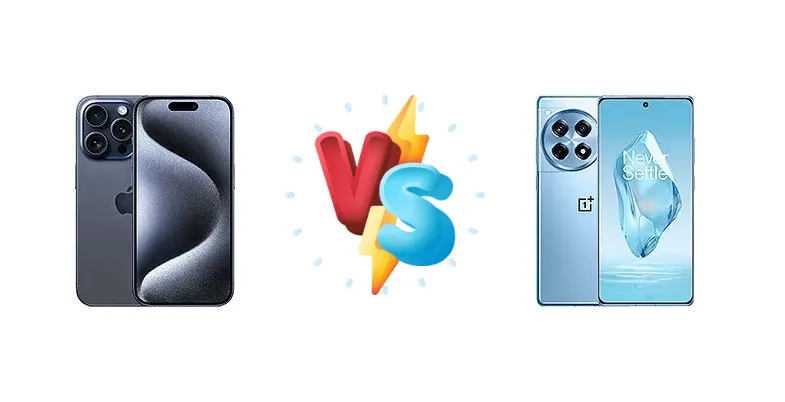
|
🏆 Quick Verdict
For users deeply embedded in the Apple ecosystem and prioritizing camera quality and refined software, the iPhone 15 Pro remains the superior choice. However, the OnePlus 12R delivers exceptional battery life and blazing-fast 100W charging, making it the winner for Android users prioritizing endurance and value.
| PHONES | ||
|---|---|---|
| Phone Names | Apple iPhone 15 Pro | OnePlus 12R |
| Network | ||
|---|---|---|
| 2G bands | GSM 850 / 900 / 1800 / 1900 | GSM 850 / 900 / 1800 / 1900 |
| 3G bands | HSDPA 850 / 900 / 1700(AWS) / 1900 / 2100 | HSDPA 850 / 900 / 1700(AWS) / 1900 / 2100 |
| 4G bands | 1, 2, 3, 4, 5, 7, 8, 12, 13, 17, 18, 19, 20, 25, 26, 28, 30, 32, 34, 38, 39, 40, 41, 42, 46, 48, 53, 66 - A3102 | 1, 2, 3, 4, 5, 7, 8, 12, 17, 18, 19, 20, 26, 28, 32, 38, 39, 40, 41, 66 |
| 5G bands | 1, 2, 3, 5, 7, 8, 12, 20, 25, 26, 28, 30, 38, 40, 41, 48, 53, 66, 70, 77, 78, 79 SA/NSA/Sub6 - A3102 | 1, 2, 3, 5, 7, 8, 12, 20, 28, 38, 40, 41, 66, 77, 78 SA/NSA |
| Speed | HSPA, LTE, 5G, EV-DO Rev.A 3.1 Mbps | HSPA, LTE, 5G |
| Technology | GSM / CDMA / HSPA / EVDO / LTE / 5G | GSM / CDMA / HSPA / LTE / 5G |
| Launch | ||
|---|---|---|
| Announced | 2023, September 12 | 2024, January 23 |
| Status | Available. Released 2023, September 22 | Available. Released 2024, February 06 |
| Body | ||
|---|---|---|
| Build | Glass front, glass back, titanium frame (grade 5) | Glass front (Gorilla Glass Victus 2), aluminum frame, glass back |
| Dimensions | 146.6 x 70.6 x 8.3 mm (5.77 x 2.78 x 0.33 in) | 163.3 x 75.3 x 8.8 mm (6.43 x 2.96 x 0.35 in) |
| SIM | · Nano-SIM + eSIM + eSIM (max 2 at a time; International)· eSIM + eSIM (8 or more, max 2 at a time; USA)· Nano-SIM + Nano-SIM (China) | · Nano-SIM + Nano-SIM + eSIM (max 2 at a time)· Nano-SIM + Nano-SIM |
| Weight | 187 g (6.60 oz) | 207 g (7.30 oz) |
| Display | ||
|---|---|---|
| Protection | Ceramic Shield glass | Corning Gorilla Glass Victus 2 |
| Resolution | 1179 x 2556 pixels, 19.5:9 ratio (~461 ppi density) | 1264 x 2780 pixels (~450 ppi density) |
| Size | 6.1 inches, 91.3 cm2 (~88.2% screen-to-body ratio) | 6.78 inches, 111.7 cm2 (~90.9% screen-to-body ratio) |
| Type | LTPO Super Retina XDR OLED, 120Hz, HDR10, Dolby Vision, 1000 nits (typ), 2000 nits (HBM) | LTPO4 AMOLED, 1B colors, 120Hz, HDR10+, Dolby Vision, 1600 nits (HBM), 4500 nits (peak) |
| Platform | ||
|---|---|---|
| CPU | Hexa-core (2x3.78 GHz + 4x2.11 GHz) | Octa-core (1x3.2 GHz Cortex-X3 & 2x2.8 GHz Cortex-A715 & 2x2.8 GHz Cortex-A710 & 3x2.0 GHz Cortex-A510) |
| Chipset | Apple A17 Pro (3 nm) | Qualcomm SM8550-AB Snapdragon 8 Gen 2 (4 nm) |
| GPU | Apple GPU (6-core graphics) | Adreno 740 |
| OS | iOS 17, upgradable to iOS 26.1 | Android 14, up to 3 major Android upgrades, OxygenOS 15 |
| Memory | ||
|---|---|---|
| Card slot | No | No |
| Internal | 128GB 8GB RAM, 256GB 8GB RAM, 512GB 8GB RAM, 1TB 8GB RAM | 128GB 8GB RAM, 256GB 8GB RAM, 256GB 12GB RAM, 256GB 16GB RAM |
| Main Camera | ||
|---|---|---|
| Features | Dual-LED dual-tone flash, HDR (photo/panorama) | Laser AF, color spectrum sensor, LED flash, HDR, panorama |
| Triple | 48 MP, f/1.8, 24mm (wide), 1/1.28", 1.22µm, dual pixel PDAF, sensor-shift OIS 12 MP, f/2.8, 77mm (telephoto), 1/3.5", 1.0µm, PDAF, OIS, 3x optical zoom 12 MP, f/2.2, 13mm, 120˚ (ultrawide), 1/2.55", 1.4µm, dual pixel PDAF TOF 3D LiDAR scanner (depth) | 50 MP, f/1.8, 24mm (wide), 1/1.56", 1.0µm, multi-directional PDAF, OIS 8 MP, f/2.2, 16mm, 112˚ (ultrawide), 1/4.0", 1.12µm 2 MP (macro) |
| Video | 4K@24/25/30/60fps, 1080p@25/30/60/120/240fps, 10-bit HDR, Dolby Vision HDR (up to 60fps), ProRes, 3D (spatial) video, stereo sound rec. | 4K@30/60fps, 1080p@30/60/120/240fps, gyro-EIS, OIS |
| Selfie camera | ||
|---|---|---|
| Features | HDR, Dolby Vision HDR | HDR, panorama |
| Single | 12 MP, f/1.9, 23mm (wide), 1/3.6", 1.0µm, PDAF, OIS SL 3D, (depth/biometrics sensor) | 16 MP, f/2.4, 26mm (wide), 1/3", 1.0µm |
| Video | 4K@24/25/30/60fps, 1080p@25/30/60/120fps, gyro-EIS | 1080p@30fps, gyro-EIS |
| Sound | ||
|---|---|---|
| 35mm jack | No | No |
| Loudspeaker | Yes, with stereo speakers | Yes, with stereo speakers |
| Comms | ||
|---|---|---|
| Bluetooth | 5.3, A2DP, LE | 5.3, A2DP, LE, aptX HD |
| Infrared port | - | Yes |
| NFC | Yes | Yes |
| Positioning | GPS (L1+L5), GLONASS, GALILEO, BDS, QZSS, NavIC | GPS, GALILEO, GLONASS, BDS, QZSS |
| Radio | No | No |
| USB | USB Type-C 3.2 Gen 2, DisplayPort | USB Type-C 2.0 |
| WLAN | Wi-Fi 802.11 a/b/g/n/ac/6e, tri-band, hotspot | Wi-Fi 802.11 a/b/g/n/ac/6/7, dual-band |
| Features | ||
|---|---|---|
| Sensors | Face ID, accelerometer, gyro, proximity, compass, barometer | Fingerprint (under display, optical), accelerometer, gyro, proximity, compass |
| Battery | ||
|---|---|---|
| Charging | Wired, PD2.0, 50% in 30 min 15W wireless (MagSafe) 15W wireless (Qi2) - requires iOS 17.2 update 4.5W reverse wired | 100W wired, 100% in 26 min |
| Type | Li-Ion 3274 mAh | Li-Ion 5500 mAh |
| Misc | ||
|---|---|---|
| Colors | Black Titanium, White Titanium, Blue Titanium, Natural Titanium | Iron Gray, Cool Blue, Electric Violet, Sunset Dune |
| Models | A2848, A3101, A3102, A3104, iPhone16,1 | CPH2609, CPH2585, CPH2611 |
| Price | $ 489.68 / C$ 849.99 / £ 559.99 / € 648.47 | € 410.84 / $ 399.95 / £ 649.00 |
| SAR | 1.14 W/kg (head) 1.16 W/kg (body) | 1.19 W/kg (head) 0.82 W/kg (body) |
| SAR EU | 0.98 W/kg (head) 0.98 W/kg (body) | - |
Apple iPhone 15 Pro
- Superior processing power with the A17 Pro chip
- Exceptional camera quality and video recording
- Seamless iOS ecosystem integration
- Shorter battery life compared to the OnePlus 12R
- Slower charging speeds
- Higher price point
OnePlus 12R
- Outstanding battery life and endurance
- Blazing-fast 100W wired charging
- More affordable price
- Lower peak display brightness
- Potentially less refined camera image processing
- Android ecosystem fragmentation
Display Comparison
The iPhone 15 Pro boasts a peak brightness of 1786 nits, offering superior visibility in direct sunlight compared to the OnePlus 12R’s 1181 nits. While both likely utilize OLED panels for vibrant colors, the iPhone 15 Pro’s ProMotion technology (LTPO) dynamically adjusts the refresh rate up to 120Hz for smoother scrolling and animations, a feature not explicitly stated for the 12R. The iPhone's smaller size may appeal to those preferring a more compact device, while the 12R likely offers a larger screen real estate for media consumption.
Camera Comparison
The context data doesn't provide detailed camera specs, but the iPhone 15 Pro is known for its computational photography prowess and cinematic video recording capabilities. Apple’s image processing prioritizes natural-looking images with excellent dynamic range. The OnePlus 12R, while likely equipped with a capable camera system, typically leans towards more vibrant, saturated colors. The iPhone’s advantage lies in its video recording features and overall image consistency. Without specific sensor details for the 12R, it’s difficult to assess its low-light performance relative to the iPhone.
Performance
The core difference lies in the chipsets: Apple’s 3nm A17 Pro hexa-core processor versus Qualcomm’s 4nm Snapdragon 8 Gen 2 octa-core. The A17 Pro’s architecture, with its 2x3.78 GHz performance cores and 4x2.11 GHz efficiency cores, is designed for optimized power efficiency and peak performance. The Snapdragon 8 Gen 2, while powerful with its Cortex-X3 prime core, operates on a larger 4nm process, potentially leading to slightly higher thermal output under sustained load. The iPhone 15 Pro benefits from Apple’s tight hardware-software integration, optimizing performance for iOS. The 12R's Snapdragon 8 Gen 2 is a proven performer, but may not match the A17 Pro's single-core performance.
Battery Life
The OnePlus 12R shines in battery endurance, achieving an active use score of 14:32h, significantly surpassing the iPhone 15 Pro’s 12:58h. This difference is further amplified by the 12R’s 100W wired charging, capable of a full charge in just 26 minutes, compared to the iPhone 15 Pro’s slower 30-minute 50% charge via PD2.0. The iPhone 15 Pro offers 15W wireless charging (MagSafe and Qi2), but the 12R lacks wireless charging. The 12R’s larger battery capacity, combined with the efficient Snapdragon 8 Gen 2, provides a clear advantage for users prioritizing all-day battery life.
Buying Guide
Buy the Apple iPhone 15 Pro if you need a seamlessly integrated ecosystem, professional-grade photo and video capabilities, and the latest iOS features. Buy the OnePlus 12R if you prefer a longer-lasting battery, significantly faster charging speeds, and a more open Android experience, all at a considerably lower price.