
iPhone 15 Pro vs OnePlus 11R: A Deep Dive into Performance and Value
| Phones Images | |||||
|---|---|---|---|---|---|
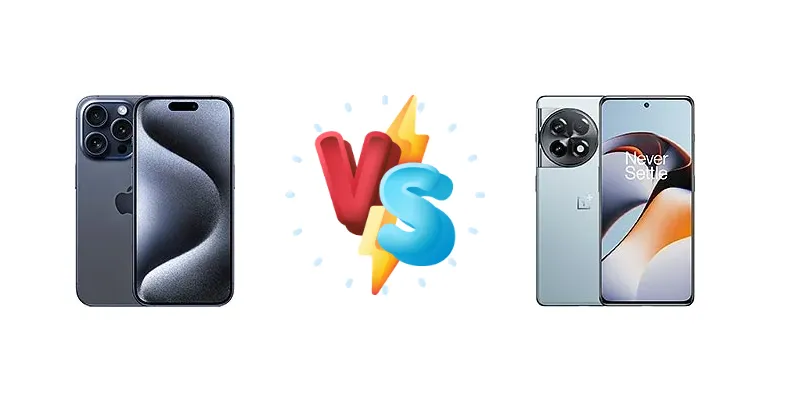
|
🏆 Quick Verdict
For users deeply embedded in the Apple ecosystem and demanding peak mobile performance, the iPhone 15 Pro is the clear winner. However, the OnePlus 11R provides exceptional value, delivering flagship-level performance and blazing-fast charging for a fraction of the cost, making it ideal for Android enthusiasts.
| PHONES | ||
|---|---|---|
| Phone Names | Apple iPhone 15 Pro | OnePlus 11R |
| Network | ||
|---|---|---|
| 2G bands | GSM 850 / 900 / 1800 / 1900 | GSM 850 / 900 / 1800 / 1900 |
| 3G bands | HSDPA 850 / 900 / 1700(AWS) / 1900 / 2100 | HSDPA 850 / 900 / 1700(AWS) / 2100 |
| 4G bands | 1, 2, 3, 4, 5, 7, 8, 12, 13, 17, 18, 19, 20, 25, 26, 28, 30, 32, 34, 38, 39, 40, 41, 42, 46, 48, 53, 66 - A3102 | 1, 3, 4, 5, 8, 28, 34, 38, 39, 40, 41 |
| 5G bands | 1, 2, 3, 5, 7, 8, 12, 20, 25, 26, 28, 30, 38, 40, 41, 48, 53, 66, 70, 77, 78, 79 SA/NSA/Sub6 - A3102 | 1, 3, 5, 8, 28, 40, 41, 77, 78 SA/NSA |
| Speed | HSPA, LTE, 5G, EV-DO Rev.A 3.1 Mbps | HSPA, LTE (3CA), 5G |
| Technology | GSM / CDMA / HSPA / EVDO / LTE / 5G | GSM / CDMA / HSPA / LTE / 5G |
| - | CDMA 800 | |
| Launch | ||
|---|---|---|
| Announced | 2023, September 12 | 2023, February 07 |
| Status | Available. Released 2023, September 22 | Available. Released 2023, February 21 |
| Body | ||
|---|---|---|
| Build | Glass front, glass back, titanium frame (grade 5) | Glass front, glass back (Gorilla Glass 5), plastic frame |
| Dimensions | 146.6 x 70.6 x 8.3 mm (5.77 x 2.78 x 0.33 in) | 163.4 x 74.3 x 8.7 mm (6.43 x 2.93 x 0.34 in) |
| SIM | · Nano-SIM + eSIM + eSIM (max 2 at a time; International)· eSIM + eSIM (8 or more, max 2 at a time; USA)· Nano-SIM + Nano-SIM (China) | Nano-SIM + Nano-SIM |
| Weight | 187 g (6.60 oz) | 204 g (7.20 oz) |
| Display | ||
|---|---|---|
| Protection | Ceramic Shield glass | - |
| Resolution | 1179 x 2556 pixels, 19.5:9 ratio (~461 ppi density) | 1240 x 2772 pixels, 20:9 ratio (~451 ppi density) |
| Size | 6.1 inches, 91.3 cm2 (~88.2% screen-to-body ratio) | 6.74 inches, 109.2 cm2 (~90.0% screen-to-body ratio) |
| Type | LTPO Super Retina XDR OLED, 120Hz, HDR10, Dolby Vision, 1000 nits (typ), 2000 nits (HBM) | Fluid AMOLED, 1B colors, 120Hz, HDR10+, 1450 nits (peak) |
| Platform | ||
|---|---|---|
| CPU | Hexa-core (2x3.78 GHz + 4x2.11 GHz) | Octa-core (1x3.0 GHz Cortex-X2 & 3x2.5 GHz Cortex-A710 & 4x1.80 GHz Cortex-A510) |
| Chipset | Apple A17 Pro (3 nm) | Qualcomm SM8475 Snapdragon 8+ Gen 1 (4 nm) |
| GPU | Apple GPU (6-core graphics) | Adreno 730 |
| OS | iOS 17, upgradable to iOS 26.1 | Android 13, upgradable to Android 15, OxygenOS 15 |
| Memory | ||
|---|---|---|
| Card slot | No | No |
| Internal | 128GB 8GB RAM, 256GB 8GB RAM, 512GB 8GB RAM, 1TB 8GB RAM | 128GB 8GB RAM, 256GB 16GB RAM, 512GB 18GB RAM |
| - | UFS 3.1 | |
| Main Camera | ||
|---|---|---|
| Features | Dual-LED dual-tone flash, HDR (photo/panorama) | Color spectrum sensor, LED flash, HDR, panorama |
| Single | - | 16 MP, f/2.4, 24mm (wide), 1/3.09", 1.0µm |
| Triple | 48 MP, f/1.8, 24mm (wide), 1/1.28", 1.22µm, dual pixel PDAF, sensor-shift OIS 12 MP, f/2.8, 77mm (telephoto), 1/3.5", 1.0µm, PDAF, OIS, 3x optical zoom 12 MP, f/2.2, 13mm, 120˚ (ultrawide), 1/2.55", 1.4µm, dual pixel PDAF TOF 3D LiDAR scanner (depth) | 50 MP, f/1.8, 24mm (wide), 1/1.56", 1.0µm, multi-directional PDAF, OIS 8 MP, f/2.2, 120˚ (ultrawide), 1/4.0", 1.12µm 2 MP (macro) |
| Video | 4K@24/25/30/60fps, 1080p@25/30/60/120/240fps, 10-bit HDR, Dolby Vision HDR (up to 60fps), ProRes, 3D (spatial) video, stereo sound rec. | 4K@30/60fps, 1080p@30/60/240fps, gyro-EIS |
| Selfie camera | ||
|---|---|---|
| Features | HDR, Dolby Vision HDR | HDR |
| Single | 12 MP, f/1.9, 23mm (wide), 1/3.6", 1.0µm, PDAF, OIS SL 3D, (depth/biometrics sensor) | 16 MP, f/2.4, 24mm (wide), 1/3.09", 1.0µm |
| Video | 4K@24/25/30/60fps, 1080p@25/30/60/120fps, gyro-EIS | 1080p@30fps |
| Sound | ||
|---|---|---|
| 3.5mm jack | - | No |
| 35mm jack | No | No |
| Loudspeaker | Yes, with stereo speakers | Yes, with stereo speakers |
| - | 24-bit/192kHz audio | |
| Comms | ||
|---|---|---|
| Bluetooth | 5.3, A2DP, LE | 5.3, A2DP, LE, aptX HD |
| Infrared port | - | Yes |
| NFC | Yes | Yes |
| Positioning | GPS (L1+L5), GLONASS, GALILEO, BDS, QZSS, NavIC | GPS (L1+L5), GLONASS (G1), BDS (B1I+B1c+B2a), GALILEO (E1+E5a), QZSS (L1+L5) |
| Radio | No | No |
| USB | USB Type-C 3.2 Gen 2, DisplayPort | USB Type-C 2.0 |
| WLAN | Wi-Fi 802.11 a/b/g/n/ac/6e, tri-band, hotspot | Wi-Fi 802.11 a/b/g/n/ac/6, dual-band |
| Features | ||
|---|---|---|
| Sensors | Face ID, accelerometer, gyro, proximity, compass, barometer | Fingerprint (under display, optical), accelerometer, gyro, proximity, compass |
| Battery | ||
|---|---|---|
| Charging | Wired, PD2.0, 50% in 30 min 15W wireless (MagSafe) 15W wireless (Qi2) - requires iOS 17.2 update 4.5W reverse wired | 100W wired |
| Type | Li-Ion 3274 mAh | Li-Po 5000 mAh |
| Misc | ||
|---|---|---|
| Colors | Black Titanium, White Titanium, Blue Titanium, Natural Titanium | Galactic Silver, Sonic Black, Solar Red |
| Models | A2848, A3101, A3102, A3104, iPhone16,1 | CPH2487 |
| Price | $ 489.68 / C$ 849.99 / £ 559.99 / € 648.47 | About 600 EUR |
| SAR | 1.14 W/kg (head) 1.16 W/kg (body) | 1.16 W/kg (head) 0.61 W/kg (body) |
| SAR EU | 0.98 W/kg (head) 0.98 W/kg (body) | - |
Apple iPhone 15 Pro
- Unmatched processing power with the A17 Pro chip
- Industry-leading video recording capabilities
- Seamless iOS ecosystem integration
- Significantly higher price point
- Slower wired charging compared to OnePlus 11R
OnePlus 11R
- Blazing-fast 100W wired charging
- Excellent performance for the price
- More affordable than the iPhone 15 Pro
- Less powerful processor than the A17 Pro
- Android ecosystem may not appeal to all users
Display Comparison
The iPhone 15 Pro boasts a measured peak brightness of 1786 nits, ensuring excellent visibility even in direct sunlight. While the OnePlus 11R’s display specs aren’t provided, OnePlus typically utilizes AMOLED panels with high brightness. The iPhone 15 Pro’s likely use of LTPO technology allows for variable refresh rates, optimizing battery life. The iPhone’s color accuracy is renowned, crucial for content creators. The 11R’s display, while likely excellent, doesn’t have the same level of confirmed peak brightness or adaptive refresh rate technology.
Camera Comparison
The iPhone 15 Pro’s camera system is known for its computational photography prowess and video recording capabilities. While specific sensor details aren’t provided, Apple’s focus is on image processing and overall system optimization. The OnePlus 11R’s camera specs are not provided, but OnePlus typically focuses on delivering a versatile camera experience. The iPhone’s video capabilities are generally considered industry-leading, offering features like ProRes recording. The A17 Pro’s image signal processor (ISP) will contribute to superior image quality and faster processing times.
Performance
Apple’s A17 Pro, fabricated on a 3nm process, represents a significant leap in mobile silicon. Its hexa-core CPU (2x3.78 GHz + 4x2.11 GHz) is designed for both peak performance and efficiency. The OnePlus 11R utilizes the Qualcomm Snapdragon 8+ Gen 1 (4nm), an octa-core processor (1x3.0 GHz Cortex-X2 & 3x2.5 GHz Cortex-A710 & 4x1.80 GHz Cortex-A510). While the Snapdragon 8+ Gen 1 is a powerful chip, the A17 Pro’s architectural advantages and smaller node size likely translate to superior sustained performance and thermal management, particularly in demanding tasks like video editing and high-end gaming. The A17 Pro’s GPU is also expected to significantly outperform the Snapdragon’s Adreno 730.
Battery Life
The iPhone 15 Pro achieves an active use battery score of 12:58h and an endurance rating of 86h, indicating strong battery life. The OnePlus 11R’s battery capacity is not specified, but its 100W wired charging is a major advantage, allowing for significantly faster charging times compared to the iPhone 15 Pro’s 50% charge in 30 minutes via PD2.0. The iPhone 15 Pro offers 15W wireless charging with MagSafe and Qi2 (requiring iOS 17.2), and 4.5W reverse wired charging. The OnePlus 11R’s charging speed is its standout feature, minimizing downtime.
Buying Guide
Buy the Apple iPhone 15 Pro if you need the absolute best mobile processing power, seamless iOS integration, and a top-tier camera system, and are willing to pay a premium. Buy the OnePlus 11R if you prioritize fast charging, excellent performance for gaming and everyday tasks, and a more affordable price point, and prefer the Android operating system.