
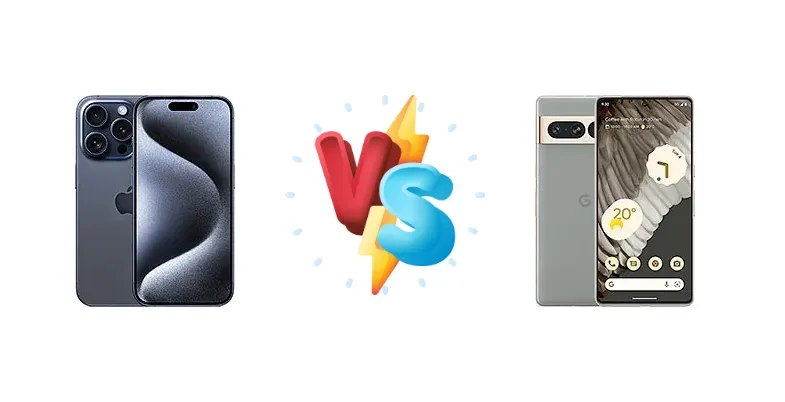
iPhone 15 Pro vs. Google Pixel 7 Pro: Which Flagship Reigns Supreme?
| Phones Images | |||||
|---|---|---|---|---|---|
|
🏆 Quick Verdict
For users prioritizing raw processing power, demanding mobile gaming, and seamless video editing, the iPhone 15 Pro is the clear choice. Its A17 Pro chip and superior display brightness offer a noticeable advantage. However, the Pixel 7 Pro remains a compelling option for photography enthusiasts and those deeply integrated into the Google ecosystem.
| PHONES | ||
|---|---|---|
| Phone Names | Apple iPhone 15 Pro | Google Pixel 7 Pro |
| Network | ||
|---|---|---|
| 2G bands | GSM 850 / 900 / 1800 / 1900 | GSM 850 / 900 / 1800 / 1900 |
| 3G bands | HSDPA 850 / 900 / 1700(AWS) / 1900 / 2100 | HSDPA 800 / 850 / 900 / 1700(AWS) / 1900 / 2100 |
| 4G bands | 1, 2, 3, 4, 5, 7, 8, 12, 13, 17, 18, 19, 20, 25, 26, 28, 30, 32, 34, 38, 39, 40, 41, 42, 46, 48, 53, 66 - A3102 | 1, 2, 3, 4, 5, 7, 8, 12, 13, 14, 17, 18, 19, 20, 25, 26, 28, 29, 30, 38, 39, 40, 41, 42, 46, 48, 66, 71 - GE2AE |
| 5G bands | 1, 2, 3, 5, 7, 8, 12, 20, 25, 26, 28, 30, 38, 40, 41, 48, 53, 66, 70, 77, 78, 79 SA/NSA/Sub6 - A3102 | 1, 2, 3, 5, 7, 8, 12, 14, 20, 25, 28, 30, 38, 40, 41, 48, 66, 71, 77, 78, 257, 258, 260, 261 SA/NSA/Sub6/mmWave - GE2AE |
| Speed | HSPA, LTE, 5G, EV-DO Rev.A 3.1 Mbps | HSPA, LTE, 5G |
| Technology | GSM / CDMA / HSPA / EVDO / LTE / 5G | GSM / CDMA / HSPA / EVDO / LTE / 5G |
| - | 1, 2, 3, 5, 7, 8, 12, 14, 20, 25, 28, 30, 38, 40, 41, 48, 66, 71, 75, 76, 77, 78 SA/NSA/Sub6 - GP4BC | |
| Launch | ||
|---|---|---|
| Announced | 2023, September 12 | 2022, October 06 |
| Status | Available. Released 2023, September 22 | Available. Released 2022, October 13 |
| Body | ||
|---|---|---|
| Build | Glass front, glass back, titanium frame (grade 5) | Glass front (Gorilla Glass Victus), glass back (Gorilla Glass Victus), aluminum frame |
| Dimensions | 146.6 x 70.6 x 8.3 mm (5.77 x 2.78 x 0.33 in) | 162.9 x 76.6 x 8.9 mm (6.41 x 3.02 x 0.35 in) |
| SIM | · Nano-SIM + eSIM + eSIM (max 2 at a time; International)· eSIM + eSIM (8 or more, max 2 at a time; USA)· Nano-SIM + Nano-SIM (China) | Nano-SIM + eSIM |
| Weight | 187 g (6.60 oz) | 212 g (7.48 oz) |
| - | IP68 dust/water resistant (up to 1.5m for 30 min) | |
| Display | ||
|---|---|---|
| Protection | Ceramic Shield glass | Corning Gorilla Glass Victus |
| Resolution | 1179 x 2556 pixels, 19.5:9 ratio (~461 ppi density) | 1440 x 3120 pixels, 19.5:9 ratio (~512 ppi density) |
| Size | 6.1 inches, 91.3 cm2 (~88.2% screen-to-body ratio) | 6.7 inches, 110.6 cm2 (~88.7% screen-to-body ratio) |
| Type | LTPO Super Retina XDR OLED, 120Hz, HDR10, Dolby Vision, 1000 nits (typ), 2000 nits (HBM) | LTPO AMOLED, 120Hz, HDR10+, 1000 nits (HBM), 1500 nits (peak) |
| - | Always-on display | |
| Platform | ||
|---|---|---|
| CPU | Hexa-core (2x3.78 GHz + 4x2.11 GHz) | Octa-core (2x2.85 GHz Cortex-X1 & 2x2.35 GHz Cortex-A78 & 4x1.80 GHz Cortex-A55) |
| Chipset | Apple A17 Pro (3 nm) | Google Tensor G2 (5 nm) |
| GPU | Apple GPU (6-core graphics) | Mali-G710 MP7 |
| OS | iOS 17, upgradable to iOS 26.1 | Android 13, upgradable to Android 15, up to 5 major Android upgrades |
| Memory | ||
|---|---|---|
| Card slot | No | No |
| Internal | 128GB 8GB RAM, 256GB 8GB RAM, 512GB 8GB RAM, 1TB 8GB RAM | 128GB 8GB RAM, 256GB 8GB RAM, 128GB 12GB RAM, 256GB 12GB RAM, 512GB 12GB RAM |
| - | UFS 3.1 | |
| Main Camera | ||
|---|---|---|
| Features | Dual-LED dual-tone flash, HDR (photo/panorama) | Laser AF, Dual-LED flash, Pixel Shift, Auto-HDR, panorama |
| Single | - | 10.8 MP, f/2.2, 21mm (ultrawide), 1/3.1", 1.22µm |
| Triple | 48 MP, f/1.8, 24mm (wide), 1/1.28", 1.22µm, dual pixel PDAF, sensor-shift OIS 12 MP, f/2.8, 77mm (telephoto), 1/3.5", 1.0µm, PDAF, OIS, 3x optical zoom 12 MP, f/2.2, 13mm, 120˚ (ultrawide), 1/2.55", 1.4µm, dual pixel PDAF TOF 3D LiDAR scanner (depth) | 50 MP, f/1.9, 25mm (wide), 1/1.31", 1.2µm, dual pixel PDAF, OIS 48 MP, f/3.5, 120mm (periscope telephoto), 1/2.55", 0.7µm, dual pixel PDAF, OIS, 5x optical zoom 12 MP, f/2.2, 126˚ (ultrawide), 1/2.9", 1.25µm, AF |
| Video | 4K@24/25/30/60fps, 1080p@25/30/60/120/240fps, 10-bit HDR, Dolby Vision HDR (up to 60fps), ProRes, 3D (spatial) video, stereo sound rec. | 4K@30/60fps, 1080p@30/60/120/240fps; gyro-EIS, OIS, 10-bit HDR |
| Selfie camera | ||
|---|---|---|
| Features | HDR, Dolby Vision HDR | HDR, panorama |
| Single | 12 MP, f/1.9, 23mm (wide), 1/3.6", 1.0µm, PDAF, OIS SL 3D, (depth/biometrics sensor) | 10.8 MP, f/2.2, 21mm (ultrawide), 1/3.1", 1.22µm |
| Video | 4K@24/25/30/60fps, 1080p@25/30/60/120fps, gyro-EIS | 4K@30/60fps, 1080p@30/60fps |
| Sound | ||
|---|---|---|
| 3.5mm jack | - | No |
| 35mm jack | No | No |
| Loudspeaker | Yes, with stereo speakers | Yes, with stereo speakers |
| Comms | ||
|---|---|---|
| Bluetooth | 5.3, A2DP, LE | 5.2, A2DP, LE, aptX HD |
| NFC | Yes | Yes |
| Positioning | GPS (L1+L5), GLONASS, GALILEO, BDS, QZSS, NavIC | GPS (L1+L5), GLONASS (G1), BDS (B1I+B1c+B2a), GALILEO (E1+E5a), QZSS (L1+L5) |
| Radio | No | No |
| USB | USB Type-C 3.2 Gen 2, DisplayPort | USB Type-C 3.2 |
| WLAN | Wi-Fi 802.11 a/b/g/n/ac/6e, tri-band, hotspot | Wi-Fi 802.11 a/b/g/n/ac/6e, tri-band, Wi-Fi Direct |
| Features | ||
|---|---|---|
| Sensors | Face ID, accelerometer, gyro, proximity, compass, barometer | Fingerprint (under display, optical), accelerometer, gyro, proximity, compass, barometer |
| - | Ultra Wideband (UWB) support | |
| Battery | ||
|---|---|---|
| Charging | Wired, PD2.0, 50% in 30 min 15W wireless (MagSafe) 15W wireless (Qi2) - requires iOS 17.2 update 4.5W reverse wired | 23W wired, PD3.0, 50% in 30 min 23W wireless Reverse wireless |
| Type | Li-Ion 3274 mAh | Li-Ion 5000 mAh |
| Misc | ||
|---|---|---|
| Colors | Black Titanium, White Titanium, Blue Titanium, Natural Titanium | Obsidian, Snow, Hazel |
| Models | A2848, A3101, A3102, A3104, iPhone16,1 | GP4BC, GE2AE, GFE4J |
| Price | $ 489.68 / C$ 849.99 / £ 559.99 / € 648.47 | € 248.84 / $ 204.00 / £ 259.99 / ₹ 36,999 |
| SAR | 1.14 W/kg (head) 1.16 W/kg (body) | - |
| SAR EU | 0.98 W/kg (head) 0.98 W/kg (body) | - |
| Tests | ||
|---|---|---|
| Battery life | - | Endurance rating 83h |
| Camera | - | Photo / Video |
| Display | - | Contrast ratio: Infinite (nominal) |
| Loudspeaker | - | -24.8 LUFS (Very good) |
| Performance | - | AnTuTu: 796369 (v9) GeekBench: 3187 (v5.1) GFXBench: 34fps (ES 3.1 onscreen) |
Apple iPhone 15 Pro
- Superior processing power with the A17 Pro chip
- Brighter and more visible display in sunlight
- Faster wired charging and MagSafe wireless charging
- Long-term software support from Apple
- Ecosystem lock-in
- Potentially higher repair costs
Google Pixel 7 Pro
- Exceptional computational photography and AI features
- Clean and intuitive Android experience
- Seamless integration with Google services
- Competitive wireless charging speeds
- Less powerful processor compared to the A17 Pro
- Display is less bright than the iPhone 15 Pro
Display Comparison
The iPhone 15 Pro boasts a significantly brighter display, reaching a measured 1786 nits compared to the Pixel 7 Pro’s 1090 nits. This translates to superior visibility in direct sunlight. While both feature excellent color accuracy, the iPhone’s higher peak brightness is a tangible advantage for outdoor use. The Pixel 7 Pro’s ‘Infinite’ contrast ratio is a marketing term; both displays offer excellent contrast. Neither specification details refresh rate, but both are expected to have adaptive refresh rates for smooth scrolling and power efficiency.
Camera Comparison
Both phones are equipped with advanced camera systems capable of capturing stunning photos and videos. However, their approaches differ. The Pixel 7 Pro leverages Google’s computational photography prowess, excelling in dynamic range and low-light performance. The iPhone 15 Pro, while also employing computational techniques, focuses on delivering a more natural look. Without specific sensor size data, it’s difficult to make a definitive judgment, but Apple’s history suggests a larger main sensor. Both support video recording, but the A17 Pro’s image signal processor (ISP) likely offers more advanced video processing capabilities. The absence of detail on lens apertures makes a detailed comparison difficult.
Performance
Apple’s A17 Pro, fabricated on a 3nm process, represents a substantial leap in mobile silicon. Its hexa-core CPU (2x3.78 GHz + 4x2.11 GHz) is architecturally different from the Pixel 7 Pro’s octa-core (2x2.85 GHz Cortex-X1 & 2x2.35 GHz Cortex-A78 & 4x1.80 GHz Cortex-A55) Tensor G2 (5nm). The A17 Pro’s smaller node allows for greater transistor density and improved thermal efficiency, meaning sustained performance under load will likely be higher. While the Tensor G2 excels at AI and machine learning tasks, the A17 Pro dominates in CPU and GPU benchmarks. The iPhone 15 Pro will offer a smoother experience in graphically intensive games and applications.
Battery Life
The iPhone 15 Pro achieves an active use battery score of 12:58h and an endurance rating of 86h, slightly exceeding the Pixel 7 Pro’s 83h endurance rating. While the Pixel 7 Pro offers 23W wired and wireless charging, the iPhone 15 Pro supports both PD2.0 wired (50% in 30 min) and 15W wireless charging via MagSafe and Qi2 (requiring iOS 17.2). The iPhone also offers 4.5W reverse wired charging. The slightly better endurance rating of the iPhone 15 Pro, combined with faster wired charging, gives it a slight edge in battery performance.
Buying Guide
Buy the Apple iPhone 15 Pro if you need uncompromising performance for demanding tasks like video editing, high-end mobile gaming, or professional workflows. Its robust ecosystem and long-term software support are also key benefits. Buy the Google Pixel 7 Pro if you prioritize computational photography, a clean Android experience, and seamless integration with Google services. The Pixel’s AI features and unique camera capabilities make it ideal for casual photographers and those seeking a smart, intuitive smartphone.