
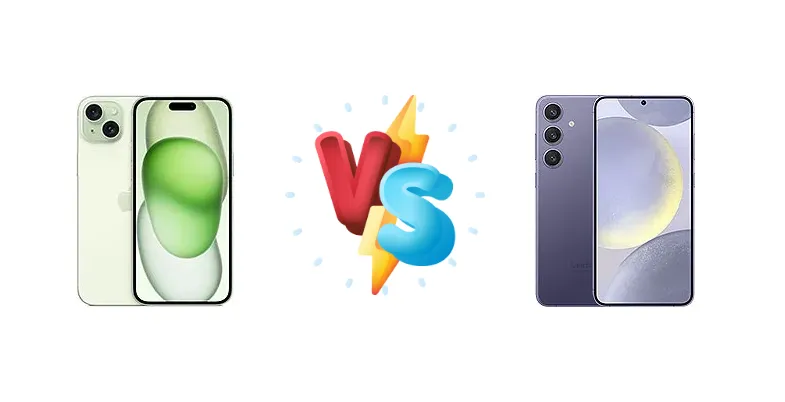
iPhone 15 Plus vs. Samsung Galaxy S24+: A Deep Dive Comparison
| Phones Images | |||||
|---|---|---|---|---|---|
|
🏆 Quick Verdict
For users prioritizing all-day battery life and a streamlined software experience, the iPhone 15 Plus emerges as the winner. Its 16:33-hour active use score significantly surpasses the S24+'s 12:30h, despite the S24+'s faster charging capabilities. However, the S24+ offers a more versatile chipset option and potentially faster performance depending on the region.
| PHONES | ||
|---|---|---|
| Phone Names | Apple iPhone 15 Plus | Samsung Galaxy S24+ |
| Network | ||
|---|---|---|
| 2G bands | GSM 850 / 900 / 1800 / 1900 | GSM 850 / 900 / 1800 / 1900 |
| 3G bands | HSDPA 850 / 900 / 1700(AWS) / 1900 / 2100 | HSDPA 850 / 900 / 1700(AWS) / 1900 / 2100 |
| 4G bands | 1, 2, 3, 4, 5, 7, 8, 12, 13, 17, 18, 19, 20, 25, 26, 28, 30, 32, 34, 38, 39, 40, 41, 42, 46, 48, 53, 66 - A3094 | 1, 2, 3, 4, 5, 7, 8, 12, 13, 17, 18, 19, 20, 25, 26, 28, 32, 38, 39, 40, 41, 66 - International |
| 5G bands | 1, 2, 3, 5, 7, 8, 12, 20, 25, 26, 28, 30, 38, 40, 41, 48, 53, 66, 70, 77, 78, 79 SA/NSA/Sub6 - A3094 | 1, 2, 3, 5, 7, 8, 12, 20, 25, 26, 28, 38, 40, 41, 66, 75, 77, 78 SA/NSA/Sub6 - International |
| Speed | HSPA, LTE, 5G, EV-DO Rev.A 3.1 Mbps | HSPA, LTE (up to 7CA), 5G |
| Technology | GSM / CDMA / HSPA / EVDO / LTE / 5G | GSM / CDMA / HSPA / EVDO / LTE / 5G |
| Launch | ||
|---|---|---|
| Announced | 2023, September 12 | 2024, January 17 |
| Status | Available. Released 2023, September 22 | Available. Released 2024, January 24 |
| Body | ||
|---|---|---|
| Build | Glass front, glass back, aluminum frame | Glass front (Gorilla Glass Victus 2), glass back (Gorilla Glass Victus 2), aluminum frame |
| Dimensions | 160.9 x 77.8 x 7.8 mm (6.33 x 3.06 x 0.31 in) | 158.5 x 75.9 x 7.7 mm (6.24 x 2.99 x 0.30 in) |
| SIM | · Nano-SIM + eSIM + eSIM (max 2 at a time; International)· eSIM + eSIM (8 or more, max 2 at a time; USA)· Nano-SIM + Nano-SIM (China) | · Nano-SIM + Nano-SIM + eSIM + eSIM (max 2 at a time) - INT· Nano-SIM + eSIM + eSIM (max 2 at a time) - USA· Nano-SIM + Nano-SIM - CN |
| Weight | 201 g (7.09 oz) | 196 g or 197 g (6.91 oz) |
| Display | ||
|---|---|---|
| Protection | Ceramic Shield glass | Corning Gorilla Glass Victus 2 |
| Resolution | 1290 x 2796 pixels, 19.5:9 ratio (~460 ppi density) | 1440 x 3120 pixels, 19.5:9 ratio (~513 ppi density) |
| Size | 6.7 inches, 110.2 cm2 (~88.0% screen-to-body ratio) | 6.7 inches, 110.2 cm2 (~91.6% screen-to-body ratio) |
| Type | Super Retina XDR OLED, HDR10, Dolby Vision, 1000 nits (HBM), 2000 nits (peak) | Dynamic LTPO AMOLED 2X, 120Hz, HDR10+, 2600 nits (peak) |
| Platform | ||
|---|---|---|
| CPU | Hexa-core (2x3.46 GHz Everest + 4x2.02 GHz Sawtooth) | 8-core (1x3.39GHz Cortex-X4 & 3x3.1GHz Cortex-A720 & 2x2.9GHz Cortex-A720 & 2x2.2GHz Cortex-A520)10-core (1x3.2GHz Cortex-X4 & 2x2.9GHz Cortex-A720 & 3x2.6GHz Cortex-A720 & 4x1.95GHz Cortex-A520) |
| Chipset | Apple A16 Bionic (4 nm) | Qualcomm SM8650-AC Snapdragon 8 Gen 3 (4 nm) - USA/Canada/ChinaExynos 2400 (4 nm) - International |
| GPU | Apple GPU (5-core graphics) | Adreno 750 (1 GHz) - USA/Canada/ChinaXclipse 940 - International |
| OS | iOS 17, upgradable to iOS 26.1 | Android 14, up to 7 major Android upgrades, One UI 8.0 |
| Memory | ||
|---|---|---|
| Card slot | No | No |
| Internal | 128GB 6GB RAM, 256GB 6GB RAM, 512GB 6GB RAM | 256GB 12GB RAM, 512GB 12GB RAM |
| Main Camera | ||
|---|---|---|
| Dual | 48 MP, f/1.6, 26mm (wide), 1/1.56", 1.0µm, dual pixel PDAF, sensor-shift OIS 12 MP, f/2.4, 13mm, 120˚ (ultrawide), 0.7µm | - |
| Features | Dual-LED dual-tone flash, HDR (photo/panorama) | LED flash, auto-HDR, panorama |
| Triple | - | 50 MP, f/1.8, 24mm (wide), 1/1.56", 1.0µm, dual pixel PDAF, OIS 10 MP, f/2.4, 67mm (telephoto), 1/3.94", 1.0µm, PDAF, OIS, 3x optical zoom 12 MP, f/2.2, 13mm, 120˚ (ultrawide), 1/2.55" 1.4µm, Super Steady video |
| Video | 4K@24/25/30/60fps, 1080p@25/30/60/120/240fps, HDR, Dolby Vision HDR (up to 60fps), stereo sound rec. | 8K@24/30fps, 4K@30/60fps, 1080p@30/60/120/240fps, HDR10+, stereo sound rec., gyro-EIS |
| Selfie camera | ||
|---|---|---|
| Features | HDR, Dolby Vision HDR | HDR, HDR10+ |
| Single | 12 MP, f/1.9, 23mm (wide), 1/3.6", 1.0µm, PDAF SL 3D, (depth/biometrics sensor) | 12 MP, f/2.2, 26mm (wide), 1/3.2", 1.12µm, dual pixel PDAF |
| Video | 4K@24/25/30/60fps, 1080p@25/30/60/120fps, gyro-EIS | 4K@30/60fps, 1080p@30fps |
| Sound | ||
|---|---|---|
| 35mm jack | No | No |
| Loudspeaker | Yes, with stereo speakers | Yes, with stereo speakers |
| Comms | ||
|---|---|---|
| Bluetooth | 5.3, A2DP, LE | 5.3, A2DP, LE |
| NFC | Yes | Yes |
| Positioning | GPS, GLONASS, GALILEO, BDS, QZSS | GPS, GLONASS, BDS, GALILEO, QZSS |
| Radio | No | No |
| USB | USB Type-C 2.0, DisplayPort | USB Type-C 3.2, DisplayPort 1.2, OTG |
| WLAN | Wi-Fi 802.11 a/b/g/n/ac/6, dual-band, hotspot | Wi-Fi 802.11 a/b/g/n/ac/6e, tri-band, Wi-Fi Direct |
| Features | ||
|---|---|---|
| Sensors | Face ID, accelerometer, gyro, proximity, compass, barometer | Fingerprint (under display, ultrasonic), accelerometer, gyro, proximity, compass, barometer |
| Battery | ||
|---|---|---|
| Charging | Wired, PD2.0, 50% in 30 min 15W wireless (MagSafe) 15W wireless (Qi2) - requires iOS 17.2 update 4.5W reverse wired | 45W wired, PD3.0, 65% in 30 min 15W wireless (Qi) 4.5W reverse wireless |
| Type | Li-Ion 4383 mAh | Li-Ion 4900 mAh |
| Misc | ||
|---|---|---|
| Colors | Black, Blue, Green, Yellow, Pink | Onyx Black, Marble Grey, Cobalt Violet, Amber Yellow, Jade Green, Sandstone Orange, Sapphire Blue |
| Models | A3094, A2847, A3093, A3096, iPhone15,5 | SM-S926B, SM-S926B/DS, SM-S926U, SM-S926U1, SM-S926W, SM-S926N, SM-S9260, SM-S926E, SM-S926E/DS |
| Price | € 555.00 / $ 441.16 / £ 450.00 | $ 429.50 / € 549.00 / £ 445.98 |
| SAR | 1.01 W/kg (head) 1.12 W/kg (body) | 1.16 W/kg (head) 0.84 W/kg (body) |
| SAR EU | 0.98 W/kg (head) 0.98 W/kg (body) | 0.74 W/kg (head) 1.25 W/kg (body) |
Apple iPhone 15 Plus
- Exceptional battery life (16:33h active use)
- Streamlined iOS ecosystem
- Higher peak display brightness (1642 nits)
- Slower wired charging (50% in 30 min)
- Less chipset flexibility (A16 Bionic only)
Samsung Galaxy S24+
- Faster wired charging (65% in 30 min)
- Snapdragon 8 Gen 3 option (select regions)
- More versatile Android operating system
- Shorter battery life (12:30h active use)
- Chipset variance (Exynos vs Snapdragon)
Display Comparison
The iPhone 15 Plus boasts a peak brightness of 1642 nits, exceeding the Galaxy S24+'s 1452 nits, making it more visible in direct sunlight. While both utilize OLED technology, the iPhone 15 Plus benefits from a potentially more refined color calibration, typical of Apple’s displays. The S24+’s display, however, is likely to have a variable refresh rate (LTPO) for improved power efficiency, a feature not explicitly stated for the iPhone 15 Plus but commonly found in flagship OLEDs. The S24+ also supports Vision Booster, enhancing visibility in bright conditions, but the iPhone's higher peak brightness provides a baseline advantage.
Camera Comparison
Both devices offer capable photo and video recording systems, but detailed sensor information is lacking. The image processing philosophies differ significantly; iPhones generally aim for natural color reproduction, while Samsung often boosts saturation and contrast. The S24+’s chipset likely includes a more advanced ISP (Image Signal Processor) for faster image processing and potentially better low-light performance. The absence of detailed camera specs necessitates a reliance on real-world testing to determine a clear winner, but the S24+'s potential for computational photography advancements is noteworthy.
Performance
The Galaxy S24+ presents a chipset divergence: the Snapdragon 8 Gen 3 (4nm) for USA/Canada/China, and the Exynos 2400 (4nm) for international markets. The Snapdragon 8 Gen 3, with its Cortex-X4 prime core clocked at 3.39GHz, is expected to deliver superior sustained performance and thermal management compared to the Exynos variant. Apple’s A16 Bionic (4nm), a hexa-core processor, offers a different architectural approach. While core count is lower, Apple’s chip design and software optimization often result in exceptional single-core performance and efficiency. The S24+'s 8-core CPU offers more multi-threaded potential, but real-world gains depend heavily on software optimization and the specific chipset variant.
Battery Life
The iPhone 15 Plus demonstrates a clear advantage in battery endurance, achieving an active use score of 16:33h compared to the S24+'s 12:30h. This translates to nearly 4 hours of additional usage on a single charge. While the S24+ supports 45W wired charging (PD3.0), reaching 65% in 30 minutes, the iPhone 15 Plus’s 50% charge in 30 minutes (PD2.0) is slower. Both offer 15W wireless charging, but the iPhone 15 Plus gains compatibility with Qi2, offering potentially more efficient wireless charging with compatible accessories. Both devices also offer 4.5W reverse wired charging, useful for topping up accessories.
Buying Guide
Buy the Apple iPhone 15 Plus if you need exceptional battery endurance, a consistently smooth iOS experience, and are invested in the Apple ecosystem. Buy the Samsung Galaxy S24+ if you prefer the flexibility of Android, faster wired charging, and the potential for peak performance with the Snapdragon 8 Gen 3 (available in select regions).