
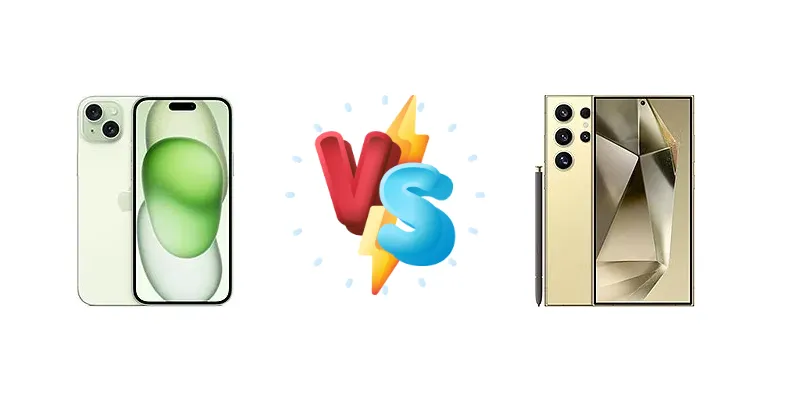
iPhone 15 Plus vs. Samsung Galaxy S24 Ultra: A Deep Dive Comparison
| Phones Images | |||||
|---|---|---|---|---|---|
|
🏆 Quick Verdict
For users prioritizing longevity and a simpler ecosystem, the iPhone 15 Plus emerges as the winner, boasting a significantly longer active use battery score of 16:33h. However, the Galaxy S24 Ultra’s faster charging and more powerful Snapdragon 8 Gen 3 chipset appeal to power users.
| PHONES | ||
|---|---|---|
| Phone Names | Apple iPhone 15 Plus | Samsung Galaxy S24 Ultra |
| Network | ||
|---|---|---|
| 2G bands | GSM 850 / 900 / 1800 / 1900 | GSM 850 / 900 / 1800 / 1900 |
| 3G bands | HSDPA 850 / 900 / 1700(AWS) / 1900 / 2100 | HSDPA 850 / 900 / 1700(AWS) / 1900 / 2100 |
| 4G bands | 1, 2, 3, 4, 5, 7, 8, 12, 13, 17, 18, 19, 20, 25, 26, 28, 30, 32, 34, 38, 39, 40, 41, 42, 46, 48, 53, 66 - A3094 | 1, 2, 3, 4, 5, 7, 8, 12, 13, 17, 18, 19, 20, 25, 26, 28, 32, 38, 39, 40, 41, 66 - International |
| 5G bands | 1, 2, 3, 5, 7, 8, 12, 20, 25, 26, 28, 30, 38, 40, 41, 48, 53, 66, 70, 77, 78, 79 SA/NSA/Sub6 - A3094 | 1, 2, 3, 5, 7, 8, 12, 20, 25, 26, 28, 38, 40, 41, 66, 75, 77, 78 SA/NSA/Sub6 - International |
| Speed | HSPA, LTE, 5G, EV-DO Rev.A 3.1 Mbps | HSPA, LTE (up to 7CA), 5G |
| Technology | GSM / CDMA / HSPA / EVDO / LTE / 5G | GSM / CDMA / HSPA / EVDO / LTE / 5G |
| Launch | ||
|---|---|---|
| Announced | 2023, September 12 | 2024, January 17 |
| Status | Available. Released 2023, September 22 | Available. Released 2024, January 24 |
| Body | ||
|---|---|---|
| Build | Glass front, glass back, aluminum frame | Glass front (Corning Gorilla Armor), glass back (Corning Gorilla Armor), titanium frame (grade 2) |
| Dimensions | 160.9 x 77.8 x 7.8 mm (6.33 x 3.06 x 0.31 in) | 162.3 x 79 x 8.6 mm (6.39 x 3.11 x 0.34 in) |
| SIM | · Nano-SIM + eSIM + eSIM (max 2 at a time; International)· eSIM + eSIM (8 or more, max 2 at a time; USA)· Nano-SIM + Nano-SIM (China) | · Nano-SIM + Nano-SIM + eSIM + eSIM (max 2 at a time) - INT· Nano-SIM + eSIM + eSIM (max 2 at a time) - USA· Nano-SIM + Nano-SIM - CN |
| Weight | 201 g (7.09 oz) | 232 g or 233 g (8.18 oz) |
| Display | ||
|---|---|---|
| Protection | Ceramic Shield glass | Corning Gorilla Armor |
| Resolution | 1290 x 2796 pixels, 19.5:9 ratio (~460 ppi density) | 1440 x 3120 pixels, 19.5:9 ratio (~505 ppi density) |
| Size | 6.7 inches, 110.2 cm2 (~88.0% screen-to-body ratio) | 6.8 inches, 113.5 cm2 (~88.5% screen-to-body ratio) |
| Type | Super Retina XDR OLED, HDR10, Dolby Vision, 1000 nits (HBM), 2000 nits (peak) | Dynamic LTPO AMOLED 2X, 120Hz, HDR10+, 2600 nits (peak) |
| Platform | ||
|---|---|---|
| CPU | Hexa-core (2x3.46 GHz Everest + 4x2.02 GHz Sawtooth) | 8-core (1x3.39GHz Cortex-X4 & 3x3.1GHz Cortex-A720 & 2x2.9GHz Cortex-A720 & 2x2.2GHz Cortex-A520) |
| Chipset | Apple A16 Bionic (4 nm) | Qualcomm SM8650-AC Snapdragon 8 Gen 3 (4 nm) |
| GPU | Apple GPU (5-core graphics) | Adreno 750 (1 GHz) |
| OS | iOS 17, upgradable to iOS 26.1 | Android 14, up to 7 major Android upgrades, One UI 8.0 |
| Memory | ||
|---|---|---|
| Card slot | No | No |
| Internal | 128GB 6GB RAM, 256GB 6GB RAM, 512GB 6GB RAM | 256GB 12GB RAM, 512GB 12GB RAM, 1TB 12GB RAM |
| Main Camera | ||
|---|---|---|
| Dual | 48 MP, f/1.6, 26mm (wide), 1/1.56", 1.0µm, dual pixel PDAF, sensor-shift OIS 12 MP, f/2.4, 13mm, 120˚ (ultrawide), 0.7µm | - |
| Features | Dual-LED dual-tone flash, HDR (photo/panorama) | Laser AF, LED flash, auto-HDR, panorama |
| Quad | - | 200 MP, f/1.7, 24mm (wide), 1/1.3", 0.6µm, multi-directional PDAF, OIS 10 MP, f/2.4, 67mm (telephoto), 1/3.52", 1.12µm, PDAF, OIS, 3x optical zoom 50 MP, f/3.4, 111mm (periscope telephoto), 1/2.52", 0.7µm, PDAF, OIS, 5x optical zoom 12 MP, f/2.2, 13mm, 120˚ (ultrawide), 1/2.55", 1.4µm, dual pixel PDAF, Super Steady video |
| Video | 4K@24/25/30/60fps, 1080p@25/30/60/120/240fps, HDR, Dolby Vision HDR (up to 60fps), stereo sound rec. | 8K@24/30fps, 4K@30/60/120fps, 1080p@30/60/120/240fps, HDR10+, stereo sound rec., gyro-EIS |
| Selfie camera | ||
|---|---|---|
| Features | HDR, Dolby Vision HDR | HDR, HDR10+ |
| Single | 12 MP, f/1.9, 23mm (wide), 1/3.6", 1.0µm, PDAF SL 3D, (depth/biometrics sensor) | 12 MP, f/2.2, 26mm (wide), 1/3.2", 1.12µm, dual pixel PDAF |
| Video | 4K@24/25/30/60fps, 1080p@25/30/60/120fps, gyro-EIS | 4K@30/60fps, 1080p@30fps |
| Sound | ||
|---|---|---|
| 35mm jack | No | No |
| Loudspeaker | Yes, with stereo speakers | Yes, with stereo speakers |
| Comms | ||
|---|---|---|
| Bluetooth | 5.3, A2DP, LE | 5.3, A2DP, LE |
| NFC | Yes | Yes |
| Positioning | GPS, GLONASS, GALILEO, BDS, QZSS | GPS, GLONASS, BDS, GALILEO, QZSS |
| Radio | No | No |
| USB | USB Type-C 2.0, DisplayPort | USB Type-C 3.2, DisplayPort 1.2, OTG |
| WLAN | Wi-Fi 802.11 a/b/g/n/ac/6, dual-band, hotspot | Wi-Fi 802.11 a/b/g/n/ac/6e/7, tri-band, Wi-Fi Direct |
| Features | ||
|---|---|---|
| Sensors | Face ID, accelerometer, gyro, proximity, compass, barometer | Fingerprint (under display, ultrasonic), accelerometer, gyro, proximity, compass, barometer |
| Battery | ||
|---|---|---|
| Charging | Wired, PD2.0, 50% in 30 min 15W wireless (MagSafe) 15W wireless (Qi2) - requires iOS 17.2 update 4.5W reverse wired | 45W wired, PD3.0, 65% in 30 min 15W wireless (Qi) 4.5W reverse wireless |
| Type | Li-Ion 4383 mAh | Li-Ion 5000 mAh |
| Misc | ||
|---|---|---|
| Colors | Black, Blue, Green, Yellow, Pink | Titanium Black, Titanium Gray, Titanium Violet, Titanium Yellow, Titanium Blue, Titanium Green, Titanium Orange |
| Models | A3094, A2847, A3093, A3096, iPhone15,5 | SM-S928B, SM-S928B/DS, SM-S928U, SM-S928U1, SM-S928W, SM-S928N, SM-S9280, SM-S928E, SM-S928E/DS |
| Price | € 555.00 / $ 441.16 / £ 450.00 | $ 514.94 / C$ 929.99 / £ 630.00 / € 658.53 / ₹ 84,999 |
| SAR | 1.01 W/kg (head) 1.12 W/kg (body) | 1.26 W/kg (head) 0.62 W/kg (body) |
| SAR EU | 0.98 W/kg (head) 0.98 W/kg (body) | 1.06 W/kg (head) 1.30 W/kg (body) |
Apple iPhone 15 Plus
- Exceptional battery life (16:33h active use)
- Seamless iOS ecosystem
- Qi2 wireless charging compatibility
- Slower wired charging speed (50% in 30 min)
- Less powerful chipset compared to Snapdragon 8 Gen 3
Samsung Galaxy S24 Ultra
- Faster 45W wired charging (65% in 30 min)
- Powerful Snapdragon 8 Gen 3 processor
- Likely more versatile camera system
- Shorter battery life (13:49h active use)
- Android OS may require more user management
Display Comparison
The iPhone 15 Plus achieves a measured peak brightness of 1642 nits, exceeding the Galaxy S24 Ultra’s 1447 nits, potentially offering better visibility in direct sunlight. While both utilize advanced display technology, the S24 Ultra likely incorporates an adaptive refresh rate (LTPO) for improved power efficiency, a feature not explicitly stated for the iPhone 15 Plus. The difference in brightness, while measurable, may be imperceptible to many users, but the S24 Ultra’s potential for dynamic refresh rate adjustments could contribute to overall battery savings.
Camera Comparison
Both devices offer robust photo and video capabilities, but details regarding sensor sizes and specific lens configurations are absent. The Galaxy S24 Ultra, given Samsung’s history, likely features a more versatile camera system with multiple telephoto lenses and potentially higher resolution sensors. The iPhone 15 Plus excels in computational photography and video stabilization, offering a consistent and user-friendly experience. Without specific sensor data, it’s difficult to definitively declare a winner, but Samsung typically prioritizes hardware specifications in its camera offerings.
Performance
The Samsung Galaxy S24 Ultra’s Qualcomm Snapdragon 8 Gen 3 (4nm) chipset, with its 8-core architecture, offers a more complex CPU configuration than the iPhone 15 Plus’s 6-core Apple A16 Bionic (4nm). The Snapdragon’s Cortex-X4 prime core, clocked at 3.39GHz, is designed for peak performance, while the A16 Bionic relies on a balance between its Everest and Sawtooth cores. While raw clock speed isn’t everything, the Snapdragon 8 Gen 3 is expected to deliver superior multi-core performance, benefiting demanding applications and multitasking. However, Apple’s tight software integration often optimizes performance for real-world usage.
Battery Life
The iPhone 15 Plus demonstrates a clear advantage in battery endurance, achieving 16:33h of active use compared to the Galaxy S24 Ultra’s 13:49h. While the S24 Ultra supports faster 45W wired charging (65% in 30 minutes) with PD3.0, versus the iPhone 15 Plus’s 50% in 30 minutes with PD2.0, the iPhone’s superior battery capacity and efficiency provide a longer overall runtime. Both offer 15W wireless charging, with the iPhone 15 Plus gaining Qi2 support (requiring iOS 17.2), and both include 4.5W reverse wired charging.
Buying Guide
Buy the Apple iPhone 15 Plus if you need exceptional battery life, a seamless iOS experience, and prioritize simplicity over extensive customization. Buy the Samsung Galaxy S24 Ultra if you prefer a versatile camera system, the power of the Snapdragon 8 Gen 3 for demanding tasks, and the flexibility of the Android operating system.