
iPhone 15 Plus vs Honor Magic6 Pro: A Deep Dive into Battery, Performance, and Charging
| Phones Images | |||||
|---|---|---|---|---|---|
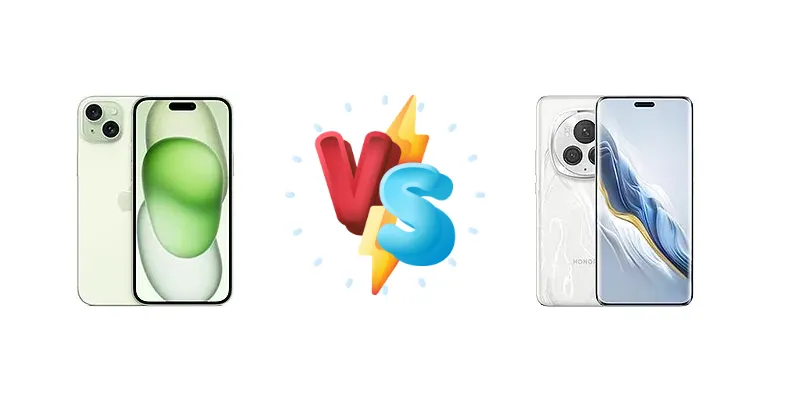
|
🏆 Quick Verdict
For users prioritizing all-day battery life and exceptionally fast charging, the Honor Magic6 Pro emerges as the winner. Its 80W wired and 66W wireless charging significantly outperform the iPhone 15 Plus’s slower speeds. However, the iPhone 15 Plus maintains a strong position for those deeply embedded in the Apple ecosystem.
| PHONES | ||
|---|---|---|
| Phone Names | Apple iPhone 15 Plus | Honor Magic6 Pro |
| Network | ||
|---|---|---|
| 2G bands | GSM 850 / 900 / 1800 / 1900 | GSM 850 / 900 / 1800 / 1900 |
| 3G bands | HSDPA 850 / 900 / 1700(AWS) / 1900 / 2100 | HSDPA 800 / 850 / 900 / 1700(AWS) / 1900 / 2100 |
| 4G bands | 1, 2, 3, 4, 5, 7, 8, 12, 13, 17, 18, 19, 20, 25, 26, 28, 30, 32, 34, 38, 39, 40, 41, 42, 46, 48, 53, 66 - A3094 | LTE |
| 5G bands | 1, 2, 3, 5, 7, 8, 12, 20, 25, 26, 28, 30, 38, 40, 41, 48, 53, 66, 70, 77, 78, 79 SA/NSA/Sub6 - A3094 | SA/NSA |
| Speed | HSPA, LTE, 5G, EV-DO Rev.A 3.1 Mbps | HSPA, LTE, 5G |
| Technology | GSM / CDMA / HSPA / EVDO / LTE / 5G | GSM / CDMA / HSPA / CDMA2000 / LTE / 5G |
| Launch | ||
|---|---|---|
| Announced | 2023, September 12 | 2024, January 11 |
| Status | Available. Released 2023, September 22 | Available. Released 2024, January 18 |
| Body | ||
|---|---|---|
| Build | Glass front, glass back, aluminum frame | Glass front (NanoCrystal Shield), glass back or silicone polymer back (eco leather) |
| Dimensions | 160.9 x 77.8 x 7.8 mm (6.33 x 3.06 x 0.31 in) | 162.5 x 75.8 x 8.9 mm (6.40 x 2.98 x 0.35 in) |
| SIM | · Nano-SIM + eSIM + eSIM (max 2 at a time; International)· eSIM + eSIM (8 or more, max 2 at a time; USA)· Nano-SIM + Nano-SIM (China) | · Nano-SIM + eSIM· Nano-SIM + Nano-SIM |
| Weight | 201 g (7.09 oz) | 225 g or 229 g (7.94 oz) |
| Display | ||
|---|---|---|
| Protection | Ceramic Shield glass | NanoCrystal Shield |
| Resolution | 1290 x 2796 pixels, 19.5:9 ratio (~460 ppi density) | 1280 x 2800 pixels, 19.5:9 ratio (~453 ppi density) |
| Size | 6.7 inches, 110.2 cm2 (~88.0% screen-to-body ratio) | 6.8 inches, 112.8 cm2 (~91.6% screen-to-body ratio) |
| Type | Super Retina XDR OLED, HDR10, Dolby Vision, 1000 nits (HBM), 2000 nits (peak) | LTPO OLED, 1B colors, 120Hz, Dolby Vision, HDR, 1600 nits (HBM), 5000 nits (peak) |
| Platform | ||
|---|---|---|
| CPU | Hexa-core (2x3.46 GHz Everest + 4x2.02 GHz Sawtooth) | Octa-core (1x3.3 GHz Cortex-X4 & 3x3.2 GHz Cortex-A720 & 2x3.0 GHz Cortex-A720 & 2x2.3 GHz Cortex-A520) |
| Chipset | Apple A16 Bionic (4 nm) | Qualcomm SM8650-AB Snapdragon 8 Gen 3 (4 nm) |
| GPU | Apple GPU (5-core graphics) | Adreno 750 |
| OS | iOS 17, upgradable to iOS 26.1 | Android 14, up to 4 major Android upgrades, MagicOS 8 |
| Memory | ||
|---|---|---|
| Card slot | No | No |
| Internal | 128GB 6GB RAM, 256GB 6GB RAM, 512GB 6GB RAM | 256GB 12GB RAM, 256GB 16GB RAM, 512GB 12GB RAM, 512GB 16GB RAM, 1TB 16GB RAM |
| Main Camera | ||
|---|---|---|
| Dual | 48 MP, f/1.6, 26mm (wide), 1/1.56", 1.0µm, dual pixel PDAF, sensor-shift OIS 12 MP, f/2.4, 13mm, 120˚ (ultrawide), 0.7µm | - |
| Features | Dual-LED dual-tone flash, HDR (photo/panorama) | Laser AF, color spectrum sensor, LED flash, HDR, panorama |
| Triple | - | 50 MP, f/1.4-2.0, 23mm (wide), 1/1.3", 1.2µm, PDAF, OIS 180 MP, f/2.6, (periscope telephoto), 1/1.49", 0.56µm, PDAF, OIS, 2.5x optical zoom 50 MP, f/2.0, 13mm, 122˚ (ultrawide), 1/2.88", 0.61µm, AF |
| Video | 4K@24/25/30/60fps, 1080p@25/30/60/120/240fps, HDR, Dolby Vision HDR (up to 60fps), stereo sound rec. | 4K@24/30/60fps, 1080p@30/60/120/240fps, gyro-EIS, OIS, HDR, 10-bit video |
| Selfie camera | ||
|---|---|---|
| Features | HDR, Dolby Vision HDR | - |
| Single | 12 MP, f/1.9, 23mm (wide), 1/3.6", 1.0µm, PDAF SL 3D, (depth/biometrics sensor) | 50 MP, f/2.0, 22mm (wide), 1/2.93", 0.6µm, AF TOF 3D, (depth/biometrics sensor) |
| Video | 4K@24/25/30/60fps, 1080p@25/30/60/120fps, gyro-EIS | 4K@30fps, 1080p@30/60fps, gyro-EIS |
| Sound | ||
|---|---|---|
| 35mm jack | No | No |
| Loudspeaker | Yes, with stereo speakers | Yes, with stereo speakers |
| Comms | ||
|---|---|---|
| Bluetooth | 5.3, A2DP, LE | 5.3, A2DP, LE, aptX HD |
| Infrared port | - | Yes |
| NFC | Yes | Yes |
| Positioning | GPS, GLONASS, GALILEO, BDS, QZSS | GPS (L1+L5), GLONASS, BDS (B1I+B1c+B2a), GALILEO (E1+E5a) |
| Radio | No | No |
| USB | USB Type-C 2.0, DisplayPort | USB Type-C 3.2, DisplayPort 1.2, OTG |
| WLAN | Wi-Fi 802.11 a/b/g/n/ac/6, dual-band, hotspot | Wi-Fi 802.11 a/b/g/n/ac/6/7, dual-band, Wi-Fi Direct |
| Features | ||
|---|---|---|
| Sensors | Face ID, accelerometer, gyro, proximity, compass, barometer | Fingerprint (under display, optical), Face ID, accelerometer, gyro, proximity, compass |
| Battery | ||
|---|---|---|
| Charging | Wired, PD2.0, 50% in 30 min 15W wireless (MagSafe) 15W wireless (Qi2) - requires iOS 17.2 update 4.5W reverse wired | 80W wired 66W wireless Reverse wireless 5W reverse wired |
| Type | Li-Ion 4383 mAh | Si/C Li-Ion 5600 mAh |
| Misc | ||
|---|---|---|
| Colors | Black, Blue, Green, Yellow, Pink | Black, Green, Blue, Purple, White |
| Models | A3094, A2847, A3093, A3096, iPhone15,5 | BVL-AN16, BVL-N49 |
| Price | € 555.00 / $ 441.16 / £ 450.00 | € 455.54 / $ 899.00 / £ 598.99 |
| SAR | 1.01 W/kg (head) 1.12 W/kg (body) | - |
| SAR EU | 0.98 W/kg (head) 0.98 W/kg (body) | - |
Apple iPhone 15 Plus
- Excellent ecosystem integration with other Apple devices.
- Strong resale value.
- Mature and polished software experience.
- Slower charging speeds compared to the Honor Magic6 Pro.
- Less flexible software customization options.
- Higher price point.
Honor Magic6 Pro
- Blazing-fast 80W wired and 66W wireless charging.
- Powerful Snapdragon 8 Gen 3 processor.
- More open and customizable Android experience.
- Slightly shorter active use battery life.
- Brand recognition is lower than Apple.
- Software updates may be less frequent.
Display Comparison
Both the iPhone 15 Plus and Honor Magic6 Pro boast excellent displays, achieving peak brightness levels of 1642 nits and 1578 nits respectively. While the iPhone 15 Plus holds a slight edge in maximum brightness, the real-world difference is minimal. Both lack detailed panel information like refresh rate or panel type, but the focus here is on brightness. The Honor Magic6 Pro’s display is likely OLED, common for flagship Android devices, while the iPhone 15 Plus uses a Super Retina XDR display. The small brightness difference won't be noticeable in most scenarios.
Camera Comparison
Detailed camera analysis is limited by the provided data, but both phones are positioned as capable imaging devices. The lack of sensor size or megapixel information makes a direct comparison difficult. However, the iPhone 15 Plus’s reputation for computational photography and video quality is well-established. The Honor Magic6 Pro likely leverages Qualcomm’s image signal processor (ISP) within the Snapdragon 8 Gen 3, offering advanced features like improved low-light performance and faster image processing. Without further details, it’s safe to assume both phones deliver excellent image quality, but with different processing styles – Apple leaning towards natural tones, and Honor potentially favoring more vibrant colors.
Performance
The core of the performance difference lies in the chipsets: Apple’s A16 Bionic (4nm) versus Qualcomm’s Snapdragon 8 Gen 3 (4nm). The A16 Bionic utilizes a hexa-core architecture, while the Snapdragon 8 Gen 3 employs an octa-core configuration. While core count isn’t everything, the Snapdragon 8 Gen 3’s Cortex-X4 prime core offers a significant performance boost in demanding tasks. The Snapdragon 8 Gen 3’s architecture, with its mix of Cortex-A720 and A520 cores, is designed for sustained performance and efficiency, potentially leading to less throttling during extended gaming sessions. The iPhone’s A16 Bionic is known for its single-core performance, but the Snapdragon 8 Gen 3’s multi-core advantage could be more noticeable in multi-threaded applications.
Battery Life
Battery life is a key differentiator. The iPhone 15 Plus achieves an active use score of 16:33h, while the Honor Magic6 Pro manages 14:06h. However, the Honor Magic6 Pro compensates with significantly faster charging. Its 80W wired charging can replenish the battery much quicker than the iPhone 15 Plus’s slower PD2.0 charging, reaching 50% in 30 minutes. The 66W wireless charging on the Honor Magic6 Pro is a game-changer, dwarfing the iPhone 15 Plus’s 15W MagSafe/Qi2 charging. The Honor also offers 5W reverse wired charging, while the iPhone offers 4.5W. The Honor’s faster charging offsets the slightly lower active use score, making it more convenient for users who frequently need to top up their battery.
Buying Guide
Buy the Apple iPhone 15 Plus if you need seamless integration with other Apple devices, a mature software ecosystem, and a well-established app library. Buy the Honor Magic6 Pro if you prioritize battery endurance, blazing-fast charging speeds, and a more open Android experience with cutting-edge hardware like the Snapdragon 8 Gen 3.