
iPhone 15 Plus vs. Google Pixel 8a: A Deep Dive into Apple's Big Screen Rival
| Phones Images | |||||
|---|---|---|---|---|---|
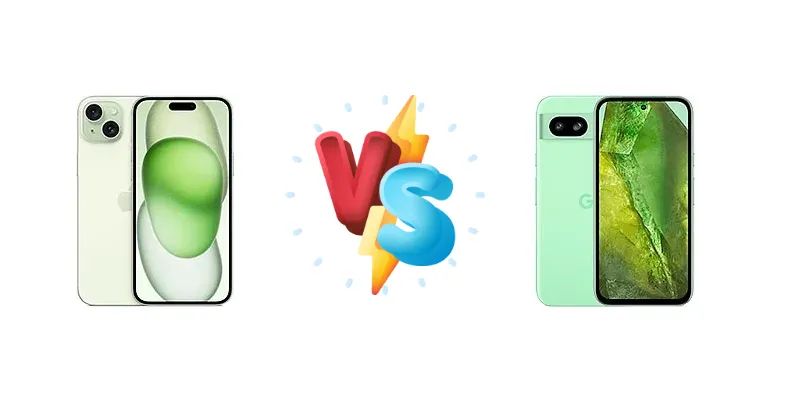
|
🏆 Quick Verdict
For users prioritizing all-day battery life and seamless ecosystem integration, the iPhone 15 Plus is the superior choice. However, the Pixel 8a’s exceptional endurance rating, combined with its innovative camera features and lower price, makes it a strong contender for budget-conscious consumers.
| PHONES | ||
|---|---|---|
| Phone Names | Apple iPhone 15 Plus | Google Pixel 8a |
| Network | ||
|---|---|---|
| 2G bands | GSM 850 / 900 / 1800 / 1900 | GSM 850 / 900 / 1800 / 1900 |
| 3G bands | HSDPA 850 / 900 / 1700(AWS) / 1900 / 2100 | HSDPA 800 / 850 / 900 / 1700(AWS) / 1900 / 2100 |
| 4G bands | 1, 2, 3, 4, 5, 7, 8, 12, 13, 17, 18, 19, 20, 25, 26, 28, 30, 32, 34, 38, 39, 40, 41, 42, 46, 48, 53, 66 - A3094 | 1, 2, 3, 4, 5, 7, 8, 12, 17, 18, 19, 20, 26, 28, 32, 38, 40, 41, 42, 66 - G6GPR (International) |
| 5G bands | 1, 2, 3, 5, 7, 8, 12, 20, 25, 26, 28, 30, 38, 40, 41, 48, 53, 66, 70, 77, 78, 79 SA/NSA/Sub6 - A3094 | 1, 2, 3, 5, 7, 8, 12, 20, 26, 28, 38, 40, 41, 66, 75, 76, 77, 78 SA/NSA/Sub6 - G6GPR (International) |
| Speed | HSPA, LTE, 5G, EV-DO Rev.A 3.1 Mbps | HSPA, LTE, 5G |
| Technology | GSM / CDMA / HSPA / EVDO / LTE / 5G | GSM / HSPA / LTE / 5G |
| Launch | ||
|---|---|---|
| Announced | 2023, September 12 | 2024, May 07 |
| Status | Available. Released 2023, September 22 | Available. Released 2024, May 14 |
| Body | ||
|---|---|---|
| Build | Glass front, glass back, aluminum frame | Glass front (Gorilla Glass 3), aluminum frame, plastic back |
| Dimensions | 160.9 x 77.8 x 7.8 mm (6.33 x 3.06 x 0.31 in) | 152.1 x 72.7 x 8.9 mm (5.99 x 2.86 x 0.35 in) |
| SIM | · Nano-SIM + eSIM + eSIM (max 2 at a time; International)· eSIM + eSIM (8 or more, max 2 at a time; USA)· Nano-SIM + Nano-SIM (China) | Nano-SIM + eSIM |
| Weight | 201 g (7.09 oz) | 188 g (6.63 oz) |
| Display | ||
|---|---|---|
| Protection | Ceramic Shield glass | Corning Gorilla Glass 3, Mohs level 5 |
| Resolution | 1290 x 2796 pixels, 19.5:9 ratio (~460 ppi density) | 1080 x 2400 pixels, 20:9 ratio (~430 ppi density) |
| Size | 6.7 inches, 110.2 cm2 (~88.0% screen-to-body ratio) | 6.1 inches, 90.3 cm2 (~81.6% screen-to-body ratio) |
| Type | Super Retina XDR OLED, HDR10, Dolby Vision, 1000 nits (HBM), 2000 nits (peak) | OLED, HDR, 120Hz, 2000 nits (peak) |
| Platform | ||
|---|---|---|
| CPU | Hexa-core (2x3.46 GHz Everest + 4x2.02 GHz Sawtooth) | Nona-core (1x3.0 GHz Cortex-X3 & 4x2.45 GHz Cortex-A715 & 4x2.15 GHz Cortex-A510) |
| Chipset | Apple A16 Bionic (4 nm) | Google Tensor G3 (4 nm) |
| GPU | Apple GPU (5-core graphics) | Immortalis-G715s MC10 |
| OS | iOS 17, upgradable to iOS 26.1 | Android 14, upgradable to Android 16, up to 7 major Android upgrades |
| Memory | ||
|---|---|---|
| Card slot | No | No |
| Internal | 128GB 6GB RAM, 256GB 6GB RAM, 512GB 6GB RAM | 128GB 8GB RAM, 256GB 8GB RAM |
| Main Camera | ||
|---|---|---|
| Dual | 48 MP, f/1.6, 26mm (wide), 1/1.56", 1.0µm, dual pixel PDAF, sensor-shift OIS 12 MP, f/2.4, 13mm, 120˚ (ultrawide), 0.7µm | 64 MP (16 MP eff.), f/1.9, 26mm (wide), 1/1.73", 0.8µm, dual pixel PDAF, OIS 13 MP, f/2.2, 120˚ (ultrawide), 1.12µm |
| Features | Dual-LED dual-tone flash, HDR (photo/panorama) | Dual-LED flash, Pixel Shift, Ultra HDR, panorama, Best Take |
| Video | 4K@24/25/30/60fps, 1080p@25/30/60/120/240fps, HDR, Dolby Vision HDR (up to 60fps), stereo sound rec. | 4K@30/60fps, 1080p@30/60/120/240fps, OIS |
| Selfie camera | ||
|---|---|---|
| Features | HDR, Dolby Vision HDR | HDR, panorama |
| Single | 12 MP, f/1.9, 23mm (wide), 1/3.6", 1.0µm, PDAF SL 3D, (depth/biometrics sensor) | 13 MP, f/2.2, 20mm (ultrawide), 1.12µm |
| Video | 4K@24/25/30/60fps, 1080p@25/30/60/120fps, gyro-EIS | 4K@30fps, 1080p@30/60fps |
| Sound | ||
|---|---|---|
| 35mm jack | No | No |
| Loudspeaker | Yes, with stereo speakers | Yes, with stereo speakers |
| Comms | ||
|---|---|---|
| Bluetooth | 5.3, A2DP, LE | 5.3, A2DP, LE |
| NFC | Yes | Yes |
| Positioning | GPS, GLONASS, GALILEO, BDS, QZSS | GPS, GLONASS, GALILEO, BDS, QZSS, NavIC |
| Radio | No | No |
| USB | USB Type-C 2.0, DisplayPort | USB Type-C 3.2 |
| WLAN | Wi-Fi 802.11 a/b/g/n/ac/6, dual-band, hotspot | Wi-Fi 802.11 a/b/g/n/ac/6e, dual/tri-band (market/region dependent) |
| Features | ||
|---|---|---|
| Sensors | Face ID, accelerometer, gyro, proximity, compass, barometer | Fingerprint (under display, optical), accelerometer, gyro, proximity, compass, barometer |
| Battery | ||
|---|---|---|
| Charging | Wired, PD2.0, 50% in 30 min 15W wireless (MagSafe) 15W wireless (Qi2) - requires iOS 17.2 update 4.5W reverse wired | 18W wired, PD3.0 7.5W wireless Bypass charging |
| Type | Li-Ion 4383 mAh | Li-Po 4492 mAh |
| Misc | ||
|---|---|---|
| Colors | Black, Blue, Green, Yellow, Pink | Obsidian, Porcelain, Bay, Aloe |
| Models | A3094, A2847, A3093, A3096, iPhone15,5 | GKV4X, G6GPR, G8HHN, G576D |
| Price | € 555.00 / $ 441.16 / £ 450.00 | $ 229.98 / C$ 417.99 / £ 279.00 / € 299.99 / ₹ 33,300 |
| SAR | 1.01 W/kg (head) 1.12 W/kg (body) | - |
| SAR EU | 0.98 W/kg (head) 0.98 W/kg (body) | - |
| EU LABEL | ||
|---|---|---|
| Battery | - | 40:06h endurance, 1000 cycles |
| Energy | - | Class B |
| Free fall | - | Class A (270 falls) |
| Repairability | - | Class B |
Apple iPhone 15 Plus
- Superior single-core performance with the A16 Bionic chip.
- Brighter display for better outdoor visibility.
- Seamless integration within the Apple ecosystem.
- Higher price point compared to the Pixel 8a.
- Wireless charging requires MagSafe or iOS 17.2 for Qi2.
Google Pixel 8a
- Exceptional battery endurance and longevity.
- Innovative AI-powered camera features.
- More affordable price point.
- Slower charging speeds compared to the iPhone 15 Plus.
- Potentially less powerful GPU for demanding games.
Display Comparison
Both the iPhone 15 Plus and Pixel 8a feature displays capable of reaching high brightness levels, with the iPhone 15 Plus edging out the Pixel 8a at 1642 nits versus 1508 nits. While both are excellent for outdoor visibility, the iPhone’s higher peak brightness provides a slight advantage in direct sunlight. Neither specification details refresh rate, but given the market segment, it's likely the iPhone 15 Plus has a ProMotion display (LTPO) for adaptive refresh rates, offering smoother scrolling and animations, while the Pixel 8a likely operates at a standard 60Hz. This difference impacts perceived smoothness and power consumption.
Camera Comparison
Both phones are capable of capturing excellent photos and videos, but approach image processing differently. The iPhone 15 Plus’s camera system (details unspecified in provided data) is known for its natural color reproduction and consistent performance. The Pixel 8a, powered by Google’s computational photography expertise, excels in dynamic range and low-light performance. The Tensor G3’s image signal processor (ISP) is specifically tuned for enhancing details and reducing noise. Without sensor size details, it’s difficult to definitively declare a winner, but Google’s software optimizations often compensate for hardware limitations. The Pixel 8a’s focus on AI-powered features like Best Take and Magic Editor provides unique creative possibilities.
Performance
The iPhone 15 Plus leverages Apple’s A16 Bionic chip, a 4nm processor with a hexa-core CPU configuration (2x3.46 GHz Everest + 4x2.02 GHz Sawtooth). This architecture is optimized for both performance and efficiency. Conversely, the Pixel 8a utilizes Google’s Tensor G3, also a 4nm chip, but with a nona-core CPU (1x3.0 GHz Cortex-X3 & 4x2.45 GHz Cortex-A715 & 4x2.15 GHz Cortex-A510). While core count is higher on the Pixel, Apple’s chip design typically delivers superior single-core performance, crucial for responsive app launches and fluid multitasking. The A16 Bionic’s integrated GPU is also likely to outperform the Tensor G3’s, providing a better gaming experience. However, the Tensor G3 excels in AI and machine learning tasks, powering features like Magic Eraser and real-time translation.
Battery Life
Battery life is a significant differentiator. The Pixel 8a boasts an impressive endurance rating of 83 hours, and an active use score of 11:25h, while the iPhone 15 Plus achieves 111h endurance and 16:33h active use. This suggests the Pixel 8a’s battery optimization and potentially lower power consumption of its display contribute to its longevity. The iPhone 15 Plus supports both PD2.0 wired charging (50% in 30 minutes) and 15W wireless charging via MagSafe and Qi2 (requiring iOS 17.2). The Pixel 8a offers 18W wired charging with PD3.0 and 7.5W wireless charging, along with 'bypass charging' which reduces battery degradation during prolonged charging. The Pixel 8a’s bypass charging is a notable advantage for long-term battery health.
Buying Guide
Buy the Apple iPhone 15 Plus if you need a large display for media consumption, prioritize long-term software support, and are heavily invested in the Apple ecosystem. Buy the Google Pixel 8a if you prefer a more compact form factor, value Google’s AI-powered features, and seek exceptional battery endurance without the premium price tag.