
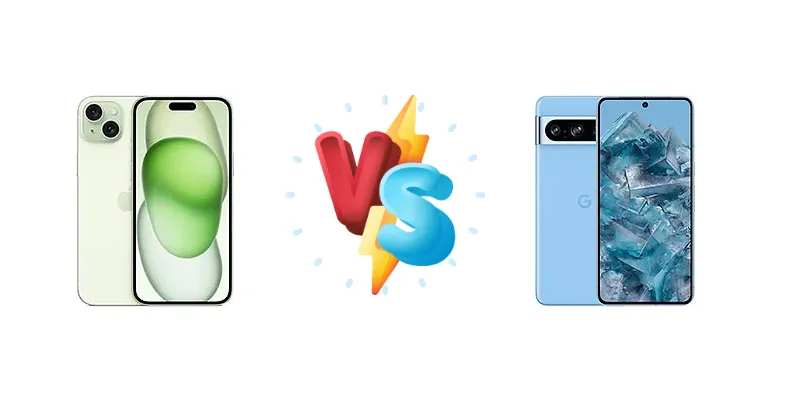
iPhone 15 Plus vs. Google Pixel 8 Pro: A Deep Dive Comparison
| Phones Images | |||||
|---|---|---|---|---|---|
|
🏆 Quick Verdict
For the average user prioritizing all-day battery life and a seamless, polished experience, the iPhone 15 Plus emerges as the winner. Its 16:33-hour active use score and 111-hour endurance rating significantly outperform the Pixel 8 Pro, despite the Pixel’s advanced camera features.
| PHONES | ||
|---|---|---|
| Phone Names | Apple iPhone 15 Plus | Google Pixel 8 Pro |
| Network | ||
|---|---|---|
| 2G bands | GSM 850 / 900 / 1800 / 1900 | GSM 850 / 900 / 1800 / 1900 |
| 3G bands | HSDPA 850 / 900 / 1700(AWS) / 1900 / 2100 | HSDPA 800 / 850 / 900 / 1700(AWS) / 1900 / 2100 |
| 4G bands | 1, 2, 3, 4, 5, 7, 8, 12, 13, 17, 18, 19, 20, 25, 26, 28, 30, 32, 34, 38, 39, 40, 41, 42, 46, 48, 53, 66 - A3094 | 1, 2, 3, 4, 5, 7, 8, 12, 13, 14, 17, 18, 19, 20, 25, 26, 28, 29, 30, 38, 39, 40, 41, 46, 48, 66, 71 - G1MNW |
| 5G bands | 1, 2, 3, 5, 7, 8, 12, 20, 25, 26, 28, 30, 38, 40, 41, 48, 53, 66, 70, 77, 78, 79 SA/NSA/Sub6 - A3094 | 1, 2, 3, 5, 7, 8, 12, 20, 25, 26, 28, 29, 30, 38, 40, 41, 48, 66, 70, 71, 77, 78, 257, 258, 260, 261 SA/NSA/Sub6/mmWave - G1MNW |
| Speed | HSPA, LTE, 5G, EV-DO Rev.A 3.1 Mbps | HSPA, LTE, 5G |
| Technology | GSM / CDMA / HSPA / EVDO / LTE / 5G | GSM / HSPA / LTE / 5G |
| Launch | ||
|---|---|---|
| Announced | 2023, September 12 | 2023, October 04 |
| Status | Available. Released 2023, September 22 | Available. Released 2023, October 12 |
| Body | ||
|---|---|---|
| Build | Glass front, glass back, aluminum frame | Glass front (Gorilla Glass Victus 2), glass back (Gorilla Glass Victus 2), aluminum frame |
| Dimensions | 160.9 x 77.8 x 7.8 mm (6.33 x 3.06 x 0.31 in) | 162.6 x 76.5 x 8.8 mm (6.40 x 3.01 x 0.35 in) |
| SIM | · Nano-SIM + eSIM + eSIM (max 2 at a time; International)· eSIM + eSIM (8 or more, max 2 at a time; USA)· Nano-SIM + Nano-SIM (China) | Nano-SIM + eSIM |
| Weight | 201 g (7.09 oz) | 213 g (7.51 oz) |
| Display | ||
|---|---|---|
| Protection | Ceramic Shield glass | Corning Gorilla Glass Victus 2 |
| Resolution | 1290 x 2796 pixels, 19.5:9 ratio (~460 ppi density) | 1344 x 2992 pixels, 20:9 ratio (~489 ppi density) |
| Size | 6.7 inches, 110.2 cm2 (~88.0% screen-to-body ratio) | 6.7 inches, 108.7 cm2 (~87.4% screen-to-body ratio) |
| Type | Super Retina XDR OLED, HDR10, Dolby Vision, 1000 nits (HBM), 2000 nits (peak) | LTPO OLED, 120Hz, HDR10+, 1600 nits (HBM), 2400 nits (peak) |
| Platform | ||
|---|---|---|
| CPU | Hexa-core (2x3.46 GHz Everest + 4x2.02 GHz Sawtooth) | Nona-core (1x3.0 GHz Cortex-X3 & 4x2.45 GHz Cortex-A715 & 4x2.15 GHz Cortex-A510) |
| Chipset | Apple A16 Bionic (4 nm) | Google Tensor G3 (4 nm) |
| GPU | Apple GPU (5-core graphics) | Immortalis-G715s MC10 |
| OS | iOS 17, upgradable to iOS 26.1 | Android 14, upgradable to Android 16, up to 7 major Android upgrades |
| Memory | ||
|---|---|---|
| Card slot | No | No |
| Internal | 128GB 6GB RAM, 256GB 6GB RAM, 512GB 6GB RAM | 128GB 12GB RAM, 256GB 12GB RAM, 512GB 12GB RAM, 1TB 12GB RAM |
| Main Camera | ||
|---|---|---|
| Dual | 48 MP, f/1.6, 26mm (wide), 1/1.56", 1.0µm, dual pixel PDAF, sensor-shift OIS 12 MP, f/2.4, 13mm, 120˚ (ultrawide), 0.7µm | - |
| Features | Dual-LED dual-tone flash, HDR (photo/panorama) | Multi-zone Laser AF, Dual-LED flash, Pixel Shift, Ultra-HDR, panorama, Best Take, Zoom Enhance |
| Triple | - | 50 MP, f/1.7, 25mm (wide), 1/1.31", 1.2µm, dual pixel PDAF, OIS 48 MP, f/2.8, 113mm (periscope telephoto), 1/2.55", 0.7µm, dual pixel PDAF, OIS, 5x optical zoom 48 MP, f/2.0, 126˚ (ultrawide), 1/2.0", 0.8µm, dual pixel PDAF |
| Video | 4K@24/25/30/60fps, 1080p@25/30/60/120/240fps, HDR, Dolby Vision HDR (up to 60fps), stereo sound rec. | 4K@30/60fps, 1080p@24/30/60/120/240fps; gyro-EIS, OIS, 10-bit HDR |
| Selfie camera | ||
|---|---|---|
| Features | HDR, Dolby Vision HDR | HDR, panorama |
| Single | 12 MP, f/1.9, 23mm (wide), 1/3.6", 1.0µm, PDAF SL 3D, (depth/biometrics sensor) | 10.5 MP, f/2.2, 20mm (ultrawide), 1/3.1", 1.22µm, PDAF |
| Video | 4K@24/25/30/60fps, 1080p@25/30/60/120fps, gyro-EIS | 4K@24/30/60fps, 1080p@30/60fps |
| Sound | ||
|---|---|---|
| 35mm jack | No | No |
| Loudspeaker | Yes, with stereo speakers | Yes, with stereo speakers |
| Comms | ||
|---|---|---|
| Bluetooth | 5.3, A2DP, LE | 5.3, A2DP, LE, aptX HD |
| NFC | Yes | Yes |
| Positioning | GPS, GLONASS, GALILEO, BDS, QZSS | GPS (L1+L5), GLONASS (G1), GALILEO (E1+E5a), QZSS (L1+L5) |
| Radio | No | No |
| USB | USB Type-C 2.0, DisplayPort | USB Type-C 3.2 |
| WLAN | Wi-Fi 802.11 a/b/g/n/ac/6, dual-band, hotspot | Wi-Fi 802.11 a/b/g/n/ac/6e/7, tri-band, Wi-Fi Direct |
| Features | ||
|---|---|---|
| Sensors | Face ID, accelerometer, gyro, proximity, compass, barometer | Fingerprint (under display, optical), accelerometer, gyro, proximity, compass, barometer, thermometer (skin temperature) |
| Battery | ||
|---|---|---|
| Charging | Wired, PD2.0, 50% in 30 min 15W wireless (MagSafe) 15W wireless (Qi2) - requires iOS 17.2 update 4.5W reverse wired | 30W wired, PD3.0, PPS, 50% in 30 min 23W wireless Reverse wireless Bypass charging |
| Type | Li-Ion 4383 mAh | Li-Ion 5050 mAh |
| Misc | ||
|---|---|---|
| Colors | Black, Blue, Green, Yellow, Pink | Obsidian, Porcelain, Bay, Mint |
| Models | A3094, A2847, A3093, A3096, iPhone15,5 | GC3VE, G1MNW |
| Price | € 555.00 / $ 441.16 / £ 450.00 | € 362.00 / $ 289.97 / £ 329.95 / ₹ 54,999 |
| SAR | 1.01 W/kg (head) 1.12 W/kg (body) | - |
| SAR EU | 0.98 W/kg (head) 0.98 W/kg (body) | - |
Apple iPhone 15 Plus
- Exceptional battery life (16:33h active use)
- Powerful A16 Bionic chip for smooth performance
- Seamless integration with the Apple ecosystem
- Less flexible software customization compared to Android
- Charging speed is relatively slower than some competitors
Google Pixel 8 Pro
- Advanced camera features and AI-powered image processing
- Unique software features like Magic Eraser and Best Take
- Faster wireless charging (23W) and reverse wireless charging
- Significantly shorter battery life (11:14h active use)
- Tensor G3 chip may not match A16 Bionic in raw performance
- Software updates can be fragmented across Android ecosystem
Display Comparison
Both the iPhone 15 Plus and Pixel 8 Pro boast excellent displays, with measured peak brightnesses of 1642 nits and 1600 nits respectively. While the difference is minimal, the iPhone 15 Plus holds a slight edge in peak brightness. Neither manufacturer specified refresh rates in the provided data, but both are expected to offer adaptive refresh rates for smoother scrolling. The Pixel 8 Pro’s display benefits from Google’s color calibration expertise, while the iPhone 15 Plus leverages Apple’s color accuracy standards. The lack of LTPO information prevents a full assessment of power efficiency gains from variable refresh rates.
Camera Comparison
Both devices are equipped with advanced camera systems capable of capturing high-quality photos and videos. However, their approaches differ significantly. The Pixel 8 Pro emphasizes computational photography, leveraging Google’s AI algorithms to enhance image quality, particularly in low-light conditions. The iPhone 15 Plus relies on Apple’s image processing pipeline, known for its natural-looking results. Without specific sensor size or aperture data, it’s difficult to definitively declare a winner. However, Google’s focus on software-driven improvements gives the Pixel 8 Pro an advantage in challenging scenarios. The absence of details on video capabilities prevents a complete assessment, but both are expected to offer cinematic mode and high-resolution recording.
Performance
The iPhone 15 Plus is powered by the Apple A16 Bionic (4nm), a hexa-core chip known for its single-core performance dominance. The Pixel 8 Pro utilizes the Google Tensor G3 (4nm), a nona-core processor designed for on-device AI and machine learning tasks. While the Tensor G3 has more cores, the A16 Bionic’s architectural advantages and optimized software integration generally translate to faster real-world performance in demanding applications. The A16’s Everest and Sawtooth cores deliver a potent combination of speed and efficiency. The Pixel 8 Pro’s Cortex-X3 core aims to compete, but the overall system performance leans towards the iPhone. Both utilize a 4nm process, suggesting comparable thermal efficiency, though Apple’s thermal management is historically more refined.
Battery Life
Battery life is a key differentiator. The iPhone 15 Plus achieves an impressive 16:33 hours of active use and an endurance rating of 111 hours, significantly outperforming the Pixel 8 Pro’s 11:14 hours and 90-hour endurance rating. While both offer 50% charging in 30 minutes, the Pixel 8 Pro supports 30W wired charging with PD3.0 and PPS, while the iPhone 15 Plus uses PD2.0. The Pixel 8 Pro also offers 23W wireless charging and reverse wireless charging, while the iPhone 15 Plus supports 15W wireless charging via MagSafe and Qi2 (requiring iOS 17.2) and 4.5W reverse wired charging. The iPhone’s superior endurance rating suggests more efficient power management despite a potentially similar battery capacity.
Buying Guide
Buy the Apple iPhone 15 Plus if you need exceptional battery life, a consistently smooth user experience, and are deeply invested in the Apple ecosystem. Its strength lies in its optimized hardware and software integration. Buy the Google Pixel 8 Pro if you prioritize cutting-edge camera technology, AI-powered features, and a more open Android experience. The Pixel 8 Pro excels in computational photography and offers unique software enhancements.