
iPhone 14 vs Xiaomi 13 Pro: Which Flagship Reigns Supreme?
| Phones Images | |||||
|---|---|---|---|---|---|
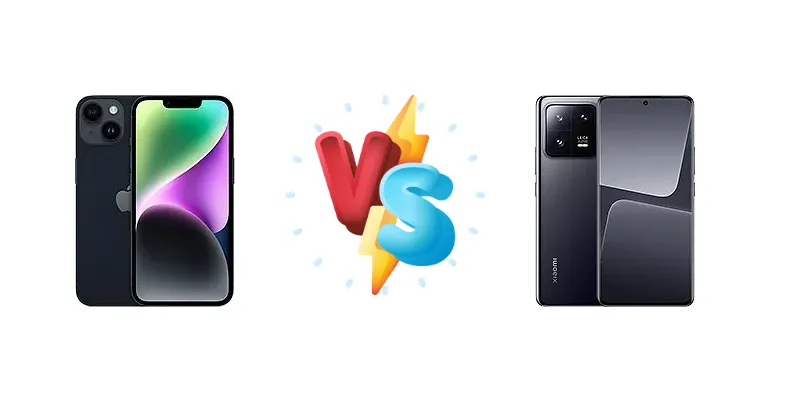
|
🏆 Quick Verdict
For the average user prioritizing longevity and a seamless software experience, the Xiaomi 13 Pro emerges as the winner. Its significantly faster charging (100% in 19 minutes vs 30 minutes for 50% on the iPhone 14) and superior battery endurance (115h vs 90h) outweigh the iPhone's software advantages.
| PHONES | ||
|---|---|---|
| Phone Names | Apple iPhone 14 | Xiaomi 13 Pro |
| Network | ||
|---|---|---|
| 2G bands | GSM 850 / 900 / 1800 / 1900 | GSM 850 / 900 / 1800 / 1900 |
| 3G bands | HSDPA 850 / 900 / 1700(AWS) / 1900 / 2100 | HSDPA 800 / 850 / 900 / 1700(AWS) / 1900 / 2100 |
| 4G bands | 1, 2, 3, 4, 5, 7, 8, 12, 13, 17, 18, 19, 20, 25, 26, 28, 30, 32, 34, 38, 39, 40, 41, 42, 46, 48, 66 - A2882, A2884 | 1, 2, 3, 4, 5, 7, 8, 12, 13, 17, 18, 19, 20, 25, 26, 28, 32, 38, 39, 40, 41, 42, 48, 66 - International |
| 5G bands | 1, 2, 3, 5, 7, 8, 12, 20, 25, 26, 28, 30, 38, 40, 41, 48, 66, 70, 77, 78, 79 SA/NSA/Sub6 - A2882, A2884 | 1, 3, 5, 7, 8, 20, 28, 38, 40, 41, 66, 71, 75, 77, 78 SA/NSA - International |
| Speed | HSPA, LTE, 5G, EV-DO Rev.A 3.1 Mbps | HSPA, LTE, 5G |
| Technology | GSM / CDMA / HSPA / EVDO / LTE / 5G | GSM / CDMA / HSPA / CDMA2000 / LTE / 5G |
| 1, 2, 3, 5, 7, 8, 12, 20, 25, 26, 28, 30, 38, 40, 41, 48, 66, 70, 77, 78, 79 SA/NSA/Sub6 - A2883 | 1, 3, 5, 8, 28, 38, 40, 41, 77, 78, 79 SA/NSA - China | |
| Launch | ||
|---|---|---|
| Announced | 2022, September 07 | 2022, December 11 |
| Status | Available. Released 2022, September 16 | Available. Released 2022, December 14 |
| Body | ||
|---|---|---|
| Build | Glass front, glass back, aluminum frame | Glass front (Gorilla Glass Victus), ceramic back or silicone polymer back, aluminum frame |
| Dimensions | 146.7 x 71.5 x 7.8 mm (5.78 x 2.81 x 0.31 in) | 162.9 x 74.6 x 8.4 mm or 8.7 mm |
| SIM | · Nano-SIM + eSIM + eSIM (max 2 at a time; International)· eSIM + eSIM (8 or more, max 2 at a time; USA)· Nano-SIM + Nano-SIM (China) | · Nano-SIM + eSIM· Nano-SIM + Nano-SIM |
| Weight | 172 g (6.07 oz) | 210 g or 229 g (7.41 oz) |
| IP68 dust/water resistant (up to 6m for 30 min) Apple Pay (Visa, MasterCard, AMEX certified) | IP68 dust/water resistant (up to 1.5m for 30 min) | |
| Display | ||
|---|---|---|
| Protection | Ceramic Shield glass | Corning Gorilla Glass Victus |
| Resolution | 1170 x 2532 pixels, 19.5:9 ratio (~460 ppi density) | 1440 x 3200 pixels, 20:9 ratio (~522 ppi density) |
| Size | 6.1 inches, 90.2 cm2 (~86.0% screen-to-body ratio) | 6.73 inches, 108.9 cm2 (~89.6% screen-to-body ratio) |
| Type | Super Retina XDR OLED, HDR10, Dolby Vision, 800 nits (HBM), 1200 nits (peak) | LTPO AMOLED, 1B colors, 120Hz, Dolby Vision, HDR10+, 1200 nits (HBM), 1900 nits (peak) |
| Platform | ||
|---|---|---|
| CPU | Hexa-core (2x3.23 GHz Avalanche + 4x1.82 GHz Blizzard) | Octa-core (1x3.2 GHz Cortex-X3 & 2x2.8 GHz Cortex-A715 & 2x2.8 GHz Cortex-A710 & 3x2.0 GHz Cortex-A510) |
| Chipset | Apple A15 Bionic (5 nm) | Qualcomm SM8550-AB Snapdragon 8 Gen 2 (4 nm) |
| GPU | Apple GPU (5-core graphics) | Adreno 740 |
| OS | iOS 16, upgradable to iOS 26.1 | Android 13, upgradable to Android 14, HyperOS |
| Memory | ||
|---|---|---|
| Card slot | No | No |
| Internal | 128GB 6GB RAM, 256GB 6GB RAM, 512GB 6GB RAM | 128GB 8GB RAM, 256GB 8GB RAM, 256GB 12GB RAM, 512GB 12GB RAM |
| NVMe | UFS 3.1 - 128GB UFS 4.0 - 256/512GB | |
| Main Camera | ||
|---|---|---|
| Dual | 12 MP, f/1.5, 26mm (wide), 1/1.7", 1.9µm, dual pixel PDAF, sensor-shift OIS 12 MP, f/2.4, 13mm, 120˚ (ultrawide) | - |
| Features | Dual-LED dual-tone flash, HDR (photo/panorama) | Laser AF, color spectrum sensor, Leica lens, Dual-LED dual-tone flash, HDR, panorama |
| Single | 12 MP, f/1.9, 23mm (wide), 1/3.6", PDAF SL 3D, (depth/biometrics sensor) | - |
| Triple | - | 50.3 MP, f/1.9, 23mm (wide), 1.0"-type, 1.6µm, dual pixel PDAF, OIS 50 MP, f/2.0, 75mm (telephoto), PDAF (10cm - ∞), 3.2x optical zoom 50 MP, f/2.2, 14mm, 115˚ (ultrawide), AF |
| Video | 4K@24/25/30/60fps, 1080p@25/30/60/120/240fps, HDR, Dolby Vision HDR (up to 60fps), stereo sound rec. | 8K@24fps (HDR), 4K@24/30/60fps (HDR10+, 10-bit Dolby Vision HDR, 10-bit LOG), 1080p@30/120/240/960fps, 1080p@1920fps, gyro-EIS |
| Selfie camera | ||
|---|---|---|
| Features | HDR | HDR, panorama |
| Single | 12 MP, f/1.9, 23mm (wide), 1/3.6", 1.0µm, PDAF SL 3D, (depth/biometrics sensor) | 32 MP, f/2.0, 22mm (wide), 1/3.14", 0.7µm |
| Video | 4K@24/25/30/60fps, 1080p@25/30/60/120fps, gyro-EIS | 1080p@30fps |
| Sound | ||
|---|---|---|
| 3.5mm jack | No | No |
| 35mm jack | No | No |
| Loudspeaker | Yes, with stereo speakers | Yes, with stereo speakers |
| - | 24-bit/192kHz audio | |
| Comms | ||
|---|---|---|
| Bluetooth | 5.3, A2DP, LE | 5.3, A2DP, aptX HD, aptX Adaptive |
| Infrared port | - | Yes |
| NFC | Yes | Yes |
| Positioning | GPS, GLONASS, GALILEO, BDS, QZSS | GPS (L1+L5), GLONASS (G1), BDS (B1I+B1c+B2a), GALILEO (E1+E5a), QZSS (L1+L5), NavIC (L5) |
| Radio | No | No |
| USB | Lightning, USB 2.0 | USB Type-C 2.0, OTG |
| WLAN | Wi-Fi 802.11 a/b/g/n/ac/6, dual-band, hotspot | Wi-Fi 802.11 a/b/g/n/ac/6e, dual-band, Wi-Fi Direct |
| Features | ||
|---|---|---|
| Sensors | Face ID, accelerometer, gyro, proximity, compass, barometer | Fingerprint (under display, optical), accelerometer, proximity, gyro, compass, barometer |
| Ultra Wideband (UWB) support Emergency SOS via satellite (SMS sending/receiving) | - | |
| Battery | ||
|---|---|---|
| Charging | Wired, PD2.0, 50% in 30 min 15W wireless (MagSafe) 15W wireless (Qi2) - requires iOS 17.2 update | 120W wired, PD3.0, QC4, 100% in 19 min 50W wireless, 100% in 36 min 10W reverse wireless |
| Type | Li-Ion 3279 mAh (12.68 Wh) | Li-Po 4820 mAh |
| Misc | ||
|---|---|---|
| Colors | Midnight, Purple, Starlight, Blue, Red, Yellow | Ceramic White, Ceramic Black, Ceramic Flora Green, Mountain Blue |
| Models | A2882, A2649, A2881, A2884, A2883, iphone14,7 | 2210132G, 2210132C |
| Price | € 344.00 / $ 277.58 / £ 300.00 / ₹ 64,900 | About 750 EUR |
| SAR | 1.15 W/kg (head) 1.16 W/kg (body) | - |
| SAR EU | 0.98 W/kg (head) 0.98 W/kg (body) | - |
| Tests | ||
|---|---|---|
| Battery life | Endurance rating 90h | Endurance rating 115h |
| Camera | Photo / Video | Photo / Video |
| Display | Contrast ratio: Infinite (nominal) | Contrast ratio: Infinite (nominal) |
| Loudspeaker | -25.2 LUFS (Very good) | -25.6 LUFS (Very good) |
| Performance | AnTuTu: 817125 (v9) GeekBench: 4761 (v5.1) GFXBench: 60fps (ES 3.1 onscreen) | AnTuTu: 1281666 (v9) GeekBench: 5087 (v5.1), 5323 (v6) GFXBench: 64fps (ES 3.1 onscreen) |
Apple iPhone 14
- Strong ecosystem integration
- Long-term software support
- User-friendly iOS interface
- Slower charging speeds
- Lower battery endurance
- Less customizable software
Xiaomi 13 Pro
- Significantly faster charging (120W)
- Superior battery endurance (115h)
- Brighter display (1253 nits)
- Potentially shorter software support
- Android customization can be complex
- Ecosystem less integrated than Apple's
Display Comparison
The Xiaomi 13 Pro boasts a notably brighter display, reaching 1253 nits compared to the iPhone 14’s 804 nits. This translates to superior visibility in direct sunlight. Both displays share an 'Infinite' (nominal) contrast ratio, suggesting excellent black levels. While neither specification details refresh rate, the Xiaomi 13 Pro is known to have a 120Hz LTPO panel, offering adaptive refresh rates for smoother scrolling and improved power efficiency – a feature not explicitly confirmed for the iPhone 14. The higher brightness of the Xiaomi 13 Pro benefits outdoor users significantly.
Camera Comparison
Both phones feature capable photo and video systems, but details are limited. The Xiaomi 13 Pro’s camera system is likely to feature larger sensors and more advanced image processing capabilities, typical of Xiaomi’s flagship offerings. While both phones support video recording, the Xiaomi 13 Pro’s advanced features, such as 8K recording (based on market positioning), likely provide more creative control. The absence of specific sensor details for the iPhone 14 makes a direct comparison difficult, but Apple’s computational photography is renowned for its consistent results. We can assume both phones will offer excellent image quality, but the Xiaomi 13 Pro likely has an edge in low-light performance and zoom capabilities.
Performance
The Xiaomi 13 Pro leverages the Qualcomm Snapdragon 8 Gen 2 (4nm), an octa-core processor, while the iPhone 14 utilizes Apple’s A15 Bionic (5nm) hexa-core chip. The Snapdragon 8 Gen 2’s 4nm process offers improved thermal efficiency compared to the A15’s 5nm node, potentially leading to less throttling during sustained workloads. The Snapdragon’s core configuration – a Cortex-X3 prime core alongside A715 and A710 performance cores – is designed for demanding tasks. While the A15 Bionic remains a powerful chip, the Snapdragon 8 Gen 2 generally delivers superior multi-core performance, benefiting users engaged in video editing or heavy multitasking. Both devices likely utilize LPDDR5x RAM, but specific speeds aren't provided.
Battery Life
The Xiaomi 13 Pro’s endurance rating of 115 hours significantly surpasses the iPhone 14’s 90 hours. This is further bolstered by the Xiaomi 13 Pro’s blazing-fast 120W wired charging, achieving a full charge in just 19 minutes, compared to the iPhone 14’s 30 minutes for a 50% charge. The Xiaomi 13 Pro also offers 50W wireless charging and 10W reverse wireless charging, features absent or slower on the iPhone 14 (15W MagSafe/Qi2). The Xiaomi 13 Pro’s combination of higher endurance and significantly faster charging provides a substantial advantage for users who prioritize minimizing downtime.
Buying Guide
Buy the Apple iPhone 14 if you need a tightly integrated ecosystem, prioritize long-term software support, and value the simplicity of iOS. Buy the Xiaomi 13 Pro if you prefer faster charging, a brighter display, and a more customizable Android experience, and are comfortable with a potentially shorter software support lifecycle.